Solve the Vegetable Shortage of Living Alone with Dried Vegetables | A New, Effortless Habit

Summary of this article
The vegetable shortage of living alone is caused by three structural problems: "it's hard to buy small quantities," "cooking is a hassle," and "lack of storage space." Dried vegetables let you take out just the amount you need and store them at room temperature, with a best-before date of 6 months to a year and zero waste. This article explains simple recipes like mug miso soup, quick risotto, and takikomi gohan, along with a monthly cost comparison showing the real cost comes out lower than fresh vegetables.
TOC
What you will learn from this article
- The real reasons for a vegetable shortage when living alone
- Why dried vegetables are a perfect match for living alone
- Concrete ways to use them and incorporate them
- Cost comparison with fresh vegetables
- How to choose dried vegetables and tips for storing them
"I know I ought to eat vegetables, but somehow I just can't..."
If you're in your 20s or 30s and living alone, you've probably thought this at least once. The daily vegetable intake the Ministry of Health, Labour and Welfare recommends is 350g. But in reality, there's data showing that the vegetable intake of single-person households falls well below the average.
The cause isn't weak willpower. It's a problem of structure. Shopping is a hassle, you let vegetables rot before using them up, you don't have time to cook. These three hurdles pile up and push you away from vegetables.
That's where we'd like you to take note of dried vegetables. Frankly, there aren't many ingredients that fit the vegetable-shortage problem of living alone this well. In this article, we'll tell you how to start a "fuss-free vegetable life" using dried vegetables.
The 3 root causes of a vegetable shortage when living alone
Cause 1: buying small quantities is hard
The vegetables sold at supermarkets are, in most cases, too much for one person. A whole head of cabbage, a bunch of spinach, a whole daikon... Everyone has had the experience of it going bad before you could use it up, and ending up throwing it out.
Buy cut vegetables and you can adjust the amount, but they're pricey and don't keep. That cut vegetable you put in the fridge thinking "I'll use it tomorrow" has turned brown three days later. It happens, right?
Cause 2: the hurdle of cooking is quietly high
Coming home from work, then washing, peeling, cutting, and stir-frying vegetables... Doing this every day is, honestly, exhausting.
Kitchens for people living alone are often cramped, and it can be hard even to secure space to lay out a cutting board. Many people also own only the bare minimum of cookware and seasonings.
Cause 3: storage space is limited
Refrigerators for people living alone have small capacity, and models without a vegetable compartment aren't rare. Because fresh vegetables take up space, weighing them against other ingredients tends to lead to "I'll skip vegetables this time."
| Cause of vegetable shortage | Concrete situation | The solution with dried vegetables |
|---|---|---|
| Buying small quantities is hard | Can't use up a whole head of cabbage | Take out just the amount you need |
| Cooking is a hassle | The hassle of washing, cutting, and heating | Just rehydrate in hot water |
| Can't store it | The fridge is small / no vegetable compartment | Long-term storage at room temperature OK |
| Spoils quickly | Discolors and gets slimy in 3 days | Best-before date of 6 months or more |
| Poor value | Discarded before using up | Zero waste |
5 reasons dried vegetables are ideal for living alone
Reason 1: use just as much as you want
The greatest strength of dried vegetables is being able to "take out and use just the amount you need." A handful in miso soup, a handful in soup. For the rest, just close the seal and store it.
There's none of the "I have to use it all up" pressure of fresh vegetables, so it's easier on the mind, too.
Reason 2: room-temperature storage takes up no space
Because dried vegetables have had their moisture removed, they can be stored at room temperature. They don't crowd the fridge. A size that slips neatly onto a pantry shelf or into a kitchen drawer is another welcome point for living alone.
Reason 3: a long best-before date means no rushing
The best-before date of general dried vegetables is about 6 months to a year. There's no need to rush, "I have to eat it soon," like with fresh vegetables. Even without stocking up on the weekend, if you keep some on hand you can use them anytime.
Reason 4: almost no cooking
Pour hot water, put them in the pot, heat them in the microwave. Basically that's it. No knife or cutting board needed.
For a morning miso soup, just put dried vegetables and miso in a mug and pour hot water. In under 5 minutes, a miso soup with vegetables is done.
Reason 5: surprisingly, the nutrients remain
You might think, "doesn't drying reduce the nutrients?" — but that isn't really the case. Some nutrients vulnerable to water and heat, like vitamin C, decrease, but dietary fiber and minerals like potassium and iron remain intact.
If anything, because the moisture is gone, the nutrient density per unit weight can be higher than fresh vegetables.
| Comparison item | Fresh vegetables | Cut vegetables | Dried vegetables |
|---|---|---|---|
| Storage period | 3-7 days | 1–3 days | 6 months to 1 year |
| Storage method | Refrigeration required | Refrigeration required | Room-temperature OK |
| Cooking effort | Wash, cut, heat | Washing and heating | Just rehydrate in hot water |
| Disposal Risk | High | Very high | Almost zero |
| Dietary fiber | ○ | ○ | ◎ (concentrated) |
| Cost per serving | 50 to 150 yen | 80–200 yen | 30–100 yen |
Easy dried-vegetable recipes you can start today
Mug miso soup (cooking time: 3 minutes)
The easiest way to incorporate dried vegetables. Just adding one cup at breakfast greatly boosts your vegetable intake.
- Put dried vegetables (a handful) and miso (1 tbsp) in a mug
- Pour in 150–200ml of hot water
- Wait 1–2 minutes, stir, and it's done
Recommended dried vegetables are wakame, green onion, spinach, cabbage, and the like. Keeping several dried vegetables mixed together gives you a well-balanced miso soup every time.
Quick soup risotto (cooking time: 5 minutes)
A recipe perfect for when you're a little peckish.
- Put rice (half a bowl) and dried vegetables (a handful) in a heatproof container
- Add consommé soup base and hot water
- Cover with plastic wrap and heat in the microwave for 2 minutes
- Top with cheese and heat another 30 seconds
Lazy vegetable ramen (cooking time: 5 minutes)
When you eat instant noodles, just add a handful of dried vegetables. That alone dramatically improves the nutritional balance. Bagged noodles or cup noodles are both fine. Just put them in at the same time you pour the hot water.
Vegetable takikomi gohan in a rice cooker (cooking time: 5 minutes + cooking)
Just rinse the rice, add dried vegetables and seasonings, and cook. The rice cooker does the work, so the actual hands-on time is about 5 minutes.
- Rinse 2 go of rice and set it in the rice cooker
- Add dried vegetables (2–3 tbsp), soy sauce (1 tbsp), and mirin (1 tbsp)
- Add water to the usual mark and cook
Cook a larger batch and freeze it, and weekday dinners become even easier.
Fresh vegetables vs. dried vegetables|a cost comparison for living alone
Simulating a month's vegetable cost
Many people think "aren't dried vegetables pricey?" — but for someone living alone, once you factor in the cost of waste, the story changes。
. Let's compare the case of buying fresh vegetables and discarding 30% with the case of using dried vegetables with zero waste.
| Item | For fresh vegetables | For dried vegetables |
|---|---|---|
| Monthly purchase amount | About 4,000–6,000 yen | About 2,000–3,500 yen |
| Waste portion (estimated 30%) | About 1,200–1,800 yen worth | 0 yen |
| Effective cost per edible portion | Equivalent to about 5,700–8,600 yen | About 2,000–3,500 yen |
| Shopping frequency | 2–3 times a week | Storage |
| Cooking time (monthly total) | About 10–15 hours | About 2–4 hours |
With fresh vegetables, on top of the purchase amount, the loss from the discarded portion can't be ignored. Furthermore, if you factor in shopping travel time and cooking time as "invisible costs," the cost performance of dried vegetables is quite excellent.
Combining with fresh vegetables is best
To avoid any misunderstanding, let us add: this isn't a story of "you only need to eat dried vegetables." Take in fresh vegetables too via salads and stir-fries, and supplement with dried vegetables on busy or troublesome days. This hybrid approach is the most realistic.
How does the vegetable supply for living alone compare with other options?
Besides dried vegetables, there are several options for the vegetable supply of living alone. Let's organize the suitability of each compared with cooking for yourself, convenience-store deli items, delivery services, and vegetable juice.
| Means | Convenience | Cost sense | Suited to |
|---|---|---|---|
| Cooking yourself (fresh vegetables) | △ prep work required | Pricey once waste occurs | On days you can find time to cook |
| Convenience-store deli items | ◎ just buy them | 150–300 yen per item | For days you want to wrap it up quickly, just today |
| Delivery service | ○ it's delivered, but you have to be there to receive it | A monthly fee applies | For people who want to leave it all to someone else |
| Vegetable Juice | ◎ just drink it | 100–200 yen each | For people who want to add one to their morning |
| Dried vegetables | ◎ just rehydrate in hot water | 30–100 yen per meal | For people who want to keep some on hand and use a little every day |
Convenience-store deli items and vegetable juice are easy, but keeping them up gets pricey, and some people find the salt content or strong flavor bothersome. Delivery services are convenient, but there's the hassle of receiving them and the monthly-fee burden. Cooking for yourself is ideal, but keeping it up every day is tough. Dried vegetables — being storable at room temperature and usable a little at a time every day, just the amount you need — can be called an easy-to-sustain option as the base of the vegetable supply for living alone.
How to choose dried vegetables and tips for storing them
3 points for choosing
Dried vegetables vary considerably in quality by maker. When choosing, check the following 3 points.
- Whether the raw material is domestically grown: domestically grown vegetables tend to have more thorough quality control
- Presence of additives: ones made simply from vegetables alone are best
- Drying method: texture and nutrition differ by method — air-drying (hot-air drying), freeze-drying, and so on
At Agriture in Kyoto, even domestically grown vegetables whose shape doesn't meet standards and rarely reach the market are processed by air-drying (hot-air drying) in partnership with contract farms and welfare facilities in northern Kyoto. With a method that uses no additives and makes the most of vegetables' inherent flavor, we handle nearly 100 kinds of items including Kyoto vegetables. Because it makes use of off-spec vegetables, using it also leads to reducing food waste. (From knowledge at our own production site)
Things to watch out for in storage after opening
The great enemy of dried vegetables is moisture. After opening, following the points below keeps them tasty longer.
- For resealable bags: press out the air thoroughly before closing
- If there's no seal: transfer them to an airtight bag such as a Ziploc
- Storage location: a cool place away from direct sunlight (a kitchen shelf or drawer)
- Moisture countermeasure: tucking in a desiccant makes it even better
For bulk buying, online shopping is convenient
For people living alone, we recommend buying in bulk via online shopping. There's no need to carry heavy loads home, and setting up a subscription prevents forgetting to buy. If you're trying dried vegetables for the first time, an assortment pack combining several vegetables is handy.
Summary: start with 2 or 3 bags of dried vegetable mix
The vegetable shortage of living alone can be solved not with willpower but with structure. What lowers all three hurdles — shopping, cooking, and storage — at once is dried vegetables. If you're unsure, using them differently as follows makes it easier to keep up.
- For a morning cup: wakame, green onion, spinach in a mug miso soup or soup
- For noodles and rice: cabbage, carrot, burdock in instant noodles or takikomi gohan
- As a stock base: a "vegetable mix" of several vegetables mixed together
First, buy 2 or 3 bags of vegetable mix (about 30–50g per bag) and start by adding a handful to your daily miso soup or soup. Combined with fresh vegetables and salads, you can increase the amount of vegetables without strain.
Learn about Office Yaoya
We have prepared materials
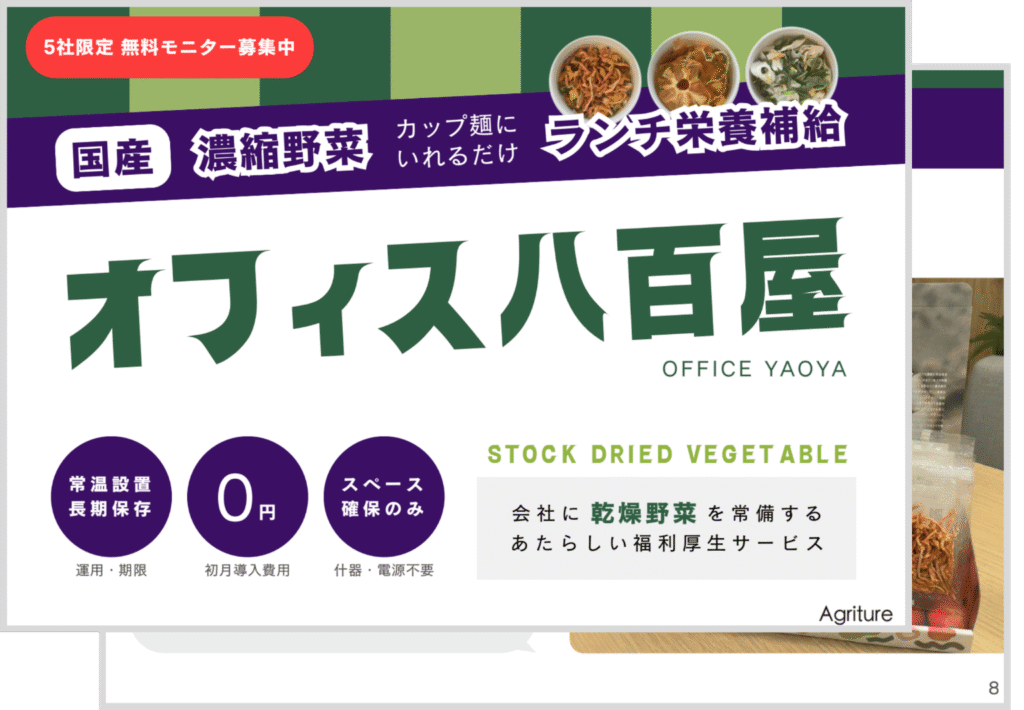
- Service details and vegetable lineup
- Pricing and plans
- How adoption and operation work
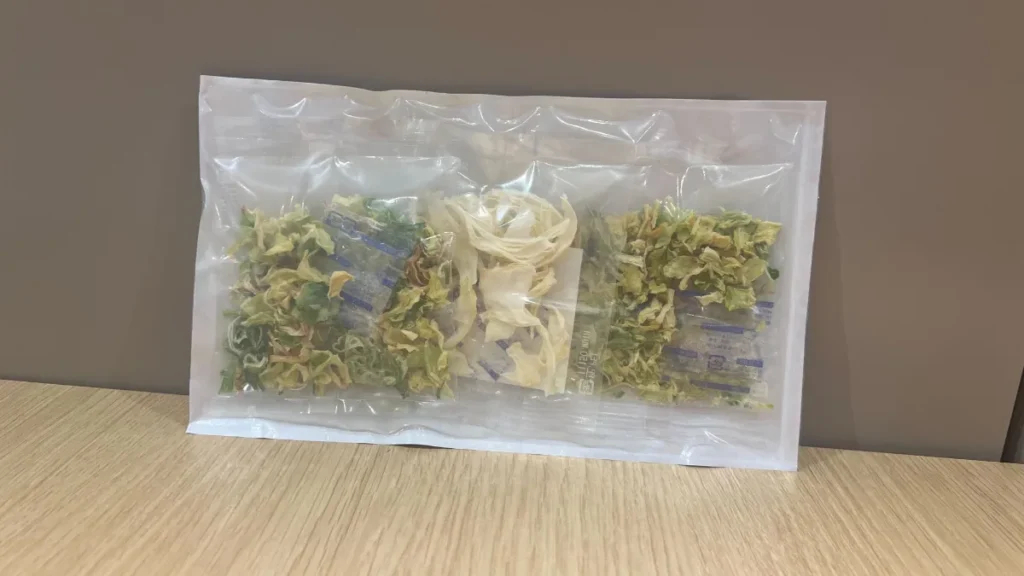
Sample sets are also available. Download the materials for details!
We offer sample sets so you can try Office Yaoya in small quantities. See the materials for details.
Recommended reading
- Ways to resolve a lack of vegetables that even busy people can practice
- How to resolve a lack of vegetables even with convenience-store food
- Cost-performance comparison and how to choose vegetable powder
- The relationship between dried vegetables and dietary fiber
FAQ
We've compiled frequently asked questions about the vegetable shortage of living alone and dried vegetables.
- Can I get the 350g of vegetables I need a day from dried vegetables alone?
-
There's no need to aim for 350g from dried vegetables alone. Since dried vegetables swell to about 5 to 10 times their size when rehydrated, you take in more vegetables than they appear. Adding a handful to 2 or 3 meals a day gets you close to the target amount when combined with fresh vegetables.
- How do the nutrients in dried vegetables compare with fresh vegetables?
-
Some nutrients vulnerable to water and heat, like vitamin C, decrease during the drying process, but dietary fiber and minerals like potassium and iron remain almost entirely. Because the moisture is gone, there's also an aspect where the nutrients are concentrated for the same weight.
- How do you rehydrate dried vegetables?
-
Soak them in water for 5 to 10 minutes, or with hot water they rehydrate in 1 to 2 minutes. When adding them to miso soup or soup, it's fine to put them straight in the pot without rehydrating — they rehydrate naturally as they simmer.
- What kinds of dried vegetables are there?
-
Almost every vegetable — cabbage, spinach, carrot, daikon, burdock, green onion, komatsuna, pumpkin, and more — has a dried type. For a first try, a "vegetable mix" of several mixed together is easy to use.
- Are they inedible once past the best-before date?
-
The best-before date is "a guide for eating them at their best," so passing it doesn't mean they immediately become inedible. However, since flavor and texture gradually decline, we recommend using them up within 2 to 3 months after opening.
- What's a recommended amount to buy for living alone?
-
First, try starting with 2 or 3 bags of dried vegetable mix (about 30–50g per bag) as a month's supply. If you use them in miso soup or soup every day, 100–150g a month is a guide. If it looks like you can use them up, buying in bulk from the next time keeps the unit price down.
Download the office dried vegetable materials
We will send the materials to your email address based on the information you provide.