Dried Cardamom

Dried cardamom is a commercial spice raw material made by drying the fruit (pods) and seeds of a plant in the ginger family. Its signature is a sweet, refreshing, refined aroma, and that aroma is sealed inside the pods through low-temperature drying. Agriture runs it in parallel with finely milled cardamom powder (made to order), proposing dried cardamom for applications that keep the pod shape and draw out the aroma slowly, and powder for applications that knead it directly into batters and powdered products.
Compared with other spices such as clove and cinnamon, cardamom can be differentiated by its "sweet, refreshing, refined aroma," its presence as "the queen of spices," and its wide compatibility from chai to confectionery. It is an ingredient with many prototype inquiries as an aroma raw material for chai, curry, coffee, Nordic-style baked goods, and spice blends.
TOC
Agriture's dried cardamom, three points of care
1. Low-temperature drying that makes the most of the aroma
The appeal of cardamom is a sweet, refreshing, refined aroma. Agriture designs the process to hold the drying temperature down and pull moisture out slowly, keeping as much of the aroma inside the pods as possible. The aroma that rises when the pod is split is a factor that governs the finish of chai, baked goods, and spice blends.
2. Processing into pod or seed shapes you can select
Cardamom can be processed into both whole pods and seeds removed from the pod. Whole pods suit steeping and simmering where you want to draw out the aroma slowly, and seeds suit confectionery and blends where you crush them to release the aroma quickly. You can select the shape to suit the application.
3. Selection that judges how the aroma rises
Agriture judges the pod's color and luster, the evenness of the grains, and how the aroma rises when processing it into raw material. Because aroma strength and seed fullness vary by lot, we confirm the aroma at the prototype stage and then organize the mass-production supply line.
Product catalog showing the items we handle
Flexible support from small lots to large lots
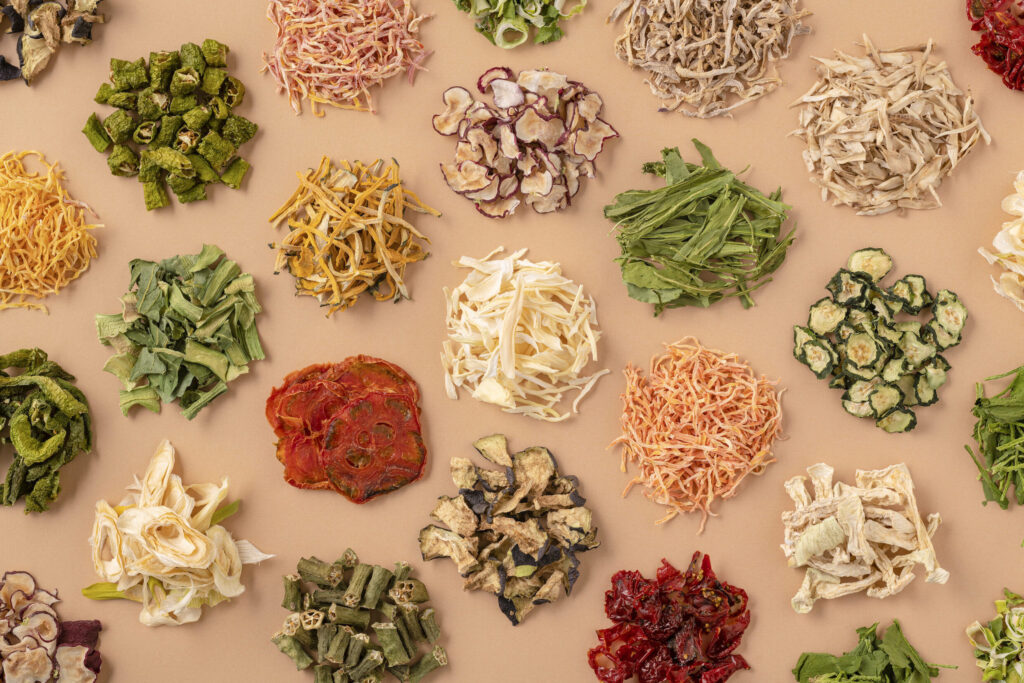
- Sold in small lots from 1 kg
- Handling heirloom vegetables from across Japan
- Dried fruits and herbs also supported
Characteristics of commercial dried cardamom
Even among dried spice raw materials, cardamom holds a distinct position for its sweet, refreshing aroma, wide compatibility, and presence as "the queen of spices." Here are its strengths organized across six points, with pod and seed shapes in mind.
A sweet, refreshing, refined aroma
Cardamom's signature is a refined aroma where sweetness and refreshingness harmonize. The aroma that rises when the pod is split has a character not found in other spices, and can be used as an aromatic accent in chai, baked goods, and blends.
Selectable whole and seed shapes
It can be developed both as whole pods and as removed seeds. Whole pods for steeping and simmering, and seeds crushed for confectionery and blends, can be used differently to suit the application.
A presence called "the queen of spices"
Cardamom has long been called "the queen of spices" and prized for its refined aroma. As a dried product that stores at room temperature, it lets you bring that aroma into the finished product regardless of season.
Good compatibility with chai and coffee
Cardamom is known as the star spice of chai, and the way of adding it to coffee is also enjoyed. Combined with milk and sweet beverages, its refreshing aroma stands out.
Versatility in confectionery and bakery
Cardamom is a spice that has been used to add aroma to Nordic-style baked goods and bread. As an aromatic accent in cookies, sweet bread, and sweets, it suits a wide range of designs, Western and Japanese alike.
Use in combination with powder
Used together with finely milled cardamom powder (made to order), you can use, by application, whole pods that draw out the aroma slowly in steeping and powder that can be kneaded directly into batters and powdered products.
Product specifications (commercial)
Basic specifications at the prototype stage are as follows. Purchase lot, lead time, and packaging format are worked out through individual consultation.
| Item | Details |
|---|---|
| Product name | Dried Cardamom |
| Raw material | Cardamom |
| Shape | Whole (with pods) / seeds. Selected according to the application |
| Appearance | Whole with pods, or removed seeds |
| Aroma | A sweet, refreshing, refined aroma |
| Net content | Individual quote according to use and lot |
| Best-before date | About 6 months from the shipping date |
| Storage method | Avoid high temperature, high humidity, and direct sunlight; after opening, seal and store in a cool, dark place |
| Minimum prototype lot | Inquire |
Customization support
From the prototype stage, you can consult us on shape, packaging, and turning it into a finished product. Because we keep records while refining the blend, the specifications are unlikely to drift between prototype and mass production.
| Item | Available | Details |
|---|---|---|
| Shape adjustment | Whole / seeds | Select whole pods or removed seeds to suit the application, such as steeping use or confectionery use |
| Powdering | Fine powder (made to order) | For direct blending into confectionery, beverages, and spice blends |
| Blend design | Combining with other spices | A chai or curry mix with cinnamon, clove, and ginger |
| Packaging form | Commercial bulk / small bag / individual wrapping | From beverage bulk to packs for confectionery raw material |
| OEM productization | End-to-end support through the finished product | From planning to production of chai mixes, spice blends, and confectionery raw materials |
For those considering the fine-powder type
For applications where you want to spread cardamom's aroma evenly into batters and powdered products, such as blending into confectionery and beverages or spice blends, the finely milled cardamom powder (made to order) is well suited. Please also see the list of powder raw materials.
Commitments to variety, grower, and growing region
Cardamom is a perennial of the ginger family whose fruit (pods) and seeds are used as a spice, long called "the queen of spices." Agriture makes the pod's state and how the aroma rises the axes of its raw material design.
BRAND | The positioning of cardamom as a raw material
Cardamom is a spice that has been used widely from beverages to confectionery, such as chai, curry, coffee, and Nordic-style baked goods. Agriture translates this refined aroma into a commercial raw material and supplies it as an ingredient usable in a wide range of finished products, from chai mixes and spice blends to confectionery raw materials.
PRODUCER | Basic policy for sourcing and coordination
We select it by aligning the pod's color and luster, the evenness of the grains, and how the aroma rises with suppliers. At the prototype stage we obtain small quantities from multiple suppliers, evaluate aroma retention during drying, and then organize the supply line for mass-production lots.
VARIETY | Green and black
Cardamom comes in green cardamom, with a refreshing, refined aroma, and black cardamom, with a smokier, more robust aroma. Green, with its delicate aroma, is often chosen for chai and confectionery, and black for simmered dishes, and they can be used differently to suit the application.
SELECTION | Choosing by how the aroma rises
Cardamom's aroma rises differently depending on the seed fullness and the drying state. Agriture selects lots where the aroma is clearly felt and processes them into raw material in shapes suited to the application.
Low-temperature drying technology and quality control
Careful drying that does not let the aroma escape
Cardamom's aroma readily escapes with strong heat or long heating. By carefully managing the drying step, we finish it under conditions that keep the aroma inside the pods.
Retaining aroma through low-temperature drying
High-temperature drying readily drives off the aroma and tends to dull the pod's color and luster. By pulling moisture out slowly in a low-temperature range, we finish it so the aroma rises when the pod is split. As an aroma ingredient for chai and confectionery, we aim for a raw material where the character of cardamom comes through. For chai, lightly crushing the pod before steeping makes the aroma come out more readily. For confectionery, removing the seeds, crushing them, and kneading them into the batter spreads the aroma throughout.
Use cases
Here are the applications for which we receive prototype inquiries at Agriture, organized into six categories. All are examples of recipe design that make use of cardamom's sweet, refreshing aroma and its pod and seed shapes.
1. Chai and spice tea
It can be used as the star spice of chai and spice tea. Lightly crushing the pod and steeping it with black tea and milk makes a sweet, refreshing aroma rise. It can also be developed into a chai mix combined with cinnamon, clove, and ginger, or a raw material for instant chai mixes.
2. Curry and spice blends
It can be used as an aroma raw material for curry and spice blends. Whole pods suit the way of transferring aroma to oil as a whole spice, and seeds or powder suit being mixed into a blend. It can be built into the design of authentic spice dishes such as biryani and garam masala.
3. Confectionery and bakery
It can be used to add aroma to baked goods, sweet bread, and sweets. It can be developed into aroma-forward confectionery and bakery products, such as Nordic-style cinnamon rolls and cardamom bread, cookies, and pound cake. Removing and crushing the seeds spreads the aroma evenly into the batter.
4. Coffee and beverages
It can be used to add aroma to coffee, lattes, and hot drinks. The way of adding cardamom to coffee is enjoyed as a Middle Eastern style, and its refreshing aroma stands out in rich beverages. It can also be built into raw materials for spiced lattes and hot chocolate.
5. Beverages, syrups, and processed products
It can be built in as an aroma raw material for spice syrups, spice drinks, and processed foods. It can be securely kept as room-temperature stock, and can handle designs that draw out the aroma slowly with whole pods and designs that blend it evenly with powder. It suits aroma-centered products such as chai mixes and spice syrups.
6. Spice mixes and blend products
It can be used as a component ingredient in original spice mixes and blend products. Because cardamom has a sweet, refreshing aroma, it suits being an accent in blend designs where you want to add depth to the aroma by combining it with other spices. Combined with the powder, you can balance aroma strength with ease of blending.
Commercial usage and rehydration
Basics of how to draw out the aroma
- For chai: lightly crush the pod and then steep it together with black tea and milk to release the aroma readily
- For curry: warm whole pods in oil to transfer the aroma, or crush the seeds and mix them into the blend
- For confectionery: remove and crush the seeds and knead them into batters and fresh cream
- Because the aroma readily escapes if overheated, adding it in a step closer to finishing helps it remain
Blending guide
- Chai: steep about 1 to 2 pods per cup (200 ml)
- Curry: 3 to 5 pods for four servings, or a small amount of crushed seeds
- Confectionery: adjust from a pinch of crushed seeds per 100 g of batter
- Because it is a strongly aromatic ingredient, test from a small amount and match it to your preferred strength
How to store
- Before opening: store in a cool, dark place at room temperature, away from heat, humidity, and direct sunlight
- After opening: transfer to a zip bag or airtight container and use up within 1 to 2 months
- Best-before date is about 6 months from the shipping date. Because the aroma readily escapes, store it sealed
- To keep the aroma long, it is good to split the pods or crush the seeds just before use
Related cases and articles
- Dried mugwort – a dried herb raw material that makes use of aroma
- Dried moringa – a commercial dried ingredient
- Dried edible rose – an ingredient for aroma and color
- List of dried raw materials
- Consult us on food OEM and raw material supply
Product catalog showing the items we handle
Flexible support from small lots to large lots
- Sold in small lots from 1 kg
- Handling heirloom vegetables from across Japan
- Dried fruits and herbs also supported
Frequently asked questions
What kind of spice is cardamom?
Cardamom is a spice made by drying the fruit (pods) and seeds of a plant in the ginger family, characterized by a sweet, refreshing, refined aroma. Long called "the queen of spices," it has been used widely from beverages to confectionery, such as chai, curry, coffee, and Nordic-style baked goods. It is an ingredient suited to aroma-centered product design.
Should I choose whole or seeds?
For drawing out the aroma slowly in steeping or simmering, whole pods suit, and for releasing the aroma quickly and evenly in confectionery or blends, seeds or powder suit. Chai and curry use whole, and baked goods and spice mixes use seeds or powder, so you can use them differently by application. We can process it into both shapes.
What is the difference between green and black?
Green cardamom is characterized by a refreshing, refined aroma and is used widely in chai, confectionery, and beverages. Black cardamom has a smokier, more robust aroma and suits simmered dishes. You can consult us on which to use to match the aroma direction of the finished product.
How does it differ from cardamom powder?
Dried cardamom (whole and seeds) is for "applications that draw out the aroma slowly in steeping or simmering," while powder is for "applications that blend directly into confectionery, beverages, and spice blends." Chai and curry suit whole, and baked-good batters and spice mixes suit the powder. Using them together lets you design how the aroma is released by application.
What is the minimum prototype lot?
Please inquire about the minimum prototype lot. You can prototype multiple conditions in parallel, such as a chai-use-versus-confectionery-use shape comparison, or a comparison of how the aroma is released from whole versus seeds. You can consult us through to OEM finished-product production. After hearing the intended finished-product specifications, lot, and schedule, we propose a quote and lead time individually.
Please tell me the best-before date and how to store it.
The best-before date is about 6 months from the shipping date. Before opening, store in a cool, dark place at room temperature, away from heat, humidity, and direct sunlight. Because cardamom readily loses aroma, after opening transfer it to a zip bag or airtight container and we recommend using it up within 1 to 2 months. To keep the aroma long, it is good to split the pods or crush the seeds just before use.
Recommended reading
- Dried mugwort – an aromatic dried herb
- Dried moringa – a commercial dried ingredient
- Dried edible rose – an ingredient for aroma and color
- List of dried raw materials
- List of powders
Download the product catalog
We will send the materials to your email address based on the information you provide.