
Corporate gifts in the SDGs era | Raise your brand strength with food gifts

Summary of this article
Corporate gifts in the SDGs era have changing selection criteria, as roughly 90% of listed companies issue sustainability reports. In this article, we explain the appeal points of food gifts × SDGs Goals 2, 12, 15, and 8, why dried vegetables contribute to reducing food loss, five selection criteria such as packaging material and best-before date, uses by price range from 500 to over 5,000 yen, and the flow of OEM from lots of 100.
TOC
SDGs efforts are changing corporate gift selection
Souvenirs for business partners, shareholder benefits, anniversary commemorative items. There are many occasions each year when a company gives Gift. Recently, however, a growing number of staff feel "somehow uneasy" about continuing to choose the conventional standard gifts as they are.
Behind this is the rising social interest in the SDGs and sustainability. We have entered an era where a company's stance is reflected even in a single gift. This article summarizes how to choose food gifts with the SDGs in mind, and concrete measures for actually enhancing brand value.
Why an SDGs perspective is required in corporate gifts
Now that roughly 90% of listed companies issue sustainability reports, gift selection too has come to be seen as part of CSR and ESG. If you give a business partner an over-packaged gift, there is even a risk of being taken as "this company has low environmental awareness."
Conversely, choosing a gift that considers the SDGs itself becomes a subtle message. There are in fact many cases where it is received favorably, as in "So your company values these kinds of principles."
Three backgrounds behind the attention on sustainable gifts
| Background | Details |
|---|---|
| The expansion of ESG investment | Investors have come to include corporate social responsibility in their evaluation criteria |
| The rise of Generation Z | Young employees and business-partner staff are sensitive to sustainability |
| The tightening of business partners' procurement standards | An increasing number of companies require CSR standards across the entire supply chain |
Why sustainable food gifts are chosen
Gifts span a wide range of genres, but "food" is a category especially compatible with sustainability.
The strength of food gifts: practicality that causes no trouble to receive
The outcome most to be avoided in corporate gifts is "I received it but don't use it." Stationery and tumblers are easily split by preference, and it is not unusual for them to lie asleep in a desk drawer.
Because food gifts are consumables, the burden on the recipient is light. In particular, long-keeping dried foods and tea have little pressure of worrying about a best-before date, and are a genre that people readily feel "grateful" for.
Appeal points of food × SDGs
| SDGs Goal | Relation to food gifts | Concrete appeal examples |
|---|---|---|
| Goal 2: Zero Hunger | Food loss reduction | Use of off-grade vegetables, long-keeping foods |
| Goal 12: Responsible Consumption and Production | Reducing over-packaging | Simple packaging, reusable containers |
| Goal 15: Life on Land | sustainable agriculture | Supporting organic cultivation and regional agriculture |
| Goal 8: Decent Work and Economic Growth | Contributing to the regional economy | Collaboration with regional farmers and processors |
Why dried-vegetable gifts are "suited to the SDGs"
Dried vegetables are an ingredient drawing attention as a food-loss measure. Whereas about 15–20% of fresh vegetables are discarded at the distribution stage, drying them lets them keep for six months to over a year at room temperature. Vegetables of off-grade shape or size can also be turned into products without problem once cut and dried.
At Agriture, we dry vegetables sourced directly from contract farms near Kyoto, combining support for regional agriculture with reduction of food loss. Gifts with such a story naturally convey their value to the recipient as well.
Five criteria to keep in mind when selecting gifts
Even if you think "I want to choose a sustainable gift," you are likely unsure what specifically to check. Keeping the following five criteria in mind will make the selection go smoothly.
Criterion 1: Is the procurement background of the raw materials clear?
Choose products where traceability is ensured—the production area, farming method, the labor environment of the supplier, and so on. Beyond labels such as "domestic" and "organic," products where you can see the producer's face have higher trustworthiness.
Criterion 2: The environmental burden of the packaging material
| Type of packaging | Environmental burden | Impression |
|---|---|---|
| Over-packaging (individual wrapping + outer box + paper bag) | High | Risk of being seen as an old-fashioned corporate culture |
| Simple packaging (the necessary minimum) | Low | An impression of high environmental awareness |
| Reusable containers | Low | Combining practicality and sustainability |
| FSC-certified paper, recycled paper | Moderate | Conveys a concrete stance of effort |
Criterion 3: Best-before date and disposal risk
A gift with a short best-before date may not be finished by the recipient and end up discarded. This makes it a gift that generates food loss. Choosing foods with a best-before date of six months or more is safe.
Recommendations by corporate gift use scene
We look at how to choose according to concrete scenes.
Souvenirs for business partners, mid-year and year-end gifts
The most frequent gift scene of the year. So they can be handed out at the recipient's office, individually wrapped dried-vegetable soups and dried-vegetable chips are well received. Making it an original package with the company name also leads to brand awareness.
Shareholder benefits, anniversary commemorative items
The ideal is a gift that lets shareholders feel "this company is serious about social contribution." Enclosing a leaflet with a production-area story in a dried-vegetable gift set can naturally showcase the company's SDGs activities.
Welfare gifts for employees
In the context of health management, some companies have begun distributing dried-vegetable sets to employees. The message "we want you to eat vegetables more easily" is readily accepted as a welfare benefit too.
We have materials available to help you understand vegetable-based novelties
Agriture OEM, flexibly handling everything from small lots to large lots
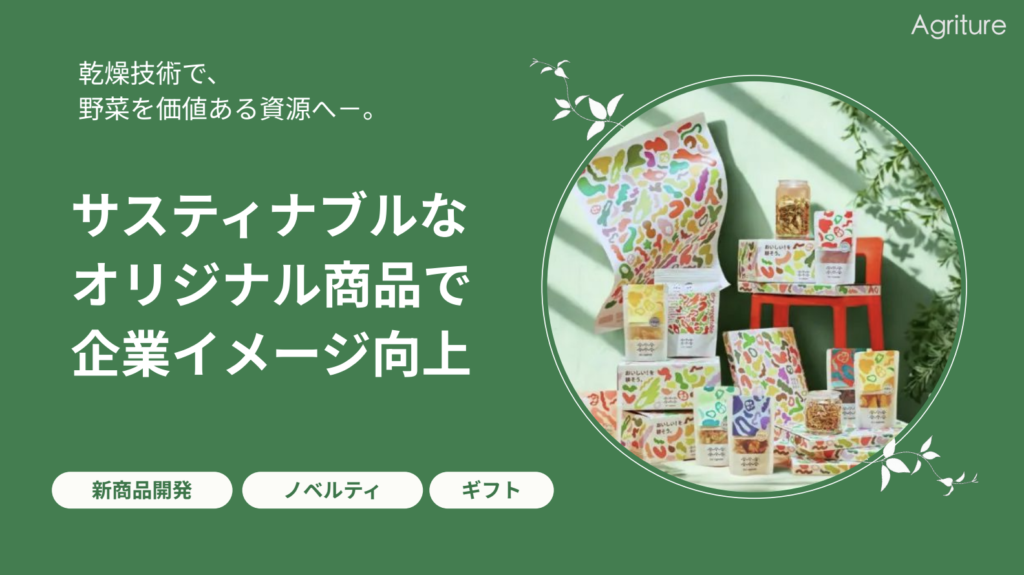
- SDGs-friendly products using non-standard vegetables
- Delivery possible in as short as two weeks
- Small lots from 500 bags
How to make an original gift: an OEM utilization guide
Giving a ready-made product is fine, but making your own original gift enhances brand value even further.
The basic flow of OEM
| Step | Details | Guideline period |
|---|---|---|
| 1. Hearing | Confirming the gift's use, budget, and quantity | 1 week |
| 2. Product design | The combination of contents and the package design | 2–3 weeks |
| 3. Prototyping | Creating samples and checking the taste and appearance | 1–2 weeks |
| 4. Mass production | Full production and inspection | 2–4 weeks |
| 5. Delivery | Bulk delivery to a designated location or individual shipping | 1 week |
The whole thing is a guide of 2–3 months. For anniversaries and the like, starting to move six months ahead lets you prepare with room to spare.
The advantage of being able to start from a small lot
At Agriture, we accommodate the manufacture of original gifts from lots of 100. Being able to meet flexible requests such as "I want to try a small quantity first" or "I want to make a different set for each department" is a strength unique to a small- and medium-scale dried-vegetable manufacturer.
Points for packages with the company name and logo
When putting a logo on the gift packaging, the size and placement call for taste. If the logo stands out too much, it is shunned as "advertising-like," and if it is too small, it is unclear who the gift is from. A design that places the logo at about 10–15% of the package area and does not get in the way of the product's appeal is preferred.
How to think about cost-effectiveness
The budget spent on gifts differs by company, but the way of thinking about cost-effectiveness is common.
How to choose by price range
| Price range (per item) | Use | Example contents |
|---|---|---|
| 500–1,000 yen | Trade-show distribution, a small souvenir | 1–2 kinds of dried-vegetable mini packs |
| ¥1,000–3,000 | Mid-year and year-end gifts, business-partner visits | A set of 3–5 kinds of dried vegetables |
| ¥3,000–5,000 | Anniversaries, for VIPs | Dried vegetables + a soup set + a leaflet |
| 5,000 yen and up | Shareholder benefits, special presents | An original box + multiple items |
Measure ROI by "deepening of the relationship"
Measuring a gift's ROI by direct sales is difficult, but thinking of it by the metric of "deepening of the relationship" is reasonable. If a business partner says, "The gift was what made me learn about your company's SDGs activities," a few-thousand-yen gift may lead to a multi-million-yen deal.
Honestly, giving a cheap ready-made box of sweets and giving an original gift with a story leave completely different impressions.
Using dried vegetables, Food novelties that respond to the SDGs please feel free to consult us about the planning and manufacturing of.
We have materials available to help you understand vegetable-based novelties
Agriture OEM, flexibly handling everything from small lots to large lots
- SDGs-friendly products using non-standard vegetables
- Delivery possible in as short as two weeks
- Small lots from 500 bags
Summary
Corporate gift selection in the SDGs era is not mere formality but part of brand communication.
We look back at the points to keep in mind.
- An era where an SDGs perspective is required in corporate gifts too
- Food gifts easily combine practicality and sustainability
- Dried vegetables excel on three points: reducing food loss, long-term storage, and supporting regional agriculture
- Center your selection criteria on "the background of the raw materials," "packaging," and "best-before date"
- Making an original gift via OEM raises brand value a step further
If you want to convey your stance on the SDGs through corporate gifts, please consult Agriture. We support everything from planning to delivery of original gifts using dried vegetables that arrive from contract farms in Kyoto.
FAQ
Recommended reading
Commercial dried vegetables / Drying processing service / Contract processing service / Food OEM Market Trends 2026: A Growth Strategy Seen Through Small-Lot and Domestic-Ingredient Needs / How to choose retirement gifts | A collection of food gift ideas that convey gratitude
Download the novelty materials
We will send the materials to your email address based on the information you provide.
If you are considering product development with off-spec or your own farm's vegetables:From planning to processing, materials, package printing and novelties, you can consult us through a single point of contact. → Learn more about one-stop product development
- How to Rehydrate Dried Vegetables: Tips for Commercial and Restaurant Use
- A food novelty strategy that raises brand strength through trade show handouts
Author of this article
Related articles
-
 Food industry trade show trends 2025 | The latest developments to keep in mind
 -
 A guide to preparing for a trade show | Schedule, costs, and checklist
 -
 Prevent trade show failures! 8 common failure patterns and countermeasures
 -
 Kyoto-style food development | Gift-oriented product development OEM using Kyoto vegetables
 -
 Creating a regional brand with a Kyoto-vegetable OEM | The complete flow from planning to sales
 -
 Kyoto ingredient processing OEM | How to make the most of Kyoto vegetables and quality control
 -
 How to source commercial vegetable powder in small lots, and how to use it
 -
 Heirloom vegetable OEM | A commercialization case guide using Kyoto vegetables and local ingredients