
A food novelty strategy that raises brand strength through trade show handouts

Summary of this article
About 70% of items handed out at trade shows are thrown away within a week, so choosing a memorable novelty matters. This article explains how food novelties appeal to the five senses, the surprise, talkability, and room-temperature-storage strengths of dried-vegetable mini packs, the guideline of starting production 3–4 months out, budget planning at 200 yen per unit × 500 units plus 30,000–50,000 yen in design fees, and how to make use of packaging and QR codes.
TOC
Trade-show giveaways: are people saying "I got it, but I tossed it"?
Trade show What racks your brain every time you exhibit at is the choice of giveaways (novelties). Ballpoint pens, clear folders, eco bags. The standard items are cheap and easy to arrange, but honestly, they barely stay in visitors' memories.
According to one survey, about 70% of the novelties received at trade shows are thrown away within a week or stay unused, tucked away at the back of a drawer. If you're going to spend budget handing them out, you'd want to choose something that gets talked about in the office—"that company's novelty was fun, wasn't it?"
This article introduces strategies for lifting your brand image with trade-show giveaways, along with concrete ways to make use of food novelties.
Why giveaways tie directly to brand image
Trade-show visitors go around dozens to hundreds of booths in a single day. At each booth they receive materials and novelties, but they only remember a fraction of them after returning to the office. The "surprise" and "practicality" of a giveaway greatly influence its retention rate in memory.
In other words, a giveaway is not a mere freebie but one of the first brand experiences. If you can make someone think "this company has good taste," the hurdle for follow-up sales after exchanging business cards drops sharply.
What makes a giveaway visitors genuinely appreciate
| Condition | Reason |
|---|---|
| Light and not bulky | At trade shows people carry around a large amount of handouts, so bulky items are avoided |
| Can be consumed right away | Doesn't pile up on the desk. Food and drinks can be enjoyed that same day |
| Becomes a conversation starter | Being asked "what is this?" extends the time spent at the booth |
| Related to your own business | Unrelated novelties don't stick in memory |
| Photogenic on social media | If people post a photo, it becomes free advertising |
Why food novelties work at trade shows
Compared with stationery and merchandise-type novelties, food novelties have advantages unique to trade shows.
Impact that appeals to the five senses
Food is one of the few novelties that can appeal to sight, smell, and taste. If you have people sample dried-vegetable chips, your company name is etched into memory along with the feeling of "this is delicious." This is an approach stationery can't achieve.
The ripple effect of "I want to take it home and show my family"
Food novelties are often taken home and shared with family and colleagues. In other words, a single novelty reaches multiple people. If the company name or URL is on the packaging, one giveaway can reach 3–5 people by the math.
Affinity with the trade show's theme
Not only at food-industry trade shows but also at shows related to health, the environment, and regional revitalization, food novelties fit in naturally. At a show themed on SDGs or sustainability, a food that carries a "food-loss reduction" story, like dried vegetables, has strong appeal.
Types of food novelties and how to choose
Food novelties come with a range of options too. Choose among them according to the scale of the trade show and your target.
Comparison of standard food novelties
| Type | Unit-price guide | Shelf stability | Impact | Ease of distribution |
|---|---|---|---|---|
| Individually wrapped candy and sweets | 30–80 yen | ◎ | △ | ◎ |
| Mini-pack snacks | 100 to 200 yen | ○ | △ | ○ |
| Original drip coffee | 100–300 yen | ◎ | ○ | ○ |
| Dried-vegetable mini pack | 150-400 yen | ◎ | ◎ | ○ |
| Mini-bottle seasonings | 200–500 yen | ○ | ○ | △ (heavy) |
| Tea packs | 80–200 yen | ◎ | ○ | ◎ |
The advantage of dried-vegetable novelties
Dried-vegetable mini packs have three strengths as trade-show novelties.
The first is "surprise." Almost no one has ever received dried vegetables at a trade show, so they stick in memory easily.
The second is "talkability." Just adding a line like "these are dried vegetables made by a farmer in Kyoto" sparks conversation. The way communication time at the booth naturally lengthens is a big sales advantage.
The third is "room-temperature storage." That the quality holds up even when a visitor carries it around in their bag all day is a fairly important point for a food novelty. Chocolate carries the risk of melting in summer, but dried vegetables carry no such risk.
The production process for trade-show novelties
For those who think "I want to make a food novelty but don't know where to start," we'll lay out the flow of production.
A guideline production schedule
| Phase | Details | How many months before the trade show to start |
|---|---|---|
| Planning | Deciding target, budget, and quantity | 3–4 months out |
| Product selection | Deciding the direction of contents and packaging | 2–3 months out |
| Design | Package design and proofing | 2 Months Before |
| Prototyping | Sample check and revisions | 1.5 months out |
| Production and delivery | Full production, inspection, and delivery | 2–3 weeks out |
Starting to move 2–3 months before the trade show is ideal. During the popular trade-show seasons (spring and fall), production gets crowded, so we recommend consulting even earlier.
How to build the budget
The budget for trade-show novelties is built from "expected visitors × distribution rate × unit price."
For example, for a 3-day trade show where you expect 500 visitors to your booth and plan to hand one to everyone:
- Unit price 200 yen × 500 units = 100,000 yen
- Package design fee: 30,000–50,000 yen (first time only)
- Total: 130,000–150,000 yen
From the second time on there's no design fee, so the cost per run drops. If you exhibit three or more times a year, producing in bulk cuts costs further.
Choosing contents to match your target
| Target | Recommended contents | Reason |
|---|---|---|
| B2B company staff | Dried-vegetable soup base | Easy to use at the office |
| People in the health and beauty industries | Dried vegetable chips | Can convey healthiness |
| Food-maker development staff | Dried-vegetable sample set | Can show its potential as an ingredient |
| Consumer-facing trade shows | Dried-vegetable furikake | Popular with children and well received by families |
We have materials available to help you understand vegetable-based novelties
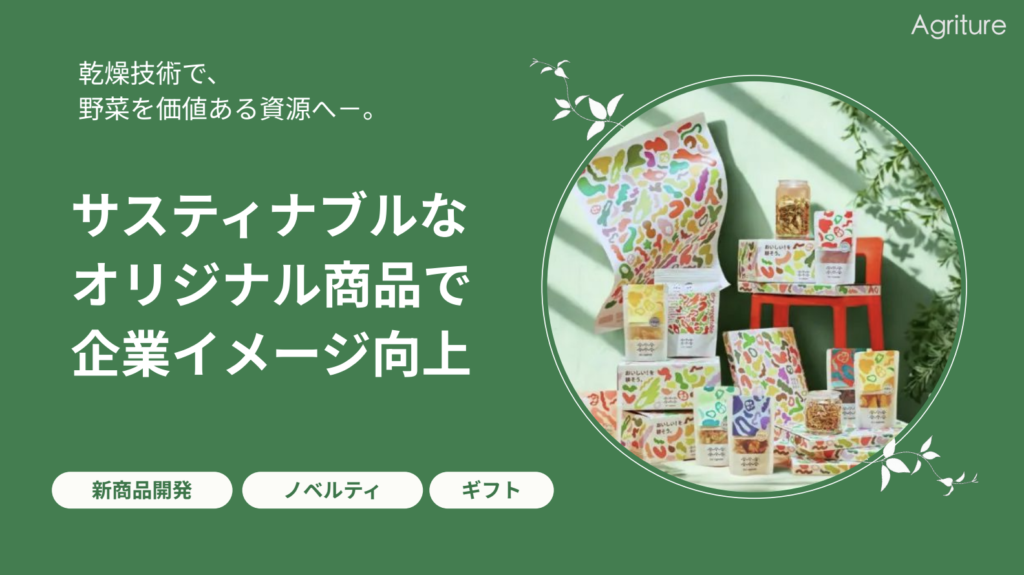
- SDGs-friendly products using non-standard vegetables
- Delivery possible in as short as two weeks
- Small lots from 500 bags
Package design that maximizes brand image
To draw out the full effect of a novelty, package design—not just the contents—is the key.
Elements to nail in the design
| Element | Point |
|---|---|
| Company name and logo | About 10–15% of the whole. A size that is reliably visible without standing out too much |
| URL and QR code | A path to the website. Designed to send people directly to a landing page or catalog page |
| Tagline | A phrase that conveys your business in one line |
| Material feel | Kraft paper or a matte texture to convey quality |
| Color | Built on your corporate color, with a food-friendly warm hue as an accent |
How to make use of QR codes
If you put a QR code on the packaging, it's effective to set the destination to a landing page dedicated to the trade show. Rather than your regular top page, just placing a product catalog or inquiry form together with a message like "To those we met at the trade show" changes your conversion rate.
Eco-conscious packaging options
If you choose packaging that uses biomass film or FSC-certified paper, you can showcase your SDGs efforts through the giveaway too. The cost rises by about 10–20% over standard packaging, but it resonates especially with targets who have high CSR awareness.
Ways to double the effect through clever distribution
Even with the same novelty, just being clever about how you hand it out makes a difference in effect.
Make it a reward for completing a survey
Rather than handing it to everyone, giving it to people who complete a short survey lets you collect lead information and distribute novelties at the same time. The pitch "answer our survey and we'll give you dried vegetables from Kyoto" has strong pull to the booth.
A two-part setup: sampling plus a take-home
A setup where you offer dried-vegetable chip samples at the booth while handing over a different flavor as a take-home is effective. The flow of "it was delicious, so I want a take-home too" naturally extends time at the booth and increases opportunities to explain your products and services.
Linking with a social-media posting campaign
Combining it with a campaign like "post a photo of the novelty on social media for an extra gift" can be expected to produce online ripple effects. By encouraging posts that combine the trade show's hashtag with your own, you can reach visitors beyond your booth as well.
Using dried vegetables, Food novelties for trade shows please feel free to consult us about the planning and manufacturing of.
We have materials available to help you understand vegetable-based novelties
- SDGs-friendly products using non-standard vegetables
- Delivery possible in as short as two weeks
- Small lots from 500 bags
Summary
Trade-show giveaways are an important touchpoint for etching your brand image into visitors' memories.
Let's lay out the keys to success.
- Standard ballpoint pens and clear folders are hard to remember
- Food novelties have impact and a ripple effect that appeal to the five senses
- Dried vegetables hit all three notes: room-temperature storage, talkability, and SDGs appeal
- Incorporate QR codes and eco-conscious materials into the package design
- Double the effect with clever distribution (survey tie-ins, sampling)
Agriture produces dried-vegetable novelties for trade shows from 150 units. We handle everything in one place, from package design consultation to shipping arrangements, so please feel free to reach out for your next trade show.
FAQ
Recommended reading
Commercial dried vegetables / Drying processing service / Contract processing service / Complete guide to using dried tomato | uses by dish and tips for rehydrating / Building a regional brand with Kyoto-vegetable commercialization OEM|From powder processing to sales
Download the novelty materials
We will send the materials to your email address based on the information you provide.
If you are considering product development with off-spec or your own farm's vegetables:From planning to processing, materials, package printing and novelties, you can consult us through a single point of contact. → Learn more about one-stop product development
- Corporate gifts in the SDGs era | Raise your brand strength with food gifts
- 10 healthy novelties that delight at company events
Author of this article
Related articles
-
 Food industry trade show trends 2025 | The latest developments to keep in mind
 -
 A guide to preparing for a trade show | Schedule, costs, and checklist
 -
 Prevent trade show failures! 8 common failure patterns and countermeasures
 -
 Kyoto-style food development | Gift-oriented product development OEM using Kyoto vegetables
 -
 Creating a regional brand with a Kyoto-vegetable OEM | The complete flow from planning to sales
 -
 Kyoto ingredient processing OEM | How to make the most of Kyoto vegetables and quality control
 -
 How to source commercial vegetable powder in small lots, and how to use it
 -
 Heirloom vegetable OEM | A commercialization case guide using Kyoto vegetables and local ingredients