
What is vegetable paste? The difference from powder, dried vegetables, purée, and extract

Summary of this article
We organize what vegetable paste is, starting from its differences from powder, dried vegetables, purée, and extract. We compare five vegetable-processing materials by the three elements of "moisture content, shelf life, and processing suitability," and turn the selection by scene—cooking, sweets, baby food, commercial—into a quick-reference chart. We also explain the manufacturing process, the degree of retention of nutrition, color, and flavor, and the basics of how to make it. Whether in product development or home cooking, it's a framework for choosing the optimal form in one shot by working backward from the application. Agriture's contract processing centers on dried vegetables and powder, and paste and purée are handled by introducing a partner.
Vegetable paste is a food ingredient made by heating and grinding fresh vegetables into a paste (a smooth semi-solid). Because it contains a lot of moisture, it has a mellow mouthfeel and is used in sauces, baby food, sweets, dressings, and the like. On the other hand, vegetable powder, dried vegetables, purée, and extract—similar vegetable-processing materials have clear differences, and the optimal form changes by application.
In this article, we compare five vegetable-processing materials including vegetable paste (paste, powder, dried vegetables, purée, extract) by the three elements of "moisture content, shelf life, and processing suitability", and organize the selection by application, the differences in manufacturing method, easy uses in sweets, cooking, baby food, and commercial settings, and the basics of how to make it. Knowing the merits and demerits of each form lets you choose without hesitation in product development or at the cooking site.
What you'll learn in this article
- What is vegetable paste (the definition and features of the paste form)
- A thorough comparison of five vegetable-processing materials by three elements
- Selection by application (sweets, cooking, baby food, commercial)
- Differences in manufacturing method, shelf life, and cost
- The basics of how to make it and options for OEM use

We have materials available to help you understand dried processing OEM
Agriture OEM, flexibly handling everything from small lots to large lots
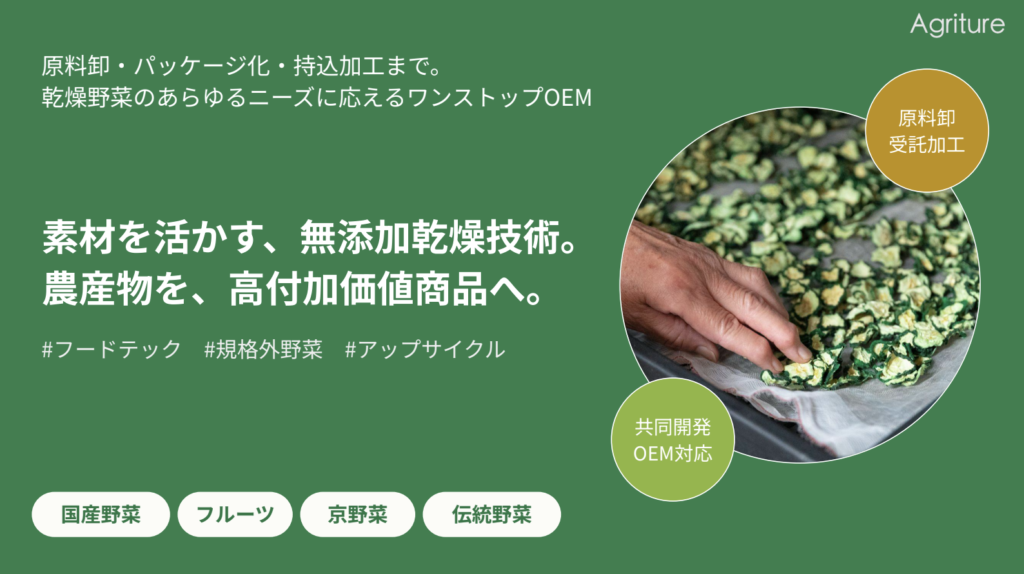
- OEM available from small lots of 10 kg
- Drying of brought-in raw materials also possible
- Support from processing to filling in one place
TOC
What is vegetable paste? Basic knowledge
The paste form refers to a state in which a solid ingredient is ground or heated into a smooth, semi-solid form. Vegetable paste is made by processing raw or boiled vegetables with a food processor, mixer, or commercial grinder. At the cooking and confectionery site, it is characterized by "containing a lot of moisture, being easy to spread, easy to mix, and retaining the ingredient's taste."is characterized by
Vegetable paste is a material that can be made even in an ordinary household, but for commercial use it is distributed in factory-mass-produced canned, tube, frozen, and vacuum-pack forms. From sweets-making and cooking to baby food and restaurant prep, it is an all-purpose material used in a wide range of scenes.
Comparing five vegetable-processing materials
Vegetable-processing materials are distributed not only as vegetable paste but in five forms—powder, dried vegetables, purée, and extract. Because each has its own individuality in moisture content, shelf life, and processing suitability, distinguishing use by application is fundamental.
| Material | Moisture content | Texture / shape | Main use |
|---|---|---|---|
| Paste | 50〜80% | Smooth semi-solid | Sauce, baby food, dressing |
| Purée | 70〜90% | Smooth, on the liquid side | Soup, drink, dessert |
| Dried vegetables (cut) | 3〜10% | Dry granules / small pieces | Instant noodles, soup ingredients, deli sides |
| Powder | 3〜8% | Fine powder | Confectionery, beverages, functional foods |
| Extract | Liquid to concentrate | Umami-component extract liquid | Dashi, seasonings, functional ingredients |
FOR BUSINESS
乾燥野菜を業務用でお探しですか
国産の野菜・果物を乾燥し、必要に応じて粉砕してお出ししています。扱っている品目は100種前後で、規格は 乾燥品の一覧・パウダーの一覧 に掲載しています。
少量でのご購入は、姉妹ブランドの通販サイト OYAOYA で承っています。
Selection decided by three elements
Vegetable-processing materials can be evaluated by the three elements of "moisture content, shelf life, and processing suitability,"and the form that fits your application is decided in one shot. This is a judgment axis common to both product development and the cooking site.
Element 1: Moisture content
Moisture content is an element directly tied to the moisture design of the final product. High-moisture forms (paste 50–80%, purée 70–90%) suit liquid-based products (soup, sauce, drink). Conversely, for products where you don't want to increase moisture (cookies, biscuits, chocolate, furikake), dried vegetables or powder with a moisture content of 3–10% are chosen.
| Target product | Recommended moisture content | Suitable form |
|---|---|---|
| Sauce, soup | 50〜90% | Paste / purée |
| Baked goods, bread dough | 3〜10% | Powder / dried vegetables |
| Drinks, beverages | Liquid to fine powder | Purée / powder / extract |
| Topping, furikake | 3〜8% | Dried vegetables / powder |
Element 2: Shelf life
Shelf life is an element that determines sourcing lot, logistics cost, and disposal loss. Materials with higher moisture content tend to have shorter storage periods, so you judge in tandem with whether you have refrigeration or freezing equipment. When a restaurant's refrigerator space is limited, room-temperature-storable powder and dried vegetables have a large advantage.
| Material | Storage condition | Best-before guideline |
|---|---|---|
| Paste (frozen) | -18°C or below | 6–12 months |
| Paste (vacuum-pack chilled) | 0〜10℃ | 1–3 months |
| Purée (frozen) | -18°C or below | 6–12 months |
| Dried vegetables, powder | Room temperature, dry | 12–18 months |
| Extract | Chilled / room temperature (varies by concentration) | 6–18 months |
Element 3: Processing suitability
Processing suitability is an element indicating "which form fits which process."If it's already liquid, paste, purée, or extract that disperses quickly; if mixing with flours, dried vegetables or powder—you choose by compatibility with the process.
| Processing step | Suitable material | Point |
|---|---|---|
| Mixing (liquid base) | Paste, purée, extract | High dispersibility and uniformity |
| Kneading in (mixing with flours) | Powder | Requires moisture-amount adjustment |
| Topping (finishing) | Dried vegetables, powder | Texture and color come alive |
| Reconstitution cooking (reconstitute with hot water) | Dried vegetables | Requires reconstitution time |
| Extraction / concentration | Extract | Uniformity of umami components |
💡 POINT | Choose the three elements by deciding priority order
A material satisfying all three elements is rare. Moisture content → shelf life → processing suitability Deciding priority in this order finds the material that best fits your own circumstances. It is a universal framework usable in both product development and the cooking site.
Selection by application
If the application is decided, you can confirm the optimal form in a quick-reference chart for the four scenes of "cooking, sweets, baby food, commercial."you can confirm the optimal form in a quick-reference chart for the four scenes of
| Use | Suitable form | Reason |
|---|---|---|
| Cooking (home / restaurant) | Paste, purée | The simplicity of using them as is for heating and mixing |
| Sweets-making | Powder, purée | Easy to adjust coloring and flavoring |
| Baby food | Paste, powder | Smooth texture / additive-free, domestically grown single items |
| Commercial (restaurants, food factories) | Powder, dried vegetables, frozen paste | Sourcing stability, shelf life, work efficiency |
| Functional foods, supplements | Powder, extract | Concentration of active ingredients, blending suitability |
We have materials available to help you understand dried processing OEM
Agriture OEM, flexibly handling everything from small lots to large lots
- OEM available from small lots of 10 kg
- Drying of brought-in raw materials also possible
- Support from processing to filling in one place
Differences in manufacturing method
The manufacturing methods of the five forms each differ, and the differences in process affect nutrition retention, flavor, and cost as well.
| Material | Manufacturing process | Nutrition retention / features |
|---|---|---|
| Paste | Heat → grind → sealed packaging | Some water-soluble vitamins decrease; flavor retention is excellent |
| Purée | Heat → strain → seal | Smoother than paste |
| Dried vegetables | Wash → cut → dry (hot air / vacuum / FD) | Moisture removal, nutrition concentration, texture present |
| Powder | Dry → grind → sieve | Made into fine powder, high uniformity, easy to bring out color |
| Extract | Extract → concentrate → filter | Extracts only umami and functional components |
Easy uses in sweets and cooking
For households and cooks using vegetable materials for the first time, knowing practical uses in sweets-making and cooking reduces failures. Grasp the three points of amount to add, timing, and ingredients to combine.
Uses in sweets
For sweets such as cookies, pound cakes, macarons, and steamed buns, powder at 3–8% mixed into the flours is fundamental. When using paste or purée, mixing it in at the butter-sugar-egg creaming stage disperses it smoothly. If you want to show vivid color, blend it a little more thickly into the dough before baking—that's the tip.
Uses in cooking
In cooking, adding paste at the end of heating keeps the color and flavor. For curry, pasta sauce, and soup, mixing ingredient paste in at the finish is a common use. When using it in salad dressing, mixing it with the oil first and then adding vinegar or lemon juice makes it less likely to separate.
Comparison of nutrition, color, and flavor
When the form changes, the degree of retention of nutrients, color, and flavor changes too. In particular, vitamin C, which is weak to heat, and pigments that oxidize easily with oxygen (anthocyanin, lutein) are components easily affected by the manufacturing method.
| Material | Nutrient retention | Color | Flavor |
|---|---|---|---|
| Paste | ◎ (decreases when heated) | ◎ | ◎ |
| Purée | ◎ | ◎ | ◎ |
| Dried vegetables (hot air) | ◯ | ◯ | ◯ |
| Dried vegetables (FD) | ◎ | ◎ | ◎ |
| Powder (hot air) | ◯ | ◯ | ◯ |
| Powder (FD) | ◎ | ◎ | ◎ |
| Extract | ◯ (extracted components) | ◯ | ◎ |
Agriture's contract-processing patterns
At Agriture, we contract-process centered on dried vegetables and vegetable powder. Because paste and purée are outside our area of strength, we handle them by bridging to a partner as needed. In new product development using vegetables, if you are hesitating between "dried vegetables/powder or paste/purée," first consult Agriture's wholesale / OEM information.
In particular, drying and powdering of domestically grown vegetables is handled from 100 g, and you can continue with the same specification from small-lot prototyping to mass production. We supply vegetables processed at five manufacturing bases—from contract farmers in Kyoto and Kyotango to Nagano, Mie, Ehime, and Okinawa—as commercial-use raw materials.
How to choose vegetable-processing materials Q&A
Q. How do paste and purée differ?
A. They are often used basically synonymously, but by industry convention, purée is more on the liquid side and smoother. Paste is slightly firmer, at a viscosity easy to spread or mix.
Q. Which form is safe for baby food?
A. For the early months (5–6 months), Paste, purée is fundamental. From the middle period onward, powder and dried vegetables can also be used, but choose domestically grown, single-item, additive-free ones.
Q. What is the storage method when making it at home?
A. For paste and purée, portioning and freezing in an ice-cube tray is convenient. You can thaw just the amount you use one at a time, storing 2–3 weeks in the freezer, or 1–2 months with a vacuum pack.
FOR BUSINESS
乾燥野菜を業務用でお探しですか
国産の野菜・果物を乾燥し、必要に応じて粉砕してお出ししています。扱っている品目は100種前後で、規格は 乾燥品の一覧・パウダーの一覧 に掲載しています。
少量でのご購入は、姉妹ブランドの通販サイト OYAOYA で承っています。
The three points of the summary on selection
The five forms—vegetable paste, powder, dried vegetables, purée, and extract—are chosen by the three elements of moisture content, shelf life, and processing suitability as a basic rule. If you emphasize room-temperature storage for commercial use, dried vegetables or powder; if you emphasize smoothness for home cooking or baby food, paste or purée; and if it's a function appeal, powder or extract are suitable.
If you choose the optimal form by working backward from application, sales channel, and sourcing conditions, both product development and daily cooking become more efficient. The dried vegetables and vegetable powder handled by Agriture can be viewed on the commercial vegetable powder page.
Download the OEM contract processing materials
We will send the materials to your email address based on the information you provide.
Recommended reading
→ Baby-food OEM | Selection by month and domestically grown single-item powder
→ How to use vegetable powder | By business type, cooking, and storage scene
→ Vegetable powder OEM | Unit-cost structure and 6 pitfall patterns
If you are considering product development with off-spec or your own farm's vegetables:From planning to processing, materials, package printing and novelties, you can consult us through a single point of contact. → Learn more about one-stop product development
- What Is Vegetable Powder? Features, Shelf Life, Uses and a Guide to OEM
- Solve picky eating too! 3 ideas for commercializing vegetable powder you can keep up every day
Author of this article
Related articles
-
 Original coffee marketing strategy | Ways to grow sales
 -
 ベジタリアンとは?国の規格が分けている4つの区分と食べられないもの
 -
 長ねぎと白ねぎは同じもの?ねぎの種類と呼び名を国の資料で確かめる
 -
 柚子の種類は何種類あるのか、公の資料で名前が残る系統を数えた
 -
 柚子の皮の使い道は干すと広がる、果汁と種まで使い切る手順
 -
 ゆずの時期は年に二度、青ゆずは7月から黄ゆずは10月から
 -
 ゆずの産地は高知が半分を占め、二位は徳島から愛媛に変わった
 -
 Preventing Food OEM Failures: Common Failure Cases and Countermeasures for Success