
What to write on a food's consolidated labeling panel, and how much may be omitted

You dried vegetables you grew yourself and packed them into bags. You managed the label design on your own. Now, what do you write in the box on the back?
This box has a set form called "Appended Form 1" in the Food Labeling Standards, and the state defines both the items to write and their order. You cannot sell without following it, but to put it the other way, the cells to fill in are finite. This article walks through, in order, the items that go in the collective-labeling box and their sequence, how to separate ingredient names from additives, allergens, date labels, character size, and even what can be omitted on small bags, following the descriptions in the Consumer Affairs Agency's standards, notices, and Q&A.
How to write the origin of raw materials is Origin labeling rules for ingredients in processed foods covered in, so this article touches only on where in the box it goes.
TOC
What to write in the collective-labeling box, and in what order
That box on the back is formally "the place where labeling items are displayed collectively." Article 8, Item 3 of the Food Labeling Standards provides that the labeling from the name through the food-related business operator is to be "done in accordance with Appended Form 1."
The items Appended Form 1 defines, and their order
The item fields printed in Appended Form 1 are, from the top, in the following order.
| 順 | Item field | Contents |
|---|---|---|
| 1 | Name | Common name that describes the contents |
| 2 | Ingredient name | In order of greatest weight |
| 3 | Additives | In order of greatest weight among the additives |
| 4 | Country or region of origin of ingredients | Origin of the raw material ranked first by weight |
| 5 | Net content (solid content / total content) | State the unit |
| 6 | Use-by date (or best-before date) | In year-month-day order |
| 7 | Storage method | According to the characteristics of the food |
| 8 | Country of origin | Imported goods only |
| 9 | Manufacturer | The party responsible for the labeling content |
The point that the date label comes above the storage method is often reversed on self-made labels.
The form's proviso also provides a way out. Article 8, Item 3 states, "this shall not apply where the labeling is displayed collectively in a manner as easy to understand as the labeling in the appended form," so you do not need to match even how the ruled lines are drawn.
Furthermore, the notes to Appended Form 1 allow additives to be written, separated out, in the ingredient-name field without setting up their own item field, and the raw-material origin to be written in parentheses after the corresponding ingredient name without its own item field. On small bags of dried vegetables, using these two to reduce fields is the practical approach.
What to do with bags where you can't draw a box, or bags you want to set vertically
The notes state that the form may be set vertically and that the box may be omitted where displaying a box is difficult. When you cannot draw box lines on a long, thin stick bag or a zippered stand pack, you can lay out the item names and their contents without ruled lines.
There is also an answer for when only the ingredient names won't fit. Q&A Processing-247 states that when there are many ingredients, as with boxed lunches or prepared dishes, you may write the ingredient names in a separate place as long as you indicate that location in the collective-labeling section. The rule is a nearby position on the same face, or, if that is difficult, a face the consumer can easily check.
When you can write the product name as-is in the "Name" field
The Name field is not a field for writing the product name. The standard requires "a common name that describes the contents."
Q&A Processing-7 states that if the product name is a common name describing the contents, it may be used as the name, and that writing the product name alongside in parentheses after the name is also acceptable as long as it does not mislead.
What if the product name is not a common name? Processing-8 answers: if you display the common name clearly in a place adjacent to the product name, you can omit the Name field in the collective-labeling section. However, displaying the common name markedly smaller than the product name is not allowed. If you write "Kyo no Hoshi Yasai (dried vegetables)" on the front, you can cut one line—the Name field—from the box on the back.
Note that the notes to Appended Form 1 provide that if you display the name on the principal face you can omit the name item in the form, and the same applies if you display the net content together with the name on the principal face.
Ingredient names and additives won't pass unless you separate them with a divider
When you write additives together in the ingredient-name field without creating a separate item field for them, there is one condition: "display them clearly separated from the ingredient names."
Three ways to separate: slash, line break, and separate section
Q&A Processing-248 lists three methods for clear separation and states explicitly, "they cannot be displayed continuously without a divider."
| Method | How to write it |
|---|---|
| Separate with a symbol | pork belly, sugar, salt, egg white, vegetable protein, spices / phosphate (Na), seasoning (amino acids)… |
| Separate with a line break | Write the ingredients, then break the line and write the additives from the next line |
| Separate with a separate section | Divide the ingredient-name field into upper and lower parts and write the additives in the lower part |
The examples are three, but the Q&A also writes, "this is not limited to the following methods." What is prohibited is continuing without a divider.
When you use a slash, the boundary between ingredients and additives is a single slash. Before the slash are the ingredients, after it the additives, each listed in order of greatest weight.
List ingredients in order of greatest weight; put purchased processed items in parentheses
As for the order of ingredient names, Article 3, Paragraph 1 of the standard provides that they be "displayed by their most common name, in order from the one with the highest proportion by weight among the ingredients."
For items made of two or more ingredients, such as a purchased seasoning or powder (compound ingredients), add parentheses after the name and list the contents in weight order. There are two omission provisions here.
- When a compound ingredient has three or more ingredients, those ranked third or lower by weight and under 5 percent can be grouped as "others."
- When a compound ingredient is under 5 percent of the whole product, or its contents are obvious from the name, the entire contents in parentheses can be omitted.
Q&A Processing-51 uses mayonnaise as an example and shows a way of writing it that can be shortened to "mayonnaise (contains egg)." Because mayonnaise's contents are obvious from the name, you can omit the contents in parentheses even when you use 5 percent or more.
When you use several ingredients of the same kind, writing them grouped under a general term, as in "vegetables (carrot, cabbage, onion)," is also allowed under Article 3, Paragraph 1, Item 2 of the standard. You will use this for labeling a dried-vegetable mix.
Writing "none" when you use no additives is not allowed
Q&A Processing-249 says that for a processed food using no additives, setting up an additive field and leaving it blank is possible but that omitting it is preferable, and then writes, "regardless of whether additives are used, a display of 'none' is not allowed."
This is a spot where the urge to claim additive-free easily surfaces, but you cannot write "none" inside the box. Along with that, non-use claims such as "no preservatives used" are subject to a separate Consumer Affairs Agency guideline, so check the copy outside the box at the same time.
FOR BUSINESS
Looking for dried vegetables for commercial use?
We dry domestically grown vegetables and fruits, grinding them as needed, to supply them. We handle around 100 items, and specifications are List of dried products・List of powders listed at.
Small-quantity purchases are available through our sister brand's online store, OYAOYA.
Nine allergen items are mandatory, with a grace period for cashew nut until the end of March 2028
This part changed in 2026, so you will get it wrong if you work from an old explanatory article.
The 9 mandatory items and the 20 that remain recommended
The specified raw materials defined in Appended Table 14 of the Food Labeling Standards are the 9 items: shrimp, cashew nut, crab, walnut, wheat, buckwheat, egg, milk, and peanut. Cashew nut moved from recommended to mandatory under the amendment that took effect on April 1, Reiwa 8 (2026).
However, Article 2 of the supplementary provisions of the same amendment has a transitional measure, and for processed foods manufactured, processed, or imported by March 31, Reiwa 10 (2028), the prior rules may be followed. If you are making the artwork now, assuming you will switch during the grace period, building it with cashew nut included from the start reduces reprinting.
Note that the transitional measure for walnut, made mandatory in the previous amendment, ended on March 31, Reiwa 7, so walnut is now fully mandatory.
The "items equivalent to specified raw materials" that remain recommended number 20: almond, abalone, squid, salmon roe, orange, kiwifruit, beef, sesame, salmon, mackerel, soybean, chicken, banana, pistachio, pork, macadamia nut, peach, Japanese yam, apple, and gelatin. Pistachio was added in fiscal Reiwa 7. It is not mandatory, but labeling is recommended by notice.
Settle on one—individual labeling or collective labeling
There are two ways to write allergens.
Individual labeling (the rule) Add parentheses immediately after each ingredient or additive. For an ingredient, "yeast extract (contains wheat)"; for an additive, "emulsifier (soy-derived)."
Collective labeling At the end of the ingredient-name field, group them as "(contains some wheat, egg, sesame, and soy)." If you have separated the item fields for ingredients and additives, write it at the end of each field.
The Q&A's attachment makes individual labeling the rule and then, citing cases such as a limited labeling area where it cannot all be written except by collective labeling, also allows collective labeling.
The point to watch is Q&A E-9, you cannot use individual labeling and collective labeling in combination. Settle on one. Choose collective labeling if you want to cut characters on a small bag, individual labeling if you have room in the area.
Write "milk" as "contains milk ingredients"
The specified raw material "milk" is written as "contains milk ingredients" for allergen labeling. "Contains milk" and "contains dairy products" are not allowed. Only in the case of an additive do you write "milk-derived."
For peanut, any of "落花生を含む," "ピーナッツを含む," or "落花生(ピーナッツ)を含む"—all of which mean "contains peanut"—is acceptable.
For date labels and storage method, keep a record of the basis you used to set them
Which to assign: use-by date or best-before date
Article 3, Paragraph 1 of the standard sets "a use-by date for foods whose quality deteriorates rapidly" and a best-before date for others. By the definitions in Article 2, the use-by date is "the date until which it is deemed there is no risk of lacking safety," and the best-before date is "the date until which it is deemed fully possible to retain all expected qualities."
From this definition, the Consumer Affairs Agency's date-labeling guideline frames the use-by date as one set by giving priority to the results of safety-related tests such as microbiological testing, and the best-before date as one set by giving priority to the results of physicochemical tests and sensory evaluation.
For those over 3 months, just "year and month" is enough
Write the date in year-month-day order. However, under the standard's proviso, when the period from the date of manufacture or processing to the date label exceeds 3 months, you may substitute a year-and-month display.
For a product with a best-before date of around half a year, such as dried vegetables, you can print just the year and month. This is a spot where printer setup and inventory management become easier.
Regarding display on a price label, Q&A Processing-261 says that the item names for the name and ingredient names may be omitted if it does not become hard to understand, but the item names "use-by date" and "best-before date" cannot be omitted. This is because the date alone does not tell which kind it is. Item names such as "manufacturer," "processor," and "seller" likewise cannot be omitted.
The more a product is kept at room temperature, the more you add a temperature to the storage method
Q&A Processing-12 shows that the storage method is written as "storage temperature 10°C or below" or "store at 4°C or below," and that, for items with no particular points to note beyond storing at room temperature, it may be omitted except for milk and milk drinks. However, if you need to avoid direct sunlight, you must write "store at room temperature away from direct sunlight."
The date-labeling guideline (March Reiwa 7) goes further: for foods stored at room temperature, it says you need to consider the season, the outside temperature at the destination, the rise in annual average temperature, and the temperature conditions across the entire supply chain including distribution and delivery, and then it is preferable to add to the "storage method" the specific temperature, humidity, and other conditions assumed when setting the date label it writes.
For a product whose storage method should change after opening, it is considered preferable to write it outside the box, as in "after opening, store at 4°C or below," or, if you put it inside the box, to add the item name "precautions for use" to distinguish it from the storage method.
"Dividing at 5 days" and "multiplying by 0.8" are not recommended by the Consumer Affairs Agency
On two practices that spread through old guidance, the Consumer Affairs Agency states its position in the current guideline.
- The 5-day rule: The idea of "distinguishing use-by dates from best-before dates at 5 days," notified by the Ministry of Health and Welfare and the Ministry of Agriculture, Forestry and Fisheries in Heisei 7, was dissolved in Heisei 20 because it cannot be called date-setting based on the definitions of the terms, and the Consumer Affairs Agency does not recommend it either
- The safety factor: While the method of multiplying a date derived from objective indicators by a factor of less than 1 is itself common, "it is preferable to bring the safety factor closer to 1, and to bring the time or number of days subtracted closer to 0"
The guideline's position is that mechanically multiplying by 0.8 shortens the date more than necessary and leads to food loss. It even writes that for foods with little quality variation, such as pressure-heat-sterilized retort pouches and canned goods, there is no need to consider a safety factor.
And setting the date is not the end. The guideline states, "the party responsible for labeling shall endeavor to prepare and keep materials concerning the basis for setting the date and to provide information when requested by consumers and others." Do not throw away your microbiological-testing and sensory-evaluation records.
The indicators to look at when setting the date for dried products are Best-before dates and storage of commercial dried vegetables.
Spots where people trip up on the net content and manufacturer fields
Dried vegetables and dried fruit fall under the specified commodities of the Measurement Act
The net-content provision of Article 3, Paragraph 1 of the standard says that for specified commodities under the Measurement Act you display per the Measurement Act's provisions, and for others you display the net weight, net volume, or net count with the unit stated.
So which is dried vegetables? Looking at the excerpt of Article 5 of the Specified Commodities Cabinet Order carried in the Consumer Affairs Agency's Quick Guide to Food Labeling, Item 4 lists "processed mushroom products and dried vegetables" and Item 5 lists "dried fruit." In other words, sealed dried vegetables, dried mushrooms, and dried fruit are specified commodities, so you display the net content and the name and address of the food-related business operator.
The unit is grams or kilograms. Writing like "about 20 g" or displaying by count is not allowed.
Which to call yourself: "manufacturer," "seller," or "processor"
The name of the bottom field in the collective labeling changes with your position. The notes to Appended Form 1 provide that when the food-related business operator is a seller, processor, or importer, "manufacturer" becomes "seller," "processor," or "importer," respectively.
If you sell a product made for you under OEM as your own brand, it is "seller." If you do the drying at your own factory, it is "manufacturer." If you only repacked imported raw material domestically, it is "processor." The thinking on country of origin and processor when repacking imported goods is When you repack and sell imported dried fruit domestically covered in detail in.
What you write here is "the name and address of the party, among the food-related business operators, responsible for the labeling content." Write the company that answers when an inquiry comes in.
Place the manufacturing site's location near the operator's name
Article 3, Paragraph 1 of the standard requires displaying, separately from the food-related business operator's name and address, the location of the manufacturing or processing site and the name of the manufacturer or processor. If the two are the same, you can omit the manufacturing-site side.
If they differ, Article 8, Item 5 provides that it "must be displayed adjacent to the name and address of the food-related business operator." You cannot write them apart, one near the top of the box and the other near the bottom.
There is also the route of using a manufacturing-site-specific symbol, but it requires notification to the Commissioner of the Consumer Affairs Agency and comes with the condition that the same product is made at two or more manufacturing sites. In addition, you must display one of the following: the contact of the party who answers inquiries, the address of a website listing the manufacturing site the symbol represents, or the locations of all manufacturing sites. For a small lot at just one factory, simply writing the location is faster.
Text is 8 point or larger, and on small bags you can go down to 5.5 point
Article 8, Item 9 of the standard provides as follows.
The characters used in labeling shall be characters of a size at least that of the 8-point type specified in Japanese Industrial Standard Z 8305 (1962). However, for items whose labelable area is approximately 150 square centimeters or less (omitted), the characters may be (omitted) of a size at least that of 5.5-point type.
Item 8 of the same Article 8 also states, "the color of the characters and box used in labeling shall be a color that contrasts with the background color." Artwork like brown text on a kraft-paper bag will not pass.
150 square centimeters—which area is measured?
Q&A Processing-266 defines it. The labelable area is "the surface area of the container and packaging, excluding the parts where labeling items would be hard to read even if displayed," and the overlapping part of the packaging, the twist part of candy wrapping, and the photoelectric-tube mark do not count as labelable parts. It is the surface area of the container and packaging minus the parts where labeling is impossible.
The same answer also includes the sentence, "packaging by a method that needlessly reduces the surface area is not appropriate." The idea of making the bag smaller just to use 5.5 point is blocked.
150 square centimeters is roughly one face of a 12 cm × 12 cm square. A 100 g stand pack often exceeds it across front and back, while a small bag or stick of around 20 g falls below it. For borderline products where the call is hard, Q&A Processing-259 states, "the basis is 30 cm² and 150 cm² or less, while judging according to each individual case."
Note that Processing-267 answers clearly that when the labelable area is approximately larger than 150 cm², it must be 8 point or larger. "It's only a little over, so 5.5 point" will not pass.
How far you can tighten line spacing and character width
Q&A Processing-260 states that applying some processing to text that keeps its point size is acceptable, but that markedly impairing legibility thereby is not preferable.
The answer is that tracking adjustment is possible as long as you keep the point size. Conversely, condensing the type to cut its height lowers the point size itself, so it will not pass.
How to choose the bag size and printing method is What is small-lot package printing?and Kinds of food packaging for more.
Small bags, and products sold on the spot, have more items you can omit
When the labelable area is approximately 30 square centimeters or less
Article 3, Paragraph 3 of the standard allows the following items to be omitted for containers and packaging whose labelable area is approximately 30 square centimeters or less.
| Can be omitted | Cannot be omitted |
|---|---|
| Ingredient name | Name |
| Additives | Storage method |
| Net content, solid content, total content | Use-by date or best-before date |
| Amounts of nutrients and calories | Allergens |
| Manufacturing site location and manufacturer's name | Food-related business operator's name and address |
| Country or region of origin of ingredients | A statement that it contains an L-phenylalanine compound |
| Country of origin | |
| Items concerning genetically modified foods | |
| A statement that it is a food subject to the standard for infants |
For L-phenylalanine compounds, a notice states clearly that "it cannot be omitted even when the labelable area is approximately 30 square centimeters or less," and then says that when it is difficult due to character count, it can be shortened to "aspartame (phenylalanine)" or "contains phenylalanine."
30 square centimeters is about 5 cm × 6 cm. A sample small bag or a novelty stick falls in this range. Even so, the allergens, date label, and responsible party's name remain.
When you sell on the spot where you made it
Article 5 of the standard provides that, for "selling at the place where the food was manufactured or processed" and "transferring (excluding sale) to unspecified or many persons," display of the ingredient names, net content, solid content and total content, amounts of nutrients and calories, the name and address of the food-related business operator, country of origin, raw-material origin, and the like is not required.
The Quick Guide to Food Labeling adds a note to this: "Labeling items derived from the Food Sanitation Act cannot be omitted" Allergens, additives, storage method, and the date label remain.
The provision says "selling at the place where it was manufactured or processed." Selling at a farm shop attached to the factory qualifies, but taking it to a distant marche or event venue to sell does not. Because the labeling obligation changes with where you sell even the same product, decide at the outset whether to use separate labels for direct sale and for shipping, or to make them to the shipping standard.
Operators who can omit the nutrition labeling, and when you can write estimated values
Nutrition labeling is mandatory as a rule, but Article 3, Paragraph 3 of the standard lists cases where it can be omitted. One of them is "items sold by an operator exempt from the obligation to pay consumption tax under Article 9, Paragraph 1 of the Consumption Tax Act."
The Quick Guide supplements the operation, stating that for the time being this applies to operators with taxable sales of 10 million yen or less, or to small-scale enterprises defined in Article 2, Paragraph 5 of the Small and Medium-sized Enterprise Basic Act (operators with roughly 20 or fewer regular employees, or 5 or fewer in commerce or services). A farmer or sole proprietor who has just started will often fall here.
However, if you intend to make a nutrition claim, you cannot omit it. If you put nutrition-related wording on the package, the labeling obligation returns.
Even when you are subject to the obligation, there is a provision worth reading before you send samples for analysis. Item 2 of the nutrient provision in Article 3, Paragraph 1 of the standard says that if you meet the following two, you can display values obtained by calculation from the raw-material values, analytical values of something with a similar composition, or other reasonable estimation.
- Carrying a statement indicating that the displayed values may not match values obtained by the prescribed analytical method
- Keeping the supporting materials for setting the displayed values
The sentence "these displayed values are a guide" corresponds to this provision. However, if you make a nutrient-function claim or a statement that the product can supply a nutrient, you cannot use this estimated-value method.
What we check at Agriture before making the artwork
From here, this is from the contractor's side.
Label application is counted per location
In addition to drying and grinding, we handle small-pack filling and label application. Application is counted not per bag but per location. If you apply both a brand sticker on the front and a collective-labeling label on the back, the back label also counts as one location, so that is two locations.
This is where estimates sometimes diverge, so it moves faster if, when you place the order, you tell us as a number how many labels go on the front and back. If you print the collective labeling into the front design and apply a label only on the back, it comes to one spot.
The process changes depending on whether you supply the data
If you supply the label design data, we don't charge a production fee. We handle everything up to printing and applying them on our end.
If we create the design from scratch, that is quoted separately. In that case, what we ask is that the contents of the collective labeling be finalized first. The order of ingredient names, how allergens are written, and the basis for setting the expiration date cannot be decided by the manufacturing side alone. In particular, when you bring in your own raw materials, the allergens listed on that material's specification sheet carry straight over to the labeling. Without a specification sheet, the ingredient name field cannot be written.
Limits on correcting print errors with stickers
If the labeling on a printed label is wrong, Processing-269 of the Q&A states that applying a sticker with the correct labeling over the incorrect labeling is itself acceptable.
From March 17, 2021, from the standpoint of reducing food loss, a simpler correction is also permitted: affixing or placing a pop sticker or neck ringer bearing the correct labeling at any location. The conditions are that the pop sticker or the like does not easily separate from the container and packaging and forms an integral whole, and that it is clear the correct labeling content is on the pop sticker or the like.
However, For the time being, this simpler method is not permitted for correcting safety-related labeling items such as allergens and use-by dates. If you get an allergen wrong, the only option is to apply a label over it to fix it. This difference becomes a consideration when deciding how many to print.
The conditions for small-pack filling and label application are Small-bag filling OEM service, when blending multiple items, Dried vegetable mix OEM.
Checklist for creating collective labeling
- Is the name a common name that describes the contents (not just the product name placed as is)?
- Are the ingredients listed in descending order of weight? Have you written the contents of compound ingredients in parentheses?
- Is there a separator—a slash, a line break, or a separate field—between the ingredients and the additives?
- Have you avoided writing "none" in the additives field?
- Have you checked the 9 allergen items? Have you included cashew nuts?
- Have you avoided mixing individual labeling and collective labeling?
- Have you written "milk" as "contains milk ingredients"?
- Have you chosen between a use-by date and a best-before date based on the characteristics of the food? Have you kept the supporting documentation?
- When expressing a date beyond 3 months as year and month only, is the print setting correct?
- Have you added the assumed temperature conditions to the storage method for room-temperature products?
- Is the net content expressed in grams (dried vegetables and dried fruits are specified commodities under the Measurement Act)?
- Which field name is correct—manufacturer, seller, processor, or importer?
- Have you placed the manufacturing site's address close to the business operator's name?
- Is the text 8 points or larger? If 150 square centimeters or less, is it 5.5 points or larger?
- Are the colors of the text and the frame in contrast with the background?
- Even on small packs of 30 square centimeters or less, are the name, storage method, expiration date, allergens, and business operator's name retained?
FOR BUSINESS
Looking for dried vegetables for commercial use?
We dry domestically grown vegetables and fruits, grinding them as needed, to supply them. We handle around 100 items, and specifications are List of dried products・List of powders listed at.
Small-quantity purchases are available through our sister brand's online store, OYAOYA.
FAQ
Summary
The items that go in the collective labeling frame, and their order, are set by Separate Form 1. The cells to fill are finite, and as long as you don't miss three points—putting a separator between the ingredient names and the additives, keeping allergens consistently either individual or collective, and keeping text at 8 points or larger (5.5 points or larger for small bags)—the layout comes together.
On top of that, the omission provisions matter more the smaller the maker. Bags of 30 square centimeters or less, selling at the place of manufacture, nutrition labeling by tax-exempt business operators. In each case, knowing before you print changes the artwork.
And for the expiration date alone, how you decide it weighs more than how you write it. Neither the 5-day rule nor the 0.8 safety factor is something the Consumer Affairs Agency currently recommends. Test your own products and keep the basis on record. This is the part you can't outsource.
The way to write the raw material's growing region is Origin labeling rules for ingredients in processed foods, when repackaging imported goods, When you repack and sell imported dried fruit domestically.
We have materials available to help you understand dried processing OEM
Agriture OEM, flexibly handling everything from small lots to large lots
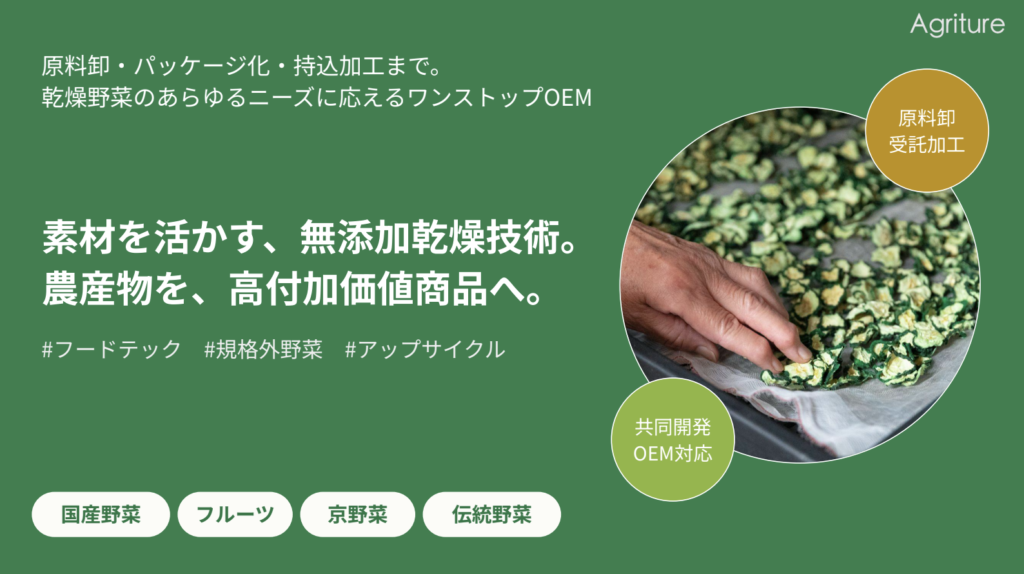
- OEM available from small lots of 10 kg
- Drying of brought-in raw materials also possible
- Support from processing to filling in one place
Download the OEM contract processing materials
We will send the materials to your email address based on the information you provide.
- The nine allergen-labeling items — now including cashew nuts — that cannot be omitted even on small packs
- 'It's in season, so we can make it now' is backwards: the fresh-produce slots fill up 3 to 6 months ahead
Author of this article
Related articles
-
 How to Make Dried Tomatoes: Drying Tips, and How Cherry and Large Tomatoes Turn Out Differently
-
 Kansai Food OEM: 6 Steps to Making a New Product and Subsidies
-
 Practical Guide to Importing Dried Vegetables: Tariffs, HS Codes, and Quarantine Explained
-
How to choose retirement gifts | A collection of food gift ideas that convey gratitude
-
 How to choose commercial vegetable dashi: comparing across three axes of ingredient, format, and scope
-
 A guide to preparing for a trade show | Schedule, costs, and checklist
-
 Peace of mind even for first-time food OEM! Tips for choosing a manufacturer and ordering without going wrong
-
 How to source commercial vegetable powder in small lots, and how to use it