
'It's in season, so we can make it now' is backwards: the fresh-produce slots fill up 3 to 6 months ahead

Inquiries like 'it's in season, so you can make it now, right?' arrive the very week that item comes into season. Strawberries in spring, pears in early autumn. The assumption that the raw material must be available because the fresh fruit is on store shelves is a natural one.
But the processor's answer is 'that season is difficult.' If you want to secure a set quantity, requesting it during the season is already too late, because we need to reserve the fresh produce before it goes into the dryer.
The season is less a signal that we can make it than a signal that the slots are already full. This gap is what causes a project aimed at a within-year launch to slip a full year.
TOC
An inquiry that arrives after the season has started won't make that year's season
From the product-planning side, the season is when information is most abundant. The real fruit appears on the market, the region's crop becomes a talking point, and internally the decision to 'go with this' gets made. The inquiry comes the moment it's decided. That moment is the one time the processor can least act.
Even if a strawberry request comes in spring, we can't act until the following year
Strawberries are in season in spring. If we receive an inquiry in spring, we cannot put together a set quantity from that spring's strawberries. To secure that quantity, the inquiry needs to come in during winter so the fresh produce can be reserved.
For both fruits and vegetables, it is better to receive the inquiry 3 to 6 months before the season. Those 3 to 6 months are not time to discuss prototypes or packaging, but time to arrange the fresh produce.
What fills up first is not the dryer slots but the field side
People tend to think 'if a processing slot is open, we can make it,' but the bottleneck is further upstream. Even if the dryer is free, nothing moves without fresh fruit to put in it that day. When working backward from the launch date, you have to draw the schedule back past the processing slot to the sourcing of the raw material.
How much of the process you can outsource, and how to work backward from the launch date, is Why choosing sweet varieties for dried fruit OEM leads to failure we lay out step by step. This article deals only with the time that sits upstream of that.
Why you can't build a quantity without reserving the fresh produce first
The reason advance reservation is needed is not a matter of mindset or a preference for planning. It's because drying is a process that consumes a large amount of raw material.
Behind 1kg of product lies more than 10kg of fresh fruit
The measured yield is 7 to 10%. It diverges from the theoretical value calculated from water content, because the peel, core, seeds, and stem are removed and there is loss during the process as well.
| Figures worth noting | Measured |
|---|---|
| Yield | 7〜10% |
| Product obtained from 1kg of fresh fruit | 70〜100g |
| Fresh fruit needed to make 1kg of product | 10〜14kg |
The quantity to communicate to the producing region is the product quantity read up by a factor of ten or more. With the order of magnitude changing this much, 'we'll take the surplus if there is any' doesn't work. Before the harvest begins, the work of deciding whose field to draw from and how much has to come first.
Using off-grade produce increases the fresh fruit you need even further
Using off-grade produce as the raw material lowers the raw-material unit price. On the other hand, a step to cut away damaged spots is added, so the yield drops. It can fall below 7%.
In other words, the moment you choose off-grade produce, the amount of fresh fruit to reserve rises further. The lower cost and the larger reserved volume come together. That adds one more reason to bring the inquiry forward. The checkpoints from the purchasing side are 7 Criteria for Judging a Commercial Dried Fruit Supplier.
FOR BUSINESS
Looking for dried vegetables for commercial use?
We dry domestically grown vegetables and fruits, grinding them as needed, to supply them. We handle around 100 items, and specifications are List of dried products・List of powders listed at.
Small-quantity purchases are available through our sister brand's online store, OYAOYA.
If you inquire now, which season can you reach
Tables that work backward from the season are common, but what the side running the project wants to know is the information in the other direction. Given what month it is now, which items can still make it if you inquire from here. We rearrange the same guideline along the inquirer's timeline.
Quick-reference table from the inquiry-timing perspective
| When to consult | Reachable seasons and items |
|---|---|
| Autumn to winter of the previous year | Spring strawberries |
| Winter to early spring | Summer peaches |
| Spring to early summer | Early-autumn pears |
| Early summer to summer | Autumn apples |
| Early summer to early autumn | Late-autumn to winter citrus |
If we receive an inquiry in early summer, autumn apples and the citrus beyond them come into range. Conversely, if in early summer you are aiming for spring strawberries, what you are aiming at is the following spring. Even if you think you're talking about half a year ahead, you are in fact planning a launch a year and a half away.
Miss the harvest once and the next one is a year away
Processing slots are flexible. If next month is full, there's the month after. The harvest has no such flexibility. The moment you miss it, the next chance is 12 months away.
If you have a product you want out within the year, it is safe to settle the item during spring or summer. If autumn arrives with the item still undecided, it won't make that year's shelves.
Whether you bring in the raw material or ask us to source it changes when things move
Agriture, based in Kyoto, undertakes contract drying of domestically grown produce, and accepts both customer-supplied raw materials and inquiries that start from sourcing. Which you choose changes what bringing it forward involves.
If you bring the material, it's you who talks with the field
If you are already connected with a producing region, the role of reserving the fresh produce shifts to your side. What the processor watches is the volume coming in and when.
What to watch is that bringing the material yourself doesn't make the lead time go away. Because the fresh fruit needed is more than ten times the product, the commitment with the producing region is needed first. To decide how much to bring in, the product quantity must be settled.
If you leave sourcing to us, settle the item and quantity first
When the inquiry includes sourcing, we communicate the quantity to the producing region. For that, the four things we'd like settled at an early stage are the following.
- The item (strawberry, apple, or citrus)
- The quantity as finished product (the fresh-fruit requirement is worked back from this)
- The use and form (eaten as is, made into powder, or put into tea)
- The shelf life required (this determines the drying method)
Putting off the use and form shifts the yield assumptions. For an item like citrus, where the usable portion changes depending on whether you cut it or grind it whole, the very amount of fresh fruit needed changes. How to pin down cut shape and water content is Custom processing of dried vegetables for more.
Citrus bears differently from year to year
Up to here the discussion has been within a single year. Citrus has one more factor that spans years.
In an off-year the purchase price rises, and it loads onto the product cost at more than ten times over
Citrus such as yuzu and sudachi has years when the yield falls. In the producing regions this is called an off-year, and in that year the purchase price rises.
Layered onto the yield discussion, the weight of this price movement becomes clear. Since there are 10 to 14kg of fresh fruit behind 1kg of product, if the unit price of the fresh fruit moves, it loads onto the product side by that whole multiple. With citrus, the seeds drop out during drying, lowering the yield further, so the conditions are a little harsher.
There is a way to avoid discarding the seeds. Our own yuzu chips are ground whole, seeds and all, eliminating what gets discarded. It's an option available when powder or chips are the end form. How to think about particle size by use is How citrus powder is made and how to choose it we explain. How to judge the harvest timing of yuzu itself is The harvest season of yuzu is a useful reference.
Dry a big batch in a bumper year, and let the method decide how long it keeps
The countermeasure is to dry a large batch in a bumper year. Dried products keep longer than fresh fruit, so by producing in a year when yield and price are favorable and working through it from stock, the cost becomes predictable. Rather than scrambling to produce in a year when 'citrus is expensive this year,' drawing from stock secured the previous year is more stable.
How long it keeps varies with the drying method. The best-before date of a dried product made domestically with no additives and no added sugar is around 6 months, and items or varieties with high sugar content are shorter still. For aiming at over a year, it's freeze-drying. A make-ahead plan ends up being decided together with the method. Which method suits what is The difference between freeze-drying and dried vegetables you can compare here.
When an inquiry comes in mid-season, here's how we respond
That said, we don't close an inquiry that arrives in season with a single 'it'll be next year.' We make a point of answering by separating what can be done that year from what can be decided toward the following year.
What can move that year are the items that are already dried
What requires reserving fresh produce is a newly dried item. If you can build it from items already dried, the harvest constraint falls away. If the project's aim is to 'use domestically grown fruit,' you can swap the item to launch within the year and move the fruit you were targeting to the real run the following year. This reshuffle can make it in time if we receive the inquiry while it's still in season.
What you can decide now toward next year
Mid-season is also when you can pick up the real fruit and test it. There are things you can lock down during this period toward the following year's real run.
- Narrow down the variety. Choose one that is neither too sweet nor too sour
- Decide the end form. Eaten as is, powder, or put into tea
- Try setting a quantity. From the product quantity, estimate the fresh fruit needed at ten times or more
- Put the inquiry month on the calendar. Count back 3 to 6 months from the season to set the date
Narrowing down the variety can only be done in season. Because drying concentrates the sugar as the moisture leaves, a variety that tastes good eaten fresh won't necessarily taste good dried. If the sugar content is too high, the sweetness becomes excessive and comes through as a harsh edge. The difference in the finished result by production method is How dried fruit is made.
An inquiry that arrives in season is not too late. Toward the following year's season, it's an inquiry at just the right time. Shift the calendar by one year as you look at it. That alone turns the same project into one that makes it in time.
FOR BUSINESS
Looking for dried vegetables for commercial use?
We dry domestically grown vegetables and fruits, grinding them as needed, to supply them. We handle around 100 items, and specifications are List of dried products・List of powders listed at.
Small-quantity purchases are available through our sister brand's online store, OYAOYA.
FAQ
We have materials available to help you understand dried processing OEM
Agriture OEM, flexibly handling everything from small lots to large lots
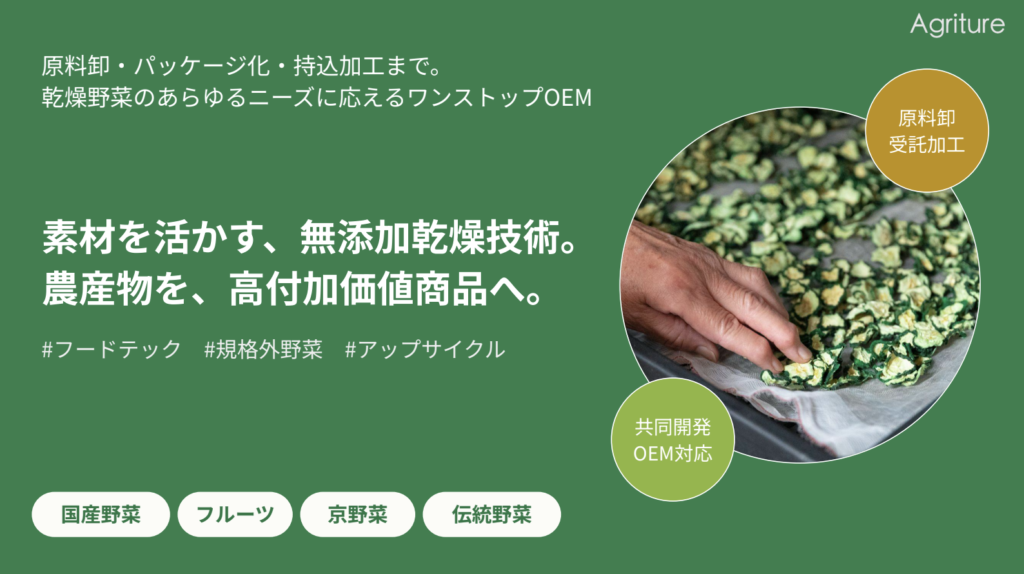
- OEM available from small lots of 10 kg
- Drying of brought-in raw materials also possible
- Support from processing to filling in one place
Download the OEM contract processing materials
We will send the materials to your email address based on the information you provide.
Author of this article
Related articles
-
 How to Make Dried Tomatoes: Drying Tips, and How Cherry and Large Tomatoes Turn Out Differently
-
 Kansai Food OEM: 6 Steps to Making a New Product and Subsidies
-
 Practical Guide to Importing Dried Vegetables: Tariffs, HS Codes, and Quarantine Explained
-
How to choose retirement gifts | A collection of food gift ideas that convey gratitude
-
 How to choose commercial vegetable dashi: comparing across three axes of ingredient, format, and scope
-
 A guide to preparing for a trade show | Schedule, costs, and checklist
-
 Peace of mind even for first-time food OEM! Tips for choosing a manufacturer and ordering without going wrong
-
 How to source commercial vegetable powder in small lots, and how to use it