
Kyoto ingredient processing OEM | How to make the most of Kyoto vegetables and quality control
Novelties
Kyoto vegetables
Raw materials & ingredients
Food OEM
Product development
Non-standard vegetables

Summary of this article
A guide to ingredient-processing OEM in Kyoto: a table of 8 categories of ingredients unique to Kyoto (Kyoto vegetables, Uji tea, Tanba ingredients, Kyotango seafood, Kyoto pickles, Kyoto sake, Japanese confectionery, yuzu); processing techniques for drying, powdering, and extract extraction; a list of Kyoto OEM companies featured on Food OEM Madoguchi; Kyoto Prefecture's climate, logistics access, and industry-cluster map; the overseas recognition of the Kyoto brand; pitfalls; and Agriture's five-site setup across Kyotango, Nagano, Mie, Ehime, and Okinawa.
The strength of commissioning ingredient-processing OEM in Kyoto lies in Kyoto vegetables access to heirloom vegetables and Kyoto-grown ingredients, backed by quality control rooted in long-established shops and craftsman culture. By combining processing techniques like drying, powdering, and extract extraction with Kyoto-grown ingredients, you can create high-value-added “Kyoto brand” products that go beyond mere OEM manufacturing.
This article covers the technology choices when commissioning ingredient-processing OEM in Kyoto, the key points of quality control, sourcing of Kyoto and heirloom vegetables, use of ingredients unique to Kyoto, Kyoto Prefecture's industrial support programs, and the processing practice Agriture carries out across its five sites in Kyotango, Nagano, Mie, Ehime, and Okinawa. Related articles: Guide to OEM food manufacturing in the Kansai region/Food OEM Prototype Cost Reduction/Powder-processing OEM in Kansai。

TOC
3 reasons Kyoto is chosen for ingredient-processing OEM
What you'll learn in this section
- 3 reasons Kyoto OEM is chosen
- The strengths of Kyoto vegetables, heirloom vegetables, and craftsman culture
- The link between ingredient access and brand value
The reasons to commission ingredient-processing OEM in Kyoto come down to three: regional ingredients, cultural resources, and quality-control know-how. We lay out the value unique to Kyoto that sets it apart from makers that simply have processing equipment.
Reason ①: Access to Kyoto and heirloom vegetables
- The brand power of Kyoto vegetables and heirloom vegetables—Kujo leek, Shogoin radish, Manganji pepper, Kamo eggplant, and more
- Sourcing routes for specialties by area, such as Kyotango, Tanba, and Yamashiro
- Direct ties with local producers (Echie Nosan, Taniyoshi Farm, and others) for ingredient supply with fixed variety and origin
Reason ②: Cultural resources and branding
- The “Kyoto-grown” and “Kyoto-vegetable” labels create value appeal that works at home and abroad
- Collaborations with long-established shops, craftsmen, and traditional crafts get OEM products chosen for “gifts, tourist souvenirs, and special occasions”
- In product development for inbound demand (visitors to Japan), the Kyoto brand works powerfully
Reason ③: Depth of quality-control know-how
- The accumulated expertise of regional industries—Japanese confectionery, pickles, Kyoto cuisine—that have upheld strict quality standards
- A cluster of plants compliant with HACCP, ISO, and organic JAS
- Industry-collaboration networks such as the Kyoto Prefecture Food Industry Council and the Kyoto Prefecture Federation of Small Business Associations
A list of ingredients unique to Kyoto (by category)
The table below organizes, by category, the Kyoto regional ingredients that support the three reasons above. Beyond Kyoto and heirloom vegetables, the ingredient groups usable in Kyoto OEM are wide-ranging—Uji tea, Tanba ingredients, Kyotango seafood, Kyoto pickles, Kyoto sake, Japanese confectionery culture, and citrus.
| Category | Main ingredients | Growing region | OEM-suited processing |
|---|---|---|---|
| Kyoto vegetables and heirloom vegetables | 九条ねぎ・賀茂なす・聖護院大根・万願寺とうがらし・京くれない人参・壬生菜・京都産柚子 | Kyoto City, Kyotango, Joyo | Drying, powder, paste |
| Uji tea, matcha | Matcha, sencha, hojicha, gyokuro, genmaicha | Uji, Wazuka, Kyotanabe | Powder, extract, blend |
| Tanba ingredients | Tanba black soybean, Tanba chestnut, Tanba shimeji, Tanba adzuki | Kameoka, Nantan, Ayabe | Drying, kanro-ni, paste |
| Kyotango seafood | Taiza crab, Tango guji, rock oyster, tilefish, blackthroat seaperch | Kyotango, Ine | Frozen, vacuum-packed, retort |
| Kyoto pickles / fermentation | Senmaizuke, shibazuke, suguki, Kyoto miso, Kyoto soy sauce | Kyoto City, Fushimi | Bottled, retort, vacuum-packed |
| Kyoto sake / rice | Fushimi sake, Tango Koshihikari, Kyoshikibu | Fushimi, Tango | Sake production, rice milling, processed goods |
| Japanese confectionery ingredients | Yatsuhashi, matcha sweets, Tanba black-soybean confections, chestnut confections | All of Kyoto City | Baked sweets, frozen desserts, gifts |
| Yuzu / citrus | 京都産柚子・京丹後ゆず・すだち・ぽん酢原料 | 京都市内・京丹後 | Juice, dried peel, powder |
The biggest differentiator of Kyoto ingredients is that they bring the “Kyoto brand story” into a product. They pair well with high-value-added channels such as gifts, tourism, inbound, and hometown tax donations, and even in OEM the “100% Kyoto-grown” appeal works powerfully.
Main techniques available for ingredient-processing OEM
What you'll learn in this section
- 6 processing techniques usable in Kyoto OEM
- Choosing among low-temperature drying, freeze-drying, powdering, and extract extraction
- Processing techniques suited to Kyoto and heirloom vegetables
The ingredient-processing techniques available in Kyoto center on four areas: drying, powdering, extract extraction, and blend design. Selection needs to account for the product category you're targeting and the processing suitability.
Comparing processing techniques
| Technology | Features | Suited ingredients / products |
|---|---|---|
| Low-temperature drying (45–60°C) | Taste, color, and aroma are retained | Kyoto vegetables, condiments, dried tomatoes |
| Hot-air drying | Low cost, high volume | Grains, root vegetables |
| Freeze-dried | Maximum retention of shape, color, and aroma | Strawberries, zenzai, miso soup ingredients |
| Powdering (milling) | Uniform dispersion, coloring, functional ingredients | Powder, dashi, drinks |
| Extract extraction | Concentration of active components | Health foods, supplements, drinks |
| Blend design | Original blends | Dashi, mixes, powder blends |
For ingredients where color, aroma, and flavor are everything—like Kyoto and heirloom vegetables—techniques that retain taste, such as low-temperature drying and freeze-drying, tend to be chosen.
Using regional ingredients unique to Kyoto
Regional ingredients within Kyoto Prefecture have area-by-area character—Kyoto vegetables, Tanba, Kyotango, Yamashiro, Rakusai. Selecting ingredients to match the product concept changes the appeal even within the same “Kyoto-grown.”
Main options for regional ingredients
| Area | Representative ingredients | OEM use examples |
|---|---|---|
| Kyoto City (Rakuchu, Rakugai) | Kujo leek, Shogoin radish, Kamo eggplant | Dried vegetables, powder, pickle ingredients |
| Kyotango | Nijusseiki pear, tomato (Momotaro), beets | Dried pear, dried tomato for dashi, dried beets |
| Tanba | Black soybean, chestnut, Kameoka beef | Japanese confectionery ingredients, gift foods |
| Yamashiro | Uji tea, matcha | Powder, blends, Japanese-Western fusion sweets ingredients |
| Rakusai | Bamboo shoots, persimmon | Dried ingredients, prepared-food ingredients |
Points to watch when using regional ingredients
- Preparation has to be concentrated in the peak season, making a year-round schedule hard to build
- Producer numbers are limited, so there is a ceiling on supply volume (not suited to large-scale mass production)
- Obtaining “Kyoto Prefecture certification / Kyoto Brand Product” has conditions (contracted producers, standards compliance)
- Using non-standard produce dovetails with a food-loss message, but sourcing volumes fluctuate widely
Quality control at Kyoto OEM providers
Points to check
Certification, equipment, and records:3 aspectsto gauge a processor's capability.
When commissioning ingredient-processing OEM in Kyoto, always confirm the quality-control system before contracting. The basic approach is to gauge a processor's capability across three aspects: certification, equipment, and records.
Quality-control checklist (6 aspects)
| Aspect to confirm | What to look at specifically |
|---|---|
| Certification | Status of HACCP, ISO 22000, FSSC 22000, and organic JAS certification |
| Inspection equipment | Presence of metal detectors, X-ray inspection, and weight checkers |
| Ingredient traceability | Lot-number control, raw-material receiving records, first-in first-out |
| Manufacturing records | Automatic-recording systems for temperature, time, and blend quantity |
| Allergen management | Cleaning and changeover procedures when making multiple items on the same line |
| Hygiene management | 5S, employee training, entry rules |
Kyoto Prefecture's own support programs and certifications
- Kyoto Brand Product certification: only agricultural produce meeting Kyoto Prefecture's quality standards may bear the name
- Kyoto Prefecture's industry-support desks: product-development support and subsidy consultation for SMEs (confirm program names and conditions with the desk for the latest information)
- Product development using Kyoto-grown raw materials: may qualify for subsidies and support programs for regional-ingredient use (varies by municipality and fiscal year)
Kyoto's climate and its suitability for ingredient processing
What you'll learn in this section
- Area-by-area climate of Kyoto City, Kyotango, Uji, and Fushimi
- Matching climate characteristics to suited processing
Kyoto has a basin climate with large temperature swings—hot and humid in summer, cold and dry in winter. These characteristics affect ingredient processing, especially the equipment conditions and operation of the drying step. Understanding this when commissioning OEM in Kyoto makes scheduling more accurate.
The link between climate and processing
- Hot, humid summers: fresh vegetables deteriorate quickly, so you need a design that shortens the time from harvest to processing
- Cold, dry winters: well suited to post-processing storage and maturation (seasonal production of pickles and dried ingredients)
- Rainy season: humidity control is important. Makers with dehumidified storage warehouses have an edge
- Basin temperature swings: favorable conditions for maturing fermented foods (miso, soy sauce, pickles). The foundation of Kyoto's traditional industries
The logistics and access advantages of Kyoto OEM
What you'll learn in this section
- The logistics advantage of being a Kansai-centered hub
- Access to the metropolitan area and overseas export
Kyoto Prefecture has ready access via JR, private rail, expressways, the bullet train, Kansai International Airport, and Itami Airport, and sits where distribution to the Kanto, Kansai, Chukyo, and Kyushu regions is easy to arrange. We lay out the advantages from the OEM client's logistics perspective.
Distribution advantages
- Kyoto Station to Tokyo Station is about 2 hours by bullet train, making meetings and audits in the Kanto region possible as day trips
- Export to Asia and the West via Kansai International Airport
- Ample freight service to the Chukyo and Kyushu directions via the Meishin, Keiji, and Shin-Meishin expressway network
- A trading infrastructure with major Kansai food makers and trading companies is in place
Kyoto's industry-cluster map (industries adjacent to ingredient processing)
What you'll learn in this section
- Adjacent industries such as Japanese confectionery, tea, sake, and ceramics
- Products born from combining with food OEM
Kyoto's food-processing OEM shows its strength not in ingredient processing alone, but in linkage with adjacent industries (fermentation, pickles, Japanese confectionery, matcha, Kyoto cuisine). Grasping which industries cluster in which areas makes it easier to design collaborations and composite products.
Main food-related industries
- Japanese confectionery / tea sweets: long-established confectioners cluster within Kyoto City
- Pickles: developed within Kyoto City, centered on Kyoto vegetables
- Matcha / Uji tea: the Yamashiro area, centered on Uji, is the growing region
- Sake: Fushimi is a representative sake-brewing district
- Japanese cuisine / Kyoto cuisine: long-established ryotei cluster within Kyoto City
The potential for collaboration with adjacent industries
Ingredient-processing OEM widens the range of product design when combined with adjacent industries. Concrete collaborations depend on the individual project; the following are examples of conceivable combination directions.
- Designs that use dried fruit and vegetable powder as ingredients for Japanese confectionery and tea sweets—kneaded in or as toppings
- Designs for new products combining dried vegetables and dried condiments into pickles and prepared foods
- Designs that blend vegetable powder into sweets ingredients for matcha and Uji-tea brands
- Designs that supply dried vegetables and dashi ingredients as commercial sub-ingredients for Japanese and Kyoto cuisine
A list of Kyoto food OEM companies
What you'll learn in this section
- A pick of 8 OEM companies within Kyoto Prefecture
- How to search by criteria on Food OEM Madoguchi
Companies within Kyoto Prefecture that take on ingredient-processing and food OEM Food OEM Madoguchi | List of OEM companies in Kyoto Prefecture can be searched by criteria there. We summarize representative companies.
| Company name | Main areas of strength |
|---|---|
| Agriture Inc. | Dried vegetables, vegetable powder, Kyoto-vegetable OEM (Kyotango base) |
| Kyoto Katsuobushi Co., Ltd. | Dashi, katsuobushi, seasonings |
| Kyotango City Food Processing Support Center | Public food-processing support, prototype support |
| MAISHIN Co., Ltd. | Food processing, OEM contracting |
| KUNZUDO | Smoking, bean confections |
| Noka no Mikata Ltd. | Farmer collaboration, regional-ingredient use |
| Be in Museum Co., Ltd. | Brand design, OEM planning |
| BENE REGALO | Gift and presentation OEM |
Many Kyoto OEM companies are listed—from confectionery, tea, and prepared foods to sake and processed foods. To compare against your project criteria, the quickest route is to narrow by criteria on Food OEM Madoguchi.
Overseas recognition of the Kyoto brand and export strategy
“Kyoto” ranks among the top Japanese place names in overseas recognition, and even in food, a “Made in Kyoto” label works powerfully in overseas markets. If you're commissioning ingredient-processing OEM in Kyoto, product design that keeps an export strategy in view is the key to differentiation.
Elements that come alive in overseas markets
- “Kyoto” is one of the regional brands with high overseas recognition among Japanese place names
- Recognition gained via inbound tourism can lead to repeat purchases through EC after visitors return home
- Halal, vegan, and other dietary-restriction support enables appeal design for religious-diet and health-conscious segments (certification must be obtained separately)
- Air transport to Asia via Kansai Airport and sea transport via the ports of Osaka and Kobe are accessible
Items to confirm when keeping export in view
- Compliance with each country's food-labeling regulations (allergens, ingredients, nutrition facts, best-before date)
- Obtaining halal, kosher, and organic certification
- The destination country's tariffs, residual-pesticide standards, and radiation-level certificates
- Multilingual packaging in Japanese, English, Chinese (traditional and simplified), and Korean
- Using JETRO and Kyoto Prefecture's overseas-expansion support
Often-overlooked pitfalls in Kyoto ingredient-processing OEM
Points to watch
Alongside the strengths of the Kyoto brand,supply volume, certification, and priceare pitfalls to grasp early in product planning.
The Kyoto brand is powerful, but it also has pitfalls when used. Knowing them early in product planning lets you avoid them.
| Pitfall | Points for avoidance |
|---|---|
| Supply-volume limits for Kyoto vegetables | Kujo leek, Shogoin radish, and others have limited producer numbers. Not suited to mass-production brands; drying and freezing to build year-round inventory is essential |
| Conditions of the certification systems | Confirm the conditions for origin certifications like “Kyoto Brand Product.” They can be hard to claim on blended products |
| Trademarks and shop names of long-established brands | “Kyoto XX” and “Long-Established XX” may conflict with others' trademarks. A trademark search beforehand is essential |
| Strong seasonality | Kyoto vegetables have a short peak. Year-round supply presupposes a drying, freezing, or vacuum-pack preservation design |
| Logistics-delay risk from the basin climate | Summer heat can constrain delivery-receiving windows. Consider refrigerated logistics and early-morning delivery |
Agriture's Kyoto and Kyotango-based ingredient-processing OEM
What you'll learn in this section
- Agriture's five-site setup and Kyoto-ingredient lineup
- Kyoto-ingredient projects for Nissin Foods, Crecia, ZIGExN, and Kai Chefon
- A quality-control system based on low-temperature drying at 45°C
Agriture takes on ingredient-processing OEM across a five-site setup centered on Kyoto City (headquarters) and Kyotango, Kyoto (manufacturing base), plus Nagano, Mie, Ehime, and Okinawa. Based on Kyoto vegetables, heirloom Kyoto vegetables, and Kyotango produce, we provide processing including low-temperature drying at 45°C, powdering, and blend design.
Agriture's Kyoto- and Kyotango-based ingredient lineup
- Kyoto-vegetable line: dried Kujo leek, dried Shogoin radish, dried Manganji pepper
- Kyotango line: dried tomato for dashi (Momotaro, Taniyoshi Farm), dried beets (Echie Nosan), dried pear (Nijusseiki pear, dry-pear)
- Direct from contract farms: Echie Nosan (beets, onions, ginger, Kujo leek), Taniyoshi Farm (Momotaro tomatoes)
- Non-standard vegetable upcycling: combining food-loss reduction with Kyoto-grown appeal
Actual projects using Kyoto and Kyotango ingredients
- Nippon Paper Crecia Action for Smile premium: adopted the OYAOYA 8-item dried-vegetable set (Kyoto-grown non-standard vegetables) (July–August 2025)
- Nissin Foods “Nissin Raoh” 6 flavors: supplied Kyoto-grown Kujo leek, Manganji pepper, and others as blended dried vegetables (October 2025)
- ZIGExN (Kyoto-vegetable novelty case): for the 3x3 basketball team run by TSE-Prime-listed ZIGExN, Inc., a Kyoto-vegetable set of Kamo eggplant, Shogoin radish, and dried Kujo leek was adopted as a “corporate novelty.” A case where the Kyoto-vegetable × novelty combination worked for brand appeal
- Kai Chefon × Chef Mikizo Hashimoto collaboration: 8 recipe videos using Kyoto vegetables, heirloom vegetables, and non-standard vegetables as ingredients (February 2026)
Agriture's quality-control system
- Low-temperature drying at 45°C as the standard processing condition, retaining color, taste, and aroma
- Traceability through lot-number control and raw-material receiving records
- Through partnership with allied plants, we also handle projects requiring HACCP and FSSC 22000 compliance
- Drawing on the Kai Group's quality-control know-how (Kai is a global cutlery maker founded in 1908, with synergies for food OEM)
We have materials available to help you understand dried processing OEM
Agriture OEM, flexibly handling everything from small lots to large lots
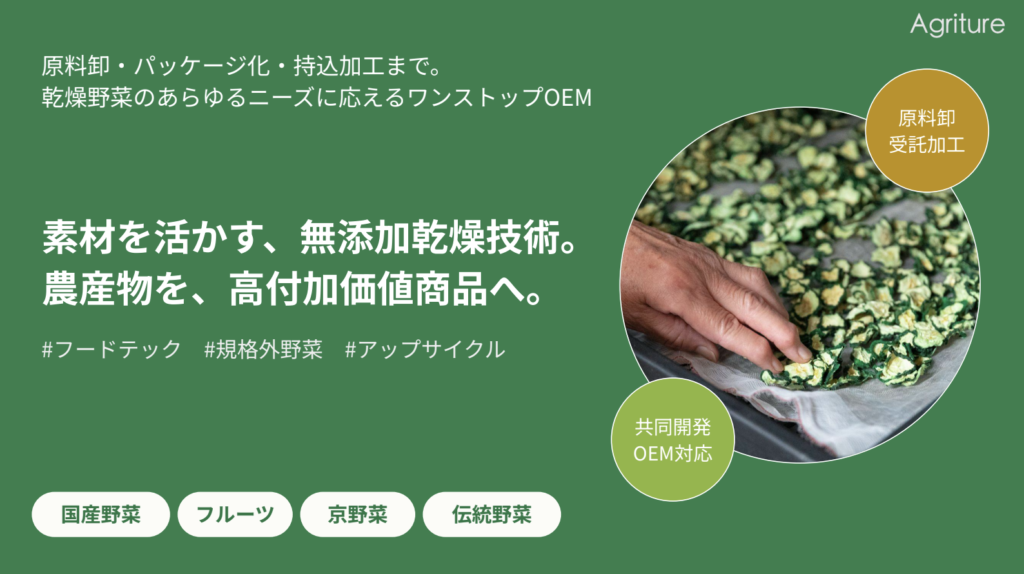
- OEM available from small lots of 10 kg
- Drying of brought-in raw materials also possible
- Support from processing to filling in one place
FAQ
Are there conditions for claiming “Kyoto-grown”?
If some or all of the raw material is produced within Kyoto Prefecture, you can use the label “uses Kyoto-grown XX.” However, to claim the “Kyoto Brand Product” certification, you must meet Kyoto Prefecture's quality standards, producer registration, and contracted-producer conditions. Confirm the labeling conditions against Kyoto Prefecture's system and keep the label consistent with the actual blend.
Can Kyoto vegetables be sourced stably year-round?
Because fresh Kyoto vegetables have a short peak, stable year-round sourcing is difficult. The standard is to secure shelf life through drying, freezing, and vacuum packing, concentrating preparation in the peak season to supply year-round. Agriture works with contract farms in Kyotango to process and stock volume at peak harvest for supply.
Can Kyoto Prefecture subsidies be used for ingredient-processing OEM?
Through the Kyoto Prefecture Industrial Support Center and Kyoto Prefecture chambers of commerce, product-development and capital-investment subsidies for SMEs are available. Product development using Kyoto-grown raw materials tends to be more likely to be selected, and funds can sometimes go toward prototyping, packaging development, and channel development. Using the free consultations with management advisors at municipalities and financial institutions eases the application burden.
Are meetings and audits from Kanto difficult?
Kyoto Station to Tokyo Station is about 2 hours by bullet train, so day-trip audits from Kanto are realistic. Agriture's manufacturing sites are the Kyoto City headquarters plus Kyotango, Nagano, Mie, Ehime, and Okinawa—five sites—and there are cases where Kanto-based meetings and audits combine multiple sites for inspection.
Can we consult Agriture?
Yes. Based in Kyoto and Kyotango, Agriture handles ingredient-processing OEM of Kyoto vegetables, heirloom Kyoto vegetables, and Kyotango produce. Prototyping consultations are possible from a minimum lot of 100 g, and through hybrid operation with allied plants we can scale in stages to certification compliance and mass production. Food OEM no Madoguchi (Agriture) Please consult us.
Summary
Three-line summary
- Kyoto ingredients can be chosen from 8 categories (Kyoto vegetables, matcha, Tanba, seafood, pickles, sake, Japanese confectionery, yuzu)
- Processing techniques come in 6 types: drying, powder, extract, freezing, retort, and fermentation
- Climate, logistics, adjacent industries, and the cluster of food OEM companies are the strengths of Kyoto OEM
The strengths of commissioning ingredient-processing OEM in Kyoto are threefold: access to Kyoto and heirloom vegetables, cultural resources and branding, and the quality-control know-how of regional industry. By combining processing techniques—drying, powdering, extract extraction, blend design—with Kyoto Prefecture's regional ingredients (Kyoto City, Kyotango, Tanba, Yamashiro, Rakusai), and drawing on the basin climate, distribution infrastructure, and the prefecture's support programs, you can differentiate OEM products as a “Kyoto brand.” From its Kyoto City headquarters, Kyotango manufacturing base, and four other regional sites, Agriture has a track record supporting projects for Nissin Foods, Nippon Paper Crecia, ZIGExN, Kai Chefon, and others.
Related article: OEM food manufacturing in Kansai・Food OEM Prototype Cost Reduction・Powder-processing OEM in Kansai. For inquiries about Kyoto ingredient-processing OEM, please see the Food OEM no Madoguchi (Agriture).
Download the OEM contract processing materials
We will send the materials to your email address based on the information you provide.
If you are considering product development with off-spec or your own farm's vegetables:From planning to processing, materials, package printing and novelties, you can consult us through a single point of contact. → Learn more about one-stop product development
FOR BUSINESS
乾燥野菜のOEM・受託加工を承ります
国産の野菜・果物の乾燥、100メッシュ相当までの粉砕、10g以上の小袋充填までをお受けしています。小ロットの試作から量産までご相談ください。寄せられた相談の実例は OEM・卸のご相談 に掲載しています。
乾燥品の賞味期限は、出荷日から6ヶ月程度を目安にご案内しています。
- Creating a regional brand with a Kyoto-vegetable OEM | The complete flow from planning to sales
- Dried Kujo green onion powder | Usage ideas and how to choose it as a food OEM raw material
Author of this article
Related articles
-
 Original coffee marketing strategy | Ways to grow sales
 -
 ベジタリアンとは?国の規格が分けている4つの区分と食べられないもの
 -
 長ねぎと白ねぎは同じもの?ねぎの種類と呼び名を国の資料で確かめる
 -
 柚子の種類は何種類あるのか、公の資料で名前が残る系統を数えた
 -
 ゆずの時期は年に二度、青ゆずは7月から黄ゆずは10月から
 -
 ゆずの産地は高知が半分を占め、二位は徳島から愛媛に変わった
 -
 Preventing Food OEM Failures: Common Failure Cases and Countermeasures for Success
 -
 How to find a food OEM | How to efficiently find the best manufacturing partner