
Freeze-Dried Strawberry Slices | Confectionery Uses by Thickness

Summary of this article
We organize how to use freeze-dried strawberry slices by thickness (2mm/3mm/5mm). It covers uses in chocolate, granola, baked goods, latte art, and drinks; packaging design from commercial to home use; and through to Agriture’s Kyotango-grown adoption patterns.
Freeze-dried strawberry (slice) is a material made by cutting strawberry into a uniform thickness (2–5mm) and then freeze-drying it. It’s thin and easy to use as a topping, and the cross-section pattern remains vivid, so it’s adopted in “surface-showing” products such as chocolate, granola, baked goods, latte art, and premium cereal. It’s more break-resistant than whole and easier to use for visual appeal than dice—an intermediate usability is its feature.
This article organizes the features of the slice type, its use in confectionery and baking, how to choose by thickness (thin / standard / thick), storage methods, and use compared with other shapes. Agriture handles slice processing of Kyotango-grown strawberries from small lots to mass production. Related articles: Commercial freeze-dried strawberries・Whole・diced。

TOC
Features of the Slice Type
The slice type is a thin cut of strawberry sliced lengthwise or crosswise, and even after freeze-drying, the seed and flesh patterns of the cross-section remain as-is. It’s a shape that can create the look of “cut strawberry” as a topping for granola or baked goods.
Strengths of the Slice Type
- The cross-section pattern stands out: You can see the strawberry’s seeds and the striped pattern of the flesh
- Uniform thickness: Gives a stable look as a topping
- Easier to handle than whole: The individual breakage risk is lower, but being thin, it’s weak to surface pressure when stacked (addressed in the packaging design described below)
- Rehydrates in a short time because it’s thin: Floated in milk or yogurt, it can create the effect of absorbing moisture and softening over time
Points to Watch with the Slice Type
- Bends from moisture absorption: Being thin, its crispness drops quickly in high-humidity environments
- Breaks when stacked: Packed into a large bag, it breaks under its own weight, so individual packaging and cushioning are needed
- Color bleeding: When combined with chocolate, pink can transfer to the chocolate side
Use in Confectionery and Baking
Slice shows its strengths in “surface-showing” uses. We organize how to use it by product category.
Selective Use by Thickness
In confectionery and baking, it’s an easy-to-use thickness lineup: 2mm = affixing, 3mm = scattering/mixing in, 5mm = decorating/surface topping.
| Thickness | Main use | Well-suited products |
|---|---|---|
| 2mm (thin) | Affixing inside chocolate, latte art | Tablet chocolate, café menu |
| 3mm (standard) | Topping for granola and cereal | Granola, fruit granola, cereal bar |
| 5mm (thick) | Topping for baked goods, drink garnish | Muffin, scone, fruit tea |
Uses by Category
- Tablet chocolate: Affix 2mm slices to the chocolate surface; the cross-section pattern conveys a premium feel
- Granola, fruit granola: With 3mm slices, the experience of softening over time when milk or yogurt is added
- Cereal bar, protein bar: At 3–5mm, usable for both mixing in and topping
- Baked goods (muffin, scone): Affix 5mm slices to the surface after baking to pitch color and pattern
- Drinks (fruit tea, sparkling): Float 5mm slices for the effect of strawberry rehydrating over time
- Latte art: Top café latte or cappuccino with 2mm slices
- Gift set: Add slices into a dried-fruit mix to brighten the coloring
Points to Watch During Processing
- When combining with high-moisture materials, top just before serving
- When baking, place on the surface after baking (to preserve color and texture)
- When combining with chocolate, take care not to exceed the chocolate’s tempering temperature (28–32°C)
FOR BUSINESS
乾燥いちごを、原料としてお探しですか
国産のいちごを乾燥・粉砕してお出ししています。カット形状や粒度の指定、継続してのお取引もご相談ください。規格は 乾燥いちご に掲載しています。
いちごの少量販売は姉妹ブランドの OYAOYA では取り扱いがありません。ほかの品目はカタログをご覧ください。
Storage Methods and Packaging Design
Because slices are thin, they’re easily affected by moisture absorption, so the storage environment and packaging design are the keys to maintaining quality.
Design for Commercial and Small Portions
Because slices have a large surface area, choosing the wrong packaging size increases breakage from stacking. The principle is to choose a packaging size matched to the amount used per opening.
| Use | Recommended Packaging | Handling After Opening |
|---|---|---|
| Commercial (confectionery factory) | Aluminum-laminate large bag (1–5kg) + oxygen absorber | Portion out in usable amounts; reseal the rest airtight |
| Small factory / shop | Medium bag (200–500g) + silica gel | Open an amount you can use up each day |
| Café / restaurant | Small bag (20–100g) + individual packaging | Open one bag per day |
| Home use / gift | 5–30g individual-portion packs | Offer as single-use |
Check Items for Storage
- Store in an environment of 50% humidity or below (temperature and humidity control in a commercial warehouse)
- Avoid direct sunlight and high temperatures (to prevent pigment fading)
- After opening, put in a fresh oxygen absorber or silica gel and reseal
- When packing slices in stacks, inserting cushioning (such as paper) inside the laminate bag reduces breakage
Use Compared with Other Shapes
Slice shows its strengths in “surface topping” and creating “visual patterns.” Grasping how to use it selectively against whole, dice, and powder means you won’t hesitate in product design.
- Sliced: Surface toppings and showing off a thin cross-section (chocolate, granola, latte art)
- Whole: Three-dimensionality and a premium feel (cake decoration, gifts)
- diced: Mixing into batter, cream, ice cream (keeping a grain feel)
- Powder: Uniform dispersion and coloring (drinks, mousse, cream)
Points When Choosing the Slice Type for OEM
We organize the items to grasp before ordering. Because slices are adopted in products with visual appeal, the design of thickness and packaging directly affects product value.
- Specifying thickness: 2mm (thin) / 3mm (standard) / 5mm (thick)
- Cutting direction: Lengthwise cut (makes the most of the strawberry’s vertical pattern) / crosswise cut (round slices)
- Raw material growing region: Domestic (such as Kyotango) / imported
- Packaging: Commercial large bag / medium bag / small portions / gift individual packaging
- Minimum lot: Prototype 10–50kg to mass production 500kg and up
Adoption patterns in Agriture projects
Cases Agriture often handles with Kyotango-grown strawberry slices include granola and cereal makers, tablet-chocolate brands, café collaboration menus, and premium baked-goods shops. Cases split about evenly between 3mm standard and 5mm thick, and cases designing the balance of flavor and acidity through variety specification (Benihoppe, Akihime) are increasing.
- Staged support from prototype 10–50kg to mass production 500kg and up
- Supports thickness specification of 2mm / 3mm / 5mm
- Direction can be specified as lengthwise or crosswise cut
- Handles both commercial large bags and gift small portions
We have materials available to help you understand dried processing OEM
Agriture OEM, flexibly handling everything from small lots to large lots
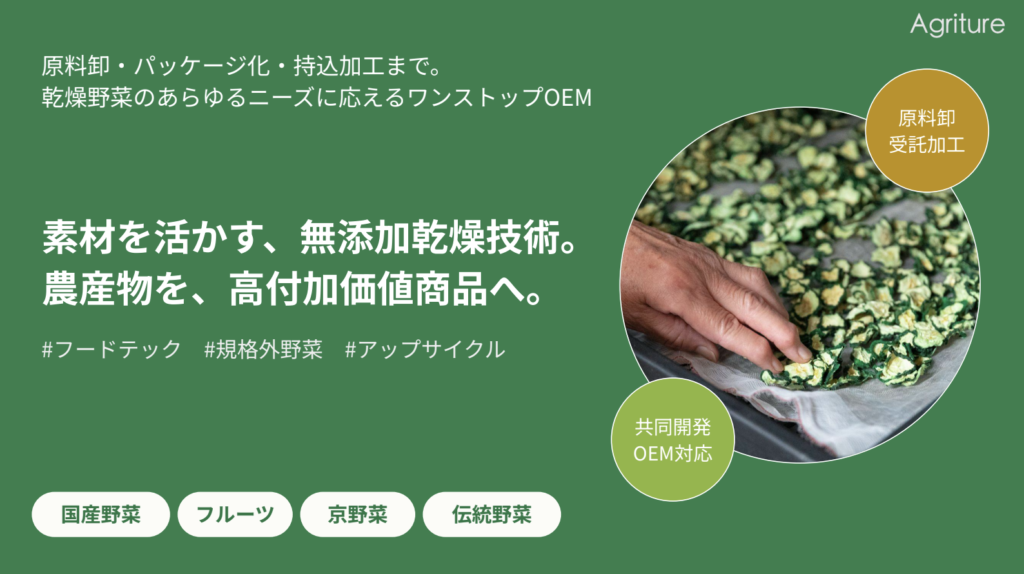
- OEM available from small lots of 10 kg
- Drying of brought-in raw materials also possible
- Support from processing to filling in one place
FOR BUSINESS
乾燥いちごを、原料としてお探しですか
国産のいちごを乾燥・粉砕してお出ししています。カット形状や粒度の指定、継続してのお取引もご相談ください。規格は 乾燥いちご に掲載しています。
いちごの少量販売は姉妹ブランドの OYAOYA では取り扱いがありません。ほかの品目はカタログをご覧ください。
FAQ
How should I choose the slice thickness?
The basics are 2mm for tablet chocolate and latte art, 3mm for granola and cereal, and 5mm for the surface of baked goods and drinks. The thinner it is, the more delicate the look, but the more it breaks, so decide it together with the packaging design.
What should I watch for when mixing into granola?
Because it breaks easily under weight during mass production, add it last when combining with other dried fruit and keep mixing time short. To avoid breakage from impact during bagging, a fill design that distributes it into one or two layers within the bag is effective.
How long does it keep?
The guide is one to two years unopened at room temperature, and one to two months after opening in an environment of 50% humidity or below. Aluminum-laminate packaging combined with an oxygen absorber and silica gel keeps the color and texture longer.
Is it okay to affix to chocolate?
Yes, you can affix it. Temper the chocolate so it doesn’t exceed the tempering temperature (28–32°C), place the slice on the surface, then let it set. For long-distance distribution, coating it over with chocolate also serves as a moisture-absorption countermeasure.
Can I consult about OEM?
We can handle it. Agriture handles slice processing of Kyotango-grown strawberries from prototype 10–50kg to mass production 500kg and up. You can consult on 2–5mm thickness, lengthwise/crosswise cut, and variety specification. Food OEM no Madoguchi (Agriture) Please consult us.
Summary
Freeze-dried strawberry (slice) is the ideal shape for “surface-showing” uses such as chocolate, granola, baked goods, and latte art. Using it selectively by thickness (2–5mm) and suppressing moisture absorption and breakage through packaging design and storage rules lets you create product designs with strong visual appeal.
Related article: Commercial freeze-dried strawberries・Whole・diced・Minimum lot・Processing cost. For OEM consultations, Food OEM no Madoguchi (Agriture).
Download the OEM contract processing materials
We will send the materials to your email address based on the information you provide.
If you are considering product development with off-spec or your own farm's vegetables:From planning to processing, materials, package printing and novelties, you can consult us through a single point of contact. → Learn more about one-stop product development
- A Thorough Comparison of Strawberry Drying Methods: The Characteristics and Uses of Freeze-Drying, Sun-Drying, and the Oven
- Freeze-Dried Strawberry Dice | Kneading Uses in Confectionery and Baking
Author of this article
Related articles
-
 Original coffee marketing strategy | Ways to grow sales
 -
 ベジタリアンとは?国の規格が分けている4つの区分と食べられないもの
 -
 長ねぎと白ねぎは同じもの?ねぎの種類と呼び名を国の資料で確かめる
 -
 柚子の種類は何種類あるのか、公の資料で名前が残る系統を数えた
 -
 柚子の皮の使い道は干すと広がる、果汁と種まで使い切る手順
 -
 ゆずの時期は年に二度、青ゆずは7月から黄ゆずは10月から
 -
 ゆずの産地は高知が半分を占め、二位は徳島から愛媛に変わった
 -
 Preventing Food OEM Failures: Common Failure Cases and Countermeasures for Success