
A list of heirloom vegetables of the 8 prefectures of Kyushu and Okinawa|A thorough introduction to characteristics, growing regions, and seasons

Summary of this article
Across the 8 prefectures of Kyushu and Okinawa are many distinctive heirloom vegetables rooted in each land's climate. This article introduces representative heirloom vegetables from the 8 prefectures in a single list—along with growing region, characteristics, and season—including Fukuoka's katsuo-na and oba shungiku, Saga's aoshima-uri and Ochi takana, Oita's Sorin kabocha, Nagasaki's kibiki kabu, Kagoshima's Satsuma oncho reishi, Kumamoto's Higo vegetables, and Okinawa's goya and shima togarashi. It also explains regional food culture and preservation efforts.
Kyushu and Okinawa are home to many distinctive heirloom vegetables rooted in each land's climate. From visual impact to depth of flavor and the history handed down, each vegetable is packed with regional pride. This article introduces, in a single list, the heirloom vegetables passed down across the 8 prefectures of Kyushu and Okinawa. Carefully explaining their characteristics, growing regions, and seasons, we get up close to the appeal of regional food culture.
TOC
What are Kyushu's heirloom vegetables? Their value and appeal
Kyushu's heirloom vegetables refer to native varieties long grown in each Kyushu prefecture that have adapted to the region's climate and terrain. These are not mere vegetables but a precious "treasure of food" that tells the story of the region's food culture and history.
Selected and fixed in each region over long years, these vegetables have distinctive flavors and shapes unique to their land. Their rich individuality—a cut above the standardized vegetables of today—is their appeal.
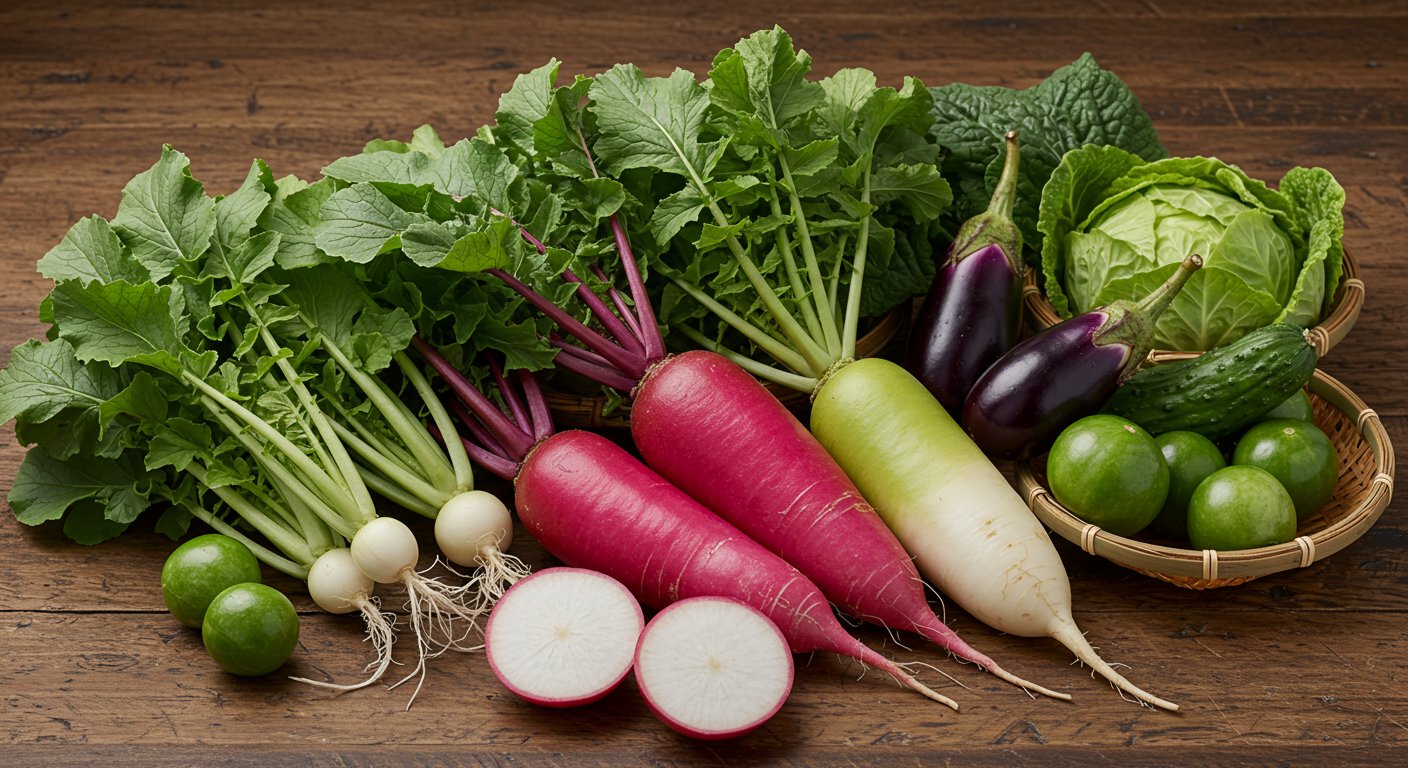
From the high-growth era of the Showa period onward, pushed by the wave of mass production and mass consumption, many heirloom vegetables faced the threat of extinction. But their value has been reappraised, and preservation and succession efforts have become active in each region.
Heirloom vegetables are the vegetables our grandparents ate every day. To know their taste is an important act of understanding regional food culture and carrying it into the future.
The heirloom vegetables Fukuoka is proud of
Fukuoka Prefecture sits in northern Kyushu, an agricultural prefecture blessed with a mild climate and a rich natural environment. Distinctive vegetables have long been grown in this region.
Katsuo-na is a Brassicaceae leafy green grown mainly in Fukuoka Prefecture, resembling takana. Known as an indispensable vegetable in Hakata zoni, it is deeply tied to the region's food culture. Its leaves are tender and flavorful, and their crinkled surface is a distinctive feature. With no pungency and little harshness, it can be used widely in dishes such as ae-mono, pickles, simmered dishes, hot pots, and stir-fries.
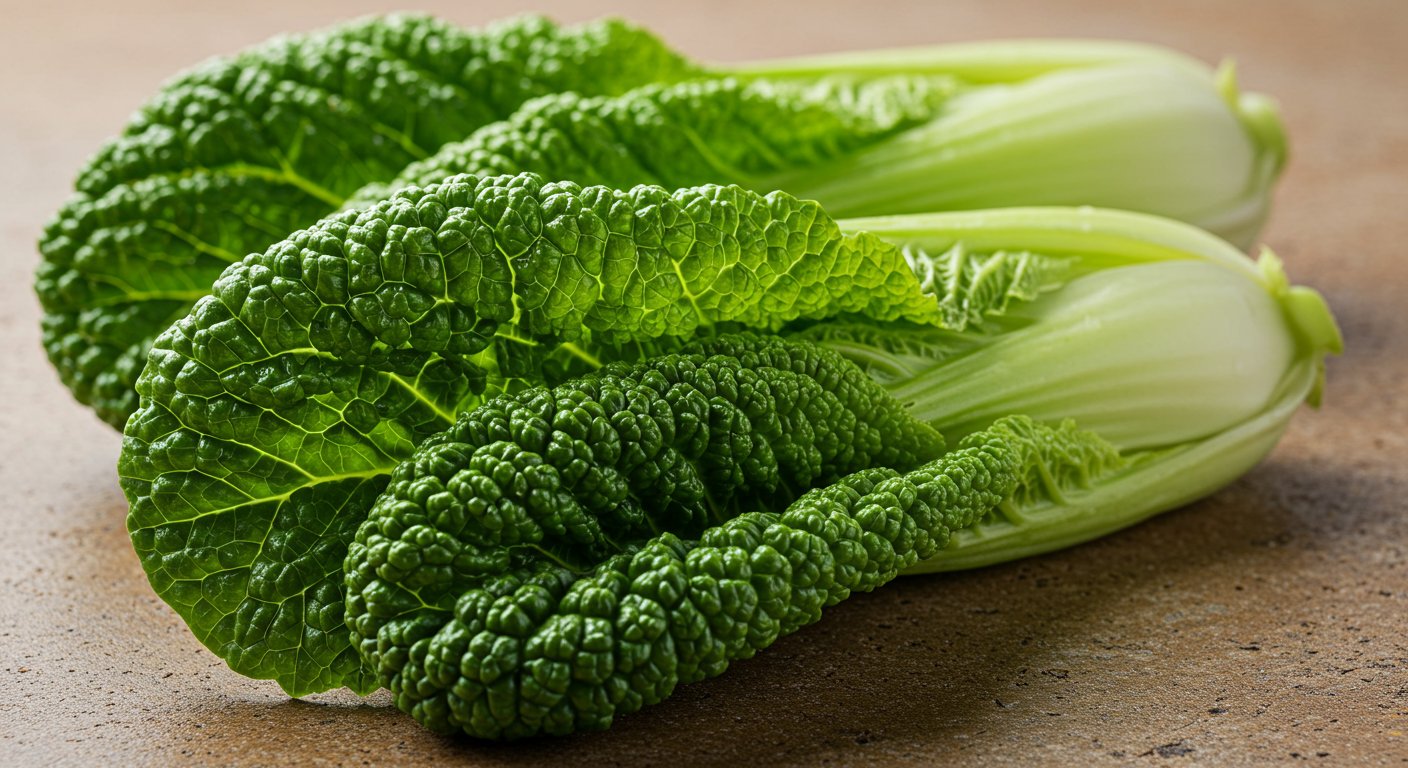
Oba shungiku is a type of shungiku grown in Kokuraminami Ward, Kitakyushu City. Its leaves are rounded, with little harshness or bitterness, and a tender texture is its feature. It is used in a wide range of dishes such as hot pots, soups, and salads.
It has long been beloved locally, but most of its market distribution is limited to within Kitakyushu City, and it is little known even within the prefecture. Branding as "Kokura oba shungiku" is currently being advanced.
Saga's distinctive heirloom vegetables
Saga Prefecture faces the Ariake Sea and is an agricultural prefecture with rich plains. It, too, is home to many heirloom vegetables unique to the region.
Aoshima-uri is a heirloom vegetable grown mainly in Taku City, Saga Prefecture. A natural cross between ao-oshima-uri and makuwa-uri, it has a gray-green skin with silver stripes—a vegetable that is beautiful to look at.
Its flesh is yellowish-green, thick, and dense, with a crisp bite. Used mainly for pickles, the aoshima-uri pickle—aged in sake lees for over a month—is a superb item where you can enjoy the sake-lees aroma and a crunchy bite. It is also popular as a gift.
Ochi takana is a heirloom vegetable long grown mainly in Ochi-cho, Karatsu City, Saga Prefecture, characterized by tender leaves with a moderate pungency and aroma. Highly regarded for pickling, it is commonly eaten locally as salt-pickled or stir-fried in oil. Growers are now decreasing, but for its keeping quality and fine flavor, efforts to preserve the tradition continue.
Have you ever eaten Saga's heirloom vegetables? Their land-specific flavors are worth experiencing at least once.

The distinctive heirloom vegetables of Oita and Nagasaki
Oita and Nagasaki, too, each have distinctive heirloom vegetables. Having supported regional food culture, these vegetables are still carefully protected today.
Oita's Sorin kabocha is a heirloom vegetable said to be Japan's oldest kabocha, produced in Usuki City, Oita Prefecture. With little sweetness and a sticky texture, it can be used in a wide range of dishes—simmered, stir-fried, deep-fried, steamed, soups, and sweets.
Mitori-mame is a type of cowpea long grown in the northern part of the prefecture centered on Usa City, Oita Prefecture. Because only the beans are taken and the pods are not eaten, it is called "mitori" (bean-taking). About the size of an azuki bean, it is black or red and kidney-shaped—that is its feature.
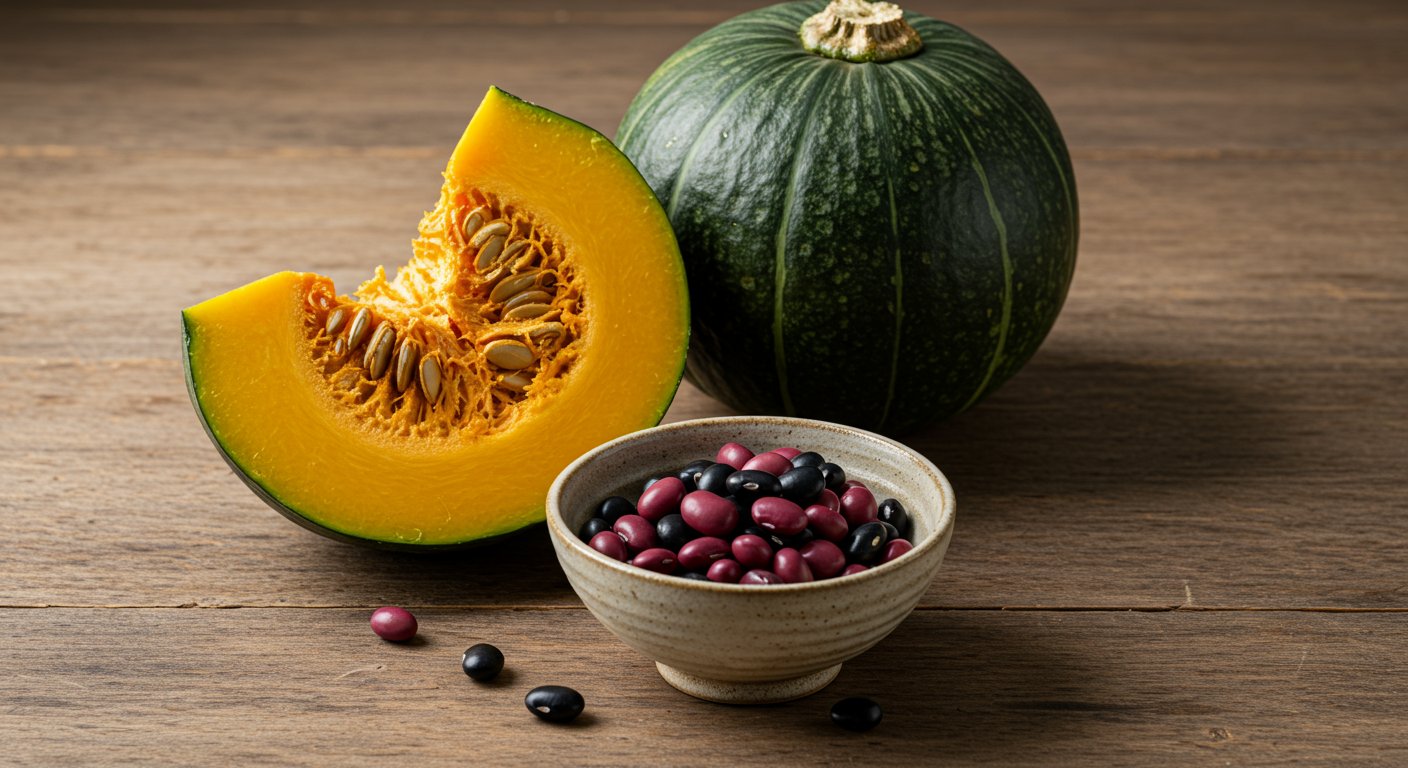
Nagasaki's kibiki kabu has been carefully protected as a heirloom vegetable of Nagasaki Prefecture. Its name is said to come from pulling it out with a wooden pole ("ki") at harvest. With strong sweetness and a juicy texture, it is enjoyed as pickles and simmered dishes.
Aka-daikon is also a heirloom vegetable representative of Nagasaki Prefecture. A type of kabu, it is characterized by a vivid crimson color. Because it is beautiful in color, it is also valued as a garnish for dishes.
Having adapted to the region's climate and soil, these vegetables have a distinctive flavor that only grows in that land. To keep protecting their taste is an important act of passing regional food culture on to the future.
The appeal of Kumamoto's and Kagoshima's heirloom vegetables
Kumamoto and Kagoshima are regions where agriculture that makes the most of a mild climate is thriving. Here, too, distinctive heirloom vegetables are handed down.
Kagoshima's Satsuma oncho reishi is a Kagoshima native variety, a type of bitter melon (nigauri) with a long shape 35–40 cm in length. Its skin is a vivid green, and its flesh is firm with a good bite. High in nutritional value and excelling in aroma and flavor is its feature.
Used mainly in stir-fries and vinegared dishes, in Okinawa and southern Kyushu the oil stir-fry with pork is famous. It is also perfect for oil stir-fries such as goya champuru, juices, and vinegar pickles.
Yamagawa daikon is also a daikon produced in Kagoshima Prefecture, used as an ingredient in the local dish "Yamagawa-zuke." Grown since the Edo period in the Yamagawa area of the southern prefecture, it is designated a "Kagoshima heirloom vegetable" by the prefecture (a designation system).
Kumamoto Prefecture, too, has many heirloom vegetables, and among them especially noteworthy is the series of heirloom vegetables called "Higo vegetables." Kumamoto City is working on branding heirloom vegetables, aiming to raise consumer recognition.
Okinawa's distinctive heirloom vegetables
Okinawa Prefecture has the distinctive environment of a subtropical climate and has nurtured a food culture different from the mainland. Many heirloom vegetables adapted to that climate exist there.
Goya (nigauri) is one of Okinawa's representative heirloom vegetables, characterized by a deep green color and a distinctive bitterness. Its surface has wart-like bumps, and it has firm flesh and a good bite. Used widely in stir-fries and vinegared dishes, goya champuru—stir-fried especially with pork and tofu—is beloved as a standard of Okinawan cuisine. It is also enjoyed in many other ways, such as juice, tempura, and miso stir-fry.
Shima togarashi is a small chili pepper long grown within Okinawa Prefecture, characterized by a round shape about 1 cm in diameter and a strong pungency. "Koregusu," made by steeping it raw in awamori, is widely used as a condiment for Okinawa soba and more. Small yet richly flavored, it is used in stir-fries, pickles, and seasonings—an indispensable presence at the everyday table.
These region-rooted heirloom vegetables are an important part of the food culture handed down together with Okinawa's climate and terrain.
Summary of Kyushu and Okinawa's heirloom vegetables
Kyushu and Okinawa carry on many heirloom vegetables rooted in each region's climate and terrain. Distinctive in size, color, and flavor, they have been enjoyed in a wide range of dishes—simmered, pickled, stir-fried. Each has adapted to its land over long years and has grown up alongside regional life. Through efforts such as cultivation succession, commercialization, and food education, their value continues to be reappraised today.
Heirloom vegetables are an irreplaceable part of a food culture that carries regional memory into the future.
Our company operates Okinawa's island vegetables We handle dried vegetables made from them, of course, and also carry out dry-processing of other heirloom vegetables. If you are interested in product development or novelty goods using heirloom vegetables, please feel free to contact us.
Reference
National Institute of Agrobiological Sciences Genebank "Native Variety Database" (accessed: 2025/08/06),https://www.gene.affrc.go.jp/databases-traditional_varieties.php
Japan Heirloom Vegetable Promotion Association "Japan's Heirloom Vegetables – 40. Fukuoka Prefecture" (accessed: 2025/08/06), https://tradveggie.or.jp/traditional-vegetables-prefecture/40-fukuoka/#i-6
Japan Traditional Vegetables Promotion Association, "Japan's Heirloom Vegetables – 41. Saga Prefecture" (accessed: 2025/08/06), https://tradveggie.or.jp/traditional-vegetables-prefecture/41-saga/#i-7
Japan Heirloom Vegetable Promotion Association "Japan's Heirloom Vegetables – 42. Nagasaki Prefecture" (accessed: 2025/08/06), https://tradveggie.or.jp/traditional-vegetables-prefecture/42-nagasaki/
Japan Heirloom Vegetable Promotion Association "Japan's Heirloom Vegetables – 43. Kumamoto Prefecture" (accessed: 2025/08/06), https://tradveggie.or.jp/traditional-vegetables-prefecture/43-kumamoto/
Japan Heirloom Vegetable Promotion Association "Japan's Heirloom Vegetables – 44. Oita Prefecture" (accessed: 2025/08/06), https://tradveggie.or.jp/traditional-vegetables-prefecture/44-ooita/
Japan Heirloom Vegetable Promotion Association "Japan's Heirloom Vegetables – 47. Okinawa Prefecture" (accessed: 2025/08/06), https://tradveggie.or.jp/traditional-vegetables-prefecture/47-okinawa/
Kagoshima Prefecture "Kagoshima's Heirloom Vegetables" (accessed: 2025/08/07), https://www.pref.kagoshima.jp/sangyo-rodo/nogyo/nosanbutu/dentou/index.html
Recommended reading
Heirloom vegetables from across Japan / Heirloom vegetables of Japan / Commercial dried vegetables / Sustainable initiatives / Drying processing service
List of representative varieties from the 8 prefectures of Kyushu and Okinawa
| Prefecture | Representative varieties | Features | Season |
|---|---|---|---|
| Fukuoka | Hakata banno negi, katsuo-na | Standards for condiments and zoni | Year-round / winter |
| Saga | Kaseno tea, Shiroishi renkon | Fertile soil along the Ariake Sea coast | Spring / autumn |
| Nagasaki | Unzen kobu takana, Nagasaki aka-kabu | Tied to pickle culture | Winter |
| Kumamoto | Suizenji-na, Aso takana | The volcanic soil of Aso | Year-round / spring |
| Oita | Seki aji-na, kabosu | A culture of citrus and condiments | Autumn |
| Miyazaki | Hyuga kabocha, Sadowara nasu | Fruiting vegetables grown in a mild climate | Summer |
| Kagoshima | Sakurajima daikon, lotus root for karashi renkon | Root vegetables of volcanic-ash soil | Winter |
| Okinawa | Shima rakkyo, goya, shima kabocha | Subtropical native varieties | Spring to summer |
Frequently asked questions (FAQ)
We have materials available to help you understand dried processing OEM
Agriture OEM, flexibly handling everything from small lots to large lots
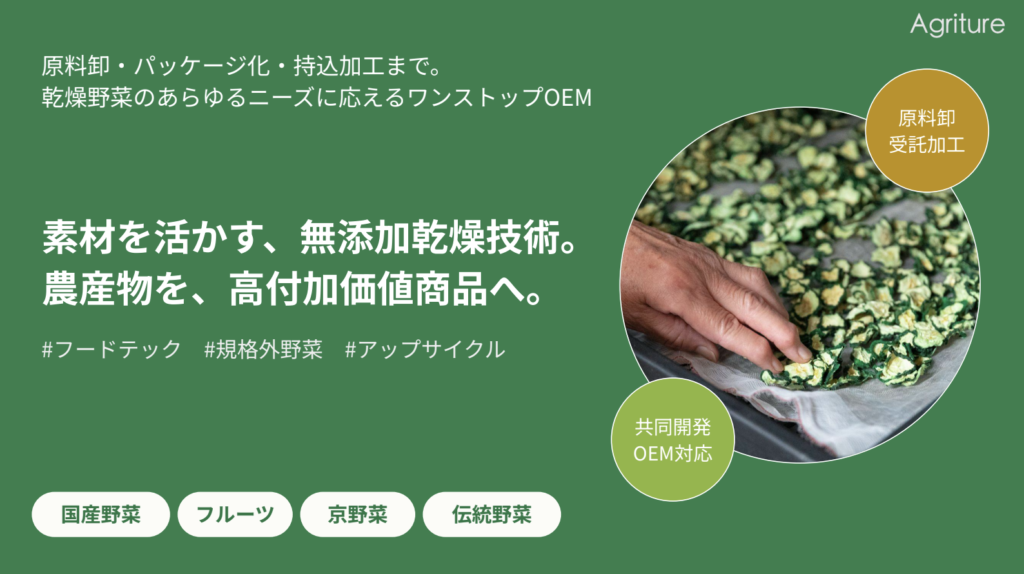
- OEM available from small lots of 10 kg
- Drying of brought-in raw materials also possible
- Support from processing to filling in one place
Download the OEM contract processing materials
We will send the materials to your email address based on the information you provide.
- Kyoto heirloom vegetables: Kyoto specialties with a long history
- Know the heirloom vegetables of Edo Tokyo | The city’s vanishing food culture
Author of this article
Related articles
-
 Okinawa island vegetables: individualistic vegetables nurtured by a subtropical climate
 -
 Kaga vegetables: Kanazawa brand vegetables where tradition lives on
 -
 The appeal of Kansai heirloom vegetables | Specialties of Naniwa, Kyoto, and Yamato thoroughly explained
 -
 Kyoto heirloom vegetables: Kyoto specialties with a long history
 -
 Know the heirloom vegetables of Edo Tokyo | The city’s vanishing food culture
 -
 They'll make you smile! The fun names of heirloom vegetables and their origins
 -
 5 cases and strategies that succeeded in branding heirloom vegetables
 -
 What is the regional character of heirloom vegetables? The tastes and stories handed down across the land