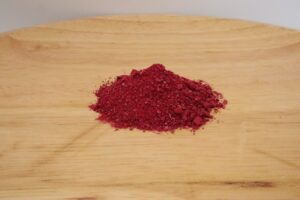
Ooba Powder

Custom-size handling (cut-thickness changes, shape adjustment): consultation available for orders of 10 kg or more Dried Ooba and makes it into powder by adding a pulverizing process.
Oba (green shiso) powder is a raw material made by drying and then finely milling oba (green shiso). For applications such as furikake, Japanese-style dressings, cold-pasta tossing powder, and Japanese-seasoning blends, it is intended to spread the refreshing aroma unique to oba uniformly through dough and powders. Oba is a green leaf of the genus Perilla in the Lamiaceae family, and the main aroma component is an essential-oil component called perillaldehyde. Because you can blend in the aroma without the trouble of chopping the leaf, it suits the design of dried foods and powder seasonings that are hard to handle with fresh leaves. At Agriture, It is distinct from red shiso; oba, unlike the red shiso used for umeboshi, refers to green shiso. The color changes through drying and milling from vivid green to a somewhat subdued green, but within a Japanese-style white dough or dressing, the green graininess stands out. Similar in aroma direction,and Green Onion Powder myoga powder Sudachi powder combined with the citrus-type
TOC
lets you design the powder formulations of condiment-type furikake and Japanese-style seasonings all at once. Specifications can be refined from small quantities.
Agriture's oba powder: three points of commitment
1. Drying design that preserves the oba-like aroma
Oba's appeal is the refreshing aroma derived from perillaldehyde. The aroma components are heat-sensitive, and the way the aroma rises changes with drying conditions. At Agriture, we control the temperature range and operate under conditions that preserve the fresh aroma characteristic of oba. We also control the frictional heat during milling, aiming for a finish where the aroma does not dissipate too much. Blend prototyping across application genres is possible.
2. Choose the particle size to match the application
Even with the same oba powder, the suitable particle size differs between applications where you want to keep graininess, like furikake, and applications where you want it to dissolve in, like dressings and seasonings. We can refine it through consultation on the particle-size direction — coarse milling for furikake and toppings, fine powder for Japanese-style dressings and powder seasonings. We accommodate particle-size adjustment to match the application.
3. Uses domestically grown oba as the raw material
Product catalog showing the items we handle
Flexible support from small lots to large lots
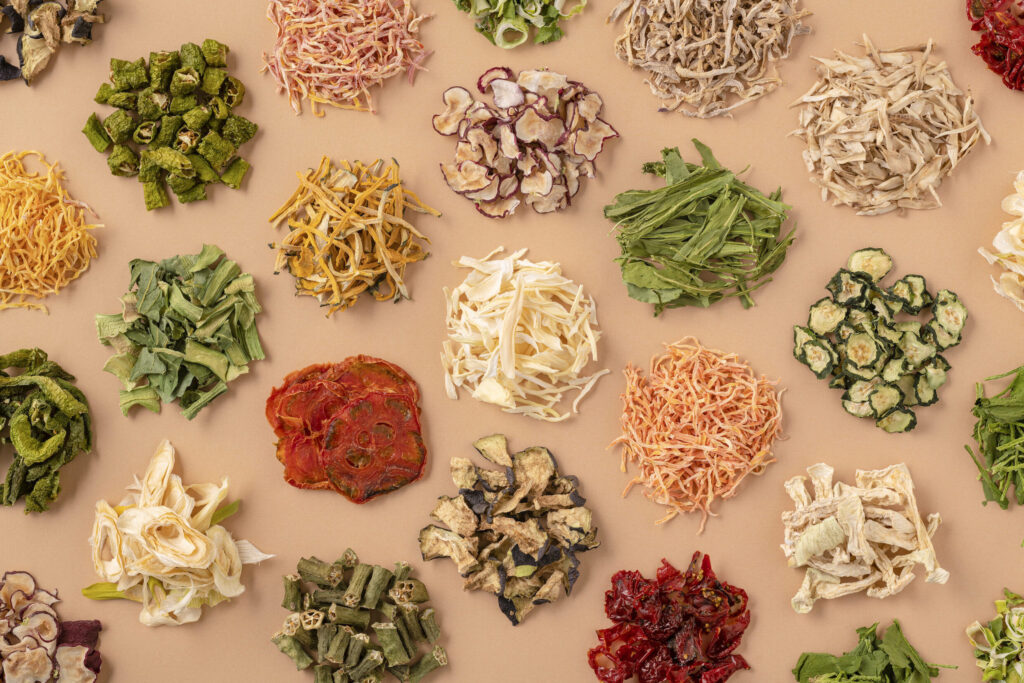
- Sold in small lots from 1 kg
- Handling heirloom vegetables from across Japan
- Dried fruits and herbs also supported
The raw material uses domestically grown oba. We accept it while checking the leaf condition and moisture content, and powder it after confirming the balance of aroma and green color. Oba — which has constraints on shelf life and handling as a fresh leaf — becomes easier to develop into room-temperature-distributed dried foods and powder seasonings by turning it into powder.
Features of commercial oba powder
Fine milling opens up the application area of "uniform blending into powders and liquids" that chopped oba or dried oba cannot reach. We organize the strengths unique to oba powder from six perspectives.
Concentrates oba's refreshing aroma
The fresh aroma characteristic of oba is concentrated in the powder. With a small amount blended, you can add the outline of an oba-like aroma to furikake, Japanese-style dressings, and cold-pasta tossing powder. It is an ingredient that lets you build a stable aroma into your design without the trouble of chopping fresh leaves.
Green particles that stand out in white dough
Oba's green color becomes a natural accent within a white furikake base, shirodashi-type dressings, and pasta tossing powder. The color changes through drying and milling to a somewhat subdued green, but mixed into a Japanese-style pale-colored base it finishes with the green graininess standing out.
Accommodates condiment and Japanese-style blends
By pre-blending with myoga, green onion, sudachi, and yuzu-type powders, you can design condiment furikake, Japanese-style seasonings, and tossing-powder bases from a single raw-material supplier. Use that combines Japanese aromatic ingredients all together is possible.
Choose particle size by application
Use together with the ingredient-shape version
You can choose the particle-size direction — coarse milling for applications where you want to keep graininess, like toppings, and fine powder for applications where you want it to dissolve in, like dressings and powder seasonings. A design easy to develop into multiple finished products from a single ingredient. Dried Ooba For applications where you want to make use of the leaf shape,
and for applications where you want to spread the aroma uniformly, powder — you can use them accordingly. Visual presence and uniform aroma blending can both be achieved with the same ingredient, oba.
Develop into room-temperature-distributed dried foods
Product specifications (commercial)
The basic specifications at the prototype stage are as follows. Procurement lots, delivery dates, and packaging forms for mass production and OEM are settled through individual consultation.
| Item | Details |
|---|---|
| Product name | Ooba Powder |
| Raw material | Fresh oba has constraints on shelf life and handling, but the powder is a dried raw material that can be handled at room temperature. It becomes easier to incorporate into product designs premised on room-temperature distribution — furikake, powder seasonings, attached seasonings for dried noodles, and the like. |
| Shape | Fine powder (leaves dried and ground) |
| Appearance | Oba (green shiso, domestically grown) |
| Aroma | A subdued green fine powder |
| Net content | Individual quote according to use and lot |
| Best-before date | About 6 months from the shipping date |
| Storage method | Avoid high temperature, high humidity, and direct sunlight; after opening, seal and store in a cool, dark place |
| Minimum prototype lot | 5kg〜 |
| Main production lot | On consultation |
Customization support
| Item | Available | Details |
|---|---|---|
| Particle-size adjustment | The refreshing aroma characteristic of oba | Coarse to fine powder |
| Blend design | Adjusted so furikake keeps graininess and dressings/powder seasonings dissolve in | Pre-mixing of Japanese-condiment powders |
| Packaging form | From commercial bulk to small bags | Light-blocking aluminum bags, sticks and small bags, individual wrapping, and the like |
| OEM productization | End-to-end handling through the final product | Mixing at specified ratios with myoga, green onion, sudachi, and yuzu types |
| Raw material supply | Own raw materials + contract processing | We also handle contract drying and grinding at a specified growing region |
Furikake, Japanese-style dressing, tossing powder, Japanese-style seasoning, etc.
For those who want to make use of the leaf shape (raw-material-form version)
Commitments to variety, grower, and growing region
→ See dried oba details
BRAND
Oba is a green leaf of the genus Perilla in the Lamiaceae family, also called green shiso. It is distinct from the red shiso used in umeboshi; a feature is that the leaf is green and the refreshing quality of the aroma is strong. The main aroma component is an essential-oil component called perillaldehyde, and the strength of the aroma and the softness of the leaf change with variety, harvest timing, and growing method. As a powder raw material, we select based on the way the aroma rises and the balance of green color.
PRODUCER
Partnering with contract growing regions, we accept raw material after sharing guidelines for variety, harvest timing, and leaf condition. We record the raw-material lots and use them to reproduce aroma and color tone in mass production.
REGION
At Agriture, using domestically grown oba as the raw material, we manage everything from drying through milling and packaging consistently. Our basic policy is a finish that retains the refreshing aroma characteristic of oba.
CULTIVATION
Oba is a crop for which facility cultivation is thriving nationwide, including Aichi Prefecture. We maintain a system that can accommodate year-round stable supply of raw material by relaying between growing regions.
Powdering technology and quality control
Aroma retention and particle-size control
We procure raw material mainly through greenhouse cultivation, preparing for seasonal fluctuations. Accepting it by the guides of leaf softness and aroma strength, we ensure reproducibility in the powdering process.
Oba's aroma components are heat-sensitive and prone to dissipating during the drying and milling process. We control the temperature range and operate under conditions that remove moisture while preserving the refreshing aroma characteristic of oba. We also control the frictional heat during milling, aiming for a finish where the powder does not become too hot. Because you can choose the particle-size direction from coarse to fine to suit the application, we can handle everything from furikake toppings to dissolving into dressings.
Packaging and distribution design
Because oba powder absorbs moisture easily, we prioritize moisture-proofing and light-blocking in the packaging. Commercial bulk uses light-blocking aluminum bags, and small bags and sticks use moisture-proof, light-blocking film — a specification we propose with in-store and warehouse storage in mind. Unlike fresh oba, it can be handled at room temperature, making it an ingredient easy to incorporate into the distribution design of dried foods and powder seasonings.
TIPS: Formulation guidelines for making the most of oba powder
Use cases
When using it in furikake, a 5–10% blend of the base powder weight gives a good balance of oba aroma and green graininess. In Japanese-style dressing, a 0.5–1% share of the total is a guide, and the aroma rises even within oil or vinegar. For cold-pasta tossing powder, a 3–5% share combined with salt and kombu-dashi types is easy to use, adding an oba-like refreshing quality. In Japanese-style seasonings, combined with myoga, green onion, and citrus types, allotting oba at 20–30% is a range where a condiment-like balance is easy to strike.
Furikake and toppings
Because the powder disperses uniformly in powders and liquids, it opens up applications that chopped oba or dried oba cannot reach. We organize the applications we are often consulted about.
For furikake, mixed-rice bases, and onigiri toppings that make use of oba's aroma and green graininess. It suits the design of condiment furikake combined with myoga, green onion, and sesame types.
Japanese-style dressings and sauces
For oba dressing, Japanese-style sauces, sauce for hiyayakko, and the like. The aroma rises even within oil or vinegar, and finishing it into a fine powder lets it dissolve in without leaving a texture on the tongue.
Tossing powder for cold pasta and tossed noodles
For tossing powder for cold pasta, somen, hiyashi chuka, and the like. Blended with salt and kombu-dashi types, it finishes into a Japanese-style flavor with oba's refreshing quality added.
Japanese-style seasonings and condiments
Confectionery / bread-making
For oba salt, oba-flavored Japanese-style seasonings, and powder seasonings. Combined with citrus powders of the sudachi and yuzu type, you can design a seasoning that brings Japanese aromatics together.
Beverages and smoothies
For uses kneaded into the dough of cookies, arare, and Japanese-style snacks. The green color and oba aroma become an accent for Japanese-conscious baked goods and rice crackers.
For flavoring Japanese-taste drinks and smoothies. Because it is a powder it is easy to measure, an ingredient that makes it easy to design formulations with suppressed lot-to-lot aroma variation.
Blending basics
- Commercial usage and blending tips
- Because it is an ingredient whose aroma rises, first check the balance of taste and aroma from a small blend
- Choose coarse milling that keeps graininess for furikake and toppings, and fine powder that dissolves in for dressings and seasonings
When there is a heating step, adjust the blend amount anticipating aroma loss
- Blend compatibility
- Combined with condiment types such as myoga and green onion, it adds depth to the flavor of Japanese-style furikake
- Combined with citrus types such as sudachi and yuzu, it finishes into a refreshing Japanese-style seasoning
How to store
- Store in a cool, dark place at room temperature, avoiding high heat, humidity, and direct sunlight
- Combined with sesame and kombu-dashi types, it is easy to develop into a tossing powder for rice and noodles
- Take the best-before date as a guide of roughly six months from the shipping date
Related ingredients and articles
- Dried Ooba: Raw material that keeps the leaf shape
- It is distinct from red shiso; oba, unlike the red shiso used for umeboshi, refers to green shiso. The color changes through drying and milling from vivid green to a somewhat subdued green, but within a Japanese-style white dough or dressing, the green graininess stands out. Similar in aroma direction,: A blend partner of the condiment type
- Green Onion Powder: The aroma of Japanese-style furikake
- Sudachi powder: The citrus for Japanese-style seasonings
- Vegetable powder list: a list of the powders we handle
Product catalog showing the items we handle
Flexible support from small lots to large lots
- Sold in small lots from 1 kg
- Handling heirloom vegetables from across Japan
- Dried fruits and herbs also supported
Frequently asked questions
How do dried oba (with leaf shape) and powder differ in use?
Dried oba is a type that keeps the leaf shape, suited to applications where you want to make use of appearance and presence — rolled items, garnishes, toppings. The powder, being finely milled, suits applications where you want to spread oba's aroma uniformly — furikake, Japanese-style dressings, tossing powder, powder seasonings. Using both together lets you achieve both visual presence and uniform aroma blending.
Are oba and red shiso different?
Oba is a green shiso, also called green shiso, distinct from the red shiso used in umeboshi and the like. Both are of the genus Perilla in the Lamiaceae family, but oba has green leaves and a refreshing aroma as its features. The oba powder on this page uses green shiso as the raw material. Powder made from red shiso is handled separately, so please consult us according to your application.
What happens to color and aroma?
Through the drying and milling process, the color changes from vivid green to a somewhat subdued green. Within a white furikake base or Japanese-style dressing, the green graininess becomes a natural accent. The main aroma component is an essential-oil component called perillaldehyde, and because it is heat-sensitive, we design to retain the aroma by adjusting the drying and milling conditions. For products with a heating step, we recommend adjusting the blend amount anticipating aroma loss.
Can the particle size be chosen?
You can choose the particle-size direction to suit the application. For applications where you want to keep graininess, like furikake and toppings, coarse milling; for applications where you want it to dissolve in, like Japanese-style dressings and powder seasonings, fine powder — we accommodate such adjustments. If you share the finished product you are aiming for, we refine the suitable particle size through consultation.
Can it be pre-blended with other Japanese-style powders?
Yes. We accommodate pre-blending with Japanese-style powders that pair well among condiment and citrus types, such as myoga, green onion, sudachi, and yuzu types. If you share the formulation you are aiming for in the finished product — condiment furikake, Japanese-style seasonings, tossing-powder bases, and so on — we handle everything from mixing to bagging at that ratio.
What is the minimum prototype lot?
Prototyping is accepted from 5 kg. For mass production and OEM, we propose a quote and delivery timeline individually. You can consult us all the way through to finished products such as furikake, Japanese-style dressings, tossing powder, and Japanese-style seasonings.
Please tell me the best-before date and how to store it.
The best-before date is about 6 months from the shipping date. Because oba powder absorbs moisture easily and the aroma also dissipates readily, store the unopened product away from high temperature, high humidity, and direct sunlight, in a cool, dark place at room temperature. After opening, transfer it to a sealed container and use it up within 1–2 months as a guide.
Recommended reading
- Dried oba – raw material that keeps the leaf shape
- Myoga powder – a condiment-type partner
- Green onion powder – the aroma of Japanese-style furikake
- Sudachi powder – the citrus for Japanese-style seasonings
- Consultations for commercial and OEM use
Download the product catalog
We will send the materials to your email address based on the information you provide.