
What are Ehime’s heirloom vegetables? Features, season, and ways to eat the 11 items organized by the association (Iyo hikabura, kinukawa eggplant, Shimizu issun) explained

Ehime Prefecture's heirloom vegetables are a group of varieties handed down within the terrain of the Matsuyama Plain, Saijo on the Seto Inland Sea coast, Nanyo along the Uwa Sea, and the mountainous area of the Shikoku Mountains (Kumakogen Town) — including wild perennials such as teiregi. The Japan Traditional Vegetable Promotion Association organizes 11 heirloom vegetables of Ehime Prefecture.
We introduce varieties handed down in Iyo — the deep-crimson Iyo hi-kabura, Sho daikon with a red-purple neck, the kinukawa nasu of Saijo, Matsuyama's fava bean “Shimizu issun,” Iyo City's beautifully crimson-purple nishiki ingen, and teiregi, the condiment vegetable of Takai-cho, Matsuyama.
TOC
The definition of "heirloom vegetable" and the scope of this article
| Certifying body | Main criteria |
|---|---|
| Kyoto Prefecture "Kyoto Heirloom Vegetables" | Cultivation history predating the Meiji era, covering the entire prefecture |
| Osaka Prefecture "Naniwa Heirloom Vegetables" | Cultivated within Osaka Prefecture from roughly 100 or more years ago |
| Nagano Prefecture "Shinshu Heirloom Vegetable Certification System" | Cultivation, food culture, and varietal traits from before the 1955–1964 period |
| Ehime Prefecture | The prefecture operates frameworks such as “Hometown Farm Products.” A “heirloom vegetable” certification system unique to the prefecture was unconfirmed at the time of writing |
In this article, we introduce all 11 Ehime Prefecture varieties organized by the Japan Traditional Vegetables Promotion Association.
Ehime's Heirloom Vegetables: A List of 11 Varieties
| # | Item | Category | Main growing region | Season |
|---|---|---|---|---|
| 1 | Iyo hi-kabura | Kabu (deep-crimson oblate) | Ishii, Takai, Horie, Hojo, Matsuyama City | Late October– |
| 2 | Sho daikon | Daikon (red-purple neck, white flesh) | Matsuyama City | December to March |
| 3 | Ozu imo | Satoimo (parent taro edible) | Ozu City | December– |
| 4 | Kumakogen Town native “ji-imo” | Potato (small, yellow) | Kumakogen Town | Throughout the prefecture |
| 5 | Kinukawa nasu | Eggplant (large ovoid, thin skin) | Saijo City | June to October |
| 6 | Matsuyama naga nasu | Eggplant (nakate–late long type) | Minami-Iyo, Iyo City; Hojo district; Shusso district; Masaki Town; Toon City, and others | Summer (detailed timing limited) |
| 7 | Shimizu issun | Fava bean (heritage variety; current mainstay is “Ryosei issun”) | Matsuyama City (Hisae, Yodo, Ono districts, and others; Shimizu-cho is the heritage introduction site) | Early–late May |
| 8 | Nishiki ingen | Common bean (crimson-purple markings) | Iyo City (former Nakayama Town, Iyo District) | June–September |
| 9 | Murasaki naga oba takana | Leafy vegetable (takana type) | Within the prefecture (specific growing-region info limited) | Late November–late March |
| 10 | Teiregi | Condiment vegetable (wild) | Takai-cho, Matsuyama City | Year-round |
| 11 | Kumakogen Town native “ji-kyuri” | Cucumber (stubby and thick) | Kumakogen Town | (seasonal info limited) |
A product catalog that shows around 100 items we handle
Agriture, flexibly handling everything from small lots to large lots
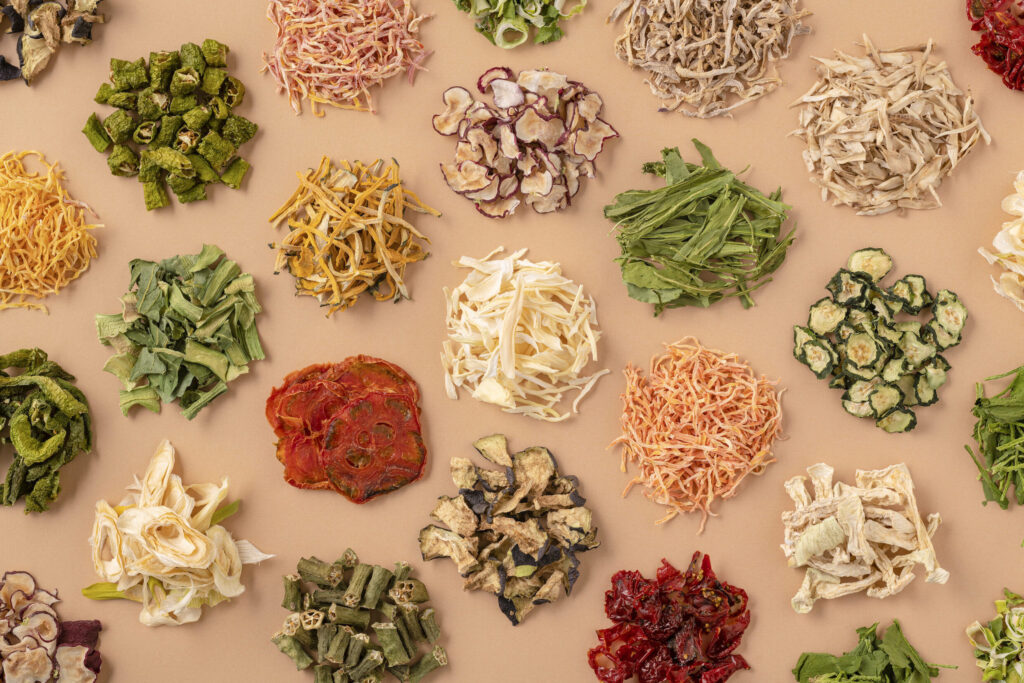
- Available for purchase in small lots from 1 kg
- We handle heirloom vegetables from across Japan
- Dried fruit and herbs also supported
FOR BUSINESS
乾燥野菜を業務用でお探しですか
国産の野菜・果物を乾燥し、必要に応じて粉砕してお出ししています。扱っている品目は100種前後で、規格は 乾燥品の一覧・パウダーの一覧 に掲載しています。
少量でのご購入は、姉妹ブランドの通販サイト OYAOYA で承っています。
The Characteristics and Ways to Eat 7 Main Ehime Heirloom Vegetables
Iyo Hi-Kabura — Matsuyama's Deep-Crimson Oblate Kabu
| Season | Late October– |
| Growing region | Ishii, Takai, Horie, Hojo, Matsuyama City |
| Well-suited dishes | Vinegar pickles, asazuke, salad, hi-kabura pickles |
Iyo hi-kabura is an oblate native kabu grown in Ishii, Takai, Horie, and Hojo of Matsuyama City, distinguished by a deep-crimson appearance. Vinegar-pickled, its crimson color develops, and it has been handed down as a local pickling ingredient.
Used to color vinegar pickles and asazuke, it also works as an accent of color in salads. In season from late October into winter, it circulates at JA farm stands in Matsuyama City.
Sho Daikon — The Matsuyama Daikon with a Red-Purple Neck
| Season | December to March |
| Growing region | Matsuyama City |
| Well-suited dishes | Simmered dishes, grated daikon, pickles, salads |
Sho daikon is a native daikon handed down for about 150 years in Matsuyama City (the former Sho district of Hojo City), its variety name deriving from the former Sho district of Hojo City, its growing region (Japan Traditional Vegetables Promotion Association). Its strong points are a red-purple neck, white flesh, and fine-grained flesh. Pickled, the red-purple of the neck develops into pink, and it can also be used for color when cooking.
Used in simmered dishes, grated, pickles, and salad, it ships in season December–March from farm stands in Matsuyama City.
Kinukawa Nasu — Saijo's Broad-Shouldered Large Ovoid Eggplant
| Season | June to October |
| Growing region | Saijo City |
| Well-suited dishes | Dengaku, grilled eggplant, agebitashi, simmered dishes |
Kinukawa nasu is a native eggplant grown in Saijo City, distinguished by a broad-shouldered large ovoid shape and thin skin. Because the skin is thin, the melting texture of the flesh comes alive in dengaku, grilled eggplant, and deep-fried and marinated dishes.
In season June–October, it circulates at JA farm stands in Saijo City.
Shimizu Issun — Matsuyama's Heritage Fava Bean
| Season | Early–late May |
| Growing region | Matsuyama City (Hisae, Yodo, Ono districts, and others; Shimizu-cho is the heritage introduction site) |
| Well-suited dishes | Boiled with salt, bean rice, tempura, soup |
Shimizu issun is a heritage fava bean handed down in Matsuyama City (Hisae, Yodo, Ono districts, and others). As seed-saving farmers advanced selection for large-grained seeds, the proportion of two-bean pods rose and the appearance came to look inferior, so it has now shifted to fixed three-bean-pod varieties such as “Ryosei issun” and “Uchikoshi issun” (Japan Traditional Vegetables Promotion Association). Its strong points are the fluffy texture and rich bean flavor unique to large grains.
Salt-boiling is a way to enjoy the bean's own flavor, and it also suits mame-gohan, tempura, and soup. It ships for a short period in early–late May at JA farm stands in Matsuyama City.
Nishiki Ingen — Iyo City's Crimson-Purple-Marked Common Bean
| Season | June–September |
| Growing region | Iyo City (former Nakayama Town, Iyo District) |
| Well-suited dishes | Simmered dishes, salad, dressed dishes, bento color |
Nishiki ingen is a native common bean grown in Iyo City (former Nakayama Town, Iyo District), its strong point a distinctive appearance with crimson-purple markings on the pod and seeds. It is a regional variety used for color in simmered dishes and salads.
It is used in a wide range of dishes — simmered dishes, dressed dishes, salads.
Teiregi — The Wild Condiment Vegetable of Takai-cho, Matsuyama
| Season | Year-round |
| Growing region | Takai-cho, Matsuyama City |
| Well-suited dishes | Condiment, soba garnish, sashimi garnish |
Teiregi is a wild condiment vegetable found at spring-water sites in Takai-cho, Matsuyama City, its formal name “oba tanetsukebana (Cardamine scutata).” A perennial of the bittercress genus in the brassica family, it is distinguished by fragrance and a sharp pungency (Japan Traditional Vegetables Promotion Association). Locally it has been handed down as a condiment for dishes.
Used as a condiment for soba and sashimi, it is a plant seen year-round, but its cultivation and distribution are limited, and it is a variety often gathered around the spring-water sites of Takai-cho, Matsuyama City.
Ozu Imo — The Parent-Taro-Edible Satoimo with Little Earthy Smell
| Season | December– |
| Growing region | Ozu City |
| Well-suited dishes | Simmered dishes, dengaku, imo-ni, fukumeni |
Ozu imo is a satoimo grown in Ozu City, distinguished by little earthy smell and the fact that even the parent taro can be eaten. A native taro-line variety, its texture comes alive in simmered dishes, dengaku, and imo-ni.
Shipping begins in December, and it circulates at JA farm stands in Ozu City.
Other Varieties
| Item | Growing region | Features |
|---|---|---|
| Matsuyama naga nasu | Minami-Iyo, Iyo City; Hojo; Shusso district; Masaki Town; Toon City, and others | A nakate–late long eggplant, a Matsuyama native variety whose production area grew from the Minami-Iyo district of Iyo City (JA Zennoh Ehime) |
| Kumakogen Town's ji-imo | Kumakogen Town | A small potato with yellow skin and flesh, strongly sticky and resistant to crumbling |
| Kumakogen Town's ji-kyuri | Kumakogen Town | A native variety with a thick, stubby shape (detailed information limited) |
| Murasaki naga oba takana | Within the prefecture (specific growing-region info limited) | A takana-type leafy vegetable in season late November–late March |
A product catalog that shows around 100 items we handle
Agriture, flexibly handling everything from small lots to large lots
- Available for purchase in small lots from 1 kg
- We handle heirloom vegetables from across Japan
- Dried fruit and herbs also supported
FOR BUSINESS
乾燥野菜を業務用でお探しですか
国産の野菜・果物を乾燥し、必要に応じて粉砕してお出ししています。扱っている品目は100種前後で、規格は 乾燥品の一覧・パウダーの一覧 に掲載しています。
少量でのご購入は、姉妹ブランドの通販サイト OYAOYA で承っています。
FAQ
Summary
Ehime's heirloom vegetables are 11 varieties handed down centered on the Matsuyama Plain in Iyo City, Saijo City, Ozu City, Kumakogen Town, and elsewhere. From the red-purple-hued Iyo hi-kabura and Sho daikon, to the summer vegetables kinukawa nasu and Matsuyama naga nasu, the beans Shimizu issun and nishiki ingen, the taros Ozu imo and ji-imo, the leafy vegetables teiregi and murasaki naga oba takana, and the native ji-kyuri — a varied lineup gathers by region.
References / information sources
- Japan Traditional Vegetables Promotion Association, “Ehime Prefecture”
- National Agriculture and Food Research Organization Genebank "Native Variety Database"
Related articles
- Heirloom vegetables of Japan
- Heirloom vegetables of Kagawa
- Heirloom vegetables of Tokushima
- Yamaguchi's Heirloom Vegetables
- Heirloom vegetables of Hyogo
Download the product catalog
We will send the materials to your email address based on the information you provide.
- What are Kagawa’s heirloom vegetables? Features, season, and ways to eat the 12 items organized by the association (kintoki carrot, Mitoyo eggplant, manba) explained
- What are Kochi’s heirloom vegetables? Features, season, and ways to eat the 32 varieties organized by the association (Irikauchi daikon, Hirooka turnip, shihochiku) explained
Author of this article
Related articles
-
 Okinawa island vegetables: individualistic vegetables nurtured by a subtropical climate
 -
 Kaga vegetables: Kanazawa brand vegetables where tradition lives on
 -
 The appeal of Kansai heirloom vegetables | Specialties of Naniwa, Kyoto, and Yamato thoroughly explained
 -
 Kyoto heirloom vegetables: Kyoto specialties with a long history
 -
 A list of heirloom vegetables of the 8 prefectures of Kyushu and Okinawa|A thorough introduction to characteristics, growing regions, and seasons
 -
 Know the heirloom vegetables of Edo Tokyo | The city’s vanishing food culture
 -
 They'll make you smile! The fun names of heirloom vegetables and their origins
 -
 5 cases and strategies that succeeded in branding heirloom vegetables