
What are Shimane’s heirloom vegetables? Features, season, and ways to eat the 9 items listed by the association (including Tsuda turnip and Kuroda seri) explained

Shimane Prefecture's heirloom vegetables are varieties handed down centered on the brackish lakeshores of Lake Shinji and Nakaumi, the Izumo plain, and the Chugoku Mountains. In Shimane Prefecture's official materials, those clearly positioned as native varieties are mainly "Tsuda kabu" and "Kuroda seri," while many of the others include regional brands and locally bred varieties developed in later years. The Japan Traditional Vegetable Promotion Association organizes 9 items as regional items of Shimane, and this article explains those 9 items including their origins and positioning.
We introduce Shimane's native varieties and regional items spanning Matsue, Izumo, and Iwami, including the reddish-purple, magatama-shaped Tsuda kabu; Izumo orochi daikon with a bite that shoots up the nose; Matsue's Aika gobo; Shussai shoga of Hikawa-cho, Izumo City; Kuroda seri of Kuroda-cho, Matsue City; Ochi nabe-negi of Onan-cho, Ochi District; Kuen-imo of Ono-cho, Matsue City; and Hamabofu of Yatsuka-cho, Matsue City (Izumo orochi daikon in 2011 and Ochi nabe-negi in 2008 are relatively new regional varieties bred within Shimane Prefecture).
TOC
The definition of "heirloom vegetable" and the scope of this article
There is no nationwide unified definition of “heirloom vegetables,” and criteria differ by certifying body. We lay out the criteria of the main certifying bodies.
| Certifying body | Main criteria |
|---|---|
| Kyoto Prefecture "Kyoto Heirloom Vegetables" | Has a cultivation history from before Meiji and covers the whole prefecture (includes bamboo shoots, excludes mushrooms and ferns, and includes extinct items) |
| Osaka Prefecture "Naniwa Heirloom Vegetables" | Cultivated within Osaka Prefecture from roughly 100 or more years ago |
| Nara Prefecture "Yamato Heirloom Vegetables" | Production in this prefecture confirmed from before the war; distinctive cultivation method, flavor and aroma, form, and provenance characteristics |
| Nagano Prefecture "Shinshu Heirloom Vegetable Certification System" | Provenance, food culture, variety traits (provenance from before the 1955-1965 period) |
| Shimane Prefecture | No heirloom-vegetable certification system of the prefecture's own. JA Shimane and each municipality support regional branding |
Of the 9 Shimane items organized by the Japan Heirloom Vegetable Promotion Association, this article covers 8 vegetable items in the main text. "Unshu ninjin," a medicinal-ginseng (Korean ginseng) type with a use different from food, is introduced separately in the "Other regional specialty varieties" section at the end of the article.
What are Shimane's heirloom vegetables? The food culture of Lake Shinji, Izumo, and Iwami
| Area | Representative items | Regional characteristics |
|---|---|---|
| Matsue (eastern Izumo) | Tsuda kabu, Aika gobo, Kuroda seri, Kuen-imo, Hamabofu | The brackish lakeshores of Lake Shinji and Nakaumi, and the Matsue castle town |
| Izumo (Izumo plain) | Izumo orochi daikon, Shussai shoga | The Izumo plain and the Hii River basin |
| Iwami (Ochi) | Ochi nabe-negi | The mountainous area of the Chugoku Mountains |
Divided into the three regions of Matsue, Izumo, and Iwami, native varieties concentrate around Lake Shinji and the Matsue castle town. It is an item composition reflecting history and terrain: the Tsuda district, which has continued since the Edo period as the Matsue domain's kitchen garden; the condiment-type items of the Izumo plain; and the winter leek of the Chugoku Mountains' mountainous area.
Quick-reference table of 8 items
| # | Item | Category | Main growing region | Season |
|---|---|---|---|---|
| 1 | Tsuda kabu | Kabu (magatama-shaped, reddish-purple) | Higashi-Tsuda-machi and the Tsuda district, Matsue City, and elsewhere | Harvest mid-November, "hade-boshi" late November to December |
| 2 | Izumo orochi daikon | Daikon (pungent) | Izumo City | Late November to early March |
| 3 | Aika gobo | Burdock | Aika and Ono, Matsue City | November–May |
| 4 | Shussai shoga | Ginger | Shussai, Hikawa-cho, Izumo City | Throughout the prefecture |
| 5 | Kuroda seri | Sannai seri | Kuroda-cho, Matsue City | November–March |
| 6 | Ochi nabe-negi | Negi | Onan-cho, Ochi District | December to January |
| 7 | Kuen-imo | Taro | Ono-cho, Matsue City | Autumn to winter |
| 8 | Hamabofu | Bofu (Apiaceae) | Yatsuka-cho, Matsue City | April–May (flower buds late May to early June) |
A product catalog that shows around 100 items we handle
Agriture, flexibly handling everything from small lots to large lots
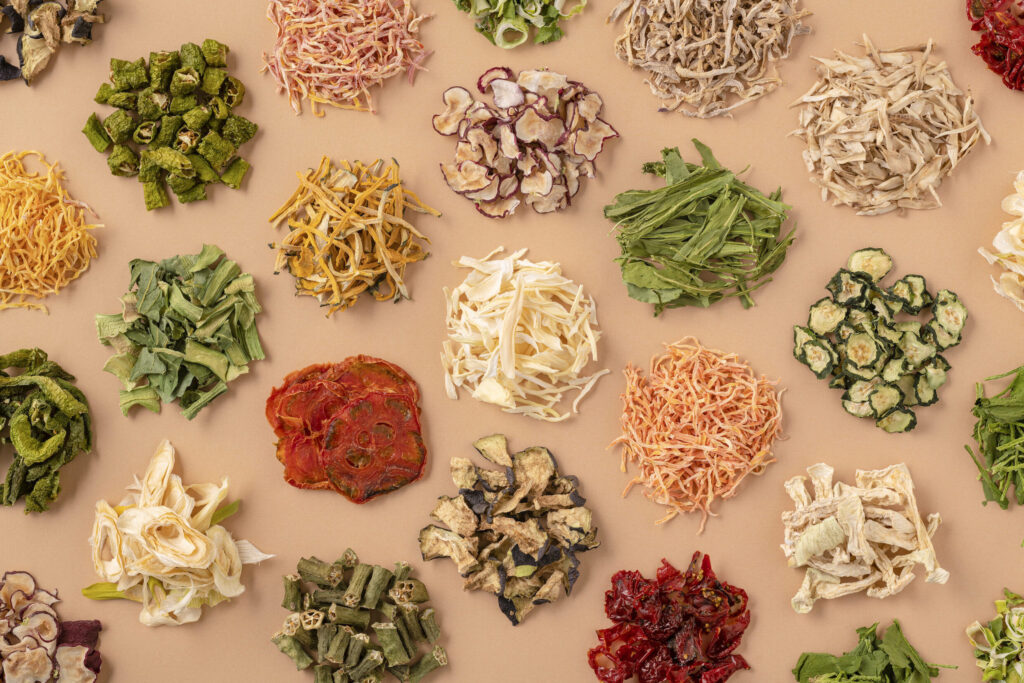
- Available for purchase in small lots from 1 kg
- We handle heirloom vegetables from across Japan
- Dried fruit and herbs also supported
FOR BUSINESS
乾燥野菜を業務用でお探しですか
国産の野菜・果物を乾燥し、必要に応じて粉砕してお出ししています。扱っている品目は100種前後で、規格は 乾燥品の一覧・パウダーの一覧 に掲載しています。
少量でのご購入は、姉妹ブランドの通販サイト OYAOYA で承っています。
The characteristics and preparation of 7 representative Shimane heirloom vegetables
Of the 8 items, we take up 7 representative ones by recognition and distribution volume (Hamabofu, whose shipping period is limited to the short span of spring to early summer, is omitted from this section and introduced in the list table).
Tsuda kabu — the magatama-shaped reddish-purple kabu and "hade-boshi" culture
| Season | Harvest mid-November, "hade-boshi" late November to mid- and late December |
| Growing region | Higashi-Tsuda-machi and the Tsuda district, Matsue City, and elsewhere |
| Well-suited dishes | Tsuda kabu pickles (nuka and salt pickling is the full pickle), asazuke, simmered dishes |
Tsuda kabu is a native kabu characterized by a shape like the "magatama," one of the three sacred treasures of Izumo mythology, reddish-purple on the upper part and white on the lower—a two-tone. It is said that in the late Edo period, at Tsuda village (the present Tsuda district of Matsue City), which was the Matsue domain's kitchen garden, the dedicated farmer Tachihara Monbei carried out variety improvement, and via "Monbei kabu" the name settled into today's "Tsuda kabu." The original lineage is said to be the Hino-na kabu brought in from Omi (present-day Shiga Prefecture) during sankin-kotai.
Harvest begins in mid-November, and from late November to mid- and late December it undergoes "hade-boshi," hung to dry for about a week on rice-drying racks called "hade," then "Tsuda kabu pickles," fully pickled with nuka and salt, become a winter preserved food of Matsue. Some also circulate as asazuke. It is a representative Shimane traditional food listed even in the Ministry of Agriculture, Forestry and Fisheries' "Nippon Traditional Food Encyclopedia."
Izumo orochi daikon — a pungent daikon with a bite that shoots up the nose
| Season | Late November to early March |
| Growing region | Izumo City |
| Well-suited dishes | Oroshi, condiment for Izumo soba, asazuke |
Izumo orochi daikon is a pungent daikon that Shimane University bred from Shimane-grown hama-daikon (beach daikon), registered as a variety in 2011. Named after the Yamata-no-Orochi legend, it has a strong bite that shoots up the nose as its hallmark. Used as a condiment for Izumo soba, the way of adding the grated-and-squeezed juice to the soba dipping sauce has taken hold.
In season late November to early March, it is distributed at JA farm stands and roadside stations within Izumo City.
Aika gobo — Matsue's aromatic burdock
| Season | November–May |
| Growing region | Aika district and Ono district, Matsue City |
| Well-suited dishes | Kinpira, simmered dishes, tempura, soups |
Aika gobo is a burdock grown in the Aika and Ono districts of Matsue City, with rich aroma and a tender texture as its hallmarks. Grown in the hard clay soil of Lake Shinji's northern shore, it is distributed as a local brand item. Its season is long, from November through the following May.
Its aroma comes to the fore in kinpira, simmered dishes, and tempura, and even in soups you can enjoy the tenderness of its flesh. It is distributed at JA farm stands within Matsue City.
Shussai shoga — the refreshing new ginger of the Izumo plain
| Season | Throughout the prefecture |
| Growing region | Shussai, Hikawa-cho, Izumo City |
| Well-suited dishes | Sweet-vinegar pickling, condiment, tsukudani, sushi gari |
Shussai shoga is a ginger grown in the Shussai district of Hikawa-cho, Izumo City, characterized by little fiber and a combination of a refreshing aroma and a sharp bite. Grown in the sandy loam of the lower Hii River basin under a mild climate, it is distributed as a local brand.
As sweet-vinegar pickles and sushi gari, its string-less smooth mouthfeel comes to the fore. It also suits tsukudani and use as a condiment, and it ships from JA farm stands and processors within Izumo City.
Kuroda seri — the aromatic seri of Kuroda-cho, Matsue
| Season | November–March |
| Growing region | Kuroda-cho, Matsue City |
| Well-suited dishes | Seri nabe, ohitashi, ae-mono, zoni |
Kuroda seri is a native seri grown in Kuroda-cho, Matsue City, with a crisp texture and superb aroma as its hallmarks. It is used as an ingredient in winter to early-spring hot pots and in Matsue's zoni. Grown by making use of repurposed paddy land and spring water, it ships over the long span from November to March.
In seri nabe the root, too, keeps a crisp texture, and in ohitashi and ae-mono its aroma comes to the fore. It ships from JA farm stands within Matsue City in winter.
Ochi nabe-negi — the winter white leek of Onan-cho
| Season | December to January |
| Growing region | Onan-cho, Ochi District |
| Well-suited dishes | Hot pot, sukiyaki, grilled negi, soups |
Ochi nabe-negi is a white leek born in 2008 in Onan-cho, Ochi District, with sweetness and tenderness as its hallmarks. It is a regional item grown under the cool climate of the mountainous Onan-cho in the Chugoku Mountains.
As the name suggests, it is a hot-pot white leek, and heating spreads a melting sweetness. In its season of December–January, it is distributed at JA farm stands within Onan-cho.
Kuen-imo — the cold-hardy taro of Matsue
| Season | Autumn to winter |
| Growing region | Ono-cho, Matsue City |
| Well-suited dishes | Simmered dishes, imo-ni, koromo-katsugi, dengaku |
Kuen-imo is a native taro grown in Ono-cho, Matsue City, characterized by strong cold-hardiness and little harshness. Matsue's farmers have long protected it by saving their own seed, and it has been used as a winter preserved ingredient.
Its texture comes into its own in simmered dishes and imo-ni, and its own flavor can be enjoyed in dengaku and koromo-katsugi too. It is a rare item sometimes carried at farm stands in Ono-cho, Matsue City.
How to buy Shimane's heirloom vegetables and tips for storing them
| Item | Main sources | Timing |
|---|---|---|
| Tsuda kabu | JA farm stands within Matsue City; processed goods (Tsuda kabu pickles) year-round | November–December |
| Izumo orochi daikon | JA farm stands and roadside stations within Izumo City | Late November to early March |
| Aika gobo | JA farm stands in Matsue City | November–May |
| Shussai shoga | JA farm stands and processors in Hikawa-cho, Izumo City | Throughout the prefecture |
| Kuroda seri | JA farm stands within Matsue City | November–March |
| Ochi nabe-negi | JA farm stands in Onan-cho, western Shimane Prefecture | December to January |
| Kuen-imo | Farm stands in Ono-cho, Matsue City | Autumn to winter |
| Hamabofu | Growers around Yatsuka-cho, Matsue City; JA direct-sales markets; roadside stations | April–May (flower buds late May to early June) |
Mail order / hometown tax to outside the prefecture
- Tsuda kabu pickles — Distributed year-round through Matsue City hometown-tax donations and processor mail order
- Izumo orochi daikon — Shipped in winter as an Izumo City hometown-tax donation gift
- Shussai shoga — Summer-autumn-only through Hikawa-cho, Izumo City hometown-tax donations and processed-goods mail order
- Processed products — Tsuda kabu pickles, Shussai shoga tsukudani, Hamabofu processed goods, and the like are distributed
A product catalog that shows around 100 items we handle
Agriture, flexibly handling everything from small lots to large lots
- Available for purchase in small lots from 1 kg
- We handle heirloom vegetables from across Japan
- Dried fruit and herbs also supported
Efforts to protect Shimane's heirloom vegetables
| Efforts | Details |
|---|---|
| Traditional-food certification of Tsuda kabu pickles | Listed in the Ministry of Agriculture, Forestry and Fisheries' "Nippon Traditional Food Encyclopedia" |
| JA Shimane Kunibiki's Tsuda kabu brand | Distributes the Tsuda kabu of Higashi-Tsuda-machi and the Tsuda district of Matsue City as a regional brand |
| The medicinal brand of Unshu ninjin | Distributes the native medicinal ginseng of the Irie district, Yatsuka-cho, Matsue City, nationwide |
| Support for the succession of regional ingredients | Each region's JA and local governments support the production and sale of native varieties |
FOR BUSINESS
乾燥野菜を業務用でお探しですか
国産の野菜・果物を乾燥し、必要に応じて粉砕してお出ししています。扱っている品目は100種前後で、規格は 乾燥品の一覧・パウダーの一覧 に掲載しています。
少量でのご購入は、姉妹ブランドの通販サイト OYAOYA で承っています。
FAQ
Other regional specialty varieties
It is included in the Japan Heirloom Vegetable Promotion Association's list, but we introduce separately the medicinal-ginseng-type item, which is not a food vegetable.
| Item | Category | Growing region | Features |
|---|---|---|---|
| Unshu ninjin | Medicinal ginseng (Araliaceae Korean ginseng type) | Irie district, Yatsuka-cho, Matsue City | A medicinal ginseng that takes about 6 years to grow. With a high saponin content, its use differs from that of food vegetables |
Summary
Shimane's regional items number 9 in total: 8 vegetable items (Tsuda kabu, Izumo orochi daikon, Aika gobo, Shussai shoga, Kuroda seri, Ochi nabe-negi, Kuen-imo, Hamabofu) plus the medicinal-ginseng-type Unshu ninjin. Shimane Prefecture's official stance positions "Tsuda kabu" and "Kuroda seri" centrally as native varieties, with the rest including regional brands and locally bred varieties developed in later years. It is an item composition where history and terrain overlap: the Tsuda district that developed as the Matsue domain's kitchen garden, the pungent daikon nurtured in the land of Izumo mythology, and the winter leek carried on in the Chugoku Mountains.
Shimane-grown native varieties circulate by season: Shussai shoga in summer-autumn; Tsuda kabu, Izumo orochi daikon, Aika gobo, and Kuroda seri in autumn-winter; Kuen-imo and Ochi nabe-negi in winter; and Hamabofu in spring. Making use of hometown-tax donations, farm stands, and processed-goods mail order lets you taste the food culture of Matsue, Izumo, and Iwami at home.
References / information sources
- Japan Heirloom Vegetable Promotion Association "Shimane Prefecture"
- Ministry of Agriculture, Forestry and Fisheries "Nippon Traditional Food Encyclopedia: Tsuda kabu pickles"
- JA Shimane Kunibiki "Tsuda kabu"
- National Agriculture and Food Research Organization Genebank "Native Variety Database"
Related articles
- Heirloom vegetables of Japan
- Kyoto Heirloom Vegetables
- Tottori's heirloom vegetables (including sand-dune rakkyo and Hakushu bijin)
- Heirloom vegetables of Hyogo
- Omi's heirloom vegetables (including Hino-na kabu)
- Shinshu's heirloom vegetables (including nezumi daikon)
Download the product catalog
We will send the materials to your email address based on the information you provide.
- What are Tottori’s heirloom vegetables? Features, season, and ways to eat the 4 items (including GI-registered sand-dune rakkyo and Hakushu bijin) explained
- What are Okayama’s heirloom vegetables? Features, season, and ways to eat the 12 varieties (including GI Tsurajima burdock and Bizen black-skin kabocha) explained
Author of this article
Related articles
-
 Okinawa island vegetables: individualistic vegetables nurtured by a subtropical climate
 -
 Kaga vegetables: Kanazawa brand vegetables where tradition lives on
 -
 The appeal of Kansai heirloom vegetables | Specialties of Naniwa, Kyoto, and Yamato thoroughly explained
 -
 Kyoto heirloom vegetables: Kyoto specialties with a long history
 -
 A list of heirloom vegetables of the 8 prefectures of Kyushu and Okinawa|A thorough introduction to characteristics, growing regions, and seasons
 -
 Know the heirloom vegetables of Edo Tokyo | The city’s vanishing food culture
 -
 They'll make you smile! The fun names of heirloom vegetables and their origins
 -
 5 cases and strategies that succeeded in branding heirloom vegetables