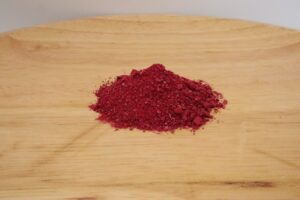
Myoga powder

Myoga powder is a raw material made by drying and finely milling domestically grown myoga, intended to spread the distinctive refreshing aroma and pale pink color of myoga uniformly through somen, hiyayakko, fish dishes, Japanese-style dressings, and seasonings. The flavor of fresh myoga — which is heavily constrained by season and shelf life — is finished into a form usable as a powder throughout the year. At Agriture, Dried myoga (a type that keeps the shape) — we powder it from the same raw material with an added fine-milling step.
Because you can substitute the powder directly for how you use myoga as a condiment, it extends broadly to flavor accents in Japanese-style menus — seasoning for somen dipping sauce, hiyayakko toppings, finishing fish dishes, and more. Prototyping is accepted from 1 kg of raw material.
TOC
Agriture's myoga powder: three points of commitment
For myoga powder, the retention of aroma components and pink color development determine the quality. At Agriture, we manage everything from drying through milling and packaging in-house at our processing facility, aiming for a finish that preserves myoga's characteristic freshness.
1. Low-temperature processing that does not let the aroma components escape
Myoga's refreshing aroma derives from terpenes such as α-pinene and is highly volatile, so it is influenced by the processing conditions. By finishing at a low temperature range from the raw-material drying stage and operating the milling step under conditions that suppress heat generation, we aim for a level where the refreshing aroma characteristic of myoga rises the moment the bag is opened. We also accommodate pre-delivery of composite blends such as condiment powder for somen dipping sauce and topping mixes for hiyayakko.
Product catalog showing the items we handle
Flexible support from small lots to large lots
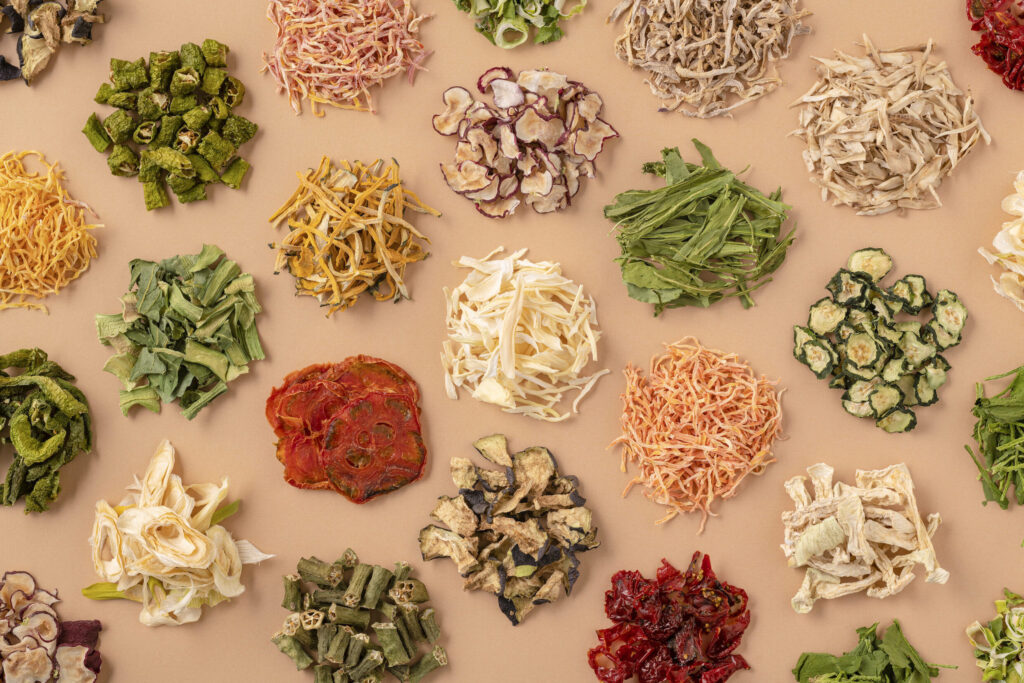
- Sold in small lots from 1 kg
- Handling heirloom vegetables from across Japan
- Dried fruits and herbs also supported
Features of commercial myoga powder
A distinctive refreshing aroma
The refreshing aroma derived from terpenes is concentrated, spreading a Japanese-condiment flavor uniformly through somen dipping sauce, hiyayakko, and fish dishes.
Pale pink color development
The anthocyanin-type pigment contained in myoga's flower spike remains in the powder as a faint pink. It also works as a color accent for Japanese-style seasonings.
Dispersibility in liquids and powders
Disperses uniformly in soups, dressings, and mayonnaise. It enables a use — "dissolving in only the aroma" — that is difficult with fresh myoga.
Year-round supply available
Fresh myoga is only distributed during the limited period from early summer to autumn, but as a powder it can be supplied as a raw material usable year-round. It suits year-round development of seasonal menus.
Use together with the ingredient-shape version
For applications where you want to keep the texture, dried myoga; for applications where you want to spread the aroma uniformly, powder — you can use them accordingly.
Product specifications (commercial)
The basic specifications at the prototype stage are as follows. Procurement lots, delivery dates, and packaging forms for mass production and OEM are settled through individual consultation.
| Item | Details |
|---|---|
| Product name | Myoga powder |
| Raw material | Myoga (domestically grown) |
| Shape | Fine powder (dried and ground) |
| Appearance | Pale pink to beige fine powder |
| Aroma | The refreshing aroma characteristic of myoga, with a faint pungency |
| Net content | Individual quote according to use and lot |
| Best-before date | About 6 months from the shipping date |
| Storage method | Avoid high temperature, high humidity, and direct sunlight; after opening, seal and store in a cool, dark place |
| Processing plant | Our own processing plant within Kyoto Prefecture |
| Minimum prototype lot | From 1 kg of raw material |
Customization support
| Item | What we support |
|---|---|
| Proportion adjustment | Myoga alone / premix with salt / Japanese-condiment blend |
| Blend design | Pre-blend prototyping with sansho, yuzu peel, sudachi peel, red shiso, and green shiso |
| Packaging form | Commercial bulk, sticks and small bags, spice jars, canisters, and more |
| OEM productization | End-to-end handling through condiment mixes, seasonings, dressings, and mentsuyu ingredients |
| Raw material supply | In addition to our own raw material, we also handle contract drying and grinding with a specified growing region and specified variety |
For those who want to make use of the shape (raw-material-form version)
For somen ingredients, hiyayakko toppings, ingredients for takikomi rice, and the like, applications that make use of myoga's shape and texture are best served by dried myoga (a type that keeps the shape). The crisp presence of myoga that powder cannot deliver comes through.
Commitments to variety, grower, and growing region
Myoga is a perennial of the genus Zingiber in the Zingiberaceae family, and what is eaten is mainly the flower spike (hana-myoga) and young stem (myoga-take). As a Japan-native condiment vegetable, it has long been used in Japanese cuisine and medicinal diets.
Main growing region
| Growing region | Features |
|---|---|
| Kochi Prefecture | Japan's largest myoga growing region. Greenhouse cultivation supports year-round shipping |
| Nara Prefecture | Open-field summer myoga is mainstream. Strong aroma |
| Akita Prefecture | A growing region for autumn myoga. Large grains and deep color development |
| Kyoto Prefecture | Small-scale cultivation as a Kyoto vegetable. Accommodates distinctive raw materials |
Using lineages by purpose
Summer myoga has a sharp aroma, suited to condiments and seasonings; autumn myoga has large grains and deep color and aroma, making it well suited to powdering. Flower spike and myoga-take differ in flavor character, and we can also accommodate part-specific prototyping — powder from the flower spike only, powder that includes the stem portion, and so on.
Powdering technology and quality control
For myoga powder, the retention of aroma components and color stability determine the quality. At Agriture, we manage everything from drying through milling and packaging consistently.
Milling conditions that do not let the aroma escape
Because myoga's aroma components are terpenes and highly volatile, we adjust the milling lot size, rotation speed, and rest time, operating under conditions that keep the powder temperature low. By moving it promptly to sealed, light-blocking packaging after milling, we maintain a quality where the aroma rises upon opening.
Preserving the pink color
Because the anthocyanin pigment in the flower-spike portion fades readily with heat, temperature control in the drying and milling steps directly affects color quality. By raising the proportion of flower spike when preparing the raw material, it is also possible to adjust the powder's color development to be deeper.
Light-blocking, sealed packaging
Because both aroma and color degrade with light and moisture, commercial bulk uses light-blocking aluminum bags, and small bags and sticks use light-blocking film — a specification we propose with in-store and warehouse storage in mind.
TIPS: Formulations that make the most of myoga powder
When using it in mentsuyu or hiyayakko, 0.3–0.5 g per 100 ml of liquid is a guide. In dressings, adding 0.5–1% per 100 g of oil and vinegar gives a faint spread of myoga aroma. When blending it with sansho and yuzu peel as a condiment mix, a 20–30% myoga share makes the refreshing quality characteristic of myoga the star. Dissolved into somen dipping sauce, the myoga flavor spreads throughout the liquid even without adding chopped myoga.
Use cases and adoption examples
Related articles / other Japanese-style raw materials
These are the Japanese-condiment powders and related raw materials handled by Agriture. Please use them for blend design with myoga.
- Dried myoga: A type that keeps the shape
- Red shiso powder: A vivid reddish-purple
- yuzu powder: the refreshing aroma of Japanese citrus
- Mustard greens powder: A sharp pungency
- Food OEM Directory: A consultation window for OEM projects
Product catalog showing the items we handle
Flexible support from small lots to large lots
- Sold in small lots from 1 kg
- Handling heirloom vegetables from across Japan
- Dried fruits and herbs also supported
Frequently asked questions
What is the difference between dried myoga (with shape) and powder?
Dried myoga is a type that keeps the shape, suited to applications that make use of texture and appearance — somen ingredients, hiyayakko toppings, ingredients for takikomi rice, and so on. The powder, being finely milled, suits applications where you want to spread the aroma uniformly — mentsuyu, dressings, seasonings, and the like. We accommodate pre-blending with sansho, yuzu peel, sudachi peel, red shiso, green shiso, and more. If you share the formulation you are aiming for in the finished product — Japanese-condiment mixes, mentsuyu ingredients, and so on — we handle everything from mixing to bagging at that ratio.
What is the minimum prototype lot?
Prototyping is accepted from 1 kg of raw material. For mass production and OEM, we propose a quote and delivery timeline individually. You can consult us all the way through to finished products such as condiment mixes, seasonings, dressings, and mentsuyu ingredients.
Please tell me the best-before date and how to store it.
The best-before date is about 6 months from the shipping date. Because the aroma volatilizes readily and the color fades easily, store the unopened product away from high temperature, high humidity, and direct sunlight, in a cool, dark place at room temperature. After opening, transfer it to a sealed container and use it up within 1–2 months as a guide.
What applications are you consulted about often?
We are often consulted about mentsuyu and soups, Japanese-style dressings, hiyayakko seasoning, furikake and mixed-rice bases, and flavor ingredients for Japanese-Western fusion menus. It is useful as a substitute in seasons when fresh myoga is hard to obtain, and for commercial menus where you want to cut down on chopping work.