
What are Ibaraki’s heirloom vegetables? Features, season, and ways to eat the 5 items explained

Ibaraki Prefecture's heirloom vegetables are native varieties handed down within the food culture of Hitachi and the rich agricultural base of the Kanto Plain. The Japan Traditional Vegetable Promotion Association The
certification lists 5 varieties, of which 4 are pre-war native varieties and 1 (Satokawa kabocha) is a native variety treated as a regional heirloom vegetable by the prefecture. Varieties with individual character by region — aka-negi, Ukishima daikon, Kaichi takana — are protected.
TOC
The definition of "heirloom vegetable" and the scope of this article
There is no nationwide unified definition of “heirloom vegetables,” and criteria differ by certifying body. To help you accurately understand this article's content, we first lay out the criteria of the main certifying bodies.
| Certifying body | Main criteria |
|---|---|
| Kyoto Prefecture "Kyoto Heirloom Vegetables" | Introduced and cultivated before the Meiji era / covering the whole of the former province / including bamboo shoots / including extinct varieties |
| Osaka Prefecture "Naniwa Heirloom Vegetables" | Cultivated within Osaka Prefecture from roughly 100 or more years ago |
| Nara Prefecture "Yamato Heirloom Vegetables" | Items whose production in this prefecture is confirmed from before the war |
| Akita Prefecture "Akita Heirloom Vegetables" | Cultivated within the prefecture from before the Showa 30s |
| Yamagata Prefecture "Yamagata Heirloom Vegetables" | Cultivated within the prefecture from before Showa 20 |
| The Japan Traditional Vegetable Promotion Association | Independent certification criteria (broader) |
In this article, we introduce 5 varieties using the certification of the Japan Traditional Vegetables Promotion Association as the primary source. There is no official certification system unique to Ibaraki Prefecture, but “Ibaraki heirloom vegetables” based on the association's certification circulate as a regional brand. However, varieties selected in the mid-1950s or later, such as Satokawa kabocha, are organized separately in the “Other Local Specialty Varieties” section at the end of the article.
What Are Ibaraki's Heirloom Vegetables? Native Varieties Nurtured by Hitachi's Food Culture
Ibaraki Prefecture lies in the eastern part of the Kanto Plain, an agricultural region mixing the warm Pacific-coast climate and the inland basin climate. With a history of intertwined domain territories — the Mito, Kasama, and Tsuchiura domains — different food cultures developed in each region.
The Mito Domain and Hitachi's Food Culture
| Region | Representative native varieties | Food-culture characteristics |
|---|---|---|
| Central (Mito, Shirosato) | Aka-negi (Red Poireau) | A legend tied to Mito Komon, root-vegetable culture |
| Western (Ishioka, Kasama) | Kaichi takana | A takana-pickling culture continuing since the Edo period |
| Southern (Inashiki, Tsuchiura) | Ukishima daikon | A daikon grown in the peatland around Lake Kasumigaura |
| Northern (Hitachiota) | Satokawa kabocha | A kabocha whose sugar content rises in the cool climate of the mountainous area |
| Southwestern (Goka) | Yatsugashira | The Kanto good-luck-food culture, the star of New Year dishes |
From the history of Mito Mitsukuni (Mito Komon) putting effort into agricultural promotion, many of Ibaraki's native varieties with deep ties to the Mito domain remain. Whether the aka-negi legend that “Mito Komon sowed the seeds” is historical fact is uncertain, but the Mito domain's agricultural-encouragement policies formed the foundation supporting the diversity of native varieties.
Comparison with Other Prefectures — Between Kanto and Tohoku
- Number of items — 5 varieties, a small number. Yamagata's 87 items and Akita's 39 items— fewer compared to, but each single variety has a strong character
- Certification system — There is no prefecture-specific certification system; the Japan Traditional Vegetables Promotion Association certification is the main basis
- Geographic position — Midway between Kanto's warm climate and Tohoku's cold climate, versatile varieties such as kabocha and negi grow
- Historical background — The Mito domain's scholarly and agricultural-encouragement policies, the water use around Lake Kasumigaura, the rich soil of the Kanto Plain
FOR BUSINESS
乾燥野菜を業務用でお探しですか
国産の野菜・果物を乾燥し、必要に応じて粉砕してお出ししています。扱っている品目は100種前後で、規格は 乾燥品の一覧・パウダーの一覧 に掲載しています。
少量でのご購入は、姉妹ブランドの通販サイト OYAOYA で承っています。
Efforts to Protect Native Varieties
- Ibaraki Agricultural Center — Continues seed preservation and characteristic surveys of native varieties
- Local farmer groups — Variety-specific organizations such as the Shirosato Town aka-negi production association and the Ishioka City Kaichi takana preservation society
- Hoshi-imo culture — A separate category from this article's heirloom vegetables, but Ibaraki's native sweet-potato varieties (Tamayutaka and others) are deeply rooted as regional culture
Ibaraki's Heirloom Vegetables: A List of All 5 Varieties and Seasonal Calendar
We've summarized the 5 Ibaraki heirloom vegetables certified by the Japan Traditional Vegetables Promotion Association in a list, along with classification, growing region, and season. Distinctively, many come into season in autumn and winter.
Quick Reference Table of the 5 Varieties
| # | Item | Category | Main growing region | Season | One-Line Feature |
|---|---|---|---|---|---|
| 1 | Aka-negi (Red Poireau) | Negi | Shirosato Town (former Katsura Village), Higashi-Ibaraki District | November–March | A native negi whose base dyes red. The Mito Komon legend |
| 2 | Ukishima daikon | Daikon | Ukishima district, Inashiki City | Around December | Bottom-swelling shape, grown in the peatland around Lake Kasumigaura |
| 3 | Kaichi takana | Leafy vegetable (Brassicaceae) | Kaichi district, Ishioka City | Around March | Few fibers and tender. The raw material for takana pickles |
| 4 | Satokawa kabocha | Squash | Misato district, Hitachiota City | September–late December | Pink skin, sugar content around 12 degrees (*detailed in the specialty varieties at the end) |
| 5 | Yatsugashira | Taro | Goka Town, Sashima District; Chikusei City; Tsukubamirai City, and others | Late October–December | A good-luck food whose parent and child taros grow in a cluster. The star of New Year dishes |
Of the 5 varieties, 4 come into season in autumn–winter (October–March), and only Kaichi takana is spring-harvested. The mix centers on native varieties with overwintering traits tied to Ibaraki's winter climate.
Seasonal calendar (by month)
| Month | Items coming into season |
|---|---|
| September–October | Satokawa kabocha |
| Late October–December | Yatsugashira, Satokawa kabocha |
| November–December | Aka-negi, Ukishima daikon, yatsugashira, Satokawa kabocha |
| The following January to March | Aka-negi (–March), Kaichi takana (March) |
November–December have the most varieties, and Ibaraki's winter table is colored by native varieties. Yatsugashira in particular is a New Year classic, the liveliest variety at year-end farm stands.
A product catalog that shows around 100 items we handle
Agriture, flexibly handling everything from small lots to large lots
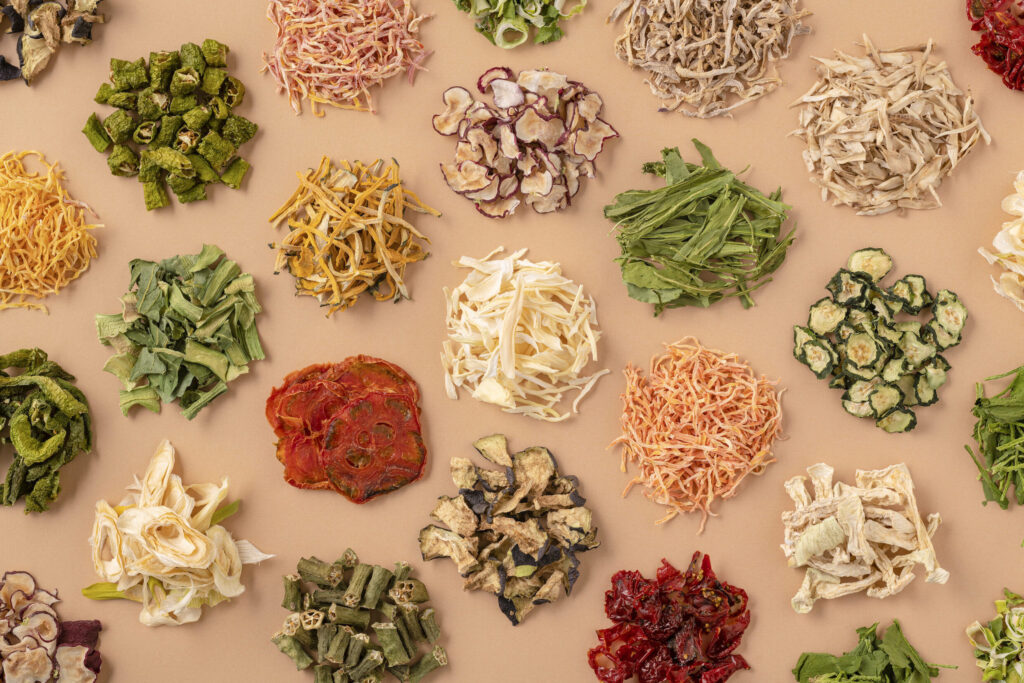
- Available for purchase in small lots from 1 kg
- We handle heirloom vegetables from across Japan
- Dried fruit and herbs also supported
The Characteristics and Ways to Eat the 4 Representative Ibaraki Heirloom Vegetables (Native Varieties)
Of the 5 certified varieties, we introduce in detail the origin, characteristics, and recommended ways to eat the 4 pre-war native varieties (aka-negi, Ukishima daikon, Kaichi takana, yatsugashira). Satokawa kabocha is explained separately in the “Other Local Specialty Varieties” at the end.
Aka-Negi — The Native Negi with a Mito Komon Legend
| Season | November to the following March |
| Growing region | Shirosato Town (former Katsura Village), Higashi-Ibaraki District |
| Well-suited dishes | Sukiyaki, hot pot, grilled negi, salad (for color) |
Aka-negi is a native negi that dyes red-purple from the base up to the lower leaf-sheath, with records showing it was already cultivated in Shirosato Town (former Katsura Village) in the Meiji era. There is a legend that “it began when Mito Komon sowed the seeds,” and locally it is affectionately also called “Red Poireau.”
Compared to ordinary white negi it has a milder pungency, and heating brings out a strong sweetness. Put raw into salad, the red of the cut face stands out, and it excels as a color vegetable too. Added to sukiyaki or hot pot, it soaks up the dashi and turns tender while keeping its red-purple, letting you enjoy its visual beauty.
Ukishima Daikon — The Bottom-Swelling Daikon Grown in Kasumigaura's Peatland
| Season | Around December |
| Growing region | Ukishima district, Inashiki City (former Sakuragawa Village) |
| Well-suited dishes | Oden, furofuki daikon, simmered dishes, sashimi garnish |
Ukishima daikon is a daikon grown in the peatland spreading around Lake Kasumigaura in the Ukishima district of Inashiki City. Distinguished by the unusual “bottom-swelling” shape that grows thicker toward the lower end, it is cultivated, as the name suggests, in low, wet land like a “floating island” at the water's edge.
Its flesh is dense and high in moisture, and it shows its true worth in a texture that comes alive in takuan pickles. Because harvesting requires hand-digging while your feet sink into the peatland, the number of growers is trending downward. At local oden shops and ryotei, it is sometimes treated as a “phantom daikon” in its December season.
Kaichi Takana — Ishioka's Pickling Green Continuing Since the Edo Period
| Season | Around March |
| Growing region | Kaichi district, Ishioka City |
| Well-suited dishes | Takana pickles, ohitashi, stir-fries, na-meshi |
Kaichi takana is a broad-leaf takana grown in the Kaichi district of Ishioka City since the Edo period. Compared to ordinary karashina it has few fibers and is tender, giving a good mouthfeel when pickled, and it has been prized as a “raw material for takana pickles.”
In season in early spring, in March, it is a rare variety with a very short harvest period. Salt-pickled, it develops a distinctive flavor, and “na-meshi,” folded into rice, is a local spring taste. Since growers are limited today, it is wise to check arrival information before visiting farm stands in Ishioka City.
Yatsugashira — The Satoimo Indispensable to New Year Dishes as a Good-Luck Food
| Season | Late October–December |
| Growing region | Goka Town, Sashima District; Chikusei City; Tsukubamirai City |
| Well-suited dishes | New Year zoni, osechi, simmered dishes, kinukatsugi |
Yatsugashira is a type of satoimo in which the parent and child taros grow in a cluster without separating, its name deriving from the shape where “eight heads become one.” Said to have come from China in the Heian period, from the Edo period onward it has been prized in New Year dishes as a good-luck food from the wordplay of “becoming the head of others.”
Denser-fleshed than ordinary satoimo, it resists crumbling and absorbs flavor well. Ibaraki Prefecture is a leading yatsugashira production area in Kanto (Goka Town, Chikusei City, Tsukubamirai City, and others), and at year-end it ships to metropolitan produce shops and department stores. Added to New Year osechi and zoni, a sticky texture mixes into the taro-like fluffiness, giving it a presence a cut above ordinary satoimo.
How to Buy Ibaraki Heirloom Vegetables and Tips for Storing Them
Because Ibaraki's heirloom vegetables are limited in production, obtaining them at growing-region farm stands, Michi-no-Eki, or some mail order is the basic route. Many varieties have short seasons, so missing the timing makes them hard to obtain.
In-prefecture direct-sales outlets / roadside stations
| Item | Main sources | Timing |
|---|---|---|
| Aka-negi | Farm stands in Shirosato Town, Michi-no-Eki Katsura | November–March |
| Ukishima daikon | Farm stands in the Ukishima district, Inashiki City | Around December |
| Kaichi takana | Farm stands in the Kaichi district, Ishioka City (limited quantity) | Around March |
| Yatsugashira | Farm stands in Goka Town, Michi-no-Eki Goka | October–December |
| Satokawa kabocha | Farm stands in the Misato district, Hitachiota City | September–December |
Ibaraki's strength is good access from the metropolitan area, and aka-negi and yatsugashira can sometimes be obtained in November–December at some Tokyo produce shops and high-end supermarkets. To be sure of getting them, visiting growing-region farm stands directly is the surest way.
Mail order / hometown tax to outside the prefecture
- Hometown tax donation — Included in each municipality's return gifts, such as Shirosato Town (aka-negi), Goka Town (yatsugashira), and Hitachiota City (Satokawa kabocha)
- Direct-from-farm e-commerce (Tabechoku, Pocket Marche) — Individual farmers list them in season. Limited quantities, so early reservation is needed
- Takana pickles processed product — Kaichi takana pickles are sold year-round by processors in Ishioka City
- Metropolitan department stores — Yatsugashira can be obtained at year-end in the osechi-ingredient corners of Mitsukoshi, Takashimaya, and others
Storage methods by item
| Item | Short-term storage | Long-term storage |
|---|---|---|
| Aka-negi | Wrapped in newspaper, one week in the vegetable compartment | Chop and freeze (1 month) |
| Ukishima daikon | Leaves cut off, wrapped in newspaper, in a cool dark place for 2 weeks | Salt-pickled or bran-pickled (1 month) |
| Kaichi takana | In damp newspaper, three days in the vegetable compartment | Salt-pickled or takana-pickled (2–3 months) |
| Yatsugashira | With soil on, in a cool dark place for 1–2 weeks | Boil and then freeze (1 month) |
| Satokawa kabocha | Whole, in a cool dark place for 1–2 months | Storable until New Year's thanks to the hard skin |
A product catalog that shows around 100 items we handle
Agriture, flexibly handling everything from small lots to large lots
- Available for purchase in small lots from 1 kg
- We handle heirloom vegetables from across Japan
- Dried fruit and herbs also supported
Efforts to Protect Ibaraki's Heirloom Vegetables
To keep protecting the 5 native varieties, activities coordinated between producer groups and local municipalities continue.
Passing On the Cultivation of Aka-Negi
| Timing | Event |
|---|---|
| Meiji era | Cultivation records in Shirosato Town (former Katsura Village) |
| Late Showa | Cultivated area shrank with the shift to white negi |
| 2000s– | Branded as “Red Poireau.” The rarity of the color drew attention |
| Present | Farmer groups in Shirosato Town continue self-saving the seed. Also adopted as a hometown-tax return gift |
For aka-negi, the rarity of the color boosted branding, and adoption at high-end restaurants also increased. It's a good example of a once-declined variety reviving as a “native variety that can be differentiated by appearance.”
Measures Against the Rarity of Kaichi Takana and Ukishima Daikon
- Kaichi takana — Ishioka City supports the operation of a preservation society as part of regional revitalization. Maintains growers by opening sales channels for the processed product (takana pickles)
- Ukishima daikon — Inashiki City conserves the peatland agriculture around Lake Kasumigaura as a “rare farming system.” The aging of producers is a challenge
- Seed bank — The Ibaraki Agricultural Center stores native-variety seeds, playing a role in preventing their loss
Because Ukishima daikon depends on the special cultivation environment of peatland, it is difficult to grow elsewhere. The significance of protecting a variety unique to this land ties in not only to food-culture conservation but also to maintaining farmland diversity.
FOR BUSINESS
乾燥野菜を業務用でお探しですか
国産の野菜・果物を乾燥し、必要に応じて粉砕してお出ししています。扱っている品目は100種前後で、規格は 乾燥品の一覧・パウダーの一覧 に掲載しています。
少量でのご購入は、姉妹ブランドの通販サイト OYAOYA で承っています。
FAQ
Other regional specialty varieties
Varieties that are included in the Japan Traditional Vegetables Promotion Association list but were bred and selected in the mid-1950s or later, differing in position from strict “heirloom vegetables (pre-war native varieties),” are introduced here separately as “local specialty varieties.”
| Item | Category | Growing region | Characteristics and standing |
|---|---|---|---|
| Satokawa kabocha | Squash | Misato district, Hitachiota City | A local specialty kabocha whose cultivation began around 1955. Its skin is a vivid pink and its sugar content around 12 degrees. Being a postwar selected variety, it is positioned by the prefecture as a regional heirloom vegetable, but it is a variety representing Hitachiota's food culture |
Summary
Ibaraki's heirloom vegetables number just 5, but each is a distinctive native variety deeply tied to its land and eating habits — aka-negi's vivid color, Ukishima daikon's peatland agriculture, Kaichi takana's pickling culture, and yatsugashira's good-luck-food culture. The Mito domain's agricultural-encouragement policies, the water use around Lake Kasumigaura, and the rich soil of the Kanto Plain built the foundation that nurtured diverse varieties.
Making the most of good access from the metropolitan area, visiting growing-region farm stands in season lets you reliably meet native varieties. Yatsugashira at New Year, aka-negi in winter, Kaichi takana in spring — a trip to Ibaraki with a season-by-season purpose can also lead to new encounters with heirloom vegetables.
References / information sources
- Japan Traditional Vegetables Promotion Association, “Ibaraki Prefecture's Heirloom Vegetables” — The 5-variety certification list and characteristics
- Ibaraki wo Tabeyou, “Ibaraki's Agriculture, Forestry, and Fishery Products” — Brand information on prefecture-grown produce
- National Agriculture and Food Research Organization Genebank "Native Variety Database" — information on native varieties nationwide
Related articles
- Japan's Heirloom Vegetables: Precious Varieties Handed Down in Each Region
- Kyoto heirloom vegetables: Kyoto specialties with a long history
- Heirloom vegetables of Hokkaido
- Heirloom vegetables of Iwate
- Heirloom vegetables of Miyagi
- Heirloom vegetables of Yamagata
- Heirloom vegetables of Fukushima
- Heirloom vegetables of Naniwa
Download the product catalog
We will send the materials to your email address based on the information you provide.
- What are Fukushima’s heirloom vegetables? Features, season, and ways to eat the 14 items explained
- What are Tochigi’s heirloom vegetables? Features, season, and ways to eat the 14 items explained
Author of this article
Related articles
-
 Okinawa island vegetables: individualistic vegetables nurtured by a subtropical climate
 -
 Kaga vegetables: Kanazawa brand vegetables where tradition lives on
 -
 The appeal of Kansai heirloom vegetables | Specialties of Naniwa, Kyoto, and Yamato thoroughly explained
 -
 Kyoto heirloom vegetables: Kyoto specialties with a long history
 -
 A list of heirloom vegetables of the 8 prefectures of Kyushu and Okinawa|A thorough introduction to characteristics, growing regions, and seasons
 -
 Know the heirloom vegetables of Edo Tokyo | The city’s vanishing food culture
 -
 They'll make you smile! The fun names of heirloom vegetables and their origins
 -
 5 cases and strategies that succeeded in branding heirloom vegetables