
How to Rehydrate Dried Vegetables: Tips for Commercial and Restaurant Use

Summary of this article
The rehydration rate (reconstitution ratio) of dried vegetables is essential knowledge for formulation calculations. This article gives a practical explanation: rehydration rates by vegetable for air-dried and freeze-dried products such as cabbage 8–10×, carrot 6–7×, and daikon 8–10×; a 3-step method for converting fresh-vegetable recipes to dried vegetables; recommended methods by product type such as instant soup, retort, and furikake; and countermeasures for water activity, cut size, and seasonal variation.
How to rehydrate dried vegetables involves tricks for commercial and foodservice use that differ a little from home cooking. To shorten prep time while maximizing a dish's umami and texture, the Japanese-cuisine idea of "rehydrating slowly like kombu to draw out vegetable dashi" is useful. This article organizes the chef-supervised method from OYAOYA (an Agriture group brand), how to use it in prep for restaurants and commercial settings, and formulation calculations for processed-food OEM.

We have materials available to help you understand dried processing OEM
Agriture OEM, flexibly handling everything from small lots to large lots
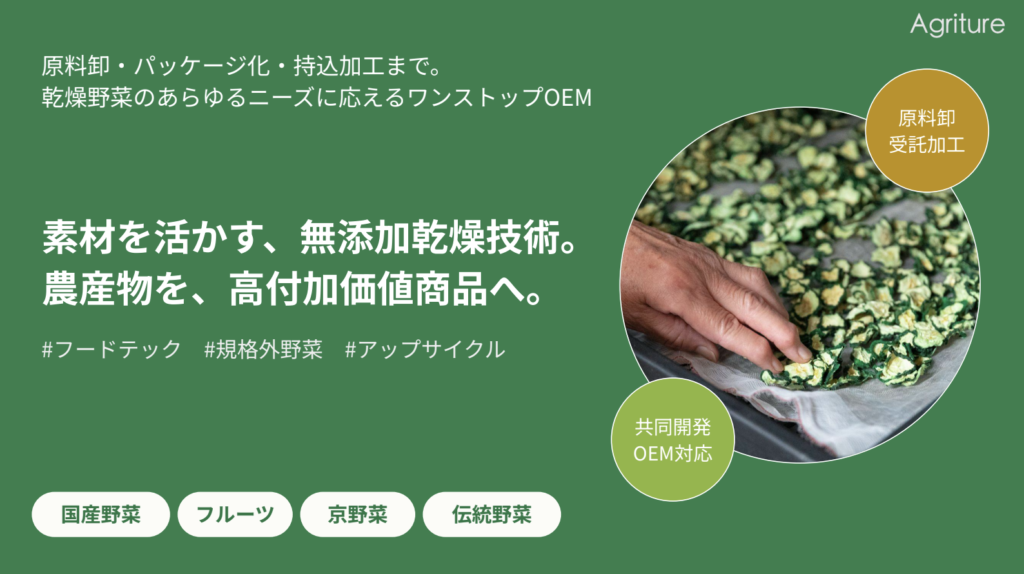
- OEM available from small lots of 10 kg
- Drying of brought-in raw materials also possible
- Support from processing to filling in one place
TOC
The basics of rehydrating dried vegetables
Dried vegetables regain a texture close to their original state by soaking in water or hot water. Because how they rehydrate differs by vegetable type, thickness of cut, and drying method,knowing the rehydration time and degree for each item makes prep easier. In restaurant prep, "shorter first → taste → add more if needed" is the basic approach, since soaking too long causes texture loss, so caution is needed.
Tricks for rehydrating dried vegetables
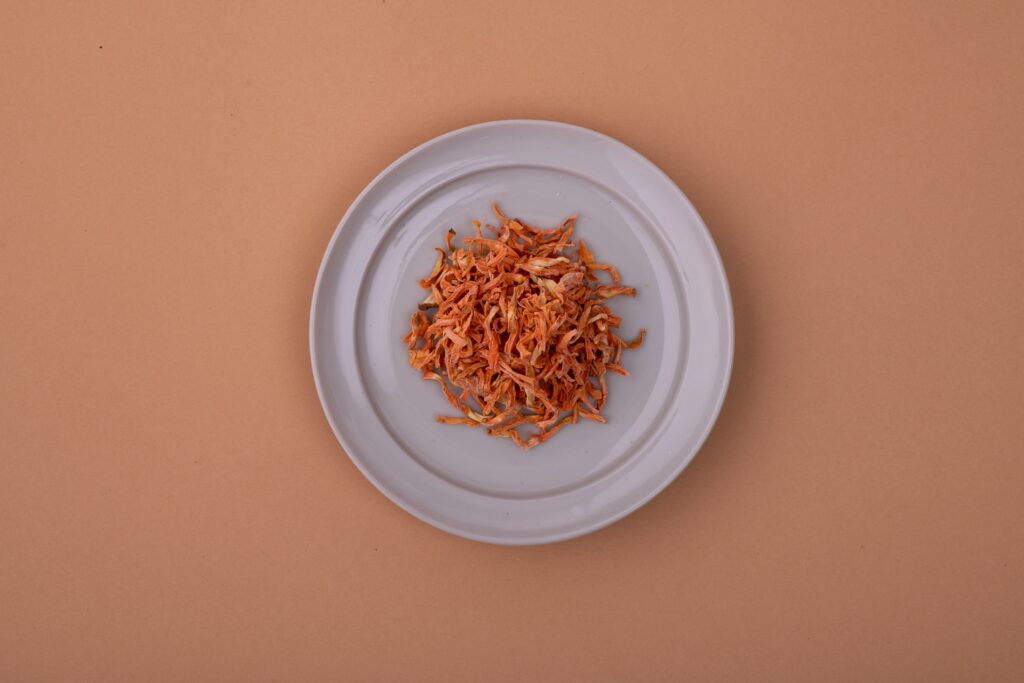
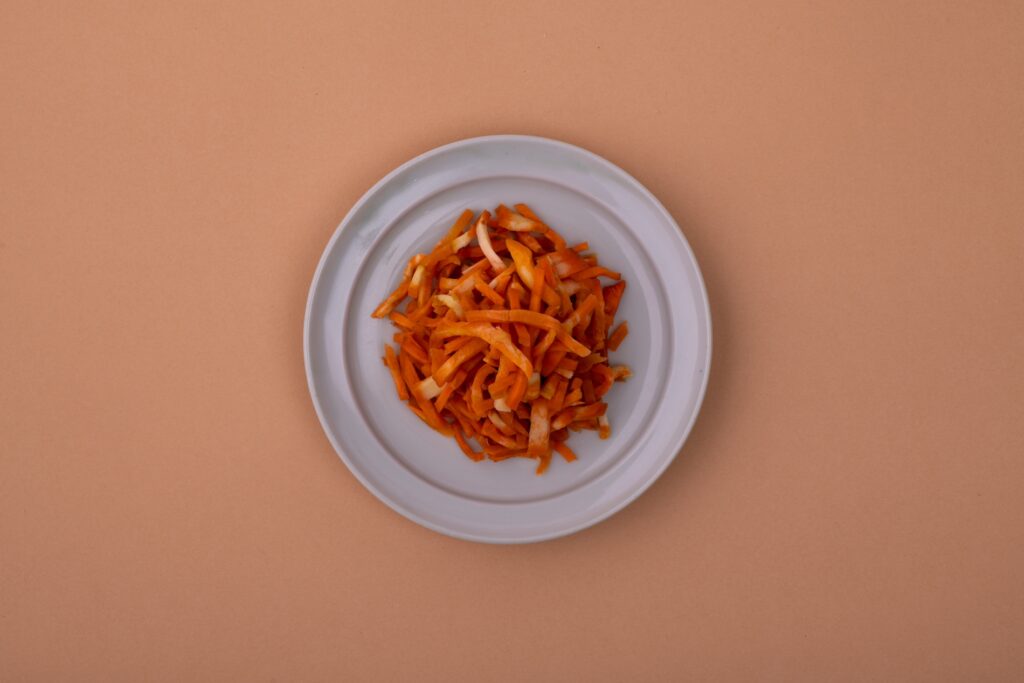
Rehydrating dried vegetables in plenty of water is the trick, and the common approach. The images below show the difference in carrots before and after rehydration. Depending on the degree of rehydration, the texture and thickness differ greatly.
Carrot before rehydration
Carrot after rehydration
💡 Tricks for rehydration time
Proceeding in the order "shorter first → taste → add more if needed" is reliable. Because soaking too long tends to lose texture, varying the rehydration time for each vegetable during prep is standard practice in restaurants. The soaking liquid is rich in flavor, so it can be used directly in soups, miso soup, and simmered dishes.
For restaurants | 3 chef-supervised methods for delicious rehydration
The dried-vegetable D2C brand "OYAOYA | This is the right way! Delicious rehydration of dried vegetables" (chef-supervised), operated by the Agriture group, introduces a way to maximize a dish's umami by rehydrating dried vegetables slowly, treating them the same as kombu. We introduce 3 rehydration methods that apply directly to restaurant prep and business menus.
① Rehydrate in vinegar (pickles) | make-ahead sides and appetizers
Soaking for half a day in a seasoning liquid of vinegar, water, and kombu dashi yields pickles infused with umami. Because vinegar keeps them well and makes room-temperature storage easy, this applies to izakaya amuse-bouche, cafe sides, and bar make-ahead appetizers. You just drop the dried vegetables in and leave them for half a day, so prep effort is minimal.
② Rehydrate as tsukudani or nibitashi | single dishes for Japanese restaurants and deli shops
Simmer slowly over medium heat with seasonings, kombu, and water; once it comes to a boil, transfer to a sealed container and finish with residual heat. The key point is that the residual heat lets the vegetables' own dashi permeate throughout, rehydrating them softly. It's a technique easy to make a staple in small dishes at Japanese restaurants, deli offerings, and Japanese-style hotel breakfasts. For nibitashi-style menus, the dashi aroma steps up a notch.
③ Rehydrate in miso | miso soup, miso bed, seasoning development
Just leave dried vegetables in miso for half a day and you get vegetable-dashi-infused miso. In particular, Dried Tomato have properties similar to kombu, with the seeds' acidity and the flesh's umami making solid dashi. miso-soup shops, cafe miso-soup menus, and ramen-shop off-menu items. Keeping it refrigerated as a prepped miso lets you handle orders smoothly.
FOR BUSINESS
乾燥野菜のOEM・受託加工を承ります
国産の野菜・果物の乾燥、100メッシュ相当までの粉砕、10g以上の小袋充填までをお受けしています。小ロットの試作から量産までご相談ください。寄せられた相談の実例は OEM・卸のご相談 に掲載しています。
乾燥品の賞味期限は、出荷日から6ヶ月程度を目安にご案内しています。
For restaurants | the nikiri-zake trick
The off-notes of rehydrated dried vegetables that bother you can be solved with nikiri-zake, used as a hidden flavoring in Japanese cuisine. It's an excellent seasoning that rehydrates them softly while drawing out umami, usable as pre-treatment at Japanese restaurants, kappo, and izakaya.
How to make and use nikiri-zake
- Preparation: put junmai sake or seishu in a pot, cover, and heat over low heat for 3 minutes. Once the alcohol evaporates, it's done
- Storage: use up within a week in the refrigerator
- How to use: spray it onto the dried vegetables before rehydrating, lightly rub, and let it sit for 10 minutes → umami is boosted when rehydrating during cooking
It's an easy pre-treatment you can prepare in 5 minutes before prepping, and beyond Japanese cuisine it applies to Western bouillon and Chinese soup bases. It's also handy for prepping dressings and marinade liquids.
How to use dried vegetables in restaurants and in prep
The biggest benefits of using dried vegetables in restaurants are three: shorter prep time, stable supply, and reduced waste. We organize the use scenarios by business type.
| Business type | Use cases | Benefits |
|---|---|---|
| Izakaya / bars | Amuse-bouche, pickles, miso-soup ingredients | Keeps well, so prepping amuse-bouche is easy |
| Japanese restaurants / kappo | Simmered dishes, nibitashi, chawanmushi ingredients | Dashi aroma steps up |
| Ramen shops | Topping vegetables, condiments | No waste, year-round supply |
| Cafes / restaurants | Soups, salads, quiche | Shorter prep, colorful ingredients |
| Hotel breakfast | Miso soup, sides, garnishes | Kyoto vegetables usable even out of season |
| Employee cafeterias / school meals | Soups, stir-fries, salads | Doubles as stockpile, counters vegetable shortfall |
💡 Why adoption is growing in restaurants
Amid rising purchase prices for fresh vegetables, dried vegetables keep for 6–12 months at room temperature, enabling sourcing less affected by price swings. Ingredients hard to obtain year-round, such as Kyoto vegetables (Kujo negi, Shogoin daikon, Manganji togarashi), can also be supplied year-round in dried form.
How to use them commercially | stockpiles, year-round supply, product development
In addition to restaurants, dried vegetables as a commercial ingredient are widely adopted by food factories, boxed-meal makers, frozen-food makers, and instant-noodle makers. The core uses are "year-round supply, light weight, room-temperature management."
- Boxed-lunch / prepared-food factories: as a secondary ingredient for furikake, Japanese deli dishes, and toppings. Saves freezer and fridge space
- Frozen-food makers: ingredients for pasta, pilaf, fried rice, and more. 100% yield makes cost management easy
- Instant-noodle / soup makers: staples as noodle-packet ingredients and soup ingredients. Use FD type and hot-air-dried type differently
- Stockpile foods / emergency foods: light and room-temperature storable, also suited to disaster and office stockpiles
Differences in reconstitution characteristics by drying method
| Drying method | Reconstitution time | Texture | Flavor |
|---|---|---|---|
| Hot-air drying | Medium to long | Somewhat firm | Medium |
| Low-temperature drying (45–60°C) | Medium | Moist | Strong (retains umami) |
| Freeze-dried (FD) | Short (1–3 min) | Sponge-like and fluffy | Strong |
| Sun drying | Long | Softer | Traditional flavor |
FD reconstitutes quickly and suits salads and toppings; low-temperature drying suits miso soup, soups, and dressed dishes that make use of umami and aroma; hot-air drying suits stir-fries, simmered dishes, and stockpiles; sun-drying suits traditional dishes like kiriboshi daikon—use them differently.
Formulation calculations for processed-food OEM (reference)
When a processed-food maker uses dried vegetables as an ingredient, the basic approach is to work backward from the rehydration rate to decide the formulation. Example: with a dried vegetable at a 4× rehydration rate, if you want 20g of vegetables per single-serving final product, you need 5g dried.
- Decide the final product's vegetable amount (after rehydration)
- Confirm the rehydration rate of the dried vegetable used
- Calculate the order weight factoring in yield and waste rate
- Fine-tune the formulation ratio in balance with other ingredients (moisture, oil, salt)
- Measure with a prototype lot (assume roughly ±10% deviation from the calculated value)
Dividing the dried-vegetable unit price by the rehydration rate gives you the fresh-vegetable-equivalent unit price, letting you compare against the market price of fresh vegetables to judge cost advantage. Factoring in waste (fresh waste rate 15–25%), logistics cost (weight 1/10 when dried), and storage cost (room temperature) brings it even closer to reality.
We have materials available to help you understand dried processing OEM
Agriture OEM, flexibly handling everything from small lots to large lots
- OEM available from small lots of 10 kg
- Drying of brought-in raw materials also possible
- Support from processing to filling in one place
FOR BUSINESS
乾燥野菜のOEM・受託加工を承ります
国産の野菜・果物の乾燥、100メッシュ相当までの粉砕、10g以上の小袋充填までをお受けしています。小ロットの試作から量産までご相談ください。寄せられた相談の実例は OEM・卸のご相談 に掲載しています。
乾燥品の賞味期限は、出荷日から6ヶ月程度を目安にご案内しています。
FAQ
Which vegetables rehydrate easily in 10 minutes?
Dried cabbage, spinach, komatsuna, and Kujo negi (thinly cut) rehydrate in 5–10 minutes. For miso soup or salads, just pouring hot water over them and letting them sit for 3–5 minutes is enough.
What should I watch out for in restaurant prep?
Beware of over-rehydrating. "Shorter first → taste → add more," varying the rehydration time for each vegetable, is standard practice. The soaking liquid is rich in flavor too, so using it directly in soups or simmered dishes boosts the umami.
Should I discard the soaking liquid?
The basic approach is to use it, not discard it. The soaking liquid of shiitake, tomato, and onion in particular makes excellent dashi and can be used directly in miso soup, soups, and simmered dishes.
I want to source commercially for a restaurant. Can I buy in 100g units?
Agriture supports commercial supply from 100g. We also handle materials hard to find in supermarkets, such as Kyoto vegetables and dried Shogoin daikon. For details, see the commercial dried-vegetable page.
What's the guideline amount for stockpile and office use?
For home use, the guide is 30g (dried) per person per day × the number of stockpile days. Because dried vegetables rehydrate to an amount close to the original fresh vegetables, a small quantity of dried vegetables secures ample vegetable intake. They keep for 6–12 months at room temperature, so they also suit disaster and office stockpiles.
Summary | Work backward from the use to decide how to rehydrate
Three-line summary
- Draw out umami with the same "slow rehydration" as kombu. Ideal for restaurant prep
- Restaurant standard: the 3 methods of pickles, tsukudani/nibitashi, and miso bed + nikiri-zake for pre-treatment
- For commercial OEM, work backward from the rehydration rate for formulation calculations (measuring is the reliable basis)
How to rehydrate dried vegetables restaurant prep, commercial stockpiles, and processed-food OEM formulations—the best method changes by use. What they share is the idea of "rehydrating slowly like kombu to draw out umami." Agriture's commercial dried-vegetable lineup is[Commercial] Dried vegetables | Domestic dried-goods ingredients available for viewing here.
Download the OEM contract processing materials
We will send the materials to your email address based on the information you provide.
Recommended reading
→ OYAOYA | This is the right way! Delicious rehydration of dried vegetables (chef-supervised)
→ [Commercial] Dried vegetables | Domestic dried-goods ingredients
→ Custom Processing of Dried Vegetables: A Guide to Cut Shape, Blending, and Moisture Content
If you are considering product development with off-spec or your own farm's vegetables:From planning to processing, materials, package printing and novelties, you can consult us through a single point of contact. → Learn more about one-stop product development
- 7 Criteria for Judging a Commercial Dried Vegetable Supplier
- Corporate gifts in the SDGs era | Raise your brand strength with food gifts
Author of this article
Related articles
-
 7 Criteria for Judging a Commercial Dried Vegetable Supplier
 -
Dried Vegetable Price Ranges: Supermarket and Online Guidelines and How to Choose by Volume
-
Raw Material Risk Management for Food Manufacturers and How to Use Dried Vegetables
-
HACCP Compliance in Food Processing: A Practical Guide to the Necessity by Processing Form and Use
-
Selection Criteria and Quality Requirements for Dried Vegetable Raw Materials for Pharmaceuticals and Health Foods
-
Custom Processing of Dried Vegetables: A Guide to Cut Shape, Blending, and Moisture Content
-
How to Choose Dried Vegetable Kayaku for Instant Noodles: Rehydration Performance and Quality Standards
-
Dried Vegetable Raw Materials for Convenience Store Bento: Techniques for Color, Texture, and Cost Improvement