
Rules for Labeling the Origin of Raw Materials in Processed Foods: 4 Labeling Methods and Penalties for Violations

Summary of this article
This article explains the raw-material-origin labeling system for dried vegetables: the background of full enforcement in April 2022, and the 4 patterns—country-by-country weight-order labeling, manufacturing-place labeling, “or” labeling, and broad-grouping labeling—with concrete examples. It details the decisive difference between “domestic” and “made in Japan,” how to handle weight changes from the drying process, calculation methods for multi-vegetable blends, and the up-to-100-million-yen fine risk for Food Labeling Act violations and how to avoid it.
Raw-material-origin labeling is a labeling system, based on the Food Labeling Act, made mandatory for all processed foods made within Japan. The food labeling standards were revised and enforced on September 1, 2017, and after a 5-year transitional period, fully enforced on April 1, 2022. Because a labeling-rule violation carries the risk of penalties or product recall, staff at processed-food OEM and food makers must grasp the system's overview and practice.
This article organizes the latest raw-material-origin labeling system based on the Food Labeling Act and Consumer Affairs Agency guidelines—the 4 labeling patterns, the difference between “domestic” and “made in Japan,” practical points for dried vegetables, violation cases and penalties, and an in-house checklist—based on official information.

We have materials available to help you understand dried processing OEM
Agriture OEM, flexibly handling everything from small lots to large lots
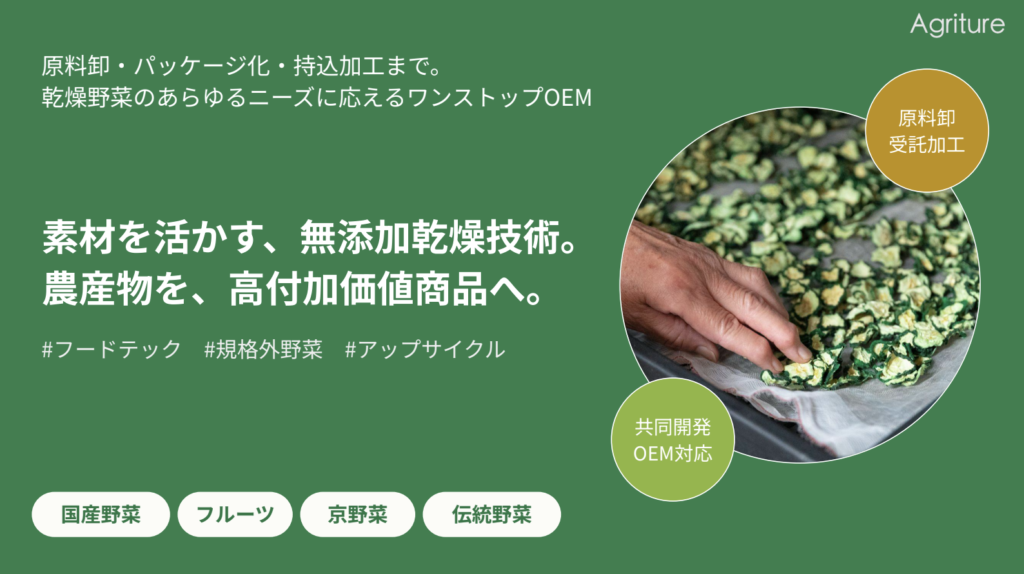
- OEM available from small lots of 10 kg
- Drying of brought-in raw materials also possible
- Support from processing to filling in one place
TOC
What is the raw-material-origin labeling system
Raw-material-origin labeling is a system that clearly shows consumers the origin of the raw material ranked first by weight ratio in a processed food. The September 1, 2017 revision of the food labeling standards expanded it from the former 22 food groups + 4 individual items to all processed foods.
| Item | Details |
|---|---|
| Governing law | Food Labeling Act (Food Labeling Standards, Article 3) |
| Enforcement | September 1, 2017 (revised notification enforced) |
| Transitional deadline | March 31, 2022 |
| Full application | April 1, 2022 |
| Audience | All processed foods manufactured or processed within Japan (fresh foods and imported goods fall under separate systems) |
| Raw materials subject to labeling | raw material ranked first by weight ratio |
| Jurisdiction | Consumer Affairs Agency |
Fresh foods have a separate system (origin labeling for fresh foods), and individual items like soybeans, wheat, and meat have further detailed labeling rules, so sorting out which system your product falls under first is the starting point of practice.
References: Consumer Affairs Agency | Information on the new raw-material-origin labeling system for processed foods、Ministry of Agriculture, Forestry and Fisheries | On the raw-material-origin labeling system for processed foods、e-Gov | Food Labeling Act
The 4 patterns of origin labeling
For raw-material-origin labeling, besides the principle of country-by-country weight-order labeling, three exception labels are permitted according to the actual sourcing situation. You need to choose the pattern that fits your own raw-material sourcing flow.
| Pattern | Labeling example | When to use it |
|---|---|---|
| ① Country-by-country weight-order labeling (principle) | “Soybeans (USA, Canada)” | When the weight ratio by origin can be grasped accurately |
| ② “Or” labeling | “Soybeans (USA or Canada)” | When origins swap but can be substantiated by frequency or past-record documentation |
| ③ Broad-grouping labeling | “Soybeans (imported)” “Soybeans (domestic or imported)” | When importing from 3 or more countries with frequent swaps |
| ④ Manufacturing-place labeling for intermediate processed raw material | “Wheat flour (made in Japan)” | When the top-weight raw material is an intermediate processed good and the origin of the fresh raw material can't be identified |
Notes on using “or” labeling and broad-grouping labeling
“Or” labeling and broad-grouping labeling are convenient, but recording of usage results or past evidence is required. If the label and the reality diverge, it's judged false labeling and can become subject to a corrective order or recall, so retaining per-lot raw-material-origin records is essential in practice.
References: Consumer Affairs Agency | Information on the new raw-material-origin labeling system for processed foods、Ministry of Agriculture, Forestry and Fisheries | On the raw-material-origin labeling system for processed foods
FOR BUSINESS
乾燥野菜を業務用でお探しですか
国産の野菜・果物を乾燥し、必要に応じて粉砕してお出ししています。扱っている品目は100種前後で、規格は 乾燥品の一覧・パウダーの一覧 に掲載しています。
少量でのご購入は、姉妹ブランドの通販サイト OYAOYA で承っています。
The decisive difference between “made in Japan” and “domestic”
An easily confused point in processed-food labeling is the difference between “made in Japan” and “domestic.”The two clearly differ in meaning, and it's a point consumers watch closely.
| Label | Meaning | Example |
|---|---|---|
| “Domestic” | The fresh raw material was produced within Japan | Uses radish grown in Japan |
| “Made in Japan” | The raw material (intermediate processed good, etc.) was processed or manufactured within Japan (the raw material's origin is a separate matter) | Imported soybeans made into tofu within Japan |
It's not rare for the raw material to be an import even when “made in Japan” is labeled. If you're putting forward a “domestic appeal” in product design, you need backing that the raw material is Japanese-grown from the ingredient level, and you have the right to use the wording “domestic” on the label.
Labeling points to watch for dried vegetables and processed foods
Dried vegetables often circulate as processed foods, so they're an item where the labeling-rule application pattern tends to get complex. Grasp the following points.
- Treated as fresh food or as processed food: drying alone may be treated as fresh food, but cutting, blending, or the packaging form can make it treated as processed food
- domestic dried vegetables: if the raw material (fresh vegetable) is Japanese-grown, the “domestic” label is possible. If the drying process is overseas, it won't be “made in Japan”
- Mixed products: origin labeling is mandatory only for the top-weight raw material. The remaining items are optional labeling
- Additives Including (glucose, etc.) also applies the separate labeling rules for food additives
- Additive-free appeal: separately from raw-material-origin labeling, you must also follow the Consumer Affairs Agency's “additive-free” guidelines (revised 2022)
References: Consumer Affairs Agency | Food labeling、Consumer Affairs Agency | Food Labeling Act, etc. (laws and consolidated information)
Violation cases and penalties
If you violate the Food Labeling Act, the Consumer Affairs Agency, local governments, and the Ministry of Agriculture, Forestry and Fisheries issue an instruction, order, or corrective guidance. In malicious cases or those involving health harm, a penalty may be applied directly.
| Violation content | Main response |
|---|---|
| Labeling error or omission | Administrative guidance / corrective order |
| Labeling “domestic” while using imported raw material | Corrective order + recall + subject to penalty |
| Labeling deficiency inviting health harm | Penalty applied immediately (fine / imprisonment) |
| False or exaggerated advertising (joint application with the Premiums and Representations Act) | Measure order / surcharge |
Range of main penalties
- Food Labeling Act violation (serious matters such as false origin labeling): up to 3 years' imprisonment or a fine of up to 3 million yen (individual) / a fine of up to 300 million yen (corporation)
- General labeling violation: administrative guidance or order; penalty upon violation of an order
- Premiums and Representations Act (in case of joint application for misleading superiority/advantage): measure order / surcharge
References: e-Gov | Food Labeling Act、Ministry of Agriculture, Forestry and Fisheries | On the number of guidance cases related to Food Labeling Act and JAS Act violations、Consumer Affairs Agency | Premiums and Representations Act
A checklist for your product's origin labeling
A checklist for processed-food makers and OEM buyers to inspect their own product's labeling. We recommend confirming at an inventory review at least once a year.
- Is the top-weight raw material identified?
- Do the chosen labeling pattern (of the 4) and the reality match?
- Are you retaining the evidence records for “or” labeling and broad-grouping labeling (at least the past 3 years)?
- Is the use of “domestic” and “made in Japan” correct?
- Are the labels for food additives, allergens, and nutrition facts also complete?
- Do the actual packaging material and label match the spec sheet?
- Is a labeling-update flow in place for new suppliers and origin changes?
- Do you check for Consumer Affairs Agency guideline revisions once a year?
We have materials available to help you understand dried processing OEM
Agriture OEM, flexibly handling everything from small lots to large lots
- OEM available from small lots of 10 kg
- Drying of brought-in raw materials also possible
- Support from processing to filling in one place
FOR BUSINESS
乾燥野菜を業務用でお探しですか
国産の野菜・果物を乾燥し、必要に応じて粉砕してお出ししています。扱っている品目は100種前後で、規格は 乾燥品の一覧・パウダーの一覧 に掲載しています。
少量でのご購入は、姉妹ブランドの通販サイト OYAOYA で承っています。
FAQ
Is raw-material-origin labeling needed even for imported processed foods?
Raw-material-origin labeling applies to “processed foods manufactured or processed within Japan.” For imported processed foods, labeling of the country of origin is mandatory under separate rules (imported-goods labeling under the food labeling standards).
Should I use “or” labeling or broad-grouping labeling?
It depends on the frequency of origin swaps and the number of countries. If you switch among 2–3 countries and can grasp the usage ratios to some extent, “or” labeling is chosen; if you frequently source from 3 or more countries, “broad-grouping labeling (imported)” is chosen. Both require retaining records of past usage results.
Does a dried-vegetable mix need origin labeling for every item?
The obligation is only for the top-weight raw material. Second and lower items are optional labeling, but for brand appeal and providing information to consumers, many makers list every item.
What should I confirm to label “domestic”?
You need to be able to prove the fresh raw material (the grown vegetable itself) was produced within Japan. In practice, you're required to retain contract-farm certificates, certificates of origin, and producer-information records, linked per lot.
If a violation comes to light, what should I do first?
First, confirm the facts internally and identify the scope of impact (affected lots, distribution destinations), then consider a voluntary report to the local government or Consumer Affairs Agency and a voluntary recall as needed. Prompt response can lead to a lighter administrative disposition in some cases.
Summary | Protect your labeling with “records” and “consistency”
Three-line summary
- Fully enforced April 2022. Origin labeling is mandatory for the top-weight raw material of all processed foods
- Choose among the 4 labeling patterns (country-by-country / or / broad-grouping / intermediate processing) to match the reality
- “Domestic” and “made in Japan” have different meanings. Protect consistency through records and lot management
With full enforcement in April 2022, the raw-material-origin labeling system has become an essential item of practice for food makers and OEM buyers. Beyond choosing the labeling pattern, securing per-lot record retention and consistency between label and reality within your yearly operation is what minimizes violation risk. We recommend regularly checking the latest revision trends on the Consumer Affairs Agency's official information. For how Agriture handles origin labeling for commercial dried vegetables, see the[Commercial] Dried vegetables | Domestic dried-goods ingredients page.
Download the OEM contract processing materials
We will send the materials to your email address based on the information you provide.
Recommended reading
→ [Commercial] Dried vegetables | Domestic dried-goods ingredients
→ Practical Guide to Importing Dried Vegetables: Tariffs, HS Codes, and Quarantine Explained
→ HACCP Compliance in Food Processing: A Practical Guide to the Necessity by Processing Form and Use
If you are considering product development with off-spec or your own farm's vegetables:From planning to processing, materials, package printing and novelties, you can consult us through a single point of contact. → Learn more about one-stop product development
- Switching from Fresh Vegetables to Dried and Sun-Dried Vegetables: Benefits for Cooking and Commercial Use
- How to Read a Dried Vegetable Quality Specification: A Quick-Reference Table of Standards for Water Activity, Color Difference, Particle Size, and Additive-Free Status
Author of this article
Related articles
-
 7 Criteria for Judging a Commercial Dried Vegetable Supplier
 -
How to Rehydrate Dried Vegetables: Tips for Commercial and Restaurant Use
-
Dried Vegetable Price Ranges: Supermarket and Online Guidelines and How to Choose by Volume
-
Raw Material Risk Management for Food Manufacturers and How to Use Dried Vegetables
-
HACCP Compliance in Food Processing: A Practical Guide to the Necessity by Processing Form and Use
-
Selection Criteria and Quality Requirements for Dried Vegetable Raw Materials for Pharmaceuticals and Health Foods
-
Custom Processing of Dried Vegetables: A Guide to Cut Shape, Blending, and Moisture Content
-
How to Choose Dried Vegetable Kayaku for Instant Noodles: Rehydration Performance and Quality Standards