
Switching from Fresh Vegetables to Dried and Sun-Dried Vegetables: Benefits for Cooking and Commercial Use

Summary of this article
As a guide to switching from fresh vegetables to dried-vegetable ingredients, we explain 5 benefits: stabilized raw-material costs, improved yield toward 100%, reduced storage and logistics costs, quality consistency, and simplified cooking processes. For food manufacturers, we cover a specific cost estimate for switching 100kg of carrots per month, a 3-step practical flow of sample evaluation, formulation testing, and transition to mass production, and countermeasures for miscalculated rehydration rates and discoloration risk.
Switching from fresh vegetables to dried or air-dried vegetables offers a wide range of benefits—saving cooking time, improving shelf stability, and reducing costs for commercial use. In home cooking, daily storage and meal planning become easier, while restaurants, boxed-meal factories, and food manufacturers see stable purchase prices, less waste, and improved yield. This article organizes the differences between fresh, dried, and air-dried vegetables, the benefits of switching, uses by industry, and the practical workflow.

We have materials available to help you understand dried processing OEM
Agriture OEM, flexibly handling everything from small lots to large lots
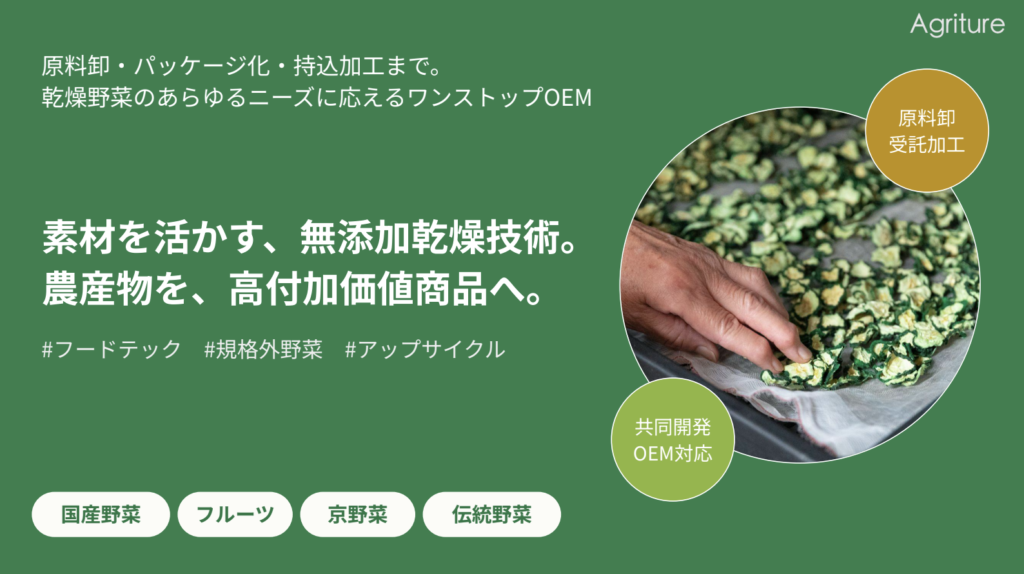
- OEM available from small lots of 10 kg
- Drying of brought-in raw materials also possible
- Support from processing to filling in one place
TOC
Differences between fresh, dried, and air-dried vegetables and where each fits
Dried vegetables and air-dried vegetables are both "fresh vegetables with the moisture removed," but they differ subtly in processing method, specifications, and where they are used. In commercial settings they are called Dried vegetables (standardized by low-temperature drying, hot-air drying, or freeze-drying), while in home and traditional foods they are called Dried vegetables (hoshi-yasai) (sun-dried or homemade). First, let's grasp the differences among the three types.
| Item | Fresh vegetables | Dried vegetables (commercial) | Air-dried vegetables (home / homemade) |
|---|---|---|---|
| Moisture content | 80〜95% | 5–15% (standardized) | 10–20% (highly variable) |
| Storage period | 3–7 days (refrigerated) | 6–12 months (room temperature) | 1–3 months (room temperature) |
| Storage place | Refrigeration required | Room temperature, dry place | Room temperature, sealed container |
| Main processor | Farmers / wholesalers | Manufacturers (standardized factories) | Home / individuals |
| Spec-sheet compatible | ◎ | ◎ | × (home cooking) |
| Nutrition | Rich in water-soluble vitamins | Concentrated fiber and minerals | Concentrated fiber |
| Disposal loss | 15–30% occurs | Nearly zero (100% yield) | Little household waste |
Where fresh vegetables fit
Fresh vegetables are overwhelmingly better for dishes where crispness, juiciness, and aroma are essential. Salads, sashimi garnishes, condiments, dressed dishes, juices, and smoothies—uses where texture and freshness directly affect the evaluation. In commercial settings, they take the leading role in the deli sections of high-end restaurants, ryotei, and premium supermarkets that handle farm-direct luxury ingredients.
Where dried vegetables (commercial) fit
Because they can be supplied year-round at standardized, stable quality, they suit processed-food OEM, instant-noodle toppings, furikake, commercial soups, boxed-meal ingredients, frozen foods, and school meals. Cut shape, moisture rate, and growing region can be fixed in a spec sheet, directly enabling stable costs under annual contracts. Being able to introduce them gradually from small-lot prototypes to mass production is another strength unique to commercial use.
Where air-dried vegetables (home / homemade) fit
Sun-drying seasonal vegetables for home use suits traditional dishes, seasonal dishes, preserved foods, miso-soup ingredients, simmered dishes, and staples for people living alone. There's also the pleasure of drying vegetables from your own garden, and things like dried daikon strips (kiriboshi daikon) and dried shiitake can be made at home. However, because they aren't standardized, they aren't suited to commercial use.
💡 The bottom line on choosing
Fresh for texture and freshness, dried for stable supply and processing, air-dried for seasonal preserved foods—using all three types by purpose is the right answer for both cooking and business. Rather than switching everything to dried vegetables, choose the best type for each menu, product, and use.
The 5 benefits of switching × how to use × industry fit
We organize the 5 benefits of switching from fresh to dried or air-dried vegetables by tying them to specific cooking uses and the industries they suit. A benefit alone means nothing; it becomes real value only when it meshes with your industry, menu, and sales channels.
Benefit 1 | Shelf stability (6–12 months at room temperature)
How to use: buy in bulk and manage on room-temperature shelves or in the pantry. Don't fill the fridge with vegetables.
Industries that fit well: with small fridges, small cafes, bars, and ramen shops, izakaya open only 2–3 days a week, companies holding office stockpiles or disaster stockpiles, and operations of employee or school cafeterias wanting vegetables on hand. You can source Onion・cabbage with big price swings without being tossed around by supermarket prices.
Benefit 2 | Faster cooking (no washing or cutting)
How to use: add directly to miso soup, soups, and simmered dishes without rehydrating; for stir-fries, rehydrate in water for 5–20 minutes. Prep work is greatly shortened.
Industries that fit well: to raise turnover at lunchtime, set-meal restaurants, cafes, and boxed-meal shops, late-night operations short-handed at peak, izakaya and ramen shops, with cramped kitchens, food trucks and stalls, run by part-time staff, meal service at care facilities and hospitals。
Benefit 3 | Reduced waste (100% yield)
How to use: rehydrate and cook only the amount you need. No excess waste, and zero effort peeling or removing cores.
Industries that fit well: where daily waste squeezes revenue, Boxed-lunch / prepared-food factories brands that emphasize food-loss messaging, sustainable brands, where ingredient management is difficult, Frozen-food makers, small-volume, many-item Café, bakery. Easy to tie into brand value combined with environmental ISO or SDGs messaging.
Benefit 4 | Cost stability (fixed unit price under annual contract)
How to use: fix unit price and volume with annual contracts and quarterly orders. Not swayed by price swings from weather or harvest.
Industries that fit well: presenting an annual price list, meal-service centers, hospital meals, care facilities, with fixed menus, chain restaurants, with tight cost management, frozen-food, instant-noodle, and furikake manufacturers、Hometown tax (furusato nozei) return gifts, and operators offering fixed prices year-round.
Benefit 5 | Concentrated nutrition (fiber and minerals)
How to use: even a small amount of dried vegetables provides ample fiber and minerals on a fresh-vegetable basis. However, some water-soluble vitamins decrease, so combine with fresh vegetables or other ingredients.
Industries that fit well: health-focused employee cafeterias, school meals, meal-support services、foods-with-function-claims and health-food manufacturers、Powder raw material for turnip potage, wanting to increase vegetable intake, workplace health management for offices. Easy to adopt as a supporting ingredient toward the daily vegetable-intake target of 350g.
💡 Which benefit to build around
The 5 benefits come as a set, but which matters most varies by industry. Restaurants: time savings and yield; food factories: cost stability and yield; health-focused operations: concentrated nutrition; stockpiles and cafeterias: shelf stability. The practical approach is to decide on 1–2 top-priority benefits, then design the switching priorities.
FOR BUSINESS
乾燥野菜のOEM・受託加工を承ります
国産の野菜・果物の乾燥、100メッシュ相当までの粉砕、10g以上の小袋充填までをお受けしています。小ロットの試作から量産までご相談ください。寄せられた相談の実例は OEM・卸のご相談 に掲載しています。
乾燥品の賞味期限は、出荷日から6ヶ月程度を目安にご案内しています。
The practical workflow for switching in commercial use
The practical process for a food manufacturer switching from fresh to dried vegetables has roughly 3 steps. Rather than switching everything at once, proceeding in the order of prototype → test sales → full adoption is the workflow that avoids failure.
- ① Sample evaluation| check color, aroma, rehydration, and texture with a 100g–1kg prototype sample. Comparing several suppliers is ideal
- ② Partial switch| introduce dried vegetables into 1–2 menu items or products. Verify cost impact by measuring actual yield and work time
- ③ Full adoption| stabilize unit price and supply with annual contracts and regular orders. For seasonal vegetables, agree in advance to secure a year's worth of lot
Selecting suppliers to avoid failure when switching
The rule of thumb for selecting dried-vegetable suppliers is to compare along multiple axes—not just price, but quality, lot flexibility, spec-sheet readiness, and prototype support.
- Choice of domestic or imported (judged by label appeal, safety, and cost)
- Spec-sheet support for cut shape, moisture rate, color tone, etc.
- Whether small-lot prototypes from 100g are possible
- Presence of pesticide-residue testing, microbial testing, and HACCP compliance
- Stable supply through contract farmers or fixed growing regions
For details on the selection process, 7 Criteria for Judging a Commercial Dried Vegetable Supplier.
We have materials available to help you understand dried processing OEM
Agriture OEM, flexibly handling everything from small lots to large lots
- OEM available from small lots of 10 kg
- Drying of brought-in raw materials also possible
- Support from processing to filling in one place
FOR BUSINESS
乾燥野菜のOEM・受託加工を承ります
国産の野菜・果物の乾燥、100メッシュ相当までの粉砕、10g以上の小袋充填までをお受けしています。小ロットの試作から量産までご相談ください。寄せられた相談の実例は OEM・卸のご相談 に掲載しています。
乾燥品の賞味期限は、出荷日から6ヶ月程度を目安にご案内しています。
FAQ
Are air-dried vegetables and dried vegetables different?
Fundamentally they are the same—"fresh vegetables with the moisture removed"—but generally "air-dried vegetables" often refers to home, homemade, sun-dried products, while "dried vegetables" refers to commercial, standardized ones. For easy home eating, air-dried vegetables are chosen; for commercial use and processed-food ingredients, dried vegetables are chosen.
How much does the nutrition change?
Fiber and minerals (calcium, iron, etc.) are firmly concentrated as the moisture is removed. On the other hand, water-soluble vitamins like vitamin C decrease somewhat with heat drying. It's appropriate to position the overall nutrition not as a "replacement for fresh vegetables" but as a "supplement."
Are supermarket dried vegetables different from commercial ones?
Dried vegetables in supermarket distribution are for households, with volumes, items, and unit prices designed for retail. Commercial products come in units of 100g to several kg and support customization such as cut shape, moisture rate, and specified growing region. It's common to use different suppliers for cooking use and commercial use.
What are the common pitfalls when switching?
Switching everything at once is a common mistake. It's safer to first prototype and test-sell with 1–2 products or menu items, confirm yield and customer response, then expand gradually. Rehydration rate and texture differences also need to be verified product by product.
Can I test with a small lot?
Agriture supports small-lot prototypes from 100g. From prep for izakaya and cafes to OEM product development for food manufacturers, we can consult on uses of every kind. For details, see the commercial dried-vegetable page.
Summary | Start the switch with partial adoption
Three-line summary
- Dried and air-dried vegetables deliver three things at once: 6–12 months of room-temperature storage, 100% yield, and cost stability
- Rather than switching everything, combining "fresh + dried vegetables" is realistic. Use them differently by business type
- For commercial use, the safe workflow is small-lot prototypes from 100g → partial switch → full adoption
Switching from fresh to dried or air-dried vegetables raises the level of cooking convenience, operational cost reduction, and shelf stability all at once. Using them differently according to use and business type, and making full use of both sets of benefits, is the tried-and-true practical approach. Agriture's commercial dried-vegetable lineup is[Commercial] Dried vegetables | Domestic dried-goods ingredients available for viewing here.
Download the OEM contract processing materials
We will send the materials to your email address based on the information you provide.
Recommended reading
→ [Commercial] Dried vegetables | Domestic dried-goods ingredients
→ How to Rehydrate Dried Vegetables: Tips for Commercial and Restaurant Use
→ 7 Criteria for Judging a Commercial Dried Vegetable Supplier
If you are considering product development with off-spec or your own farm's vegetables:From planning to processing, materials, package printing and novelties, you can consult us through a single point of contact. → Learn more about one-stop product development
- How to choose retirement gifts | A collection of food gift ideas that convey gratitude
- Rules for Labeling the Origin of Raw Materials in Processed Foods: 4 Labeling Methods and Penalties for Violations
Author of this article
Related articles
-
 7 Criteria for Judging a Commercial Dried Vegetable Supplier
 -
How to Rehydrate Dried Vegetables: Tips for Commercial and Restaurant Use
-
Dried Vegetable Price Ranges: Supermarket and Online Guidelines and How to Choose by Volume
-
Raw Material Risk Management for Food Manufacturers and How to Use Dried Vegetables
-
HACCP Compliance in Food Processing: A Practical Guide to the Necessity by Processing Form and Use
-
Selection Criteria and Quality Requirements for Dried Vegetable Raw Materials for Pharmaceuticals and Health Foods
-
Custom Processing of Dried Vegetables: A Guide to Cut Shape, Blending, and Moisture Content
-
How to Choose Dried Vegetable Kayaku for Instant Noodles: Rehydration Performance and Quality Standards