
Black Tea OEM Original Blends: Origin and Flavor Design

Summary of this article
The overall picture of designing an original blend for black tea OEM. Characteristics of tea leaves by growing region (Darjeeling / Assam / Ceylon / domestically grown), adding flavor (fragrance / real ingredients / hybrid), forms (tea bag / leaf / bottle), lots, cost, and delivery time, organized with Agriture's role of providing Japanese ingredients and introducing makers via foodoem.jp.
Black tea OEM is an outsourced service for planning and manufacturing your own brand's original black tea products. You outsource everything—tea-leaf selection, blend design, adding flavor, and packaging—to a black tea specialist maker and can roll out black tea products with your own name from small lots. Adoption centers on D2C, cafes, hotels, restaurant chains, and the commemorative-gift market, and the axis of differentiation lies in the design of the original blend. Note that Agriture proper is not a black tea manufacturing factory; its area of responsibility is providing Japanese ingredients and consulting on formulations, and introductions to black tea OEM makers go via Food OEM Directory.
This article organizes the design of an original blend for black tea OEM, the characteristics of tea leaves by growing region, methods of adding flavor, options by form such as tea bag, leaf, and bottle, minimum lots and cost sense, and points for selecting a contractor. Agriture also handles introductions to black tea OEM makers via the food OEM contact point (foodoem.jp). Related articles: Flavored tea development/Flavored coffee OEM。

TOC
The basics of black tea OEM
In black tea OEM, you collectively outsource tea-leaf selection → blend design → adding flavor → filling and packaging → inspection → shipping to a black tea specialist maker. The general forms let you choose in stages according to the orderer's requirements, from label changes based on ready-made products to full custom design from the tea leaves.
The scope of OEM handling
- Ready-made product + label change: affix an original label to the maker's existing product. Minimum lot, shortest delivery time
- Semi-custom (blend selection): select a blend from existing tea leaves. Small-lot handling
- Full custom (design from the tea leaves): specify from growing region, variety, and harvest time. Medium to large lots assumed
- Packaging OEM: tea bags, leaf, bottle cans, PET bottles, sticks
Situations where black tea OEM is chosen
- Cafes and hotels: selling and serving a store-original brand black tea
- D2C brands: rolling out a black tea series with lifestyle appeal
- Corporate commemorative gifts and promotion: for novelties, anniversaries, and customer gifts
- Department stores and select shops: a PB (private brand) black tea line
- Tourist souvenirs and regional brands: local black tea with regional fruits and herbs added
Characteristics of tea leaves by growing region and how to choose
When designing an original blend, the growing region and variety of the tea leaves determine the base taste. Knowing the characteristics of each representative growing region makes it easier to decide the initial direction of blend design.
A list of the characteristics of the main growing regions
At a stage where the direction of the original blend is not decided, starting from consideration of building it with “two base tea leaves + one accent tea leaf” from this table makes the design simple.
| Growing region | Features | Well-suited products |
|---|---|---|
| Darjeeling (India) | Muscatel flavor, delicate | Straight, high-priced gifts |
| Assam (India) | Rich, malty, full-bodied | Milk tea, chai |
| Ceylon Uva (Sri Lanka) | Menthol aroma, refreshing | Iced tea, afternoon tea |
| Nuwara Eliya (Sri Lanka) | Floral aroma, light | For straight and blending |
| Keemun (China) | Orchid aroma, smoky | Premium straight |
| Domestically grown (Shizuoka, Kagoshima, and the like) | Mild astringency, light on the palate | Pairing with Japanese sweets, local black tea |
The basic axes of blend design
- Emphasizing body: base on Assam + Ceylon, reinforce aroma with Darjeeling
- Emphasizing aroma: base on Darjeeling + Nuwara Eliya, accent with Keemun
- For milk tea: 80% Assam + 20% Ceylon is the basic
- For iced tea: Ceylon and Uva balance astringency with clarity
- Japanese taste: domestically grown black tea base plus Japanese ingredients (cherry blossom, yuzu, black soybean, brown rice, etc.)
FOR BUSINESS
乾燥野菜のOEM・受託加工を承ります
国産の野菜・果物の乾燥、100メッシュ相当までの粉砕、10g以上の小袋充填までをお受けしています。小ロットの試作から量産までご相談ください。寄せられた相談の実例は OEM・卸のご相談 に掲載しています。
乾燥品の賞味期限は、出荷日から6ヶ月程度を目安にご案内しています。
Designing flavored teas and regional blends
You differentiate an original blend through flavoring and ingredient pairing alongside origin selection. Flavoring can be done by adding aroma compounds or by blending in actual fruit or herbs, and you choose between them based on cost and brand messaging.
Flavoring methods
Adding aroma compounds versus blending in the real ingredient changes the labeling (whether "flavoring" must be listed), the sense of scale per lot, and the number of prototype rounds. Aroma compounds tend to be easy to finalize for mass production in one or two prototype rounds, but "flavoring" must be stated on the ingredient list, whereas blending in the real ingredient tends to require more prototyping to account for lot-to-lot variation in aroma and color.
| Method | Features | Well-suited brand positioning |
|---|---|---|
| Adding aroma compounds | Uniform aroma, lower cost | Mass production, chains, general-purpose products |
| Blending real ingredients (fruit, herbs) | Easy to convey ingredient character and color | Premium, D2C, regional |
| Hybrid (real ingredient plus aroma compounds) | Balances appearance and aroma | Mid-price range, gifts |
Popular flavor ingredients
- Fruit: strawberry, mango, berry, peach, yuzu, apple
- Herbs: rose, chamomile, lavender, mint, lemongrass
- Spices: cinnamon, cardamom, clove, ginger (for chai)
- Japanese ingredients: cherry blossom, matcha, brown rice, black soybean, yuzu, Japanese chestnut
Examples of regional black teas and collaboration products
Regional black tea blended with local ingredients is a category readily adopted for tourist souvenirs and regional brands. Around Agriture as well, we have had inquiries about pairing black tea with Kyoto-grown ingredients (Uji tea blends, Japanese chestnut, Yuzu, black soybean). Freeze-dried strawberries can be blended so that the strawberries plump back up softly when hot water is poured, a look you can build messaging around.
- Yuzu x domestically grown black tea: the citrus character of Japanese yuzu with the light astringency of domestically grown black tea
- Japanese chestnut x Assam: for autumn and winter milk tea and gifts
- Black soybean x Ceylon: a combination of roasty and refreshing notes
- Freeze-dried strawberry x Darjeeling: visual appeal for spring and summer
- Cherry blossom x Nuwara Eliya: a light, floral blend
Options by format (tea bag / leaf / bottle)
For black tea OEM, the shipping format changes the sales channel and the unit price. You choose it to match your channel and price range.
Characteristics by format
The standard split is tea bags for D2C subscription sales, canned leaf tea for cafe retail and gifts, and bottle cans for high-volume distribution.
| Form | Main channel | Sense of lot size |
|---|---|---|
| Tea bag (pyramid, with string) | D2C, gifts, cafe retail | From 1,000 to 5,000 units |
| Tea bag (flat, high-volume distribution) | Supermarkets, offices | From 10,000 units |
| Leaf (tea leaves) | Premium, specialty shops, canned | Available from small lots |
| PET bottle, bottle can | Vending machines, convenience stores, restaurants | Large lots assumed |
| Stick (powder) | Instant tea, milk tea mix | Medium to large lots |
Differentiating through packaging
- Premium messaging with cans and gift boxes
- Individual wrapping for a clean, single-use impression
- Unify the world of the product with Japanese-tea, herbal, or Western design
- A lineup of different sizes (5-count trial, 20-count standard, 40-count gift)
Rough guide to minimum lots, cost, and lead time
Order terms for black tea OEM vary with format, blending method, and packaging specifications. Here are the items worth confirming at the first consultation.
Rough guide to lots and cost
- Tea bag (ready-made plus label): from 500 units, 80 to 150 yen per unit
- Tea bag (semi-custom): from 1,000 to 3,000 units, 120 to 250 yen per unit
- Tea bag (full custom): from 5,000 units, 150 to 400 yen per unit
- Canned leaf tea: from 100 to 500 cans, 1,500 to 5,000 yen per can
- Original printed packaging: minimum lot of 1,000 to 3,000 units, printing plate fee of 30,000 to 200,000 yen
Lead time and schedule
- Ready-made plus label: 2 to 4 weeks
- Semi-custom: 4 to 8 weeks (including prototyping)
- Full custom: 8 to 16 weeks (origin sourcing, prototyping, mass production)
- Original printed packaging: add 4 to 8 weeks for packaging materials
Points for choosing a manufacturer
- Tea-leaf sourcing network: how far it covers Darjeeling, Assam, Ceylon, and domestically grown
- Blend design experience: a track record with flavored, regional, and gift projects
- Certifications and quality control: HACCP, Organic JAS, pesticide residue testing
- small-lot support: scaling from prototypes and test sales to mass production
- Packaging design capability: whether packaging material selection, printing, and gift boxes can all be handled in one place
- Ability to handle collaboration ingredients: the flexibility to blend in fruit, herbs, and Japanese ingredients
How Agriture is involved
Agriture itself is not a black tea manufacturing plant, but there is a domain where we take part in black tea OEM through supplying Japanese ingredients and formulation design. Matching with black tea OEM manufacturers goes through Food OEM Directory, while ingredient supply comes directly from Agriture, a division of roles.
- Kyotango-grown freeze-dried strawberry (for regional black teas and visually driven products)
- Dried tomato for dashi (for novelty blends and ingredient-forward drinks)
- Dried Kujo green onion and dried vegetable blends (for spiced chai and novelty black teas)
- Coordination of Japanese ingredient sourcing (yuzu, Japanese chestnut, black soybean, etc.)
We have materials available to help you understand dried processing OEM
Agriture OEM, flexibly handling everything from small lots to large lots
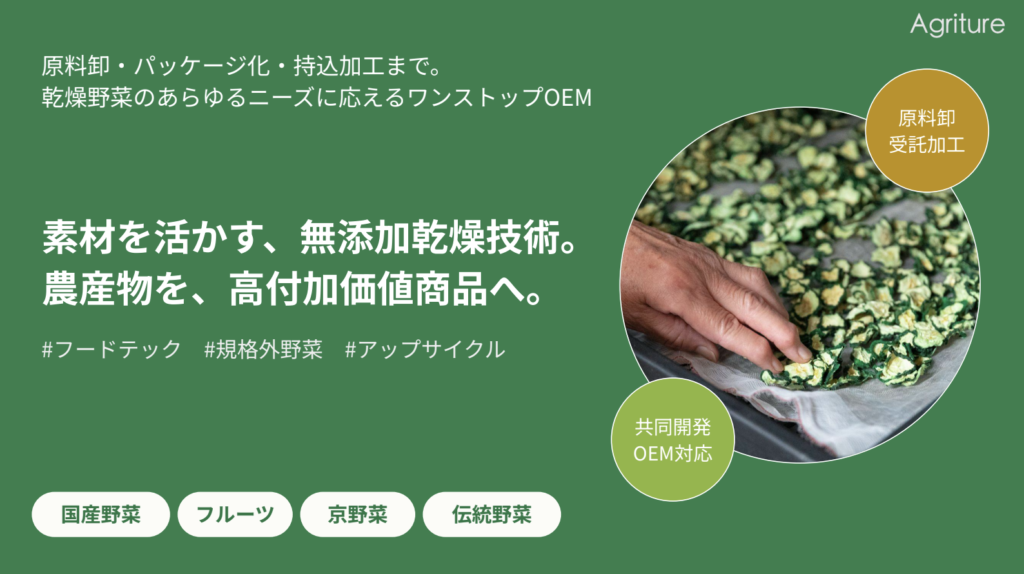
- OEM available from small lots of 10 kg
- Drying of brought-in raw materials also possible
- Support from processing to filling in one place
FOR BUSINESS
乾燥野菜のOEM・受託加工を承ります
国産の野菜・果物の乾燥、100メッシュ相当までの粉砕、10g以上の小袋充填までをお受けしています。小ロットの試作から量産までご相談ください。寄せられた相談の実例は OEM・卸のご相談 に掲載しています。
乾燥品の賞味期限は、出荷日から6ヶ月程度を目安にご案内しています。
FAQ
What is the minimum lot for black tea OEM?
As a rough guide, around 500 units for ready-made plus a label change, 1,000 to 3,000 units for a semi-custom blend, and from 5,000 units for full custom (specifying the tea leaves). Original packaging printing carries a separate minimum lot of 1,000 to 3,000 units.
From what point can an original blend be designed?
The process runs concept decision, then origin selection of the base tea leaves, then selection of flavor ingredients, then prototyping, then fine tuning. For small lots we can work by changing the ratio of existing tea leaves, while full custom is designed from origin and cultivar. Cafe and D2C brands often choose the former, and tourist souvenirs and regional brands the latter.
Can regional ingredients (Japanese ingredients, fruit) be blended in?
Yes. We are seeing more inquiries about regional black teas that blend in Japanese ingredients or fruit such as cherry blossom, yuzu, matcha, black soybean, brown rice, and freeze-dried strawberry. Agriture can take part through supplying ingredients such as Kyotango-grown freeze-dried strawberry and through formulation design.
Tea bag or leaf, which should I choose?
Tea bags suit D2C, gifts, cafe retail, and office use, while leaf suits premium, specialty shops, and canned messaging. It is easier to decide based on customer base, sales channel, and price range, and many brands run both in parallel as a lineup.
Where can I consult about black tea OEM?
Because Agriture itself is not a black tea manufacturing plant, for black tea OEM we introduce registered manufacturers through Shokuhin OEM no Madoguchi (foodoem.jp). If you want to use Agriture's ingredients in a regional blend, Food OEM no Madoguchi (Agriture) Please consult us.
Summary
An original black tea OEM blend is decided along four axes: selection of origin tea leaves, flavoring, format (tea bag / leaf / bottle), and packaging. From 500 units for ready-made plus a label change, and from 5,000 units for full custom, the design freedom scales with the lot. Combining origin, blend, and regional ingredients is what drives differentiation.
Related article: Flavored tea development・Flavored coffee OEM・Freeze-dried ingredients. For black tea OEM manufacturer introductions, use Food OEM Directory, and for regional ingredient blending or collaboration teas using Agriture's Kyotango-grown ingredients, Food OEM no Madoguchi (Agriture) is the way to reach us.
Download the OEM contract processing materials
We will send the materials to your email address based on the information you provide.
If you are considering product development with off-spec or your own farm's vegetables:From planning to processing, materials, package printing and novelties, you can consult us through a single point of contact. → Learn more about one-stop product development
- Whole Freeze-Dried Strawberry | Uses in Confectionery and Preventing Breakage
- How to choose commercial vegetable dashi: comparing across three axes of ingredient, format, and scope
Author of this article
Related articles
-
 Original coffee marketing strategy | Ways to grow sales
 -
 ベジタリアンとは?国の規格が分けている4つの区分と食べられないもの
 -
 長ねぎと白ねぎは同じもの?ねぎの種類と呼び名を国の資料で確かめる
 -
 柚子の種類は何種類あるのか、公の資料で名前が残る系統を数えた
 -
 ゆずの時期は年に二度、青ゆずは7月から黄ゆずは10月から
 -
 ゆずの産地は高知が半分を占め、二位は徳島から愛媛に変わった
 -
 Preventing Food OEM Failures: Common Failure Cases and Countermeasures for Success
 -
 How to find a food OEM | How to efficiently find the best manufacturing partner