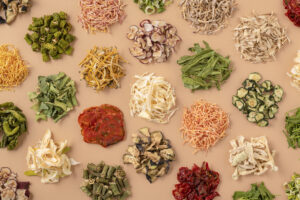
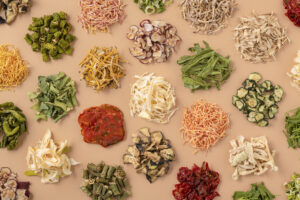
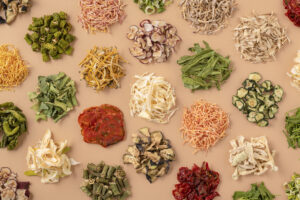
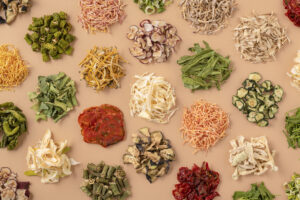
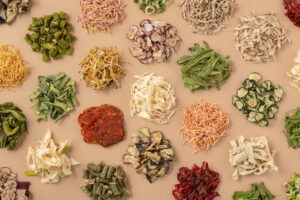
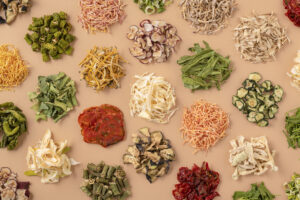
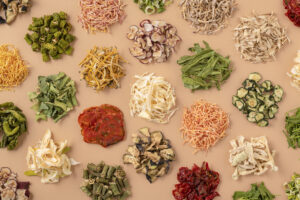
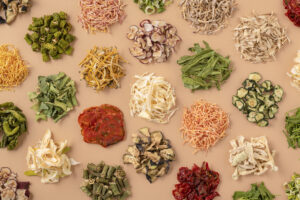
Dried vegetables (hoshi-yasai)

TOC
What Are Hoshi-Yasai (Sun-Dried Vegetables)?
Hoshi-yasai refers to processed vegetables whose water has been removed by sun-drying to improve shelf life and umami. Since before refrigerators and freezers became common, it is one of the traditional preservation methods, and drying concentrates sweetness and umami while also changing the texture.
In the food industry and agricultural sectors, commercial sun-dried vegetable raw materials are also used, aiming to reduce the disposal of harvested vegetables and improve transport efficiency. Especially today, reappraisal is advancing alongside rising demand for natural foods, disaster stockpiling, and the outdoors.
English notation: dried vegetables
Furigana: Hoshiyasai
Characteristics and Background of Sun-Dried Vegetables
The origins of sun-dried vegetables are old, made as staple side dishes in homes and farming villages since before the Edo period. Especially in regions where vegetables become hard to obtain in winter, kiriboshi daikon and dried shiitake, dried sweet potato, and the like took root as household wisdom. took root.
By drying, the workings of the enzymes and microorganisms contained in vegetables are curbed, enabling long-term storage. Also, because natural drying by sunlight and wind changes the nutritional value and flavor, they have been prized in the fields of yakuzen and shojin cuisine as well.
Today, though they declined for a time, pushed out by frozen foods and processed goods, demand has revived as additive-free-minded, raw-food, and outdoor ingredients. "Sun-dried vegetables usable as-is without rehydrating," suited to modern cooking styles, have also appeared.
Examples of Sun-Dried Vegetable Use at Agriture
At Agriture, we roll out a sun-dried vegetable (dried vegetable) series using domestically grown vegetables centered on Kyoto Prefecture. Centered on heirloom vegetables whose texture and flavor change with heating (Kujo negi, Kamo eggplant, Shogoin daikon, and the like), we carry out product design themed on the "rediscovery" of ingredients. we carry out.
Also, as OEM and commercial raw material, we design with consideration down to the flavor and texture characteristics after rehydration, and receive many inquiries from restaurants and food manufacturers. Sun-dried vegetables also shine at sites where shelf life, transportability, and cooking flexibility are demanded.
Related keywords
Kiriboshi daikon
Dried vegetables
Sun-drying
Preserved food
Related articles
Why Dried Vegetables Now? 5 Benefits Beyond Just Convenient and Nutrient-Concentrated
Dried Vegetable (Sun-Dried Vegetable) Onigiri Project | Held Every Tuesday in Kikukawa, Tokyo
FAQ
Q. What's the difference between sun-dried vegetables and dried vegetables?
A. There's no strict definition, but "sun-dried vegetables" often refers to processing by natural drying (sun-drying and the like), while "dried vegetables" has a broad meaning that also includes machine drying. has.
Related article: What's the difference between sun-dried vegetables and dried vegetables?
Q. Can sun-dried vegetables be eaten as-is?
A. Some sun-dried vegetables (dried tomato, dried carrot, and the like) can be eaten as-is, but many require rehydration in water or heated cooking. Since it varies by ingredient, check the product labeling.
Q. What happens to the nutritional value of sun-dried vegetables?
A. Vitamins decrease somewhat, but because dietary fiber, minerals, and umami components are concentrated, there are also many nutritionally excellent aspects.