
22 Companies Including Kagome Launch the "Vegetable-Shortage Solution Idea Contest 2026 for Those in Their 20s"—The Reality of 218g for Men and 210g for Women in Their 20s, Recruiting University-Born Solutions with 500,000 Yen in Total Prizes
Office
Dried vegetables
Health
Health management
Placed Vegetables
Non-standard vegetables
Vegetables
Vegetable deficiency

The "Vegetable Intake Promotion Project" (22 participating companies), for which Kagome Co., Ltd. serves as secretariat, opened entries for the "Vegetable Deficiency Relief Idea Contest 2026 for People in Their 20s" on March 2, 2026, targeting students enrolled at universities, graduate schools, technical colleges, and vocational schools nationwide. The entry period runs through August 31, and the final judging is on November 18. Total prize money is 500,000 yen, with 300,000 yen for the top award. It aims to break the serious situation—vegetable intake among people in their 20s stands at 218g for men and 210g for women against the 350g target—through ideas for products, services, and promotions.
TOC
The Full Picture of the Contest and the 22-Company Framework
This contest was first held in 2025, when 5 teams won out of 169 entries. 2026 is the second edition, expanded in scale by resetting the challenges and adding participating companies. Submissions are up to 5 PDF pages (within 5MB), accepted via Google Forms. Handwritten materials are also allowed, making it easy to join even for students with no startup experience.
Entry Guidelines and Prize Structure
| Item | Details |
|---|---|
| Organizer | Kagome Co., Ltd. (Vegetable Intake Promotion Project secretariat) |
| Participating companies | 22 (a cross-industry consortium spanning food, retail, and health) |
| Audience | Students aged 18 or older (university, graduate school, technical college, vocational school) |
| Team composition | From one person to multiple members |
| Entry period | March 2 – August 31, 2026 |
| First-round results | Early October 2026 |
| Final judging | November 18, 2026 |
| Total prize money | 500,000 yen |
| 1st / 2nd / 3rd | 300,000 yen / 100,000 yen / 50,000 yen |
| 4th / 5th | 30,000 yen / 20,000 yen |
What It Means for "22 Cross-Industry Companies" to Collaborate
The Vegetable Intake Promotion Project launched in 2020 with 19 companies and later expanded its membership. It is designed to intervene in everyday life by combining touchpoints across retail, food service, healthcare, and media to reach groups that food makers alone struggle to reach. It already operates shared infrastructure such as "VegeCheck®" (a palm-measurement device, over 1,500 units installed cumulatively) and the "Vegetable Maestro Certification" (for employees, obtained by over 1,600 people), and the contest sits on that continuum.
Why Is Vegetable Deficiency Among People in Their 20s Stuck at "60% of Target"?
The vegetable-intake target in the Ministry of Health, Labour and Welfare's "Health Japan 21 (3rd Edition)" is 350g a day, but per the 2023 National Health and Nutrition Survey the all-ages average is just 256.0g (262.2g men / 250.6g women). Limited to those in their 20s, it hovers at 218g for men and 210g for women—around 60% of target. Intake among women in their 20s worsened from the prior year, and vegetable avoidance among the young is becoming a structural issue.
Comparison of Generational Gaps and Shortfall
| Category | Daily intake | Gap from target | Target achievement rate |
|---|---|---|---|
| Target (Health Japan 21) | 350g | — | 100% |
| All-ages average | 256.0g | −94.0g | 73% |
| Men in their 20s | 218g | −132g | 62% |
| Women in their 20s | 210g | −140g | 60% |
The Causes of the Shortfall: "Prep Hassle" and "Storability"
In surveys by MAFF and food-sector think tanks, the top reasons people in their 20s don't eat vegetables are "no time to cook," "they spoil in the fridge," and "I rarely cook for myself." With more people living alone and working from home, the share of households buying fresh vegetables twice a week or more stays lower than for other generations. Short shelf life and the stress of discarding what can't be finished emerge as the two big drivers of vegetable avoidance.
Reactions from the Industry and Experts
From the Food-Distribution Front
Summing up the tone of food-industry and distribution trade papers, the standout points on a contest-format approach are that "one-off awareness campaigns don't reach people in their 20s" and that "an ecosystem is needed to implement student-born ideas through companies' sales channels." At past "Let's Eat Vegetables Forums," 113 initiatives were held cumulatively, generating information reach to about 78 million people and hands-on experiences for 70,000.
Interest from Universities and Educational Institutions
In food-science and business-administration seminars, there is a move to build this contest into practical coursework. Of the 169 entries at the inaugural 2025 event, about 40% were reportedly cross-faculty teams, and cross-disciplinary proposals spanning nutrition, marketing, and design are increasing.
Voices from Corporate Health-and-Productivity Officers
Among the project's supporting companies, such as Omron Healthcare, some have run inter-company challenges where employees compete on vegetable intake, blood pressure, and step counts. Health-and-productivity officers offer the practical assessment that "linking visualized vegetable intake with the in-house benefits menu raises the continuation rate among employees in their 20s."
The "Realistic Answer" to Filling the Vegetable Gap for People in Their 20s—Keeping Dried Vegetables in the Office
As an approach that solves the twin challenges of prep time and storability at once, keeping dried vegetables in the office is working on the ground. The dried-vegetable brand operated by Agriture, OYAOYA, offers "Office Yaoya," a benefits plan that stocks offices with over 100 kinds of dried vegetables upcycled from off-grade Kyoto-grown produce.
Features of Office Yaoya
| Item | Details |
|---|---|
| Product mix | A lineup on the order of 100 kinds, centered on dried vegetables |
| Raw materials | Off-grade vegetables grown by producers in Kyotango and Kyotamba, Kyoto |
| Processing | Dried and cut at our own plant in Kumihama, Kyotango |
| Shelf stability | Long-term storage at room temperature. No refrigeration needed |
| Prep time | A few minutes to rehydrate in water or hot water. Can go straight into soups and miso soup |
| Best-before date | 6 months from the date of manufacture |
| Positioning | A placed-in-office service for employee benefits and health-and-productivity management |
Three Advantages That Tie Directly to "Vegetable Deficiency Relief for People in Their 20s"
First, it is free of constraints on cooking skill or time. Just adding a pinch of dried vegetables to cup miso soup or instant noodles tops up 30–50g of vegetables per meal. Second, it produces no waste loss. It avoids the guilt of letting fresh vegetables rot when living alone. Third, the story of upcycling off-grade vegetables connects with Gen Z's sustainability orientation.
In Agriture's experience, employees in their 20s at companies that have adopted it consistently tell us things like, "I no longer feel guilty about spoiling vegetables in the fridge," and "I've started sprinkling it on my convenience-store lunch." As a reference for contest entry themes, office-stocked design built around everyday life is a strong axis to consider.
A product catalog that shows around 100 items we handle
Agriture, flexibly handling everything from small lots to large lots
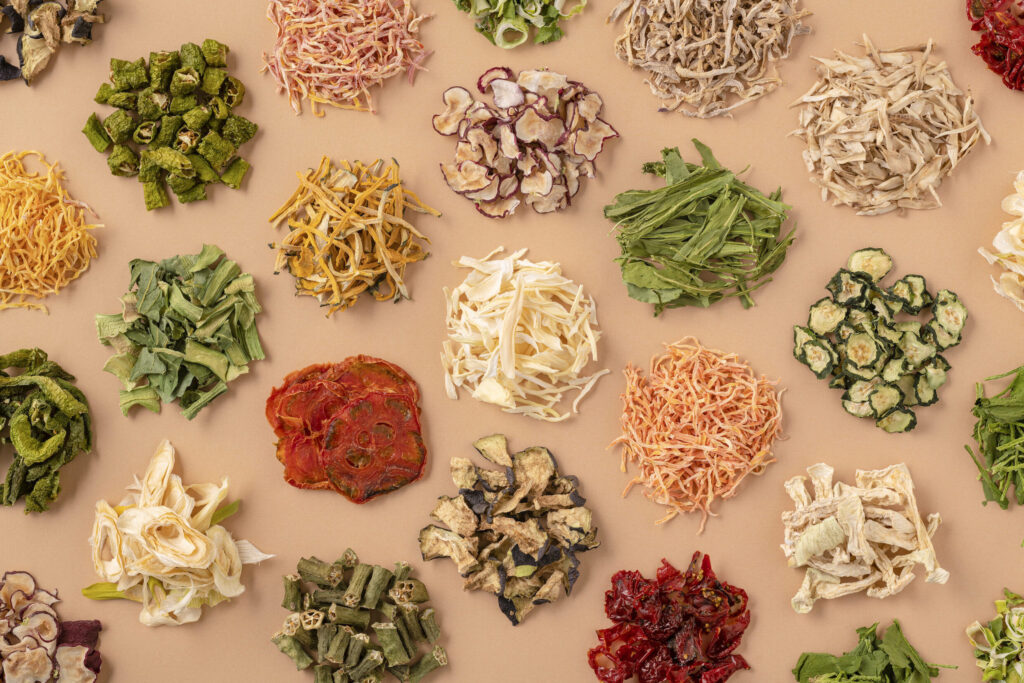
- Available for purchase in small lots from 1 kg
- We handle heirloom vegetables from across Japan
- Dried fruit and herbs also supported
Ripple Effects on the Industry—The Vegetable-Deficiency Market Starts to Move
The Formation of a "Health & Productivity Management × Vegetables" Market
Under METI's Health & Productivity Management Outstanding Organization program, efforts on nutrition and diet are built into the evaluation items. Placed-in-office vegetable and fruit supply services—Yasai Deli, OFFICE DE YASAI, OYAOYA's "Office Yaoya," and others—have entered a landscape where each divides the market on its own strength (fresh, cut, or dried). Adoption is spreading, led by IT and startup firms with a high share of employees in their 20s.
Demand for Upcycling Off-Grade Vegetables
According to MAFF surveys, off-grade vegetables at the production site amount to several to over ten percent of total shipment volume. Redirecting these to office supply is drawing attention as a structure that solves food-loss reduction and young people's vegetable intake at once. Turning 110,000 Tons of Off-Grade Asahikawa Potatoes Into Ice Cream is another case that is part of the same current.
The Link to Food-Loss Reduction
The Ministry of the Environment has announced FY2023 food loss at 4.64 million tons, and upcycling off-grade vegetables at the production and distribution stages enjoys a policy tailwind too. For details, see Ministry of the Environment Announces FY2023 Food Loss at 4.64 Million Tons.
Practical Entry Information
| Item | Details |
|---|---|
| Contest name | Vegetable Deficiency Relief Idea Contest 2026 for People in Their 20s |
| Organizer | Kagome Co., Ltd. "Vegetable Intake Promotion Project" secretariat |
| How to enter | Enter via Google Forms. Submissions up to 5 PDF pages (within 5MB) |
| Audience | Students aged 18 or older enrolled at universities, graduate schools, technical colleges, or vocational schools |
| Team | From one to multiple members (mixed schools and faculties allowed) |
| Entries open | March 2, 2026 |
| Entry deadline | August 31, 2026 |
| First-round results notice | Early October 2026 |
| Final judging and awards | November 18, 2026 |
| Total prize money | 500,000 yen |
| Inquiries | yasaiwotorou-idea@glider-associates.com |
Summary—A Perspective for Making the Contest "Your Own"
The figures of 218g for men and 210g for women in their 20s mean a shortfall of 132–140g against the 350g target. If the prep time and storability of fresh vegetables are the wall, it is worth returning entry ideas to a design that meets three conditions: "zero cooking," "high storability," and "no waste loss." Keeping dried vegetables in the office and upcycling off-grade vegetables are realistic answers already running in the market. Student entrants can raise their odds of passing by tackling this with ideas that can be drawn all the way to the implementation phase, not desk-bound awareness plans.
As related currents, Delta International's Off-Grade Mandarin Marumaru Mikan Launches in April and and JA Kumamoto Keizairen's Case of Using Off-Grade Vegetables are worth reading together to see hints for vegetable appeals aimed at people in their 20s in fuller relief.
Source
- Kagome Co., Ltd. press release (PR TIMES, March 2, 2026) https://prtimes.jp/main/html/rd/p/000000379.000099065.html
- Ministry of Health, Labour and Welfare, "Overview of the Results of the 2023 National Health and Nutrition Survey"https://www.mhlw.go.jp/stf/newpage_45540.html
- Kagome Co., Ltd., "About the Vegetable Intake Promotion Project"https://www.kagome.co.jp/statement/health/yasaiwotorou/project/interview/about/
- Delta International Releases "Marumaru Mikan," Off-Spec Mandarins Bottled Whole, on April 4—Upcycling Kyushu-Grown Satsuma Mandarins with a Hand-Peeling Method
- VegProject brings 12 companies together at “VEG FOOD EXPO 2026”—April 15–17 at Tokyo Big Sight, with a new vegan selection area and over 50,000 visitors expected
Author of this article
Related articles
-
 Certified Health and Productivity Management Organizations Expand Further: Why Food Has Become the Top Theme
 -
The global cost of food waste surges to USD 540 billion—3 measures agriculture and the food chain should tackle right now
-
Too Good To Go, the Domestic Supermarket Industry's First Adoption—Starting at 2 Super Value Stores in Tokyo, Reducing Prepared-Food Loss at Up to 50% Off
-
JA Kumamoto Keizairen Regenerates Blemished Vegetables into Washi Lights—"Tomoru Oyasai" Starts Crowdfunding on Makuake Today
-
The Day Discarded Whey Met the Peach | The Challenge of Yamanashi's KEIPE and Kiyosato Milk
-
Seven Adopts Off-Spec Toyama-Grown Komatsuna—Reducing Food Loss with Onigiri Using Overgrown Vegetables
-
Non-standard vegetable snack “Blue blossom” exhibits at a welfare event—an angle of “not making welfare something special”
-
Cookies from the "Leaves" of Nijisseiki Pears—Tottori University Students Take 2 Years to Commercialize Them as a Measure Against Abandoned Farmland