Directly tied to improving corporate productivity! Key points for adopting health management

Summary of this article
Health management (kenkou keiei) is a method of managing employee health from a management perspective, proposed by Robert Rosen in 1992. It is an essential management strategy for Japan, where the working-age population is projected to fall to 48 million by 2060. Research at Waseda University has also confirmed a statistical improvement in presenteeism. This explains four benefits, such as productivity improvement and medical cost reduction, and five steps to implementation.
The term "health management" has become common lately. This is not merely part of employee welfare but an idea drawing attention as a corporate growth strategy.
Health management refers to a management method that considers employee health management from a management perspective and practices it strategically. The U.S. management psychologist Robert Rosen proposed it in 1992, and it became widely known in Japan from the late 2000s.
By investing in maintaining and improving employee health, it is expected to raise employees' concentration and performance and create a virtuous cycle of securing and retaining excellent talent and improving corporate image and performance. It is also an effective means for strengthening corporate compliance and risk management.
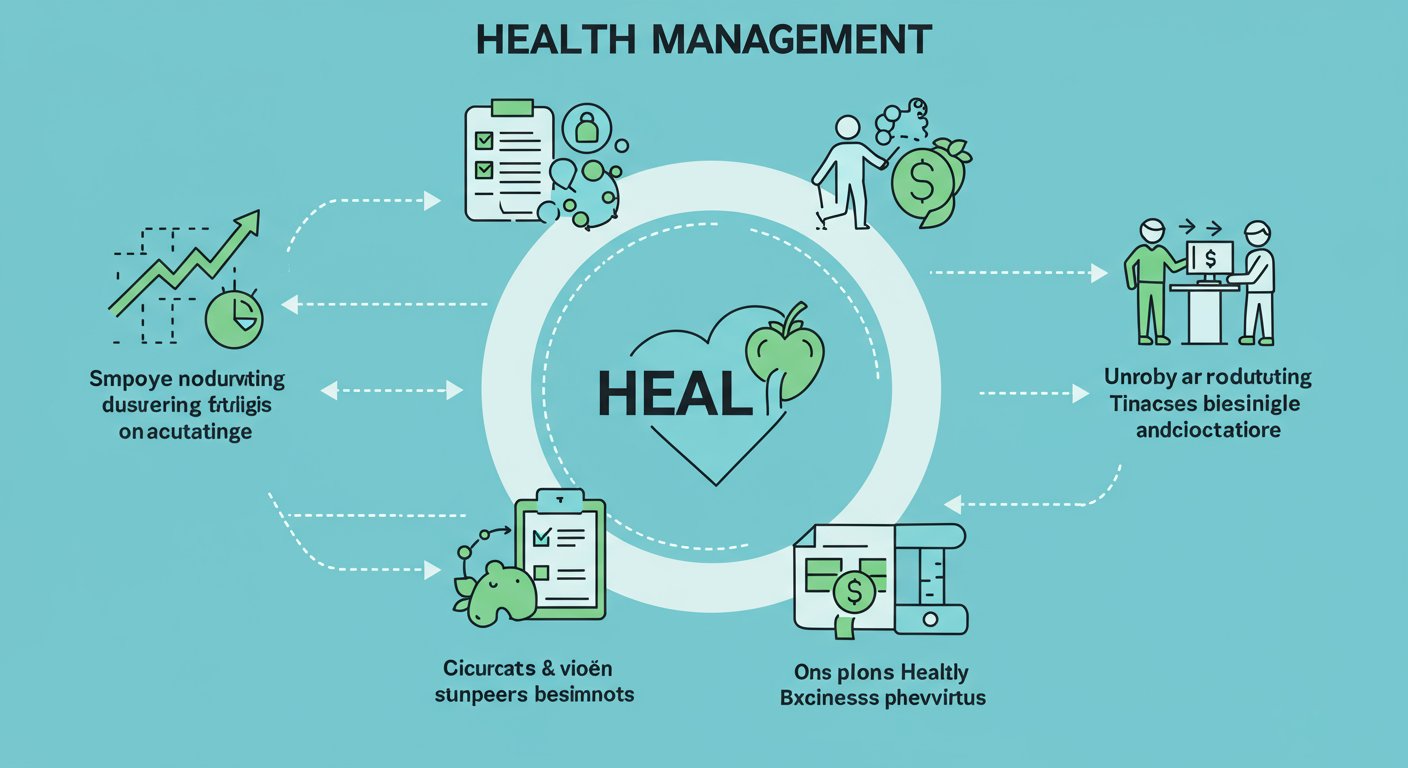
Conversely, in "unhealthy management" where employee health is not secured, a company can fall into a negative spiral of declining motivation and productivity, worsening performance, and a damaged corporate image.
Recommended reading
The background to why health management is required
Why is health management valued now?
The biggest reason is the decline in Japan's working-age population and the aging of employees. In Japan, where the falling birthrate and aging population are advancing, the working-age population has continued to decline from a peak of about 87 million in 1995. This trend will continue, and it is estimated to fall to about 48 million by 2060, roughly 60% of the 2015 level.
At each company, the aging of employees raises the risk of losing valuable talent to illness, and a serious, long-term labor shortage is anticipated. Creating a workplace where employees can work vigorously and for a long time is indispensable to continuous corporate activity.
TOC
Four concrete benefits health management brings
What benefits does working on health management bring to a company? Let us look at them mainly from four perspectives.
1. Improving employee productivity
The most direct effect of health management is improving employee productivity.
In a demonstration experiment of a sleep-improvement program conducted by a Waseda University research team, it was confirmed that presenteeism (a state of coming to work but with reduced productivity due to physical or mental issues) improved with statistical significance among employees whose sleep quality improved. Employees in good health gain higher concentration and creativity, and their work efficiency improves.
Viewed across the whole organization, an increase in healthy employees raises overall work efficiency and leads to improved corporate performance. Being healthy also directly links to improving employees' creativity.
2. Reducing medical costs and leave-of-absence costs
When an employee's health deteriorates, the company bears various costs.
Including invisible costs such as increased health insurance premium burden, the cost of securing replacement staff for those on leave, handover costs, and the secondary health risk from the increased burden on remaining employees, it becomes a very large loss.
If working on health management reduces employees' hospital visits and lightens the health insurance burden, significant economic benefits can be gained.
3. Improving corporate image
Companies that actively work on health management also gain higher social evaluation.
The Ministry of Economy, Trade and Industry has established certification systems called "Health & Productivity Stocks" and "Certified Health & Productivity Management Outstanding Organizations," and in the 2023 "Health & Productivity Stock 2023," 49 companies were selected from 31 industries. Receiving such certification improves corporate image and also leads to acquiring excellent talent.
In an era that values work-life balance, the image of "a company that puts employee health first" becomes a major advantage in recruitment as well.
4. Improving employee engagement
A company investing in employee health is also a message that says, "We value you."
When employees feel "valued by the company," their sense of belonging and motivation for work rise. As a result, this also links to lower turnover and can be expected to prevent talent loss.
Health management should be understood not merely as a cost-reduction measure but as "an upfront investment so that people keep working vigorously at the company in the future."

Steps to implementing health management
By what procedure should you proceed to implement health management at your company? Let us look at the concrete steps along with the points for success.
Step 1: Make a health management declaration
First, it is important for top management to clearly state their intent to "work on health management."
Communicate the health management policy inside and outside the company and make clear that it is a company-wide effort. This declaration prompts a shift in employee awareness and makes it easier to gain understanding of and cooperation with health management.
It is also effective for the awareness shift for managers themselves to take the lead in health-conscious behavior. When top management's seriousness comes through, the whole organization's attitude toward the effort also changes.
Step 2: Grasp the current state and identify issues
To advance health management effectively, accurately grasping your company's current state is essential.
Collect and analyze various data, such as analysis of health checkup data, stress check results, surveys on employees' lifestyle habits, and the status of leave and absence. From the results, identify your company's health issues and clarify the items to prioritize.
Only with a data-based grasp of the current state can you plan effective measures.
Step 3: Set goals and decide evaluation metrics
For the identified issues, set concrete goals and evaluation metrics.
It is important to set concrete, measurable goals, such as "halve the smoking rate in three years" or "reduce those on leave for mental issues by 30%." At the same time, decide the evaluation metrics for measuring goal achievement.
Making goals ambitious yet realistic helps maintain employee motivation.
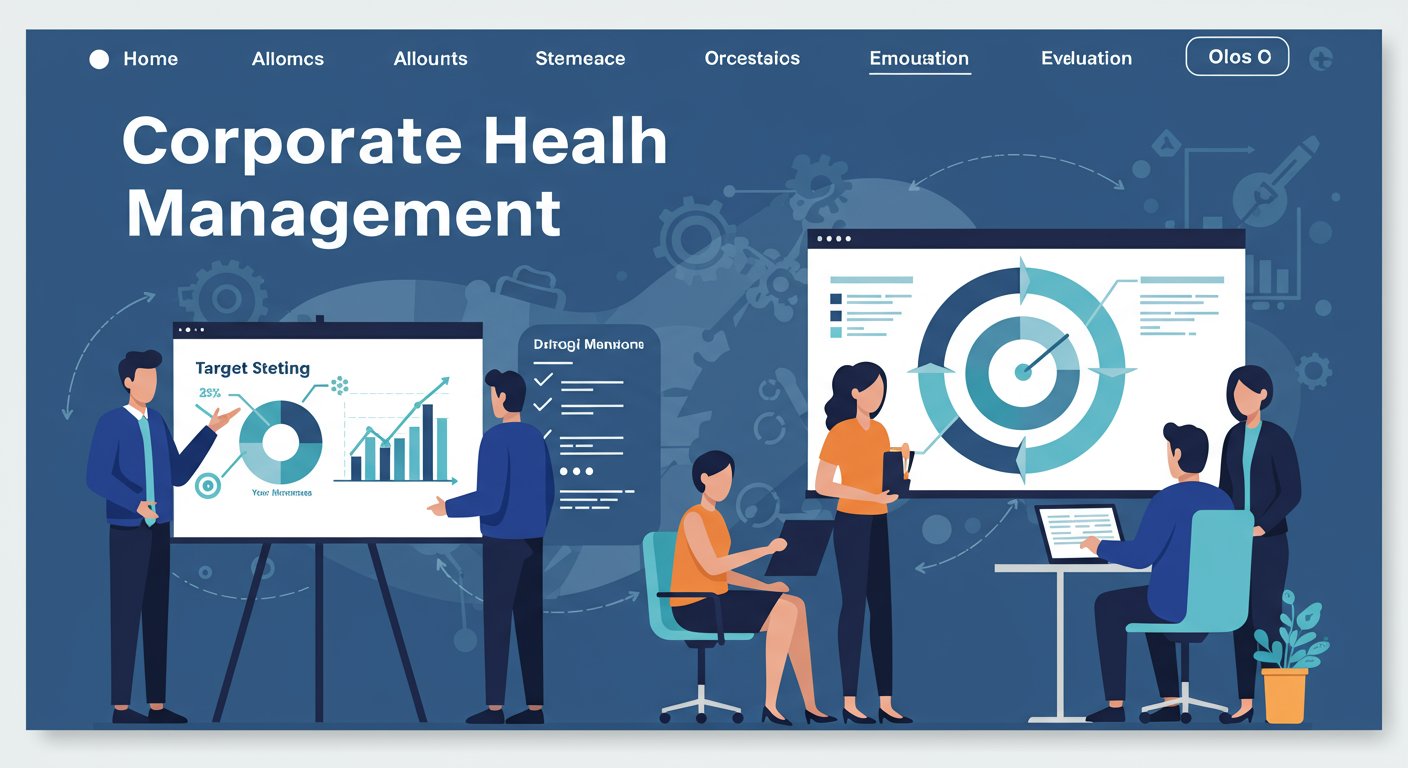
Step 4: Build an execution structure and carry out measures
Put in place an organizational structure to drive health management.
It is effective not only to involve HR and health management departments but to select representatives from each department and build a company-wide driving structure. Gaining the cooperation of experts such as occupational physicians and public health nurses is also essential.
Once the structure is in place, carry out concrete measures toward the set goals. A multifaceted approach is effective, such as promoting exercise, improving diet, mental health measures, and work-style reform.
Step 5: Establish an evaluation and improvement cycle
Health management does not end once implemented; continuous improvement is needed.
Regularly measure and evaluate the effect of measures, and make improvements or introduce new measures as needed. Running the PDCA cycle lets you achieve more effective health management.
Feed back the evaluation results and improvement measures to employees as well, aiming for participatory health management involving everyone.
Practical points for successful health management
There are several points worth grasping to make health management succeed. Let us learn from the cases of companies actually succeeding.
Top management commitment is essential
The success of health management is inseparable from strong commitment by top management.
At Kasama Seihon Insatsu, management and executives actively committed to health management, achieving significant results. Managers themselves communicated the importance of health promotion and took the lead in showing healthy behavior, which also led to a shift in employee awareness.
It is important to share company-wide the recognition that health management is not merely employee welfare but part of management strategy.
Building a participatory mechanism for employees
To spread health management, building a mechanism in which employees can participate proactively is effective.
At Omron, efforts support acquiring healthy lifestyle habits through behavior change. By building a mechanism in which employees themselves set health goals and work toward achieving them, they promote higher health awareness and behavior change.
Rather than compulsion, ingenuity that lets people participate while enjoying it is indispensable to a continuous effort.
Collaboration with experts
To achieve effective health management, collaboration with experts is also essential.
By collaborating with people who have specialized knowledge, such as occupational physicians, public health nurses, and health management advisors, you can plan and carry out more effective measures. Especially at small and medium-sized enterprises, receiving support from outside experts makes effective health management possible even with limited resources.
Using support services provided by local governments and health insurance societies is another approach.
Data-based planning of measures and effect verification
Rather than intuition or assumptions, data-based planning of measures and effect verification is required.
Through data-driven health and productivity management, Shionogi & Co. has achieved improvements in employee health indicators and in employees with mental health issues
Verifying effects quantitatively as well clarifies points for improving measures and lets you achieve more effective health management.
Summary: health management is the key to sustainable corporate growth
Health management is an important management strategy that not only protects employee health but directly links to improving corporate productivity and performance. As talent shortages from the falling birthrate and aging population grow serious, creating an environment where employees can work healthily and for a long time is indispensable to sustainable corporate growth.
Implementing health management requires steps of top management commitment, grasping the current state and identifying issues, setting goals, building an execution structure, and continuous evaluation and improvement. Building a participatory mechanism for employees, collaborating with experts, and data-based planning of measures and effect verification are also points for success.
Health management is not merely a cost-reduction measure but "an upfront investment so that people keep working vigorously at the company in the future." Now is the time to work on health management and create a virtuous cycle in which employees and the company grow together.
Why not take the first step in health management at your company starting tomorrow?