
A guide to preparing for a trade show | Schedule, costs, and checklist

Summary of this article
Trade show exhibit preparation proceeds through 10 staged steps, from goal-setting to after-follow-up. This article explains objective-specific approaches—acquiring new leads, raising awareness, strengthening existing customers—along with selecting industry-specialized trade shows, booth design and preparing back panels and fixtures, listing out printed materials like catalogs, flyers, and novelties, arranging and training staff, and building systems for surveys and business-card management.
Exhibiting at a trade show brings big effects for acquiring new customers and raising awareness. For beginners, though, not knowing where to start can feel unsettling. What you’ll learn from this article:
- A preparation schedule and cost guide for exhibiting
- A preparation checklist by time period (usable as a template)
- A comparison of major food-industry trade shows and how to choose
- Tips for booth traffic, novelties, and follow-up that produce results at a trade show
TOC
The Preparation Schedule for Exhibiting
Trade show Exhibit preparation proceeds in stages, from the exhibit application through after-follow-up. Below is a guide to a general schedule.
| Timing | What to do | Cost Guide |
|---|---|---|
| 6 Months Before | Selecting and applying to the trade show. Clarify your objective (new-lead development, expanding awareness, deepening existing customers) | Exhibit fee ¥100,000–500,000 |
| 4 Months Before | Deciding the booth design and decoration approach. Start arranging back panels, fixtures, and lighting | Booth decoration ¥100,000–300,000 |
| 3 Months Before | Planning and ordering design for handout materials (catalogs, flyers). Selecting and ordering novelties | Printed materials ¥50,000–150,000 / Novelties ¥30,000–100,000 |
| 2 Months Before | Arranging staff and a training plan. Building systems for surveys and business-card management | – |
| 1 Month Before | Confirming the load-in schedule. Final preparation of exhibits. Promotion (email, social media, invitations) | Promotion cost ¥10,000–50,000 |
| 1 Week Before | Load-in rehearsal. Final briefing for staff. Final check of what to bring | – |
| On the Day | Setup → operation → teardown. Handling visitors, collecting business cards, recording photos | – |
| After the Show | Sending thank-you emails (within 3 days). Classifying prospects and following up. Measuring results | – |
For a first-time exhibit, allowing at least four to six months of preparation from application to the day gives peace of mind. Setting the exhibit objective in particular is the very first step, yet the most essential. Depending on the objective—“acquiring new leads,” “raising awareness,” “introducing new products to existing customers,” and so on—the booth design, handouts, and staff training content all change.
With a clear objective, you can also evaluate post-show results by concrete KPIs such as “number of business cards acquired,” “number of meetings,” and “order value.”Common Failure Patterns Checking these in advance too makes it easier to avoid trouble from inadequate preparation.
Objective-Specific Approaches to Exhibiting
The objectives of exhibiting broadly divide into three. Because the focus of preparation changes with the objective, clarify it first.
| Purpose | Preparation to Prioritize | Performance Metric (KPI) |
|---|---|---|
| Acquiring New Customers | Eye-catching booth design, ample tastings and sampling, a system for exchanging business cards | Business cards acquired, meeting appointments |
| Raising Awareness | A back panel that conveys the brand message, a social-media-worthy booth, novelties to distribute | Booth visitors, social media posts |
| Strengthening Relationships with Existing Customers | New product samples on hand, a private meeting space, exclusive offers prepared | Repeat orders, upsell value |
The Exhibit Preparation Checklist
This is a checklist to prevent gaps and omissions in preparation. Please use it as a template.
In trade show preparation, we often hear, “There’s so much to do, I don’t know where to start.” With the following checklist by time period, you can manage the necessary tasks without omissions. Please use it as a template—print it and post it on the wall, or transfer it into a project management tool.
Checklist for 3 Months Before
- Set the exhibit objective and target numbers (business cards acquired, meetings, order goal)
- Finalize the booth size and location
- Plan the booth design and back panel
- List out the products and samples to display
- Write copy and order design for catalogs and flyers
- Select and order novelties (How to Choose Novelties for reference)
Checklist for 1 Month Before
- Divide staff roles and share the day’s schedule
- Create the visitor survey
- Prepare a business-card management tool (app or paper file)
- Send invitation emails and social media announcements
- Confirm the load-in date/time and method
- Confirm the status of supplies such as power, Wi-Fi, and tables
Checklist from 1 Week Before to the Day
- Prepare and pack exhibits, fixtures, and handouts for load-in
- Prepare staff name badges and uniforms
- Final check of the day’s items to bring (extension cords, tape, protective materials, etc.)
- Arrange the teardown schedule and vehicles
- Create a template for the same-day thank-you email to visitors
How to Choose a Trade Show and a Cost Guide
Major Food-Industry Trade Shows
The food industry holds many trade shows throughout the year. Choosing one suited to your product category and target is required. Because exhibitor recruitment periods differ by trade show, confirm the information early.
| Trade Show Name | Timing | Features |
|---|---|---|
| FOODEX JAPAN | March (Makuhari) | One of Asia’s largest food and beverage shows. Draws many overseas buyers; suited to exhibiting with exports in mind |
| FABEX | April (Tokyo Big Sight) | For prepared foods, ready-made meals, and deli. Centered on exhibits by commercial food and ingredient makers |
| ifia JAPAN | May (Tokyo Big Sight) | A specialized show for food ingredients and additives. For raw-material makers and functional foods |
| Premium Food Show | February (Makuhari) | Specializing in high-value-added foods. For the gift and gourmet markets |
| West Japan Food Industry Creation Expo | October (Fukuoka) | For food companies in the West Japan area. Many locally rooted business meetings |
Agriture exhibited at FOODEX JAPAN 2025, displaying commercial raw materials of dried vegetables and dried fruit.
On the Agriture site, we compile information on food-industry trade shows. For details such as dates, venues, and exhibit targets, check the trade show information list page. If there’s a trade show you’re considering exhibiting at, gather information early, before the exhibitor recruitment deadline. Success Stories of Exhibiting and The Benefits of Exhibiting. Success Stories of Exhibiting and The Benefits of Exhibiting.
Cost Breakdown for Exhibiting
| Cost item | Guideline | Notes |
|---|---|---|
| Exhibit fee (booth fee) | ¥100,000–500,000 | For one booth (3m × 3m). Varies greatly with the scale of the trade show |
| Booth decoration | ¥100,000–500,000 | Back panel, fixtures, lighting. A simple setup can come in under ¥100,000 |
| Printed materials | 50,000 to 150,000 yen | Catalogs, flyers, business cards. Varies by quantity |
| Novelties | ¥30,000–100,000 | For dried-vegetable novelties, From 500 bags, as fast as 2 weeks available |
| Labor and travel costs | 50,000 to 150,000 yen | 2–3 staff × per diem + travel + lodging |
| Load-in / load-out | ¥30,000–100,000 | Arranging a delivery company. Can be cut with your own vehicle |
For a first-time exhibit with one booth, a total of around ¥400,000–1,000,000 is the guide. To keep costs down, you can keep booth decoration simple and limit novelties to a minimal small lot.
Points for Designing a Trade Show Booth
The booth is your “face” at the trade show. To get the maximum effect from a limited space, keep the following points in mind.
- Back panel: A catchphrase and visual that make clear what the company handles even from 3m away. Keep text large and information pared down
- Fixture and table layout: An open layout facing the aisle. Easy-in, easy-out flow encourages visitors to stop by
- Lighting: Spotlights that brightly illuminate the products. A dim booth overall gets passed by
- Tasting and sampling corner: The single biggest way to draw traffic at food trade shows. Place it at the front of the booth to stop passersby
- Catalog and business card placement: Somewhere visitors can freely take them. Even when all staff are busy with visitors, people can still take information home
Spending ¥100,000–500,000 on booth decoration is common, but for a first-time exhibit, a simple setup is enough. A basic set of back panel + table + spotlights can come in under ¥100,000.
We have materials available to help you understand vegetable-based novelties
Agriture OEM, flexibly handling everything from small lots to large lots
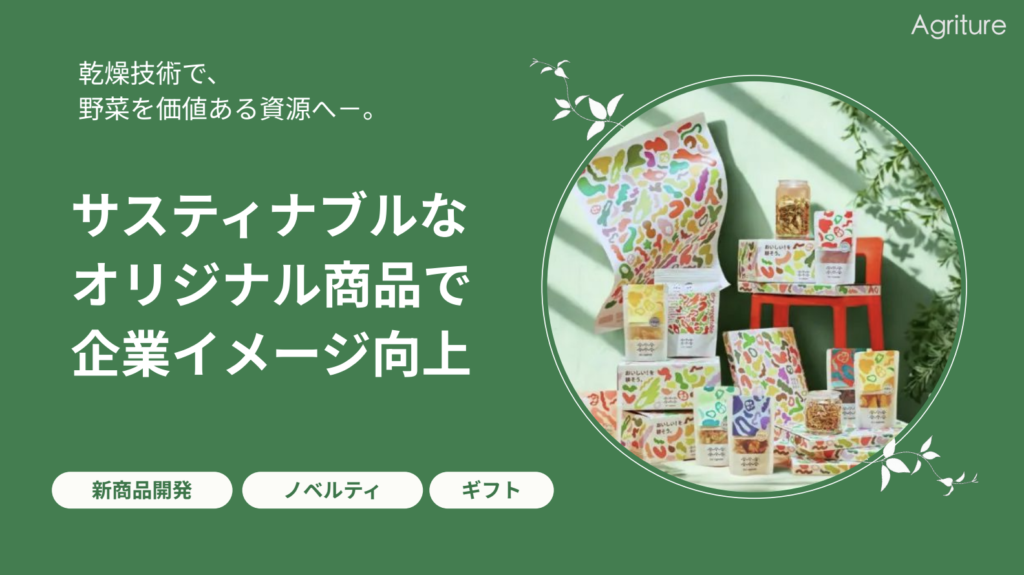
- SDGs-friendly products using non-standard vegetables
- Delivery possible in as short as two weeks
- Small lots from 500 bags
Tips for Producing Results at a Trade Show
Ideas for Drawing Booth Traffic
Because hundreds of booths line up at a trade show, ideas for stopping visitors in their tracks are essential. At food trade shows in particular, tasting and sampling are the most powerful ways to draw traffic. “Smell” and “taste” are weapons unique to trade shows that can’t be conveyed on the web, and simply placing a tasting corner at the front of the booth changes how many visitors stop by.
- Visibility: A catchphrase and back panel that make the booth’s content clear even from afar
- Experience: Setting up a tasting and sampling corner. For food, “taste” is the greatest weapon
- Speaking up: Position staff on the aisle side and proactively call out to passersby
- Advance promotion: Announce “We’re exhibiting at ○○ Trade Show” to existing customers and social media followers to encourage attendance
How to Choose Novelties for Trade Shows
Novelties handed out at trade shows are most effective when they’re “lightweight, easy to carry home, and memorable.” Ordinary ballpoint pens and clear folders are practical, but since visitors get the same items at dozens of booths, they’re hard to remember. Items with “surprise” and an “eating experience,” like food novelties, set you apart from other companies.
Agriture's Dried-vegetable novelties handles small bags for trade show giveaways from 500 bags, with delivery in as little as 2 weeks. It has been adopted by major companies such as Nissin Foods and Crecia. How to Choose Novelties and Case Studies.
Post-Show Follow-Up
A trade show’s results are decided not by the number of booth visitors on the day, but by the follow-up afterward. Even if you collect 100 business cards, they won’t lead to meetings without follow-up. When you get back from the trade show, secure time for follow-up ahead of other work.
- Within 3 Days: Send a thank-you email. Touching on what you talked about at the booth makes it memorable
- Within 1 Week: For high-prospect companies, send catalogs or quotes individually
- Within 1 Month: For prospects who responded, propose an appointment
- Post-Show Analysis: Tally business cards acquired, meetings, and closes, and put them to use for the next improvement
Measuring the Effect of Exhibiting
Once you’ve exhibited at a trade show, always measure the effect. Judging “it was worth exhibiting” by numbers rather than gut feeling makes the next exhibit decision and budget-securing go smoothly.
| Metrics | Measurement Method | Guideline |
|---|---|---|
| Business cards acquired | Count with a business-card management app | 50–200 per booth |
| Meetings | Number of concrete consultations at the booth | 10–20% of business cards acquired |
| Order value | Track trade-show-originated orders over 3 months | Target of 3–5× the exhibit cost |
| Cost-effectiveness (ROI) | Order value ÷ total exhibit cost | 300% or more to justify continuing |
Because results often take one to three months to appear, it’s required to set up a mechanism to track not just right after the show but over the medium to long term. Managing them with a “trade-show-originated” tag in a CRM or spreadsheet lets you make a data-backed case when applying for the next budget.
Frequently Asked Questions About Exhibiting
We have materials available to help you understand vegetable-based novelties
Agriture OEM, flexibly handling everything from small lots to large lots
- SDGs-friendly products using non-standard vegetables
- Delivery possible in as short as two weeks
- Small lots from 500 bags
Summary: How to Prepare for a Successful Exhibit
Success at exhibiting is decided by the quality of preparation. The keys are planned schedule management from six months out, preventing gaps and omissions with a checklist, and quick post-show follow-up.
A first-time exhibit always comes with some anxiety, but if you use this article’s checklist as a template and prepare one step at a time, it will surely lead to results. For consultation on novelties to hand out at a trade show, feel free to get in touch.
Download the novelty materials
We will send the materials to your email address based on the information you provide.
If you are considering product development with off-spec or your own farm's vegetables:From planning to processing, materials, package printing and novelties, you can consult us through a single point of contact. → Learn more about one-stop product development
- Food industry trade show trends 2025 | The latest developments to keep in mind
- How to proceed with hometown-tax product development | OEM techniques that make the most of local ingredients
Author of this article
Related articles
-
 Original coffee marketing strategy | Ways to grow sales
 -
 ベジタリアンとは?国の規格が分けている4つの区分と食べられないもの
 -
 長ねぎと白ねぎは同じもの?ねぎの種類と呼び名を国の資料で確かめる
 -
 柚子の種類は何種類あるのか、公の資料で名前が残る系統を数えた
 -
 ゆずの時期は年に二度、青ゆずは7月から黄ゆずは10月から
 -
 ゆずの産地は高知が半分を占め、二位は徳島から愛媛に変わった
 -
 Preventing Food OEM Failures: Common Failure Cases and Countermeasures for Success
 -
 How to find a food OEM | How to efficiently find the best manufacturing partner