
A Complete Guide to Making Original PB Foods: The Steps from Planning to Manufacturing and Sales

Summary of this article
As a complete guide to making original PB foods, we explain the concrete procedures from planning and branding to selecting an OEM manufacturer, from prototyping to full production, and sales strategy. We introduce practical know-how for retailers, restaurants, and startups to roll out their own brand products—target setting, checking HACCP certification, how to choose a contractor that can handle small lots, how to use matching sites, and SEO measures on e-commerce sites.
Have you ever held the wish to make your own brand of food?
Entrants from other industries—retailers, restaurants, startups, and the like—have become conspicuous. Behind this are the expansion of the food OEM market and the establishment of an environment where you can prototype even from small quantities.
But once you try to start, questions arise one after another. Where should you begin? How do you commission the manufacturing? What is the path to sales?
In this article, we explain the concrete procedures for guiding an original food from planning through manufacturing and on to sales. We introduce each step carefully so that even first-timers can proceed without getting lost.

TOC
The first step of original food development | Planning and branding
Food development starts from a clear concept.
The first thing to consider is “to whom, what, and how you deliver.” By deeply understanding the target segment’s needs and combining them with your company’s strengths, a distinctive product is born. Also clarify the points of differentiation from competing products at this stage.
Once the brand concept is set, consider the specific specifications of the product. This is the work of nailing down the details—taste, texture, package design, price range, and so on. Don’t forget the profit plan, either. Estimate the cost ratio, selling price, and projected sales volume, and confirm whether it works as a business.

The potential that market research reveals
Grasping market trends is also essential. What are consumers seeking right now? The values demanded change with the times—health orientation, convenience, environmental consideration, and so on. Use SNS, e-commerce site reviews, industry reports, and the like to gather real voices.
At the same time, assume your own sales channels. Is it mainly mail order, or are you aiming for store sales? The product’s specifications and package design will change accordingly.
"From Instagram to purchase": branding worked backward from Gen Z consumption
The foods Gen Z chooses. An era when environmental consideration becomes brand strength
What is Fair Trade? The latest 2025 trends and future outlook
Put the product concept into words
Put the concept into words in a form anyone can understand.
By clarifying “what issue it solves” and “what experience it provides,” explanations to manufacturing partners and sales destinations also become smooth. Organizing it as a brand story lets you use it in marketing, too.
How to choose a food OEM manufacturer | Finding a partner you can trust
When outsourcing manufacturing, the choice of OEM manufacturer determines success or failure.
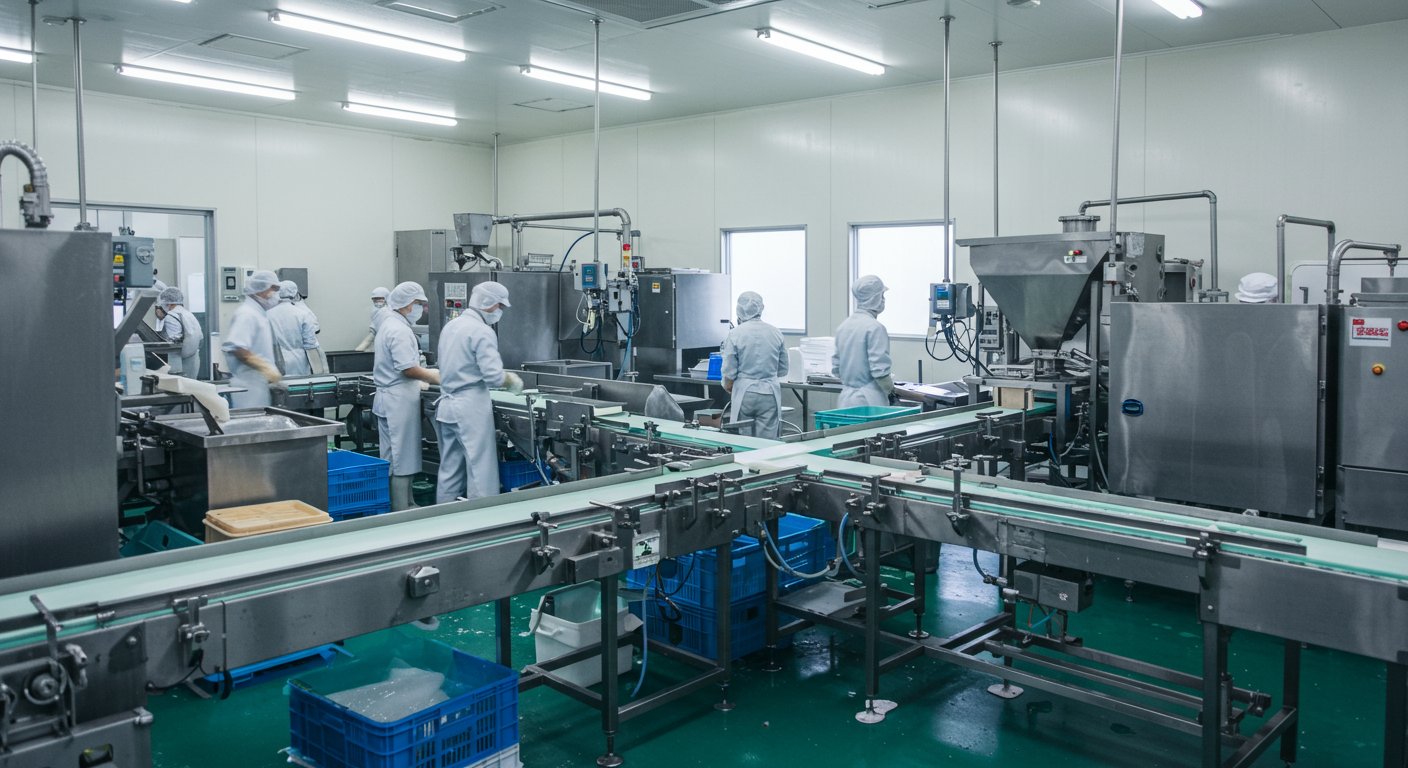
Manufacturers specializing in food OEM are increasing, and there are many companies with small-lot capabilities and special processing technologies. Finding a partner with the technical capability and responsiveness suited to your product is the key to smooth development.
Five points for selecting an OEM manufacturer
The first thing to check is the safety and quality-control system. Food goes directly into consumers’ mouths. Firmly check whether hygiene management is thorough and whether the manufacturing environment is appropriate. HACCP and ISO certification Its acquisition status is also a useful reference.
Next, technical capability and track record. Confirm whether they have the processing technology to reproduce the taste and texture your company seeks, and whether they have a track record of manufacturing similar products. A track record of dealing with major manufacturers If they have it, it can be called proof of reliability.
Cost is also an important factor. If the cost ratio is too high, the selling price rises and you lose competitiveness. Take quotes from multiple manufacturers and compare them. However, choosing on cheapness alone is dangerous. It’s important to judge the balance with quality.
The lot size they can handle also needs to be confirmed. If you want to prototype in a small lot the first time and move to full production after seeing the response, you should choose a manufacturer that can handle small lots. Conversely, if you assume mass production from the start, a manufacturer that can leverage economies of scale is suitable.
Finally, ease of communication. In the development stage, you repeat meetings many times. A manufacturer that responds quickly and flexibly lets things proceed smoothly.
How to use matching sites
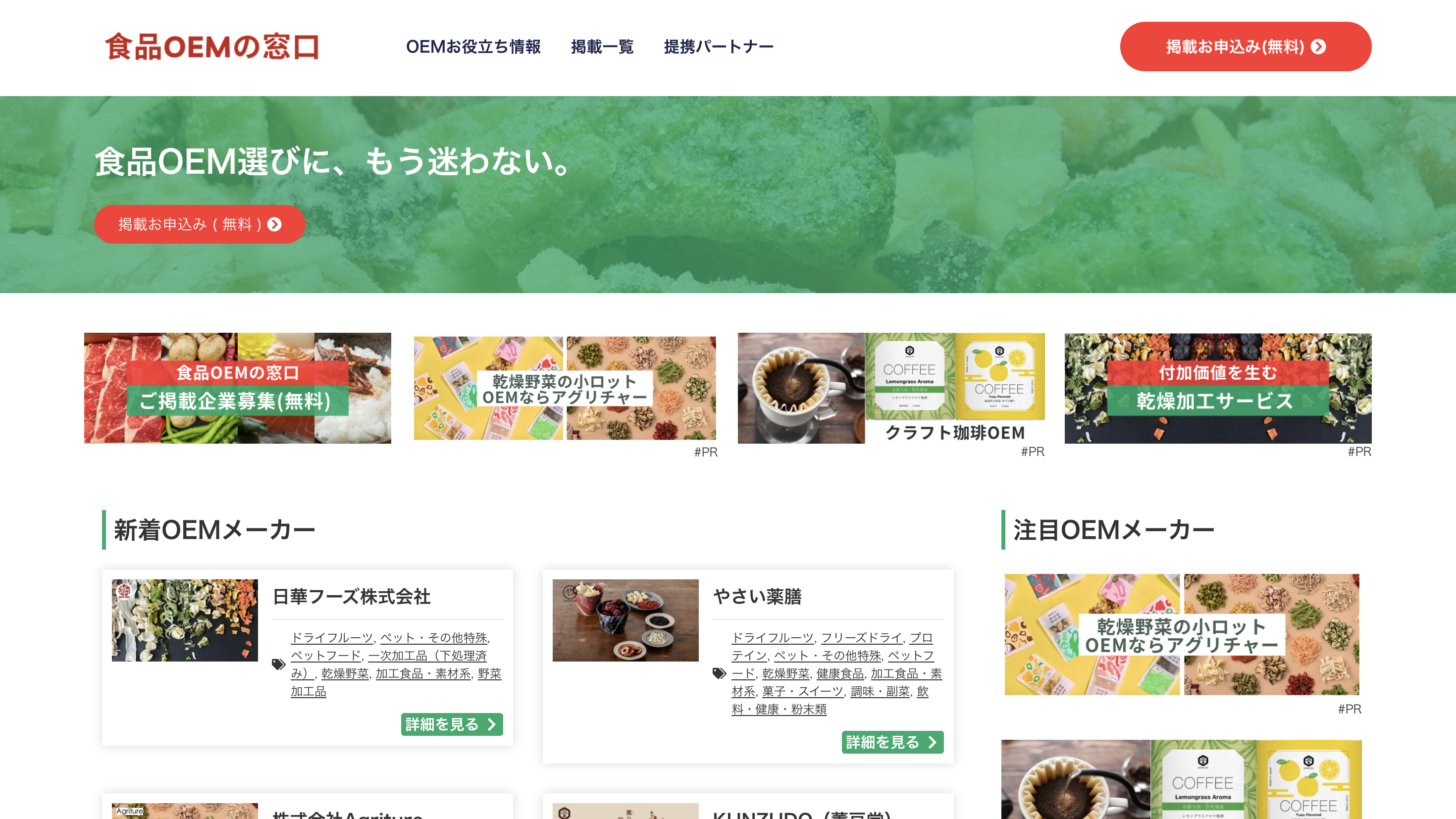
To search for OEM manufacturers efficiently, using a matching site is recommended.
A platform that lets you narrow down by concrete conditions such as “small lot,” “powder processing,” and “domestic ingredient support” lets you find a manufacturer that matches your needs in a short time. Being able to check the listed companies’ information in detail, making comparison easy, is also an advantage.
Before inquiring, organize your requirements. By conveying specifics such as processing details, lot size, delivery date, and budget, the manufacturer can also more easily make an appropriate proposal.
The big picture of the manufacturing process | From prototype to full production
Once the OEM manufacturer is decided, you finally enter the manufacturing process.
Meetings and nailing down specifications
In the first meeting, you share the product details. Convey as concretely as possible—the image of the taste, the texture, the commitment to ingredients, the package design, and so on. If you have a reference product, bringing it makes the image easier to convey.
From the manufacturer’s side, there may be proposals about feasibility or alternatives. Due to technical constraints or cost issues, you may need to adjust the original concept. Respond flexibly while firming up the optimal specifications.
Checking and refining the sample
Once the specifications are set, you proceed to producing samples.
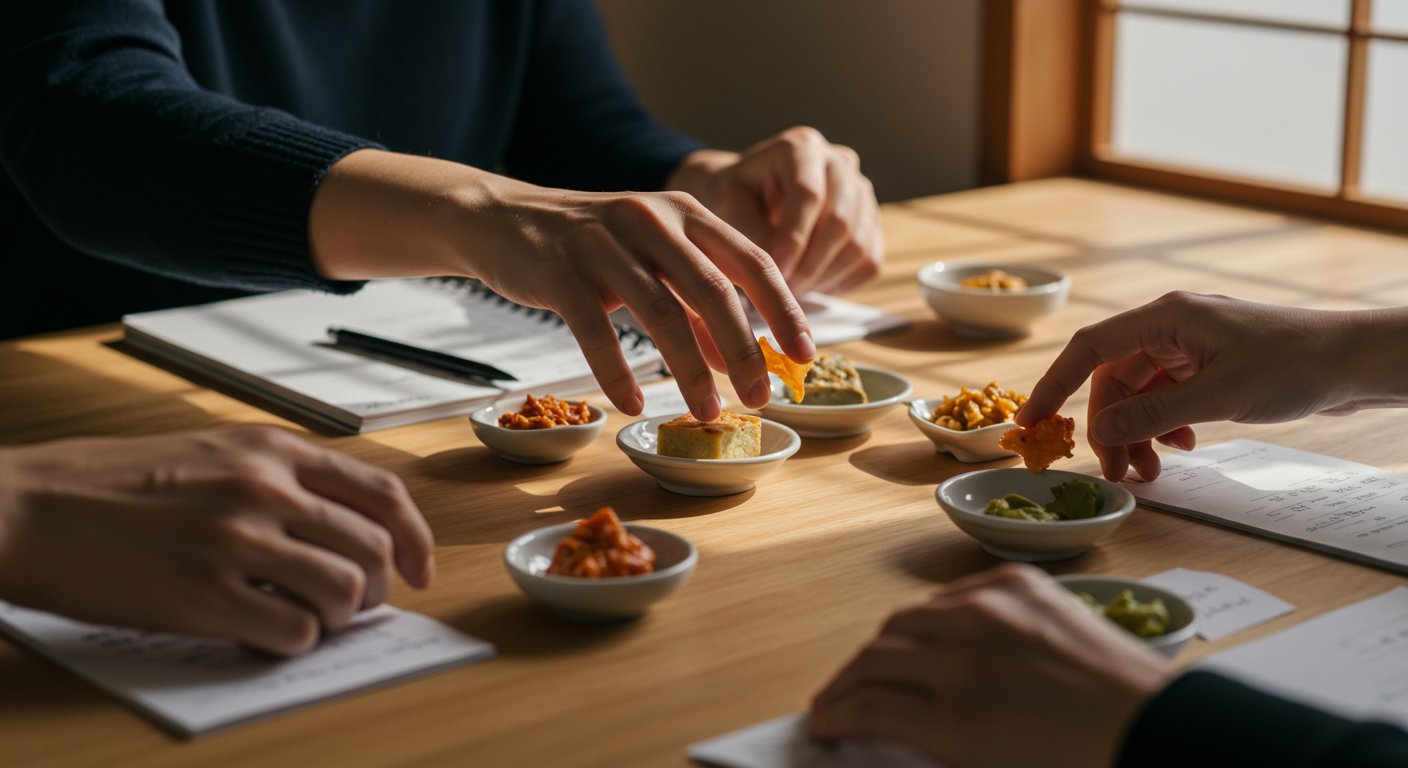
When the first sample arrives, check it closely—taste, texture, appearance, and so on. If there are parts different from your image, give concrete feedback. It’s important to convey clearly, such as “a little sweeter” or “make the texture crunchier.”
Repeat refinements and keep adjusting until you reach a quality you’re satisfied with. Compromising at this stage means regret later. Even if it takes time, finish it as a product you can be satisfied with.
Final quote and ordering
Once the sample is approved, take the final quote.
Confirm the lot size, delivery date, payment terms, and so on, and if there are no problems, place the order formally. Also firmly check the contract contents. In particular, it’s required to make clear the quality guarantee and the response in case of delivery delays.
Full production and after-service
Once full production begins, check progress periodically.
Problems can also arise during manufacturing. To prepare for unexpected situations such as raw-material procurement delays or machine trouble, keep close contact with the manufacturer.
After delivery, too, confirm there are no quality problems. Deciding in advance on the response in case of a defect also gives peace of mind. A manufacturer with solid after-service can be a partner over the long term.

How to build a sales strategy | Practical methods for delivering the product
Even if the product is made, it means nothing if it doesn’t sell. The sales strategy should be advanced in parallel with manufacturing. Through which channel and how will you sell? How will you approach the target segment? Make a concrete plan.
Selling on e-commerce sites and SEO measures
If you make mail order the main axis, building an e-commerce site is essential.
Do you launch your own site, or open a store on a mall such as Amazon or Rakuten? Each has merits and demerits. Your own site has a high profit margin and lets you freely present the brand image. On the other hand, malls have strong customer-attraction power and are advantageous for gaining early awareness.
SEO measures are also essential. Naturally incorporate keywords that are easy to search into the product page’s title and description. Be conscious of words the target segment is likely to search, such as “domestic,” “additive-free,” and “gift.”
SNS and content marketing
SNS is a powerful promotional tool you can start at low cost.
Convey the appeal of the product on Instagram and X (formerly Twitter), and build relationships with followers. Posts with a story, or sharing behind-the-scenes development anecdotes, are effective as empathy-evoking content.
Content marketing—such as blog articles and recipe videos—is also effective. By providing information valuable to users, such as arrangement recipes using the product or health-related information, you can naturally raise interest in the product.

Sales activity toward physical stores and expansion
If you aim for sales at physical stores, sales activity is needed.
List sales destinations suited to the product’s characteristics—supermarkets, specialty shops, select shops, and so on. Bring product samples and proposal materials and negotiate directly. Start from small-scale transactions the first time, and by accumulating a track record, expand your business partners.
Exhibiting at local events and regional product fairs also helps raise awareness. An opportunity to talk directly with consumers is a valuable place where you can also gain hints for product improvement.
Points for success | To make a product loved for a long time
To make an original food succeed, there are several points to keep in mind.
Product development that answers needs
First, accurately grasping market needs. What you want to make and what consumers seek don’t necessarily match. Through market research and test marketing, develop a product that is truly in demand. An attitude of listening to the customer’s voice and repeating refinements flexibly is important.
Price design that emphasizes profit margin
Next, securing the profit margin. If the cost ratio is too high, the selling price rises and you lose competitiveness. On the other hand, if you lower costs too much by dropping quality, repeat customers don’t grow. Judge the appropriate balance and aim for sustainable pricing.
Continuous promotion
Finally, investment in advertising and sales. No matter how good the product, it won’t sell if it isn’t known. It’s required to spare no advertising and promotional expense and keep sending out information continuously. Especially in the early launch period, concentrate on raising awareness.
Word of mouth and reviews are also a great force. Building a follow-up mechanism so purchasers write their impressions is also effective.
Summary | Advance original food development methodically
Original food development goes through many steps from planning to sales.
Clear concept design, selecting a trustworthy OEM manufacturer, a careful manufacturing process, and an effective sales strategy. Not compromising at each stage and advancing methodically is the shortcut to success.
In particular, using a matching site lets you efficiently find an OEM manufacturer that suits your company. By connecting with a manufacturer strong in small-lot support and special processing, it becomes easier to realize your ideal product.
Right now, the food market is diversifying, and new brands are being born one after another. The chance to give shape to your idea and deliver it to consumers is surely expanding.
If you’re interested in developing an original food, why not start by finding a trustworthy OEM partner?
With a food OEM matching site, you can find a manufacturer that matches your conditions. Many companies that can handle small lots are also listed, so even first-timers can consult with peace of mind.
Take the first step toward realizing your ideal product, starting today.
Small-pouch filling and packaging OEM service here
If you are considering product development with off-spec or your own farm's vegetables:From planning to processing, materials, package printing and novelties, you can consult us through a single point of contact. → Learn more about one-stop product development
FOR BUSINESS
乾燥野菜のOEM・受託加工を承ります
国産の野菜・果物の乾燥、100メッシュ相当までの粉砕、10g以上の小袋充填までをお受けしています。小ロットの試作から量産までご相談ください。寄せられた相談の実例は OEM・卸のご相談 に掲載しています。
乾燥品の賞味期限は、出荷日から6ヶ月程度を目安にご案内しています。
- Case studies of vegetable powder use | Success patterns by industry and a framework for adoption decisions
- The Complete Guide to Choosing a Filling OEM | Points for Selecting a Contractor Without Regret
Author of this article
Related articles
-
 Original coffee marketing strategy | Ways to grow sales
 -
 ベジタリアンとは?国の規格が分けている4つの区分と食べられないもの
 -
 長ねぎと白ねぎは同じもの?ねぎの種類と呼び名を国の資料で確かめる
 -
 柚子の種類は何種類あるのか、公の資料で名前が残る系統を数えた
 -
 ゆずの時期は年に二度、青ゆずは7月から黄ゆずは10月から
 -
 ゆずの産地は高知が半分を占め、二位は徳島から愛媛に変わった
 -
 Preventing Food OEM Failures: Common Failure Cases and Countermeasures for Success
 -
 How to find a food OEM | How to efficiently find the best manufacturing partner