
Kansai Food OEM: 6 Steps to Making a New Product and Subsidies

Summary of this article
A complete guide to creating new products with food OEM in Kansai. Why Kansai food OEM is chosen, the Kansai universities and research institutions supporting food OEM, a prefecture-by-prefecture subsidy map for Kansai OEM, the six steps of Kansai food OEM development, brand-case patterns for Kansai food OEM, pitfalls and countermeasures, a list of 48 companies in the Kansai area on Food OEM no Madoguchi, and Agriture's Kansai food OEM support. Everything from the industrial clusters of the six prefectures -- Osaka, Kyoto, Hyogo, Nara, Shiga, and Wakayama -- to subsidies, logistics, and branding, organized end to end.
The strengths of creating new products with food OEM in Kansai lie in the industrial clusters of each of the six prefectures -- Osaka, Kyoto, Hyogo (Kobe), Nara, Wakayama, and Shiga -- the Kinki region's food research institutions, the logistics networks of the Hanshin and Kintetsu lines, Kansai Airport, and the Port of Kobe, and the diversity of regional food cultures. If you plan to advance own-brand product creation for prepared foods, seasonings, health foods, confectionery, beverages, or packaging together with a contractor, the quickest path is to find high-quality Kansai OEM providers from a safety-and-reliability standpoint. Choosing Kansai as "food-development support" that accompanies you from product concept through ingredient sourcing, processing, sales channels, and branding -- not mere OEM manufacturing -- lets you add value that other regions can't offer.
In this article, we cover the Kansai industrial-cluster map, the research institutions and universities handling food-development support, prefecture-by-prefecture subsidy programs, the flow of new-product development and choosing an OEM contractor, product branding born in Kansai, the list of 48 companies in the Kansai area featured on Food OEM no Madoguchi, and the practicalities of Kansai-born new-product development that Agriture supports through its five-site structure spanning Kyotango, Kyoto Prefecture and Nagano, Mie, Ehime, and Okinawa. Related articles: Material processing OEM Kyoto/Food OEM Prototype Cost Reduction/Choosing a food OEM contractor。

TOC
Why Kansai food OEM is chosen
The three reasons to commission food-development support in Kansai are the diversity of industrial clusters by prefecture, the depth of research institutions, and logistics access. Rather than a single "Kansai OEM," understanding the character of each area and choosing accordingly lets you build a development environment that fits your new product's concept.
The food-industry cluster of the Kansai area
- Osaka: As a commercial hub, the center of food trading houses, restaurant chains, and a Kansai-wide sales network
- Kyoto: Kyoto vegetables, Japanese confectionery, pickles, Kyoto cuisine, and other traditional industries and craftsman culture
- Hyogo (Kobe, Himeji): Imported raw materials via the Port of Kobe, Nada sake brewing, Western confectionery, and bread
- Nara: Miwa somen, Yamato vegetables, Yoshino kudzu, and other processing industries for regional ingredients
- Wakayama: Mikan, plum, bonito, and other fruit and seafood processing
- Shiga: Omi beef, lake fish, tea (Tsuchiyama tea, Asamiya tea), and other ingredients of the lake country
Kansai universities and research institutions supporting food OEM
If you aim for functional appeal or technical innovation in new-product development, partnering with Kansai food research institutions and universities is an option. Making a research institution that fits your product's focus an ally lets you build appeal grounded in scientific evidence.
Partnership resources with public labs and universities
Kansai has several public research institutions (public labs) handling food-related research and analysis, as well as agricultural universities, which offer technical consultation and contract analysis for small and midsize businesses. Because the specific support and costs of each institution differ, contacting a prefecture's industry-support center or a public lab's help desk directly is the surest path.
- University agricultural faculties: places to consult about joint research and contract analysis in fields such as food functionality, fermentation, breeding, and food resources
- Prefectural public labs: institutions that take on technical consultation, component analysis, and sensory evaluation for small and midsize businesses, often at lower cost than the private sector
- Prefectural agriculture, forestry, and fisheries technology centers: consultation desks for regional vegetables and processing techniques
Benefits of partnering with public labs and universities
- Contract-analysis fees may be cheaper than the private sector (component analysis, functionality evaluation, sensory testing)
- A joint-research structure can become a competitive edge in subsidy applications
- The context of "joint research with a university or public lab" may be usable in product appeal (subject to each institution's rules)
- The possibility that a product's originality spreads through the industry via conference presentations and papers
FOR BUSINESS
乾燥野菜のOEM・受託加工を承ります
国産の野菜・果物の乾燥、100メッシュ相当までの粉砕、10g以上の小袋充填までをお受けしています。小ロットの試作から量産までご相談ください。寄せられた相談の実例は OEM・卸のご相談 に掲載しています。
乾燥品の賞味期限は、出荷日から6ヶ月程度を目安にご案内しています。
A prefecture-by-prefecture subsidy map for Kansai OEM
Subsidies and grants usable for food-development support in Kansai exist in three layers: national, prefectural, and municipal. Because conditions, adoption rates, and amounts differ by prefecture, the programs you can use change depending on which prefecture you locate your development base in.
Trends in prefectural and municipal subsidies
Because specific program names and conditions change by fiscal year and municipality, check the latest information with each prefecture's or municipality's industry-support center, chamber of commerce, or federation of small business associations. Here we organize the general trends of the programs.
- Regional-ingredient-use type: Using prefecture-grown raw materials (Kyoto-grown, Yamato vegetables, Omi-grown, etc.) above a certain ratio tends to raise the adoption rate
- Sixth-industry type: Programs that encourage matching and joint development between farmers/fishers and processors
- New-product-development type: Subsidizing part of the prototyping, capital investment, and sales-channel development costs of small and midsize businesses
- Linked to employment promotion: In some cases conditioned on combination with hiring or capital investment
Because available programs vary by prefecture, consulting each municipality's industry-support desk early in product planning is the surest path.
Practical points when applying
- Prefectural, municipal, and chamber-of-commerce programs often bar duplicate applications, so prioritize the one with the larger amount
- Meeting regional-ingredient conditions (Kyoto-grown, Yamato vegetables, Omi beef, etc.) raises the adoption rate
- Use free consultation with business advisors and SME management consultants to raise the quality of your application
- Orders and payments before the grant decision are ineligible. Be careful about the timing of the prior application
The six steps of Kansai food OEM development
The flow of creating a new product via OEM in Kansai spans six stages, from concept design to sales-channel development. Using Kansai-specific resources (research institutions, subsidies, industrial clusters) at each step improves efficiency.
Overview of the six steps
| Step | Main activities | Kansai-specific resources to use |
|---|---|---|
| (1) Concept design | Deciding the target, differentiation axis, and price range | Research into Kansai food culture and regional ingredients |
| (2) Ingredient selection and sourcing | Fixing the raw materials, origin, and varieties used | Regional-ingredient routes for Kyoto vegetables, Yamato vegetables, and Omi |
| (3) Contractor selection and prototyping | Choosing an OEM manufacturer and ordering prototypes | Prefecture-by-prefecture OEM clusters and subsidy use |
| (4) Functionality research and analysis | Component analysis, functionality evaluation, sensory testing | Partnership with public labs and universities |
| (5) Mass production and quality control | Establishing the production line and setting quality standards | Certified-factory clusters and the Kansai logistics network |
| (6) Sales-channel development | E-commerce channels, mass retailers, department stores, overseas | Export routes via Kansai Airport and the Port of Kobe |
Brand-case patterns for Kansai food OEM
For a Kansai-born new product to succeed at differentiation, the design changes depending on which axis you center on: the regional story, the ingredient story, or the cultural story. We organize the representative branding patterns.
Three branding axes
- Regional-story type: With "Kyoto x ___" or "Kobe x ___," the place name is the product value itself (e.g., Kyoto Japanese confectionery, Kobe Western confectionery)
- Ingredient-story type: Making the most of an ingredient's inherent brand power, such as "Yamato vegetables," "Omi beef," or "Kishu plum"
- Cultural-story type: Carrying cultural background into the product, as in "long-established, ___ generation" or "artisan for ___ years"
The Kansai version of sales-channel and distribution design
- Department stores and station buildings: Expand sales channels for Kansai-born brands at Hankyu, Takashimaya, Daimaru, and JR Osaka Station
- Tourist souvenir: Souvenir routes around Kansai International Airport, Shin-Osaka Station, Kyoto Station, and USJ
- Overseas export: Shipping to Asia via Kansai Airport and to Europe and North America via the Port of Kobe
- E-commerce and D2C: Applying the know-how of Kansai-born D2C brands (OYAOYA, dry-pear, etc.)
Pitfalls of Kansai food OEM and countermeasures
There are pitfalls easy to fall into when advancing new-product development in Kansai. Preparing countermeasures before you begin development lowers the risk.
Five pitfalls
- Insufficient supply of regional ingredients: Specialty items like Kyoto vegetables and Yamato vegetables have a limited number of producers. Scaling for mass production is difficult
- Seasonality: Regional ingredients depend on their season. Year-round commercialization presupposes freezing, drying, or vacuum packing
- The limits of "Kansai-dialect" branding: In sales channels outside Kansai, too strong a regional flavor can make a product hard to choose
- Conditions for a long-established brand: To claim "long-established ___," you need to state the founding year and its basis
- Osaka-style price negotiation: Kansai has a business culture with tough price negotiation. If the ordering side is in a weak position, price-cut pressure is strong
Agriture's Kansai food OEM support
Centered on its head office in Kyoto City and its manufacturing base in Kyotango, Agriture supports the ingredient processing, prototyping, and mass production of companies and brands looking to commission new-product development in the Kansai region. With a hybrid operation of five manufacturing bases and partner factories, we handle phased scaling from small D2C to major food manufacturers.
Kansai and Kyoto ingredients handled by Agriture
- Kyoto and heirloom vegetables: Kujo green onion, Shogoin daikon, Manganji pepper, Kamo eggplant
- Kyotango: Momotaro tomato (Taniyoshi Farm), beets (Echie Nosan), twentieth-century pear (dry-pear)
- Nara: Yamato vegetables (a purple-pepper powder project with the Miwa Somen Industrial Cooperative)
- Upcycling off-spec vegetables: combining food-loss reduction with regional-ingredient appeal
Project patterns in new-product development in the Kansai region
- Commercializing regional ingredients: For the Nara Miwa Somen Industrial Cooperative, we supported prototype development of a new product, "somen with Yamato vegetables," by supplying Yamato vegetable purple-pepper powder
- Collaboration with a long-established brand: Produced eight dried-vegetable recipe videos with Chef Mikizo Hashimoto of Kai's Chefon (owner of the one-Michelin-star "Ichirin") (February 2026)
- Partnership with a major food brand: Dried-vegetable sets for Nissin Foods' six "Nissin Raoh" flavors (October 2025, Food Loss Reduction Day)
- Benefits and social-value partnership: Dried vegetables for the Kai Group's "Office Yaoya" employee-benefits program
Information for consultations on creating a new product in the Kansai region
- Product concept, target, sales channels
- The regional ingredients you want to use (Kyoto, Nara, Hyogo, Shiga, etc.)
- The new product's appeal axis (regional, ingredient, cultural, functional)
- Plans to use subsidies and grants
- Expected lot and planned launch date
We have materials available to help you understand dried processing OEM
Agriture OEM, flexibly handling everything from small lots to large lots
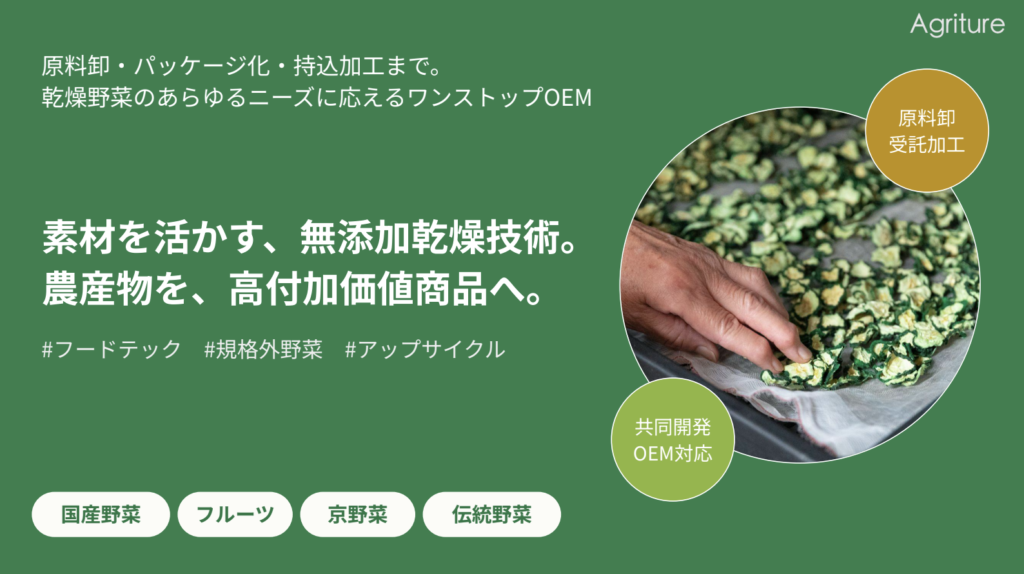
- OEM available from small lots of 10 kg
- Drying of brought-in raw materials also possible
- Support from processing to filling in one place
List of Kansai food OEM companies (Food OEM no Madoguchi)
What you'll learn in this section
- The 48 companies in the Kansai area featured on Food OEM no Madoguchi
- Major OEM providers in Osaka, Kyoto, Hyogo, Nara, Shiga, and Wakayama
- Details of each company can be checked directly from its listing page
When looking for a food OEM contractor in Kansai, Food OEM no Madoguchi features 48 processing providers in the Kansai area. Specialist manufacturers of prepared foods, seasonings, health foods, confectionery, beverages, packaging, bonito flakes, sake, and more are covered, so you can compare contractors that fit your product category from a single list. Check each company's details (equipment, specialties, minimum lot, past track record) on its listing page.
Of the 48 companies, the Kyoto Prefecture area includes Kyoto Katsuobushi, Nikka Foods, Agriture, the Kyotango City Food Processing Support Center, and othersproviders strong in Kyoto-grown ingredientsare concentrated here. Osaka has many makers of prepared foods, seasonings, and health foods; Hyogo has a Western-confectionery lineage led by Kobe Kocha; and Nara carries a traditional-food heritage including Suzuka Arare and the Miwa Somen Industrial Cooperative.
FOR BUSINESS
乾燥野菜のOEM・受託加工を承ります
国産の野菜・果物の乾燥、100メッシュ相当までの粉砕、10g以上の小袋充填までをお受けしています。小ロットの試作から量産までご相談ください。寄せられた相談の実例は OEM・卸のご相談 に掲載しています。
乾燥品の賞味期限は、出荷日から6ヶ月程度を目安にご案内しています。
Kansai food OEM FAQ
How does Kansai food OEM differ from other regions?
Kansai's strengths are the diversity of industrial clusters by prefecture and the high brand power of regional ingredients such as Kyoto vegetables, Yamato vegetables, and Kobe Western confectionery. Partnership with research institutions (Kyoto University, Osaka University, public labs) makes functional appeal easy to build, and export routes via Kansai Airport and the Port of Kobe are also in place.
Who should I consult to use subsidies?
The first step is a free consultation with a business advisor at a prefecture's industry-support center, chamber of commerce, or federation of small business associations. Business advisors raise the adoption rate by checking your application and issuing letters of recommendation. Adding partnership with a university or public lab tends to raise the adoption rate further.
Is mass production possible with regional ingredients?
Because many ingredients are difficult to scale for mass production while fresh, the basic design is year-round supply through preservation processing such as drying, freezing, or vacuum packing. The standard is to process and stock in bulk during the harvest season and ship throughout the year. Agriture handles this kind of operation in cooperation with contract farmers in Kyotango.
We're a company outside Kansai. Can we use Kansai OEM?
Yes. Even from Kanto, Chukyo, or Kyushu, you can access Kansai OEM manufacturers and research institutions by bullet train or air. If you want to use regional ingredients or make a brand strong in the Kansai market, teaming up with a Kansai-based OEM makes it easier to carry a regional story into the product.
Can I consult Agriture about new-product development in Kansai?
Yes. Centered on its head office in Kyoto City and its manufacturing base in Kyotango, Agriture supports Kansai-born new-product development with Kyoto vegetables, heirloom vegetables, off-spec vegetable upcycling, and low-temperature drying at 45C. We have a track record with Yamato vegetables (a purple chili pepper powder for the Miwa Somen Cooperative) and major projects (Nissin Foods, Nippon Paper Crecia). Food OEM no Madoguchi (Agriture) Please consult us.
Summary of choosing a Kansai food OEM
Choosing food-development support in Kansai lets you bring the prefecture-by-prefecture industrial clusters (Osaka, Kyoto, Hyogo, Nara, Wakayama, Shiga), research-institution partnerships with Kyoto University, Osaka University, and public labs, prefecture-by-prefecture subsidies, and the Kansai Airport and Port of Kobe distribution networks to bear on new-product development. Branding along the three axes of regional story, ingredient story, and cultural story adds Kansai-born value. Agriture, based in Kyoto and Kyotango, has a track record supporting new-product development for Nissin Foods, the Miwa Somen Cooperative, Kai's Chefon, and others, using Yamato vegetables, Kyoto vegetables, and off-spec vegetables as ingredients.
Related article: Material processing OEM Kyoto・Food OEM Prototype Cost Reduction・Choosing a food OEM contractor. For consultations on Kansai-born new-product development, Food OEM no Madoguchi (Agriture).
Download the OEM contract processing materials
We will send the materials to your email address based on the information you provide.
If you are considering product development with off-spec or your own farm's vegetables:From planning to processing, materials, package printing and novelties, you can consult us through a single point of contact. → Learn more about one-stop product development
- The Going Rate for Food OEM Prototyping Costs and 10 Points for Cutting Costs
- The complete guide to powder-processing OEM in Kansai | Strengths by area and how to choose small-lot-friendly manufacturers
Author of this article
Related articles
-
 Original coffee marketing strategy | Ways to grow sales
 -
 ベジタリアンとは?国の規格が分けている4つの区分と食べられないもの
 -
 長ねぎと白ねぎは同じもの?ねぎの種類と呼び名を国の資料で確かめる
 -
 柚子の種類は何種類あるのか、公の資料で名前が残る系統を数えた
 -
 ゆずの時期は年に二度、青ゆずは7月から黄ゆずは10月から
 -
 ゆずの産地は高知が半分を占め、二位は徳島から愛媛に変わった
 -
 Preventing Food OEM Failures: Common Failure Cases and Countermeasures for Success
 -
 How to find a food OEM | How to efficiently find the best manufacturing partner