
Choosing a Food OEM Prototyping Partner: 8 Criteria and the Practice of On-Site Auditing

Summary of this article
We organize how to choose a food OEM prototyping contractor with 8 criteria and the practicalities of on-site auditing. Covering the 8 criteria for choosing a contractor, how to read rankings and their pitfalls, 7 points to watch in on-site audits and factory tours, contract issues (NDA, QCD, termination clauses), a compatibility diagnosis of orderer × manufacturer, 6 signs to spot quote fraud, a classification of OEM manufacturers by industry type, a roadmap from prototype → mass production → continued ordering, calculating switching costs when changing contractors, and information for choosing Agriture as your contractor.
Choosing a food OEM contractor is the work of discerning, at the prototype stage, a manufacturer's areas of strength, quality-control systems, know-how, production capacity, and inventory response. A manufacturer that appears in many rankings is not necessarily right for you, and you need to judge by the whole picture—including "how they adapt formulation proposals," "the bridge from prototype to mass production," and "response in case of trouble." Whether you can find a contractor you can partner with reliably over the long term determines the success of food OEM.
This article summarizes the 8 criteria for choosing a food OEM contractor, the practicalities of manufacturer auditing, how to read contractor rankings, contract issues such as NDA, quality control, and inventory response, and how to design a lasting relationship with a contractor. Based in Kyoto and Kyotango, Agriture also introduces insights gained through a hybrid operation of five manufacturing sites and partner factories, having taken on prototype and outsourcing projects from small and midsize manufacturers to major firms (Nissin Foods, Nippon Paper Crecia, Takii Seed, Kai Chefon, Nara Prefecture Miwa Somen Industrial Cooperative). Related article: Food OEM Prototype Cost Reduction/OEM food manufacturing in Kansai/Material processing OEM Kyoto。

TOC
The 8 criteria for choosing a food OEM contractor
📌 What you'll learn in this section
- The 8 criteria when choosing a food OEM contractor
- How to prioritize the criteria
- 5 classifications by your industry type
If you choose a food OEM contractor by price and speed alone, mismatches occur at the mass-production stage. Examining with 8 criteria whether they can withstand the four phases—prototype, post-prototype, mass production, and continued transactions—is the way to choose without failure.
List of criteria
| Criterion | Item to confirm |
|---|---|
| Fit of strength areas | Production track record and know-how in your product category |
| small-lot support | Flexibility of minimum lot, phased support from prototype to mass production |
| Quality-control system | Certifications such as HACCP, ISO, FSSC22000and inspection systems |
| How they adapt formulation design | How far they align with the orderer's specifications; proposal ability |
| Stability of inventory and supply | Raw-material procurement routes, flexibility of production schedule |
| Cost transparency | Clear breakdown of quotes, conditions under which extra costs arise |
| The bridge to mass production | Quality maintenance and equipment support during the shift from prototype to mass production |
| Long-term peace of mind | Management stability, continuity of the person in charge, communication frequency |
How to prioritize the 8 criteria
- Products at initial launch: Prioritize ①②④ (strength areas, small lots, proposal ability)
- Ordering after mass production is confirmed: Prioritize ③⑤⑥ (quality, supply, cost)
- Aiming at continued transactions: Prioritize ⑦⑧ (mass-production shift, long-term relationship)
How to read food OEM contractor rankings
The "food OEM manufacturer rankings" and "recommended rankings" online are often built on an advertising or affiliate-revenue basis and do not guarantee practical quality or fit. Understand the uses and limits of rankings, and change how you use them.
The limits of ranking information
- Many rankings are tied to advertising and affiliates
- The content of listed companies is self-reported and may diverge from actual production and know-how
- Higher-ranked manufacturers concentrate projects, and in some cases your project's priority drops
- For small-lot support and special processing, manufacturers outside the rankings often have the strength
The correct way to use rankings
- Use them as a "starting point" for a candidate list. Make the final decision by individual quote and audit
- Prioritize companies listed in common across multiple rankings and multiple platforms
- Search on a technical axis via an industry-specialized matching platform like Food OEM no Madoguchi (foodoem.jp)
- Look for manufacturers not on the top rankings but with high industry reputation via industry associations and cooperatives
FOR BUSINESS
乾燥野菜のOEM・受託加工を承ります
国産の野菜・果物の乾燥、100メッシュ相当までの粉砕、10g以上の小袋充填までをお受けしています。小ロットの試作から量産までご相談ください。寄せられた相談の実例は OEM・卸のご相談 に掲載しています。
乾燥品の賞味期限は、出荷日から6ヶ月程度を目安にご案内しています。
7 points to watch in a food OEM audit
The "real ability of the site," invisible from paper certifications and quotes alone, is confirmed by audit and on-site inspection. If you can grasp the manufacturer's true state with one or two visits before contracting, trouble during the shift to mass production greatly decreases.
7 check items for an on-site inspection
- ① Cleanliness of the production line: Cleaning state of floors, walls, and equipment; implementation of 5S
- ② Orderliness of inventory: Orderliness of raw material and product warehouses; operation of first-in, first-out
- ③ Temperature and humidity control: Installation and recording of thermo-hygrometers in production and storage areas
- ④ Employee flow lines: Whether the operation of hygiene gloves, masks, and changing areas is thorough
- ⑤ Inspection system: Operating status of metal detectors, X-ray inspection, and weight checkers
- ⑥ Traceability: Lot-number management, raw-material receipt records, tracking of shipment lots
- ⑦ Expertise of the person in charge: Confirm the depth of know-how through dialogue with the prototyping and quality-control staff
Contract issues in food OEM (NDA, QCD, termination)
🔑 Points to protect
Entering prototyping without an NDA in place carries the risk that your formulation and concept will be diverted to competing products.
An outsourcing contract defines in detail the confidentiality of the prototype formulation, quality standards, delivery times, and the allocation of cost responsibility. To prevent later trouble, it is basic to clearly state the following issues in the contract.
4 areas to nail down in the contract
- NDA / confidentiality: Scope of disclosure and protection period for formulation recipes, raw-material procurement routes, and packaging design
- QCD responsibility: Standard values for Quality, Cost, and Delivery, and response when they diverge
- Termination clause: Inventory handling, raw-material return, and conditions for penalty charges upon mid-term termination
- IP attribution: Rights attribution of know-how and formulation gained through prototyping, and handling of trademarks and designs
Trouble cases and preventive measures
- Quality complaints: Agree in advance on response to lot differences and foreign-matter contamination (conditions for returning defects and producing replacements)
- Delivery delays: Design alternative routes for raw-material price surges and equipment failures
- Price revisions: Price-revision clauses once or twice a year, and their notice deadline
- Diversion of formulation by the contractor: Include a clause prohibiting the horizontal deployment of your formulation to other companies
Food OEM orderer × manufacturer compatibility diagnosis
Often overlooked in contractor selection is the matching of "the orderer's own type" and "the manufacturer's type." Even at the same technical level, a manufacturer that doesn't suit the orderer's style causes mismatches at the prototype stage. We introduce a framework that organizes both types in a 4×4 and diagnoses compatibility.
4 classifications of orderer type
- Creator type: Cooking researchers, chefs, brand founders, etc., with a clear vision of their own. Particular about the details
- Marketer type: Works backward from sales channels, target, and price. Data-driven, PDCA-focused
- Material supplier type: Farmers, producers, and regional cooperatives outsourcing the processing of their own materials. Strong attachment to the material
- Major company type: Has brand power and sales networks but limited in-house development resources. Speed-focused
4 classifications of manufacturer type
- Proposal-leading type: Rich in-house repertoire of formulation design and planning. Digests the orderer's requests and gives them form
- Contract-execution type: Accurately executes the orderer's instructions. You decide the formulation and they manufacture it precisely
- Research-oriented type: Good at developing functionality and new technology. Takes on new expressions even if prototype rounds mount
- Mass-production-specialized type: Strong at large-scale production and price competition. Poor at small-lot prototyping
Compatibility table
| Orderer ↓ / Manufacturer → | Proposal-leading | Contract-execution | Research-oriented | Mass-production-specialized |
|---|---|---|---|---|
| Creator type | ◎ | △ | ○ | × |
| Marketer type | ○ | ○ | △ | ○ |
| Material supplier type | ○ | ◎ | ○ | △ |
| Major company type | △ | ○ | △ | ◎ |
Compatibility is directly linked to productization speed, more than to "technical ability" or "number of track records." It's a shortcut for the orderer to understand their own type and aim from the start at a matching manufacturer type.
6 signs of food OEM quote fraud
⚠️ Warning
Extremely cheap quotes and vague breakdowns aretrouble in the making. Be sure to check the 6 signs before contracting.
Spotting the pattern of "costs that balloon later" lurking in the initial quote lets you reduce trouble after the prototype contract. If the following signs appear, confirm with a competing quote from another manufacturer.
- ① Abnormally cheap: Below 50% of the industry benchmark. Suspect a mass-production-contract "lock-in," separately listed raw-material costs, or hidden costs
- ② Won't provide a breakdown of raw-material costs: Presented rounded up as "a set including raw-material costs." No transparency on an actual-cost basis
- ③ Vague cap on the number of prototype rounds: Written as "prototype as much as needed," but later billed extra for exceeding the count
- ④ Packaging costs not included: Containers, labels, and printing billed separately, causing unexpected costs at mass production
- ⑤ Comprehensive additional-cost clause in the contract: A broad disclaimer clause stating "other necessary costs will be billed separately"
- ⑥ Payment terms of 100% prepayment: Full prepayment at the prototype stage is a sign that the manufacturer's cash flow is tight
Classification of food OEM manufacturers by industry type
Food OEM manufacturers are broadly divided into five types by business form. Which type they are changes their proposal style, price sense, lead time, and areas of strength.
The 5 types
| Type | Features | Strong at | Poor at |
|---|---|---|---|
| Contract-only type | OEM manufacturing specialist. No own brand | Faithfulness to the orderer's specifications | Weaker proposal ability |
| Own-brand-and-OEM type | Runs both an own brand and OEM | Proposal ability, market insight | Possibility of prioritizing its own products |
| Major-subcontractor type | Mainly OEM for major food manufacturers | Quality control, certification | Small-lot, flexible support |
| Regional-cooperative type | Operated by a regional industrial cooperative | Regional materials, regional brands | Mass-production scale, remote support |
| Lab / venture type | Technology development at its core | Functionality, new technology | Mass-production track record, cost |
The own-brand-and-OEM type has high proposal ability, but during busy seasons its own products may be prioritized. The major-subcontractor type has high quality, but tends to show a temperature gap with new or small-lot orderers.
Food OEM prototype → mass-production roadmap
| Step | Details |
|---|---|
| Prototype phase | Emphasize development ability, flexibility, and proposal ability (whether small-lot support is possible) |
| Mass-production phase | Emphasize equipment scale, quality control, certification, and cost |
| Continued-ordering phase | Emphasize relationship, lead time, and improvement proposals |
The criteria for judging contractor selection change by phase. A manufacturer that was best at the prototype stage may not fit for mass production or continuation. We organize the judgment axes that change across the three phases.
Emphasis by phase
| Phase | Criteria to emphasize | Main axis of judgment |
|---|---|---|
| Prototype phase (0–6 months) | Proposal ability, small-lot support, formulation matching | Efficiency of short-term prototype back-and-forth |
| Mass-production launch (6–18 months) | Quality control, yield, delivery-time accuracy | Stability of the shift to the production line |
| Continued ordering (18 months onward) | Cost, inventory supply, new-product proposals | Overall efficiency of long-term transactions |
Checks at phase transitions
- Prototype → mass production: Whether to put it on a mass-production line at the same manufacturer, or transfer to a mass-production-specialized manufacturer
- Mass production → continuation: Sharing the annual plan, price-revision clauses, and a framework for joint development of new products
- Continuation → review: Confirm the current manufacturer's competitiveness with an audit and competing quotes once every three years
Calculating switching costs when changing a food OEM contractor
When changing contractors, you need a profit-and-loss calculation that factors in not only the new manufacturer's cheapness but the "switching cost." Ignoring switching costs leads to the failure of finding that the previous manufacturer was actually cheaper within two years.
Breakdown of switching costs
- Re-prototyping cost: When starting from prototyping at a new manufacturer, prototype cost + raw-material cost + in-house labor arise
- Quality-fluctuation risk: Subtle differences in equipment and formulation change taste and texture, risking disposal and remanufacturing of the initial lot
- Brand impact: Taste changes cause repeat customers to leave and complaint-handling costs
- Lead-time extension: A supply gap of several months during the new manufacturer's launch; opportunity loss
- Packaging-material switching cost: Remaking the printing plates; disposal cost of packaging material in stock
- Contract-termination cost: Penalty charges and inventory buyback upon terminating the contract with the previous manufacturer
The profit-and-loss line for the switching decision
Total switching cost ÷ annual procurement-cost difference = payback period. Generally, if it can't be recovered within two years, continuing with the current manufacturer is a practical guideline. When a technical advantage (functionality, certification, raw materials) is gained at the new manufacturer, there is also the judgment to extend the profit-and-loss line.
Designing a lasting relationship with a food OEM contractor
If you can run not just a single prototype but mass production and continued transactions with the same contractor, the management benefits (stable quality, price-negotiation power, shorter lead times) grow large. We organize the keys to a lasting relationship.
5 actions to build a long-term relationship
- Share the annual plan: Share sales plans and new-product plans with the manufacturer to secure production slots
- Set up regular meetings: Monthly and quarterly meetings on quality, cost, and new products
- Build relationships with the people in charge: Build individual trust with the prototyping, sales, and site staff
- Continue site visits: Confirm quality maintenance and relationship with 1–2 factory visits a year
- Two-way feedback: Convey complaints and improvement proposals without hiding them, and create an environment where the manufacturer can speak up too
Timing to change contractors
- Quality complaints occur continuously and they don't respond to improvement proposals
- Price revisions occur twice a year or more, becoming expensive compared with other companies
- Frequent changes of the person in charge increase handover costs
- The manufacturer can't support your product strategy (overseas export, certification acquisition)
Agriture as a food OEM contractor
With contract processing of dried vegetables, fruits, and powders at its core, Agriture has a lineup of nearly 100 materials, five manufacturing sites (Kyotango in Kyoto Prefecture, Nagano, Mie, Ehime, Okinawa), and a hybrid operation with partner factories, with a strength in phased support from small-lot prototyping to mass production. Below, we organize decision-making material for when considering us as a contractor.
Agriture's areas of strength
- Dried vegetables, dried fruits, powders: Processing that retains color, taste, and aroma, with low-temperature drying at 45°C as the standard condition
- Upcycling of off-spec vegetables: Dry-process vegetables and fruits off-spec in shape, keeping raw-material costs down while achieving food-loss appeal
- Kyoto vegetables and heirloom vegetables: Stable procurement of Kyoto-grown materials such as Kujo green onion, Shogoin daikon, and Manganji chili
- Minimum lot of 100g supported: Small-lot prototyping of powders is possible
Genres of outsourcing projects Agriture handles
- Major food manufacturer: Nissin Foods, dried vegetable set for the 6 flavors of "Nissin Raoh" (October 2025)
- Major consumer-goods manufacturer: Nippon Paper Crecia, "Action for Smile" campaign prize, OYAOYA 8-item set (July–August 2025)
- Seed manufacturer: Takii Seed Phytorich, drying and powdering of vegetables containing the functional components of 7 items
- Cooking-researcher brand: One's Daily dried apple sticks (Mayuka Morisaki)
- In-group collaboration: Kai Chefon, chef Mikizo Hashimoto (one Michelin star), materials for 8-item recipe videos
- Traditional-industry cooperative: Nara Prefecture Miwa Somen Industrial Cooperative, purple chili powder supply (use of Yamato vegetables)
Information to confirm in advance
- Product concept, target, sales channels
- Raw materials you want to use, additives you want to avoid
- Assumed lots from prototype to mass production
- Quality certification, packaging specifications
- Planned sales launch date
We have materials available to help you understand dried processing OEM
Agriture OEM, flexibly handling everything from small lots to large lots
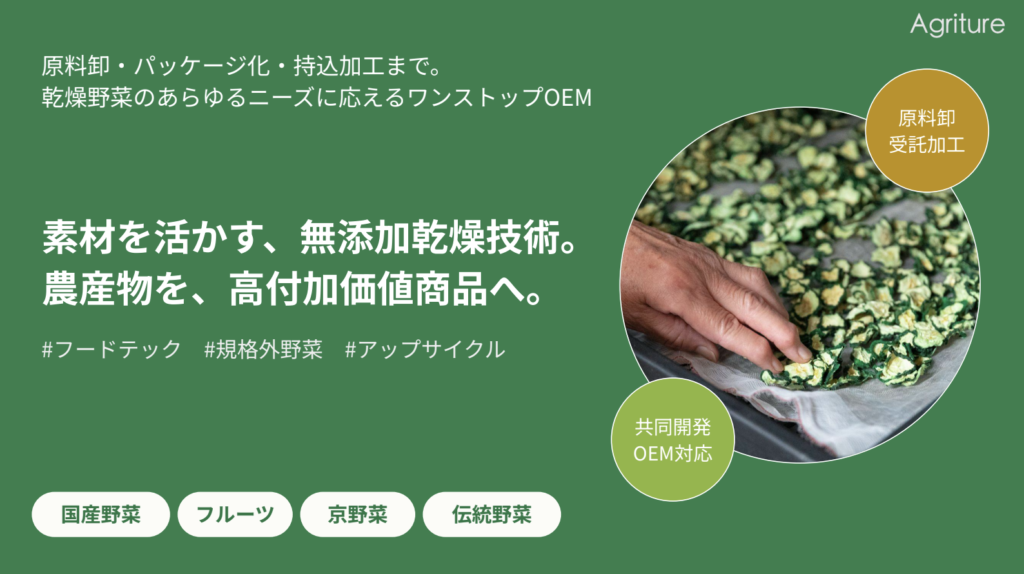
- OEM available from small lots of 10 kg
- Drying of brought-in raw materials also possible
- Support from processing to filling in one place
FOR BUSINESS
乾燥野菜のOEM・受託加工を承ります
国産の野菜・果物の乾燥、100メッシュ相当までの粉砕、10g以上の小袋充填までをお受けしています。小ロットの試作から量産までご相談ください。寄せられた相談の実例は OEM・卸のご相談 に掲載しています。
乾燥品の賞味期限は、出荷日から6ヶ月程度を目安にご案内しています。
Food OEM prototyping: FAQ
Is asking a top-ranked OEM manufacturer the correct answer?
Not necessarily. Rankings are often tied to advertising and affiliates, and the areas of strength, small-lot support, and quality-control know-how that fit your project differ by manufacturer. It's safest to use rankings as a starting point for a candidate list and make the final decision by individual quote, on-site inspection, and dialogue with the person in charge.
Is an on-site inspection of the contractor necessary?
Ideally, visit once or twice before contracting. From paper certifications and quotes alone, you can't see the site's real ability—the cleanliness of the production line, orderliness of inventory, employee flow lines, inspection system, and the expertise of the person in charge. Checking 7 points on an on-site inspection greatly reduces trouble during the shift to mass production.
What should always be confirmed in the contract?
Nail down four areas: NDA, QCD responsibility, termination clause, and IP attribution. In particular, clearly stating in the contract the confidentiality of the formulation recipe, prohibition of horizontal deployment to other companies, alternative routes for delivery delays, and inventory handling upon mid-term termination lets you prevent trouble.
Can I proceed from small-lot prototyping to mass production with the same contractor?
Ideally, choose a manufacturer that can. If the manufacturer changes between prototype and mass production, the equipment, formulation, and yield change, risking changes in taste and texture. It's reassuring to confirm a manufacturer capable of phased prototype → mass-production support under "⑦ the bridge to mass production" among the 8 criteria.
Can I consult Agriture as a contractor?
Yes. In contract processing of dried vegetables, fruits, and powders, Agriture has a setup of a minimum lot of 100g, nearly 100 materials, five manufacturing sites, and a hybrid operation with partner factories. We have a track record of phased support from prototype to mass production for a range of clients—from major firms (Nissin Foods, Nippon Paper Crecia, Takii Seed, Kai Chefon) to small and midsize manufacturers and D2C brands. Food OEM no Madoguchi (Agriture) Please consult us.
Summary of food OEM contractor selection
Choosing a food OEM contractor is decided by 8 criteria (strength areas, small lots, quality control, formulation matching, inventory supply, cost, mass-production bridge, long-term peace of mind) and by individual judgment that doesn't rely on rankings. Nailing down the 7 on-site inspection items, the contract's NDA/QCD/termination clauses, and the 5 actions for a lasting relationship—and finding a contractor you can partner with reliably from prototype to mass production—is the key to food OEM success.
Related article: Food OEM Prototype Cost Reduction・OEM food manufacturing in Kansai・Material processing OEM Kyoto. For consultation on contractors, contact Food OEM no Madoguchi (Agriture).
Download the OEM contract processing materials
We will send the materials to your email address based on the information you provide.
If you are considering product development with off-spec or your own farm's vegetables:From planning to processing, materials, package printing and novelties, you can consult us through a single point of contact. → Learn more about one-stop product development
- The Complete Guide to OEM Manufacturing of Domestic Dried Vegetables | A Thorough Explanation from Small-Lot Support to How to Choose
- The Going Rate for Food OEM Prototyping Costs and 10 Points for Cutting Costs
Author of this article
Related articles
-
 Original coffee marketing strategy | Ways to grow sales
 -
 ベジタリアンとは?国の規格が分けている4つの区分と食べられないもの
 -
 長ねぎと白ねぎは同じもの?ねぎの種類と呼び名を国の資料で確かめる
 -
 柚子の種類は何種類あるのか、公の資料で名前が残る系統を数えた
 -
 ゆずの時期は年に二度、青ゆずは7月から黄ゆずは10月から
 -
 ゆずの産地は高知が半分を占め、二位は徳島から愛媛に変わった
 -
 Preventing Food OEM Failures: Common Failure Cases and Countermeasures for Success
 -
 How to find a food OEM | How to efficiently find the best manufacturing partner