
The Going Rate for Food OEM Prototyping Costs and 10 Points for Cutting Costs

Summary of this article
A systematic explanation of the market rate for food-OEM prototyping costs and 10 points for holding costs down. We cover the 4 steps of prototyping and the points where costs arise, cost guides by genre (powder, beverages, snacks, supplements, FD ingredients), the hidden costs of prototyping failure, the shift in cost structure when moving from prototype to volume production, NDAs and IP protection, hidden variables in prototyping cost, a map for using subsidies and grants, and Agriture's practical work in cutting prototyping cost — covering the cost sense and pre-order checks a first-time OEM client should know.
Food-OEM prototyping costs generally run about 10,000–50,000 yen for powders, 20,000–100,000 yen for beverages and seasonings, and 50,000–200,000 yen for snacks and baked goods. Because prototyping incurs initial costs on the maker's side for equipment operation, raw-material procurement, and formulation design, grasping in detail what costs how much before contracting, and appropriately designing room to negotiate cost reductions, divides success and failure in OEM product development.
This article compiles the market rate for food-OEM prototyping costs, the factors that sway costs, 10 points for holding costs down, and concrete cost-cutting measures from Agriture such as a minimum lot of 100 g, off-grade-vegetable upcycling, and low-temperature drying at 45°C. Related article: Food OEM prototyping: choosing a contractor/Guide to OEM food manufacturing in the Kansai region/Material processing OEM Kyoto。

TOC
The 4 steps of food-OEM prototyping and where costs arise
📌 What you'll learn in this section
- Prototyping proceeds in 4 stages
- A breakdown of the costs arising at each stage
- The starting point of cost reduction is "aligning on the spec"
Prototyping proceeds in 4 stages to firm up a formulation that can withstand volume production. Because costs arise at each stage, understanding in detail what costs how much is the first step in cutting costs.
Breakdown of the 4 prototyping steps
| Step | Details |
|---|---|
| Aligning on the spec | Aligning target, raw materials, and price / meeting labor (included in the initial consultation cost) |
| First prototype (rough) | Confirming direction, verifying processing constraints / prototyping fee + raw-material cost |
| Second prototype and refinement | Adjusting aroma, sweetness, acidity, and color (sometimes 3–5 rounds) / prototyping fee × rounds + raw-material cost |
| Pre-volume prototype (pilot) | Final check of yield and filling suitability on the factory line / equipment operation cost + raw-material cost |
How much you nail down at the spec stage ties directly to the number of round-trips in ②–③ — that is, to cost. A posture of nailing down the details at the initial consultation ends up lowering total cost.
The market rate for food-OEM prototyping cost
Prototyping cost varies by genre, processing, and packaging. Before contracting, take quotes broken out into prototyping fee, raw-material cost, equipment operation cost, and packaging prototype cost, and it becomes clear what costs how much.
Cost guide by genre
| Food genre | Prototyping-cost guide | Notes |
|---|---|---|
| Powder types | 10,000 to 50,000 yen | Varies by formulation and particle size |
| Beverages and seasonings | 20,000–100,000 yen | Varies by sterilization process and filling equipment |
| Snacks and baked goods | 50,000–200,000 yen | Higher the more cooking steps there are |
| Supplements and health foods | 100,000 to 300,000 yen | Differs by capsule / tablet / whether coated |
| Freeze-dried ingredients | ¥100,000–500,000 | Equipment operation cost + the share from poorer yield |
The above is a guide for the prototyping fee itself; raw-material cost arises separately as an actual expense. When using expensive special or imported raw materials, raw-material cost can exceed the prototyping fee, and an initial raw-material procurement plan is called for.
The 6 factors that sway prototyping cost
- Production lot count: Small lots have high unit costs. For food, a minimum of 100 units or 10 kg or more is common
- Processing cost: The more processing steps for the raw material, the more cost arises. Extraction, concentration, grinding, etc.
- Blend components and blend ratio: For health foods, the unit price changes by component, reflected in the prototyping unit cost
- Packaging form: Container cost changes greatly by pouch, PET, aluminum zip, or glass jar
- Special techniques: Coating, enteric coating, and special films add processing cost
- Certification and inspection: Also confirm HACCP, Organic JAS, and analysis-inspection costs at the prototyping stage
10 points for holding down prototyping cost
To hold down prototyping cost, you can devise measures on 4 fronts: initial design, negotiation, procurement, and equipment use. Pressing just the 10 points below can, in some cases, cut initial costs by 20–50%.
10 points for cost reduction
- ① Prepare a detailed spec sheet: Put target, taste, price, and packaging in writing. Reduce prototyping round-trips
- ② Take quotes from multiple companies: Three or more makers with different equipment and procurement routes
- ③ Negotiate as a set with the volume contract: If volume production is premised, draw out a contract that discounts the prototyping fee
- ④ Choose a small-lot-capable maker: The smaller the minimum lot, the lower the initial cost
- ⑤ Prototype based on an existing formulation: Start semi-custom rather than full custom
- ⑥ Bring in your own raw materials: For raw materials you can procure yourself, bring them in and pay only the processing fee
- ⑦ Use off-grade raw materials: Shape-off-grade vegetables and fruits are the same quality as standard goods at lower cost
- ⑧ Use ready-made packaging at the prototyping stage: Full original printing is for volume production. Prototype with ready-made containers + labels
- ⑨ Certification after the sales channel is set: Obtain certifications like Organic JAS after the sales channel and price are fixed
- ⑩ Research subsidies and grants: Cover part of the prototyping cost with SME product-development subsidies or the Monozukuri Subsidy
Cost-reduction benefits you can draw out through negotiation
- Volume premise: a condition applying half to all of the prototyping fee toward the volume contract
- Annual contract: lower the unit price by committing to several lots a year
- Joint development: if it aligns with the maker's entry into a new category, negotiating a share of the development cost is possible
- OEM support: in some cases you can ride on the maker's subsidy use or R&D scheme
The hidden costs of prototyping failure
⚠️ Points to note
Judging by the quote amount alone, actual spending can balloon to1.5–2×the expectation.
The amount listed on a quote as prototyping cost is "direct cost" only, and the "hidden costs" arising from failed prototypes do not appear on the quote. Without factoring in hidden costs, actual total spending can balloon to 1.5–2× the expectation.
The 4 categories of hidden cost
- Opportunity loss: Delays from prototyping round-trips push back the launch, causing the loss of a business window (campaign, season)
- Discarded raw-material cost: The disposal cost of raw materials, seasonings, and packaging used in failed prototypes (including industrial-waste processing fees)
- Lead-time extension: The more prototyping rounds, the later volume production starts, extending the period working capital is tied up
- Internal labor: The meeting, evaluation, and decision labor of the ordering and development staff (converted to labor cost, several to over ten thousand yen per prototype)
Practical work to hold down hidden costs
- Detail the first round with a spec-sheet template (can cut round-trips by 2 on average)
- Quantify evaluation criteria in advance (agree on sweetness, salinity, color, and texture on a 5-point scale)
- Secure a reuse route for prototypes (an outlet other than internal promotion, employee distribution, or disposal for prototypes that cannot be commercialized)
- Make milestone meetings regular (check progress weekly to speed up decisions)
The shift in cost structure from prototype to volume production
Between prototyping and volume production, the breakdown of unit cost changes greatly. During prototyping, the share of setup cost and equipment operation cost is high; the more volume production scales, the more the share of raw-material cost rises.
Comparison of cost structure by lot
| Stage | Raw material cost | Processing cost | Setup cost | Packaging cost |
|---|---|---|---|---|
| Prototype (10–50 kg) | 10〜20% | 30〜40% | 30〜40% | 10〜20% |
| Small-lot volume production (100–500 kg) | 30〜40% | 30〜35% | 15〜20% | 15〜20% |
| Large-lot volume production (1,000 kg or more) | 50〜60% | 20〜25% | 5〜10% | 10〜15% |
Because the prototyping stage weighs heavily toward "setup cost," prototyping multiple variations in parallel on the same line can spread the setup cost (e.g., a design that runs multiple formulations in one setup, like the simultaneous prototyping of Nissin Raoh's 6 flavors).
NDAs and IP protection at the prototyping stage
🔑 Points to protect
An NDA at the prototyping stage is the minimum line of defense to prevent leakage of formulation information, production conditions, and concept materials.
The formulation recipes and processing conditions disclosed in prototyping are the information most worth protecting before volume production. The more you request quotes from multiple makers to cut costs, the higher the risk of formulation information leaking between makers.
The 4 points of IP protection to press at the prototyping stage
- Conclude an NDA: Conclude a confidentiality agreement before prototyping starts. With a mutual NDA, the maker's technical information is protected too
- Phased disclosure of the formulation: Disclose only an overview at initial quote, the detailed formulation after the contract
- Develop the distinctive formulation in-house: Keep the proprietary formulation that is the core of differentiation as your own bring-in, not contracted prototyping
- File trademarks and designs in advance: File the product name and package design at the prototyping stage
Hidden variables in prototyping cost
Even if fixed at the quote point, there is a risk that the cost moves during the period from prototype to volume production. Factoring in the range of variation at the budget-planning stage prevents unexpected cost increases.
The 4 variable factors
- Exchange rates: For imported raw materials (spices, nuts, dried fruit), raw-material cost rises several to over ten percent with a weak yen
- Fuel and electricity costs: Drying, roasting, and sterilization steps depend on electricity. Soaring fuel costs raise processing cost
- Packaging material price: Aluminum laminate, PET, and glass jars fluctuate in tandem with crude-oil and raw-material prices
- Distribution cost: Unit-price revisions for delivery service and refrigerated/frozen transport occur once or twice a year
Sharing with the maker at the prototyping stage "where the price-fluctuation risk lies by raw material" gives you material for price negotiation at volume production.
A map for using subsidies and grants
💡 Points for use
There are many cases where1/2〜2/3of the prototyping cost is eligible for subsidy, and if adopted you can halve the effective burden.
Part of the prototyping cost can be covered by national, prefectural, and municipal subsidies and grants. We organize the main subsidies and their patterns of application to prototyping cost.
Main types of subsidies and grants
| System | Audience | Whether it can be applied to prototyping cost |
|---|---|---|
| Monozukuri Subsidy (national) | SME capital investment and prototype development | ○ Applicable to prototyping and equipment-introduction cost |
| Business Restructuring Subsidy (national) | Shift to new business or new products | ○ Applicable to new-product-development prototyping cost |
| Small Business Sustainability Subsidy (national) | Sales-channel development for small businesses | △ Limited to package prototyping and sample goods |
| Prefectural product-development subsidy | Use of regional produce and prefectural raw materials | ○ Use of regional ingredients is the condition |
| Municipal startup and product-development support | Businesses within the locality | ○ Depends on the municipality |
Points to note when applying
- Adoption rates differ by subsidy, from 10 to 50%. Multiple applications are realistic
- Orders and payments before the grant decision are ineligible. Prior procedures are required
- Performance reports and settlement documents must be in order (receipts, contracts, delivery notes)
- Using the free consultations of chamber-of-commerce and society-of-commerce management advisors eases the burden of preparing application documents
Agriture's practical work in cutting prototyping cost
In OEM prototyping of dried vegetables, fruits, and dried fruit, Agriture has a system to hold down the initial prototyping cost for SME makers and D2C brands, with a minimum lot of 100 g, off-grade-vegetable upcycling, and hybrid operation with partner factories. The differentiator is being able to draw on the know-how of major collaboration achievements (Nissin Foods, Nippon Paper Crecia, Takii Seed, Kai Chefon) from the prototyping stage.
5 mechanisms for holding down prototyping cost at Agriture
- Minimum lot of 100g supported: For powders, compress the initial cost with small-quantity prototyping in 100 g units
- Upcycling of off-spec vegetables: Use raw materials that are shape-off-grade and do not circulate in the market to hold down raw-material cost (compatible with food-loss appeal)
- Hybrid operation with partner factories: For equipment we do not own in-house (freeze dryers, filling machines, etc.), we partner with cooperating factories and do not pass capital investment on to the client
- A lineup of nearly 100 ingredients: Because you can prototype from existing ingredients, the time and cost of procuring new raw materials do not arise
- Standardization of low-temperature drying at 45°C: No need for the client to prepare special equipment, so no initial investment in prototyping equipment is required
Examples of prototype-to-volume scaling in actual projects
- Takii Seed Phytorich dried-vegetable conversion: Drying and powdering 7 items of vegetables containing functional components (Kyo Kurenai carrot, Bentenmaru spinach, Healthie okra, etc.) to develop herbal teas, detox water, and green-juice powder. A design that scales from one raw material into three products across multiple uses
- One's Daily dried-apple sticks: For the brand of culinary researcher Mayuka Morisaki, drying Nagano-grown "leaf-left apples" in stick form with no added sugar. D2C-developed as an additive-free treat people and dogs can eat together
- Nissin Foods “Nissin Raoh” 6 flavors: Timed to "Food Loss Reduction Day" in October 2025, blending off-grade vegetables (kujo negi, onion, cabbage, shiitake, Manganji togarashi, etc.). A design that changes the blend by flavor from the prototyping stage to optimize cost
Information that helps at a prototyping consultation
- Product concept, target, desired retail price
- Envisioned lot (prototype-to-volume stage)
- Raw materials you want to use, additives you want to avoid
- Sales channel, planned launch date
- Whether there is additive-free, organic, or other appeal
We have materials available to help you understand dried processing OEM
Agriture OEM, flexibly handling everything from small lots to large lots
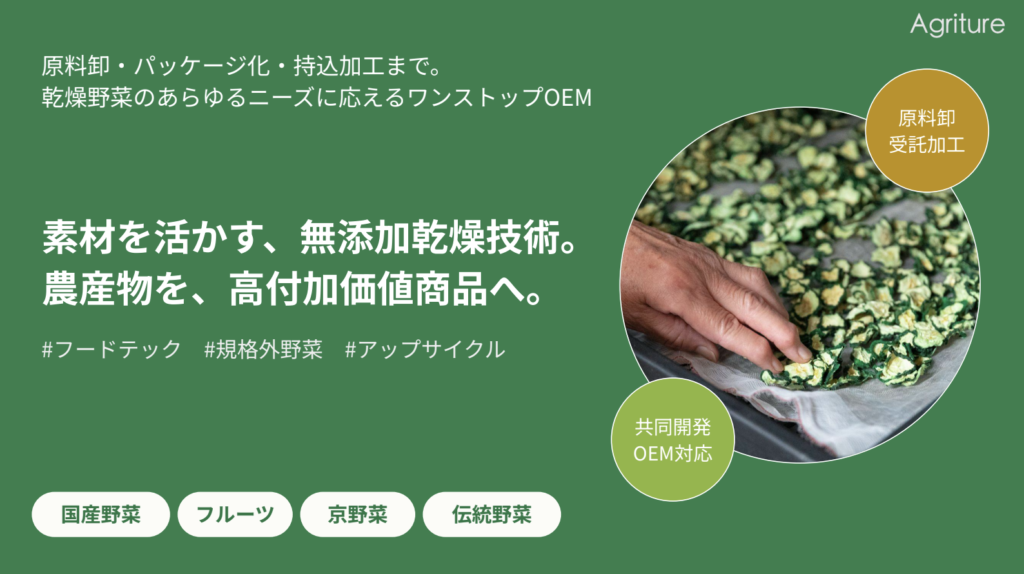
- OEM available from small lots of 10 kg
- Drying of brought-in raw materials also possible
- Support from processing to filling in one place
FAQ
About how many prototypes are needed?
It depends on the food type, but 3–5 rounds is common for seasonings and processed foods. Because the number changes with the detail of the spec sheet, nailing down taste, texture, color, aroma, and packaging in detail at the initial meeting can, in some cases, get you to the pre-volume prototype in 2–3 rounds.
How much is the gap between prototyping cost and volume unit cost?
For powder types, the prototyping unit cost is generally 3–5× the volume ratio, and 5–10× for beverages and supplements. Negotiating to discount the prototyping fee as a set with the volume contract is effective. Some makers set conditions applying 50–100% of the prototyping fee toward the volume order.
How do you find a small-lot-capable maker?
Narrowing down by minimum-lot conditions on a commercial matching platform (such as foodoem.jp, the Food OEM Concierge) is the shortcut. Agriture can handle prototyping consultations from 100 g of powder, so it suits the initial prototyping of SME makers and D2C brands.
Can subsidies and grants cover the prototyping cost?
There are cases where part of the prototyping cost can be covered by SME programs such as the Monozukuri Subsidy, product-development subsidies, and the Business Restructuring Subsidy. Because there are municipal-level subsidies too, checking the chamber of commerce and municipal site for your planned sales-channel region may turn one up.
Can I consult Agriture about prototyping?
Yes. Agriture handles prototyping consultations for dried vegetables, fruits, dried fruit, and powders. Because you can choose from nearly 100 ingredients, the time and cost of procuring new raw materials is unlikely to arise, and you can scale in stages from prototype to volume production through hybrid operation. Food OEM no Madoguchi (Agriture) Please consult us.
Summary
For food-OEM prototyping cost, once you grasp the market rate by genre (powder 10,000–50,000 yen / beverage 20,000–100,000 yen / baked goods 50,000–200,000 yen), you can hold down initial costs by 20–50% with the 10 points of detailing the spec sheet, comparing multiple companies, negotiating the volume contract, using small lots, bringing in your own raw materials, off-grade raw materials, ready-made packaging, deferring certification, and researching subsidies. Agriture supports SME and D2C prototyping-cost reduction in practice with a minimum lot of 100 g, off-grade-vegetable upcycling, and hybrid operation with partner factories.
Related article: Food OEM prototyping: choosing a contractor・OEM food manufacturing in Kansai・Ingredient-processing OEM, Kyoto. For a prototyping consultation, Food OEM no Madoguchi (Agriture).
Download the OEM contract processing materials
We will send the materials to your email address based on the information you provide.
If you are considering product development with off-spec or your own farm's vegetables:From planning to processing, materials, package printing and novelties, you can consult us through a single point of contact. → Learn more about one-stop product development
FOR BUSINESS
乾燥野菜のOEM・受託加工を承ります
国産の野菜・果物の乾燥、100メッシュ相当までの粉砕、10g以上の小袋充填までをお受けしています。小ロットの試作から量産までご相談ください。寄せられた相談の実例は OEM・卸のご相談 に掲載しています。
乾燥品の賞味期限は、出荷日から6ヶ月程度を目安にご案内しています。
- Choosing a Food OEM Prototyping Partner: 8 Criteria and the Practice of On-Site Auditing
- Kansai Food OEM: 6 Steps to Making a New Product and Subsidies
Author of this article
Related articles
-
 Original coffee marketing strategy | Ways to grow sales
 -
 ベジタリアンとは?国の規格が分けている4つの区分と食べられないもの
 -
 長ねぎと白ねぎは同じもの?ねぎの種類と呼び名を国の資料で確かめる
 -
 柚子の種類は何種類あるのか、公の資料で名前が残る系統を数えた
 -
 ゆずの時期は年に二度、青ゆずは7月から黄ゆずは10月から
 -
 ゆずの産地は高知が半分を占め、二位は徳島から愛媛に変わった
 -
 Preventing Food OEM Failures: Common Failure Cases and Countermeasures for Success
 -
 How to find a food OEM | How to efficiently find the best manufacturing partner