
Freeze-Drying Minimum Lots: Small-Lot Ordering and Choosing a Manufacturer

Summary of this article
We organize the minimum-lot market rates for freeze-drying (500 kg of fresh strawberries, 100 kg of mushrooms, etc.), how to find small-lot-capable contractors, a three-stage order strategy of prototype → limited sale → mass production, and Agriture's hybrid operation and the raw-material procurement link for Kyotango-produced strawberries.
The first snag in placing a freeze-drying OEM order is the wall of the minimum lot. For fruits like strawberry and mango, an order of around 500 kg of fresh raw material is commonly required, which becomes a major hurdle for small-scale D2C or SMEs at the prototype stage. This article organizes the minimum-lot market rates by material, how to choose small-lot-capable contractors who can be consulted from around 10 kg, the relationship between lot and yield, and a staged order strategy from prototype to mass production.
Agriture, centered on Kyotango-produced strawberries, handles small-lot freeze-drying prototyping through a hybrid operation with partner plants. Related article: Popular-material ranking/Processing cost/Commercial freeze-dried strawberries。

TOC
Minimum-lot market rates by material
The minimum lot for freeze-drying is determined by the material's moisture content, yield, and equipment operating efficiency. The more a material has high moisture and low yield, the more fresh input is needed to obtain the same finished amount, and as a result the minimum lot tends to grow larger.
Lot and yield list by material (based on raw-material input)
| Material | General minimum lot (raw-material input) | Yield guide | Finished amount |
|---|---|---|---|
| strawberry | Around 500 kg | 5〜10% | 25〜50kg |
| Mango / blueberry | 300〜500kg | 10〜15% | 30〜75kg |
| Spinach, komatsuna | 200〜400kg | 5〜10% | 10〜40kg |
| Mushrooms | 100〜300kg | 5〜10% | 5〜30kg |
| Miso-soup ingredients (tofu / wakame) | 100〜200kg | 10〜20% | 10〜40kg |
| Zenzai materials (adzuki beans / mochi) | 100〜300kg | 20〜40% | 20〜120kg |
Because the figures vary with the processor, equipment, and quality requirements, the sure way is to convey the conditions (material state, desired finished amount, quality level) at consultation and then obtain a quotation. For fruits and vegetables, the weight in the fresh state is treated as the input; for processed items (tofu, wakame, mochi, etc.), the weight in the pre-dried raw-material state is treated as the input.
Lot circumstances by strawberry form
- Whole: because the yield of shape retention drops, the finished amount tends to be smaller even for the same fresh volume
- Sliced: because chipping occurs in the cutting process, the yield tends to drop even further than for whole
- Diced (cubed): because chipping can be tolerated, the yield is more stable than whole or sliced
- Powder: because it is ground without worrying about chipping or cracking, the yield is less prone to loss
How to find small-lot-capable contractors
Even in the freeze-drying industry, where large lots are common, small-lot-capable contractors exist. Some can be consulted from around 10 kg, and some keep test-drying costs to around 50,000 yen, so at the prototype stage the key is to broaden your options and compare.
Checklist for selecting a contractor
- Flexibility of minimum lot: whether staged ordering, such as prototype from 10 kg and main from 500 kg, is possible
- Quality control system: certifications such as HACCP, ISO, and FSSC 22000, lot management, and traceability
- Raw-material capability: whether they accept brought-in raw material, support raw-material procurement, and cope with seasonality
- Shape range: how far they can handle whole, sliced, diced, and powder
- Major-client track record: mass-production experience with major food manufacturers is a guide to quality control and production stability
- Cost transparency: whether the breakdown of setup, processing, and packaging costs is clearly stated
Agriture's hybrid operation
Agriture holds the raw-material procurement and specification organization of Kyotango-produced strawberries in-house and handles the freeze-drying process in combination with partner plants. The prototype stage runs on the line of small-lot-capable plants, and the decision to switch to mass production is made under the conditions below. It is a setup suited to supporting the launch of D2C companies, SMEs, and subscription brands.
- Processes Agriture holds: raw-material procurement (Kyotango-produced, etc.), specification organization, formulation design, inspection
- Processes partner plants hold: freeze-drying, batch processing, lot management
- Prototype line: carried out at partner plants that handle from 10–50 kg of raw-material input
- Conditions for switching to mass production: approval of prototype quality + confirmation of turnover rate in a market test + agreement on mass-production cost
Staged order strategy from prototype to mass production
Because jumping straight to a 500 kg main order is high-risk, running it in three stages — prototype → limited sale → mass production — is a strategy with few failures. We organize what to confirm at each stage and how to connect it to the next step.
Three-stage order roadmap
| Stage | Lot scale | Item to confirm | Period guide |
|---|---|---|---|
| Prototyping | Fresh 10–50 kg | Flavor, shape, yield, packaging | 1 to 2 months |
| Limited sale (test marketing) | Fresh 100–300 kg | Market reaction, turnover rate, complaints | 2–3 months |
| Mass production | Fresh 500 kg and up | Cost, inventory, quality stability | Continuous ordering |
Items to nail down at the prototype stage
- Agreement on the material state: put the conditions of variety, origin, sugar content, and ripeness into the specification sheet
- Shape / size: finalize which of whole / sliced / diced / powder
- Packaging and storage: design using aluminum laminate, oxygen absorber, and silica gel together
- Yield track record: record the actual figures at the prototype point and use them for mass-production cost prediction
Securing raw material and adjusting for seasonality
Freeze-drying is fundamentally prepared to match the material's harvest timing. Especially for strongly seasonal materials like strawberry, it is common to process a substantial volume during the in-season period and supply it year-round. The mass-production plan works by counting back from the harvest timing and securing the purchasing route and processing slots in half-year units.
- 3–6 months before the harvest timing: tentatively reserve the purchase of origin, variety, and quantity
- 2–3 months before the harvest timing: secure the processing plant's slot and carry out prototyping
- Harvest timing: main processing, packaging, inspection
- Year-round: inventory design and shipping plan (product lot-number management)
The relationship between cost structure and minimum lot
Freeze-drying cost is composed of four elements: processing cost, raw-material cost, setup cost, and packaging cost. The reason the minimum lot is set large is that, from the standpoint of setup cost and equipment operating efficiency, the structure is such that the smaller the lot, the higher the unit price per kg.
Breakdown of why the unit price rises for small lots
- Setup cost: fixed cost incurred for cleaning and changeover between lots. In small lots it easily loads onto the unit price
- Equipment operating efficiency: for freeze-drying equipment, efficiency is determined by the input per batch
- Raw-material loss: trimmings, cracks, and chips push down the yield, and the larger the mass production, the more relatively it can be absorbed
- Packaging cost: packaging costs such as individual wrapping, aluminum laminate, and oxygen absorber
Cost items to confirm separately at quotation
- Processing cost (per kg): an item whose unit price varies with lot scale
- Setup cost (per batch): the smaller the lot, the greater the impact on the unit price
- Raw-material cost (fresh): for low-yield materials like strawberry, the weight of raw-material loss is large
- Packaging and inspection cost: presence or absence of individual wrapping, oxygen absorber, lot-number printing, and the like
For concrete cost market rates, see freeze-drying processing cost.
We have materials available to help you understand dried processing OEM
Agriture OEM, flexibly handling everything from small lots to large lots
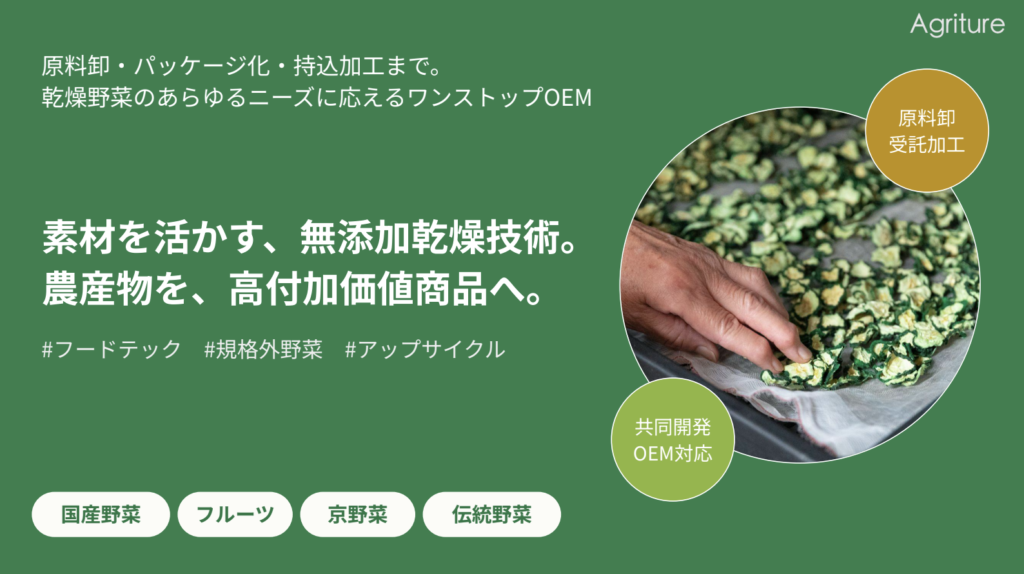
- OEM available from small lots of 10 kg
- Drying of brought-in raw materials also possible
- Support from processing to filling in one place
FAQ
Do freeze-dried strawberries really require a 500 kg minimum lot?
For a general main order, around 500 kg of fresh is the guide, but some plants can handle prototyping from 10–50 kg. If you set up a staged operation of prototyping at a small-lot-capable plant → main order at a mass-production plant, you can confirm quality while keeping the initial risk down.
Why is the yield low for strawberries?
Because strawberries have a high moisture content of about 90%, and driving off the moisture by freeze-drying greatly reduces the weight. Even 500 kg of fresh finishes at around 25–50 kg. Trimmings arising from cutting and shape retention are also a factor in the yield decline.
What is the cost market rate for small-lot-capable contractors?
Test-drying costs are around 50,000–100,000 yen, and when bringing in raw material separately, adding the raw-material cost is common. Because at the mass-production stage the processing cost per kg drops greatly, an order plan that anticipates the cost curve changing between prototype and mass production is called for.
Do I need to procure the raw material myself?
It differs by contractor. Some plants are premised on bringing in raw material, while in other cases the processor supports raw-material procurement. Because Agriture holds its own purchasing routes such as Kyotango-produced strawberries, you can consult consistently from raw-material procurement to processing and filling.
What are the criteria for shifting to mass production?
The timing for the decision is when, in the two stages of prototype → limited sale, the three points — "the inventory turnover rate has become visible," "the complaint rate settled within an acceptable range," and "the actual cost figures have firmed up" — are all aligned. Because placing a single large 500 kg order at the outset greatly increases inventory risk, we recommend staged ordering.
Summary
The minimum lot for freeze-drying varies with the material's moisture content and yield — around 500 kg of fresh for strawberry, 100–300 kg for mushrooms and miso-soup ingredients, and so on. Because some plants accept small-lot prototyping from 10–50 kg, a staged operation of prototype → limited sale → mass production, keeping the initial risk down, is a realistic order strategy.
Related article: Popular-material ranking・Processing-cost market rates・Commercial freeze-dried strawberries. For small-lot inquiries, see Food OEM no Madoguchi (Agriture).
Download the OEM contract processing materials
We will send the materials to your email address based on the information you provide.
If you are considering product development with off-spec or your own farm's vegetables:From planning to processing, materials, package printing and novelties, you can consult us through a single point of contact. → Learn more about one-stop product development
FOR BUSINESS
乾燥野菜のOEM・受託加工を承ります
国産の野菜・果物の乾燥、100メッシュ相当までの粉砕、10g以上の小袋充填までをお受けしています。小ロットの試作から量産までご相談ください。寄せられた相談の実例は OEM・卸のご相談 に掲載しています。
乾燥品の賞味期限は、出荷日から6ヶ月程度を目安にご案内しています。
- Freeze-Drying Processing Costs | Price Ranges by Product and Lot
- Freeze-Dried Material Ranking | Popularity and How to Choose by Use
Author of this article
Related articles
-
 Original coffee marketing strategy | Ways to grow sales
 -
 ベジタリアンとは?国の規格が分けている4つの区分と食べられないもの
 -
 長ねぎと白ねぎは同じもの?ねぎの種類と呼び名を国の資料で確かめる
 -
 柚子の種類は何種類あるのか、公の資料で名前が残る系統を数えた
 -
 ゆずの時期は年に二度、青ゆずは7月から黄ゆずは10月から
 -
 ゆずの産地は高知が半分を占め、二位は徳島から愛媛に変わった
 -
 Preventing Food OEM Failures: Common Failure Cases and Countermeasures for Success
 -
 How to find a food OEM | How to efficiently find the best manufacturing partner