
How to choose a coffee OEM vendor | 5 vendor categories and a quote check

Summary of this article
A thorough guide to choosing a coffee OEM supplier. It covers the 5-category classification of supplier types (self-roasting specialists, major subcontractors, drip-bag specialists, roaster-plus-retail operators, and local roasteries), 7 checkpoints for comparing quotes, a compatibility diagnosis between your company and the supplier (particularity, mass production, speed, story, cost), differences in aroma-retention technology such as nitrogen filling, how to choose a drip-bag supplier, the criteria for self-making vs. OEM (initial investment, time, quality, scale), and 6 representative companies.
Choosing a coffee OEM supplier is a crucial decision that sways a brand's taste, cost, and speed. Suppliers come in 5 types—self-roasting specialists, major subcontractors, drip-bag specialists, roaster-plus-retail operators, and local roasteries—each with different strong areas, minimum lots, and prototype flexibility.
In this article, The 5-category classification of supplier types, the quote-comparison checklist, the compatibility diagnosis, nitrogen-filling technology, and the self-making vs. OEM criteria—we organize the practical know-how for not failing in coffee OEM supplier selection. It's a practical guide for those unsure about ordering beans, ground coffee, or original drip bags.
What you'll learn in this article
- The 5-category classification of coffee OEM supplier types and the orderers they suit
- 7 checkpoints for comparing quotes
- A 3-axis diagnosis for identifying suppliers compatible with your company
- Differences in aroma-retention technology such as nitrogen filling and oxygen absorbers
- The key points of selecting an original-drip-bag supplier
- The criteria for self-making vs. OEM

We have materials available to help you understand dried processing OEM
Agriture OEM, flexibly handling everything from small lots to large lots
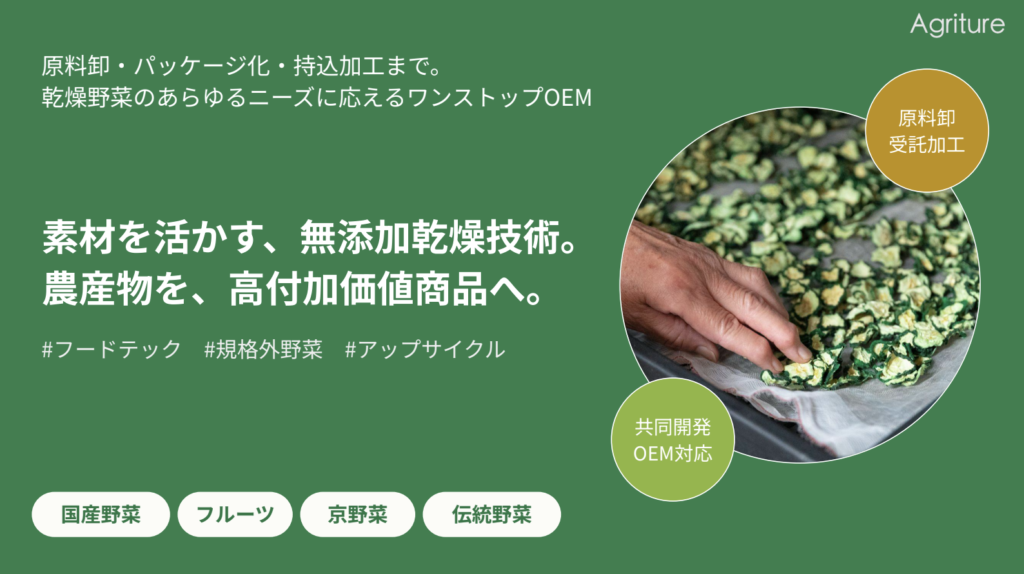
- OEM available from small lots of 10 kg
- Drying of brought-in raw materials also possible
- Support from processing to filling in one place
TOC
The 5-category classification of OEM supplier types
Coffee OEM suppliers divide broadly into 5 types by business form. your brand scale, product concept, and budget—choosing the type that fits these is the starting point for supplier selection that doesn't fail.
| Type | Features | Suitable orderer |
|---|---|---|
| Self-roasting specialist | No own brand / OEM-specialized | Small-lot, prototype-focused |
| Major-subcontractor type | Contract manufacturing for major beverage makers | Mass production, RTD, certification-focused |
| Drip-bag specialist | Filling-equipment-specialized | Drip products main |
| Roaster-plus-retail operator | Own sales + OEM together | Proposal-strength, consultation-focused |
| Local roastery | Locally rooted, small-quantity flexible | Regional-brand, story-focused |
Strengths of self-roasting specialists
Because self-roasting specialists are specialized in OEM manufacturing, they can flexibly accommodate spec changes and back-and-forth prototyping. Small-lot support is their strongest area, with many makers taking orders from 50–500 units, suiting new brand launches. On the flip side, they can be inferior to major-subcontractor types in large-lot mass production and certification systems.
Strengths of major-subcontractor types
Major-subcontractor types have strengths in quality control, certification, and mass-production capability. They can handle beverages broadly, including RTD cans and PET-bottle drinks, with smooth stable supply and export support. On the flip side, minimum lots often start from 10,000 units and up, making it a high-barrier area for small-scale brands.
Strengths of drip-bag specialists
Drip-bag specialist suppliers invest specifically in filling machines, filter technology, and nitrogen-filling equipment, tending toward high drip-coffee quality. When you make drip bags your mainstay—for gifts, novelties, hotel guest rooms, and so on—choosing a specialist supplier is the shortcut.
FOR BUSINESS
乾燥野菜のOEM・受託加工を承ります
国産の野菜・果物の乾燥、100メッシュ相当までの粉砕、10g以上の小袋充填までをお受けしています。小ロットの試作から量産までご相談ください。寄せられた相談の実例は OEM・卸のご相談 に掲載しています。
乾燥品の賞味期限は、出荷日から6ヶ月程度を目安にご案内しています。
7 points for comparing quotes
When getting quotes from OEM suppliers, comparing on the total alone is a pitfall. Roasting fees, packaging, prototype fees, shipping, and certification are often itemized separately, so you need to align the breakdowns to compare.
| Check item | Points to check |
|---|---|
| Green-bean cost | Origin, variety, grade (commodity / specialty) |
| Roasting fee | Lot unit price, roast-profile support |
| Package cost | Breakdown of bag, box, printing, and plate costs |
| Prototyping cost | Handling of first-run, additional, and tasting samples |
| Shipping, delivery | Refrigerated / room temperature, individual delivery, via warehouse |
| Certification-related costs | Costs of Organic JAS, HACCP, HALAL, and the like |
| Lead time | Total period from prototype to mass production to delivery |
When ordering for the first time, get quotes from at least 3 companies and have them quote on the same specs to make a state where simple comparison is possible. Because each supplier's strong area differs, consulting with several before narrowing to one is the practical approach.
Compatibility diagnosis between your company and the supplier
Supplier selection is decided by what your company prioritizes sets your direction. Sorting your own priorities along three axes—craft-focused, volume-focused, or speed-focused—makes it faster to decide on a supplier.
| Your priority | Suited supplier type | Deciding factor |
|---|---|---|
| Craft-focused | Dedicated in-house roasters / roaster-operators | Prototype flexibility and proposal capability |
| Volume-focused | Major-subcontractor type | Lot capacity, certification, unit price |
| Speed-focused | Drip-bag specialist | Lead time, use of existing formulations |
| Story-focused | Local roastery | Regional character and story |
| Cost-focused | Major-brand subcontractors / dedicated in-house roasters | Competitive quotes, whether raw materials can be supplied |
Differences in coffee aroma-retention technology
Coffee rapidly loses its aroma after roasting. The air gap and oxygen level at packaging greatly affect how quickly the flavor degrades within the best-before period. Here are the points for gauging a supplier’s equipment and technology.
| Technology | Effect | Characteristics of suppliers that offer it |
|---|---|---|
| Nitrogen flushing | Replaces oxygen with nitrogen to minimize oxidation | Common among major subcontractors and drip-bag specialists |
| Oxygen absorber | Absorbs residual oxygen in the bag | Handled by nearly all suppliers |
| Aroma valve | Vents gas right after roasting while blocking oxygen | Standard equipment at dedicated in-house roasters |
| Aluminum-laminated bag | Barrier against light, moisture, and oxygen | Handled by nearly all suppliers |
Nitrogen flushing requires large capital investment,so some small and mid-sized suppliers can’t handle it. For high-priced gifts and premium brands, whether a supplier can do nitrogen flushing can be the deciding factor. Oxygen absorbers and aluminum-laminated bags are standard equipment at many suppliers, so they’re areas where it’s hard to differentiate.
We have materials available to help you understand dried processing OEM
Agriture OEM, flexibly handling everything from small lots to large lots
- OEM available from small lots of 10 kg
- Drying of brought-in raw materials also possible
- Support from processing to filling in one place
Key points for drip-bag suppliers
Original drip bags If you want to make them, there are especially important factors in supplier selection. The type of filling machine, bag shape, supported bean weight, and filter material greatly affect the finished quality and price.
| Item | Things to confirm |
|---|---|
| Type of filling machine | Immersion / percolation / hybrid |
| Minimum lot | Increments of 100 / 500 / 1,000 units and up |
| Supported bean weight | Range and increments from 7 g to 12 g |
| Filter material | Non-woven / paper / biodegradable |
| Individual packaging | Aluminum lamination + oxygen absorber / nitrogen flushing |
| Outer box | Number of supported designs, whether you can supply your own |
The pitfall in ordering original drip bags is the outer box being billed separately. A quote for the drip bags alone often doesn’t include the box, and there are cases where the box-printing plate fee (100,000–300,000 yen) plus per-lot box cost makes the total cost 1.5 times higher. Getting a quote for “a full set of 10 bags per box, gift specification”is the practical approach.
The criteria for self-making vs. OEM
Buy a roaster and make it yourself, or entrust it to an OEM supplier. Four axes—initial investment, time, quality, and scale organize the decision criteria.
| Deciding factor | In-house (buying a roaster) | OEM outsourcing |
|---|---|---|
| Initial investment | Small machine: 500,000–3,000,000 yen | Prototype cost only (up to 50,000 yen) |
| Ramp-up period | 6 months to 1 year (to gain proficiency) | 1–2 months |
| Quality stability | Person-dependent; varies with proficiency | Stable with professional equipment and technique |
| Scalability | Capped by equipment scale | Expandable to match the supplier’s equipment scale |
| Cost ratio | Low at high volume | OEM advantageous up to mid-size lots |
At a scale of 10,000 units or fewer per year, OEM outsourcing is advantageous. Beyond that scale, there are cases where in-house roasting starts to offer a cost advantage, but given the capital investment and the cost of mastering roasting, when first launching a brand it’s safer to validate the market with OEM before deciding on equipment investment.
Leading coffee-OEM companies
As partners you can consult for coffee OEM, Food OEM Directory we introduce leading companies from among those listed. Across three areas—dedicated in-house roasters, coffee specialists, and general beverage makers—compare and consider the supplier that fits your concept.
| Company name | Area of strength |
|---|---|
| Hakata Coffee Kobo | In-house roasting, over 25 years of drip bags, Fukuoka |
| Base Coffee Inc. | Specialty-coffee specialist, Aichi |
| Freshness Inc. | 50 years of coffee expertise, drip-bag OEM, Tokyo |
| KUNZUDO | Craft coffee OEM, ingredients × coffee |
| shimaji coffee | In-house roasting, liquid, latte base, Hiroshima |
| Agriture Inc. | Vegetable-ingredient × coffee blend design |
All coffee and tea OEM companies are the Food OEM Portal "Coffee & Tea" list.
FOR BUSINESS
乾燥野菜のOEM・受託加工を承ります
国産の野菜・果物の乾燥、100メッシュ相当までの粉砕、10g以上の小袋充填までをお受けしています。小ロットの試作から量産までご相談ください。寄せられた相談の実例は OEM・卸のご相談 に掲載しています。
乾燥品の賞味期限は、出荷日から6ヶ月程度を目安にご案内しています。
Choosing a coffee OEM supplier: summary
To avoid failing at choosing a coffee OEM supplier, the 5 supplier types are important to understand—then choose a partner that fits your priority axis (craft / volume / speed / story / cost). Getting competitive quotes from three or more companies and comparing not just the total but the breakdown is the practical way to proceed.
If drip bags are your core, choose a specialist supplier and the outer box, nitrogen flushing, and filter material—get a quote that nails all of these down. Since the in-house-vs-OEM decision changes with annual scale, the safe steps are to validate the market with OEM at launch and decide on equipment investment once it’s on track.
Download the OEM contract processing materials
We will send the materials to your email address based on the information you provide.
Recommended reading
How to start coffee OEM in small lots
How to request tea OEM manufacturing
If you are considering product development with off-spec or your own farm's vegetables:From planning to processing, materials, package printing and novelties, you can consult us through a single point of contact. → Learn more about one-stop product development
- A complete explanation of the coffee OEM flow! All steps from order to delivery
- How to start coffee OEM at small lots | 3 formats and 7 ordering points
Author of this article
Related articles
-
 Original coffee marketing strategy | Ways to grow sales
 -
 ベジタリアンとは?国の規格が分けている4つの区分と食べられないもの
 -
 長ねぎと白ねぎは同じもの?ねぎの種類と呼び名を国の資料で確かめる
 -
 柚子の種類は何種類あるのか、公の資料で名前が残る系統を数えた
 -
 ゆずの時期は年に二度、青ゆずは7月から黄ゆずは10月から
 -
 ゆずの産地は高知が半分を占め、二位は徳島から愛媛に変わった
 -
 Preventing Food OEM Failures: Common Failure Cases and Countermeasures for Success
 -
 How to find a food OEM | How to efficiently find the best manufacturing partner