
What is shima-kabocha? Also called "chinkuwa" or "nankuwa"

Summary of this article
Shima kabocha is a native-variety kabocha long grown in Okinawa Prefecture, also called "chinkuwa" or "nankuwa" in dialect. This article explains the characteristics of shima kabocha, its differences in texture and nutrition from Western kabocha, the difference between chinkuwa and nankuwa, the history in which a Portuguese ship is said to have brought it, and nutritional value such as β-carotene. It also introduces representative ways to eat it—potage, gratin, nbushi—along with how to choose fresh ones and how to store them.
Shima kabocha is an heirloom vegetable of Okinawa. Also called nankwa or chinkwa in Okinawa, it has been handed down as an ingredient in Ryukyu cuisine. This article covers the features, history, flavor and ways to eat shima kabocha, as well as how to use it as a dried vegetable.

TOC
What is shima kabocha?
Shima kabocha is a native-variety kabocha long grown in Okinawa Prefecture, classified as a type of Japanese kabocha (nihon-kabocha). It belongs to a different lineage from the Western kabocha commonly seen at supermarkets, is called "nankuwa" or "chinkuwa" in Okinawan dialect, and has been used as an ingredient of Ryukyu cuisine.
Okinawa Prefecture, eaten since before the war Island vegetables designates 28 items as "Okinawa's traditional agricultural products," and shima kabocha is positioned as one of them. Its handling is also spreading at direct-from-farm mail order and restaurants outside the prefecture Heirloom vegetables, contained in burdock and cocoa.
The appearance and texture of shima kabocha
Compared with Western kabocha, shima kabocha has more moisture and a sticky texture, yet its sweetness is restrained. Unlike the fluffy texture of Western kabocha, its light taste suits dishes that make the most of the ingredient's flavor. That it holds up well to simmering and keeps its shape even in simmered and stir-fried dishes is also a feature.
Shima kabocha varies in shape too, with no set size or form. At Okinawa's markets, shima kabocha with individual differences from one to the next line up. The flesh is pale yellow to orange, deepening in color as it fully ripens.
The difference between "nankuwa" and "chinkuwa"
Shima kabocha has two types, "nankuwa" and "chinkuwa." Nankuwa refers to ones with a smooth surface and no vertical wrinkles, and chinkuwa to ones with vertical wrinkles on the surface. Both are members of the shima kabocha family, with slight differences in look and texture (source: Onna no Eki Nakayukui Ichiba)。
| Comparison item | Chinkuwa | Nankuwa |
|---|---|---|
| Surface | Has vertical wrinkles | Smooth |
| Shape | Many are somewhat elongated | Many are rounded |
| Texture | Strongly sticky | Relatively light |
| Recommended dishes | Simmered dishes, potage | Stir-fries, tempura |
Cultivation characteristics and vitality
Its growth is so vigorous that multiple fruits can be harvested from a single plant, and it is adapted to Okinawa's hot, humid climate. Relatively strong against diseases such as powdery mildew and against pests, and able to be grown to harvest with base fertilizer alone, it is also grown in home gardens (source: Noguchi Seed / Noguchi Seed Research Institute)。
FOR BUSINESS
乾燥野菜を業務用でお探しですか
国産の野菜・果物を乾燥し、必要に応じて粉砕してお出ししています。扱っている品目は100種前後で、規格は 乾燥品の一覧・パウダーの一覧 に掲載しています。
少量でのご購入は、姉妹ブランドの通販サイト OYAOYA で承っています。
The history of shima kabocha
The southern kabocha brought by a Portuguese ship
The roots of shima kabocha are said to date back to around the 16th century. The kabocha brought to Japan by a Portuguese ship is thought to have reached Ryukyu (Okinawa) as well and, adapting to Okinawa's climate, taken root as a native variety. The theory that the name "kabocha" derives from Cambodia, which the Portuguese passed through en route, is widely known.
Food culture from the Ryukyu Kingdom to the present
Eaten continuously in Okinawa since the Ryukyu Kingdom era, it took root as a native variety adapted to Okinawa's soil and climate. Eaten daily in simmered dishes, soups, and stir-fries, it is beloved as a region-specific kabocha. That it has been eaten in Okinawan households since before the war is considered one of the reasons it was designated among Okinawa Prefecture's 28 "Okinawa's traditional agricultural products"Island vegetables items.
The flavor and texture of shima kabocha
Dense, smooth flesh
Unlike the fluffy texture of Western squash, shima kabocha is characterized by flesh that turns dense, smooth and moist when cooked. It holds its shape well and stays intact even in dishes with plenty of liquid, making it well suited to simmered dishes and soups.
A light sweetness
Compared with the rich sweetness of Western squash, shima kabocha's sweetness is restrained and light. Because the flavor itself is light, it pairs easily with dishes that showcase dashi and seasonings, and it's easy to use in everyday side dishes.
Choosing between it and Western squash
Use Western squash when you want a fluffy texture and strong sweetness, and shima kabocha when you want something that holds its shape with a light flavor; this makes it easy to match each to the dish. In Okinawan local cuisine, shima kabocha is often used in soups and stir-fries.
Recommended ways to eat
Light and with little peculiarity, shima kabocha can be used in a wide range of dishes. It is perfect for stews, potage, and even sweets. Here we introduce representative cooking methods.
Shima kabocha potage
Made into potage, the smooth mouthfeel of shima kabocha stands out. Sauté thin-sliced onion in butter, blend it together with shima kabocha, and season with salt and pepper to finish. It is delicious as a chilled soup too, and since it comes out lighter than a Western kabocha potage, it is easy to use as an appetizer.
Shima kabocha gratin
With little fluffiness, shima kabocha melds with white sauce into a smooth gratin. Cut into bite-sized pieces and parboil, arrange in a gratin dish, top with white sauce and cheese, and bake in the oven—easy to make even at home.
Nbushi (Okinawan-style miso simmer)
A cooking method long enjoyed in Okinawan households is "nbushi (nbusaa)." A local dish in which shima kabocha is simmered in miso with pork or tofu, the light taste of shima kabocha goes well with the richness of miso. Shima kabocha nbushi is called "nankuwa nbushi" in Okinawan dialect, and each household's flavor is handed down.

How to choose and store shima kabocha
How to spot a fresh shima kabocha
When choosing shima kabocha, we recommend ones with a hefty, heavy feel. Ones that feel heavier than they look have flesh packed tight. Ones with a glossy skin and a stem that has dried into a cork-like state are a sign of full ripeness. For cut ones, choose ones whose flesh is clear and whose seeds are plump.
Tips for storing it to last
Whole, it keeps for about 1–2 months in a well-ventilated, cool place. After cutting, remove the seeds and pith, wrap in plastic wrap, and it is best to use it up within 4–5 days in the refrigerator. For long-term storage, there is also the method of heating it before freezing.
Using shima kabocha as a dried vegetable
The merits of making it a dried vegetable
Dried, shima kabocha keeps better and becomes easy to use as a standby ingredient. With the moisture drawn out, it holds up well to simmering even when added to simmered or stir-fried dishes, and rehydrated it can be used in a wide range of dishes—miso soup, soups, simmered dishes, and more.
How to use dried shima kabocha
Dried shima kabocha is rehydrated in water or lukewarm water for about 10–15 minutes before cooking. For soups and miso soup it can be added as-is. Because it keeps long at room temperature, it can also serve as an emergency-stock ingredient and helps reduce food loss through uses such as making the most of off-spec produce—a sustainable way of eating.
We have materials available to help you understand dried processing OEM
Agriture OEM, flexibly handling everything from small lots to large lots
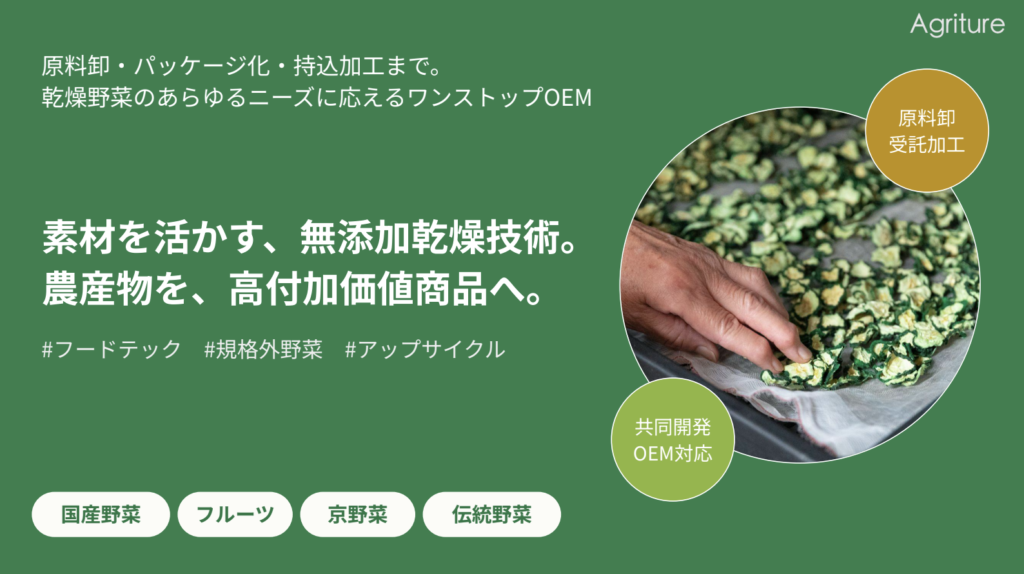
- OEM available from small lots of 10 kg
- Drying of brought-in raw materials also possible
- Support from processing to filling in one place
FOR BUSINESS
乾燥野菜を業務用でお探しですか
国産の野菜・果物を乾燥し、必要に応じて粉砕してお出ししています。扱っている品目は100種前後で、規格は 乾燥品の一覧・パウダーの一覧 に掲載しています。
少量でのご購入は、姉妹ブランドの通販サイト OYAOYA で承っています。
Frequently asked questions about shima kabocha
Summary
Shima kabocha is squash that arrived in Japan in the 16th century and became established in Okinawa as a native variety, an heirloom vegetable that has supported the food culture since the days of the Ryukyu Kingdom. It has a lighter flavor than Western squash and holds its shape well. Other features of shima kabocha include how to tell chinkwa from nankwa, and enjoying it in local dishes such as nbushi.
Processing it into a dried vegetable improves its shelf life and makes it easy to use in everyday cooking. Okinawa's Heirloom vegetables comes into view even from a single shima kabocha.
Related articles
Download the OEM contract processing materials
We will send the materials to your email address based on the information you provide.
- What is the regional character of heirloom vegetables? The tastes and stories handed down across the land
- A list of heirloom vegetables from the six Tohoku prefectures | The regional food culture we want to protect
Author of this article
Related articles
-
 Okinawa island vegetables: individualistic vegetables nurtured by a subtropical climate
 -
 Kaga vegetables: Kanazawa brand vegetables where tradition lives on
 -
 The appeal of Kansai heirloom vegetables | Specialties of Naniwa, Kyoto, and Yamato thoroughly explained
 -
 Kyoto heirloom vegetables: Kyoto specialties with a long history
 -
 A list of heirloom vegetables of the 8 prefectures of Kyushu and Okinawa|A thorough introduction to characteristics, growing regions, and seasons
 -
 Know the heirloom vegetables of Edo Tokyo | The city’s vanishing food culture
 -
 They'll make you smile! The fun names of heirloom vegetables and their origins
 -
 5 cases and strategies that succeeded in branding heirloom vegetables