
They'll make you smile! The fun names of heirloom vegetables and their origins

Summary of this article
Across Japan there are many heirloom vegetables with unique names drawn from their shape, place name, or origin. In this article, we introduce heirloom vegetables with amusing names and the origins of their naming -- Fukushima's "Iwaki tokkuri-imo," Aichi's "Kindawara makuwauri," Akita's "Kaizawa fukudachi-na" and "Musumekitaka," Shiga's "Hino-na," Nagoya City's "Yagoto-gosun carrot," Yamagata's "ukogi," and more -- along with the background of the wisdom and playfulness of our forebears packed into them.
Across Japan there are many heirloom vegetables with distinctive names. Unique vegetables whose very names make you smile in spite of yourself. This time, we introduce in detail the amusing names of such heirloom vegetables and their origins.
Heirloom vegetables are vegetables long grown in a given land and deeply tied to the region's food culture. Having adapted to the land's climate and character over long years and supported people's lives, they could be called "the intellectual property of the region."
The heirloom vegetables of each region are often given unique names drawn from their shape or origin, with an intriguing story hidden in each.
TOC
You can't help but laugh! Unique names drawn from shape
Among heirloom vegetables, many are named for their distinctive shape. Their visual impact is strong, and just hearing the name makes you smile in spite of yourself.
For example, "Iwaki tokkuri-imo" from Iwaki City, Fukushima Prefecture. As the name suggests, it's a taro shaped like a tokkuri (a sake flask), and it has long been loved by locals for its unique appearance.
* The image is an AI-created rendering
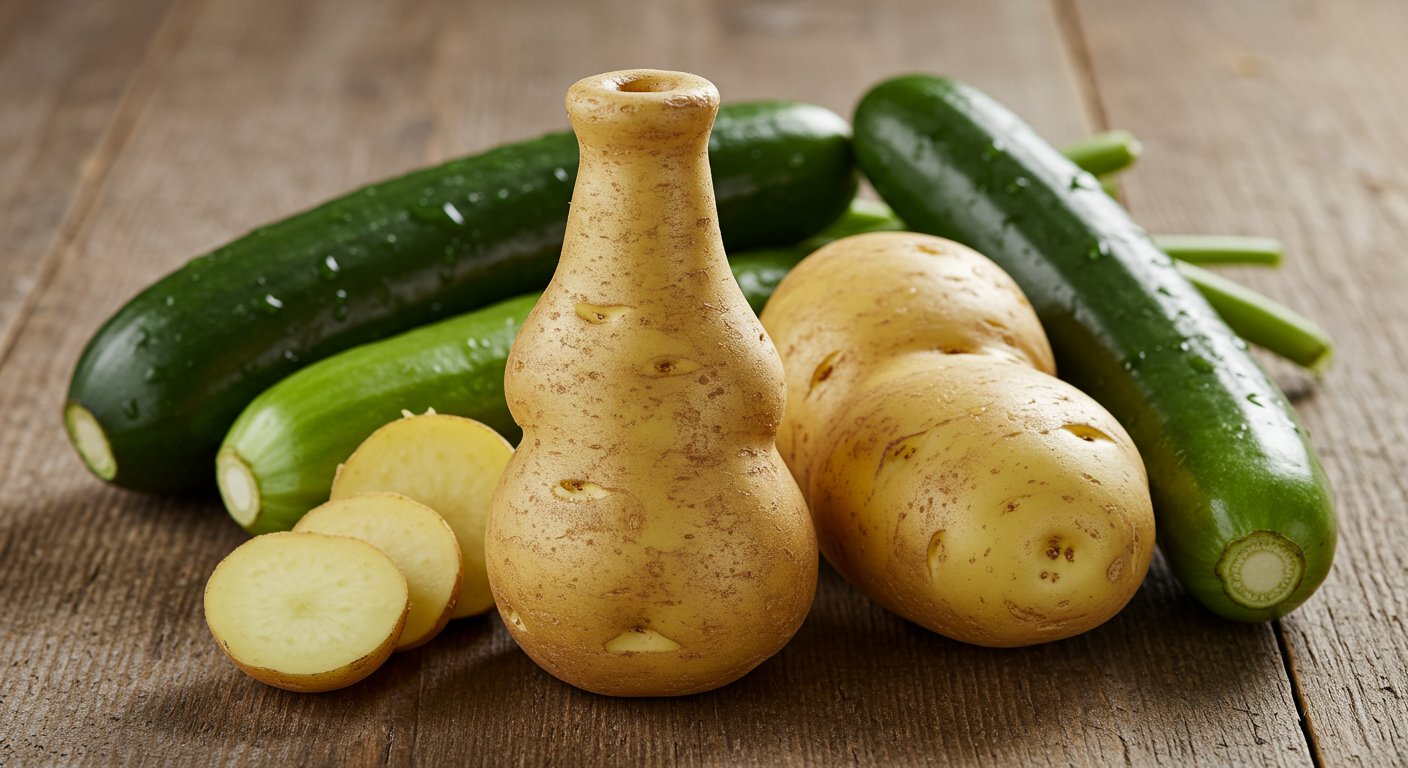
Also, in Aichi Prefecture there's a heirloom vegetable called "Kindawara makuwauri." In the Edo period, the makuwauri grown in this region ripened bale-shaped and golden, so it was named "Kindawara" (golden bale). It's a naming that lets you feel the rich imagination of people long ago.
Akita Prefecture has a vegetable called "Kaizawa fukudachi-na." "Fukudachi" means "bolting," describing the way the flower stalk stretches up in early spring. Characterized by a slight bitterness and strong sweetness, it's enjoyed as ohitashi and pickles.
Vegetables with origins that make you say "Ah, I see!"
Among heirloom vegetables, there are not a few whose origins, once you learn them, make you slap your knee and say "Ah, I see!" The many names deeply reflecting regional history and culture let you feel the depth of Japan's food culture.
"Hino-na" from Hino Town, Shiga Prefecture, is a heirloom vegetable said to have been discovered about 550 years ago in the mountains of the Kamakake settlement. "Sakura-zuke" (sweet-vinegar-pickled hino-na) made with this vegetable was spread nationwide by Omi merchants.
* The image is an AI-created rendering
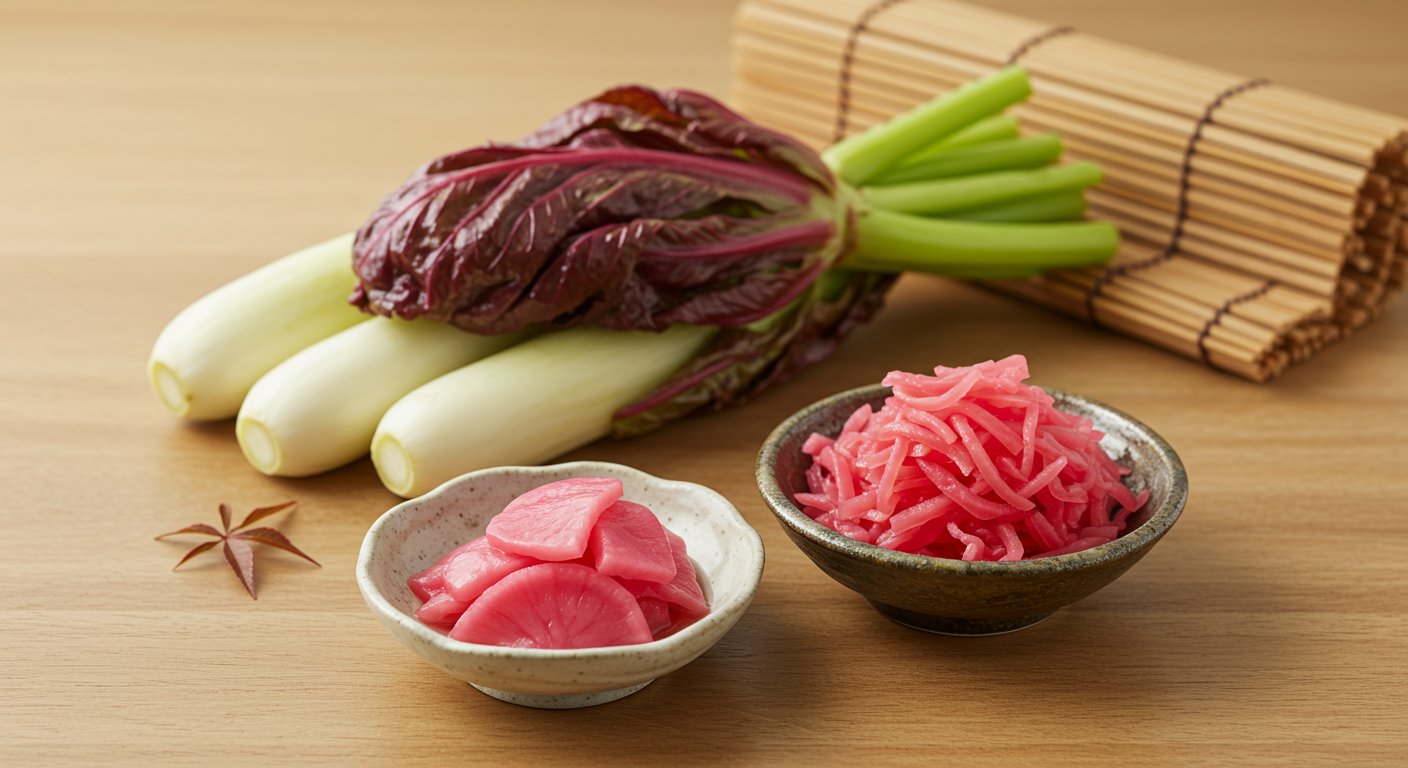
Its naming is said to carry a historical episode: Emperor Gokashiwabara of the time recorded these pickles as "sakura-zuke" in a waka of thanks for the offering. Hino-na has a distinctive look -- red above ground, white below -- and when pickled it dyes a beautiful cherry-blossom pink, which seems to be how it got this name.
Fukushima Prefecture has an azuki bean (in Iwaki City and elsewhere) called "Musumekitaka." Written in kanji, it reads "Has the daughter come?", and it's said the name originates from a nickname for a short-cooking bean that could be boiled and served right away when a married-off daughter came home to visit. It's a warm name that conveys a parent's affection.
Heirloom vegetables named after place names and people
Many heirloom vegetables are named after the place name of the region where the vegetable was nurtured, or the name of a person who contributed to its improvement. Because of this, they also become a starting point for learning the geography and history of all of Japan.
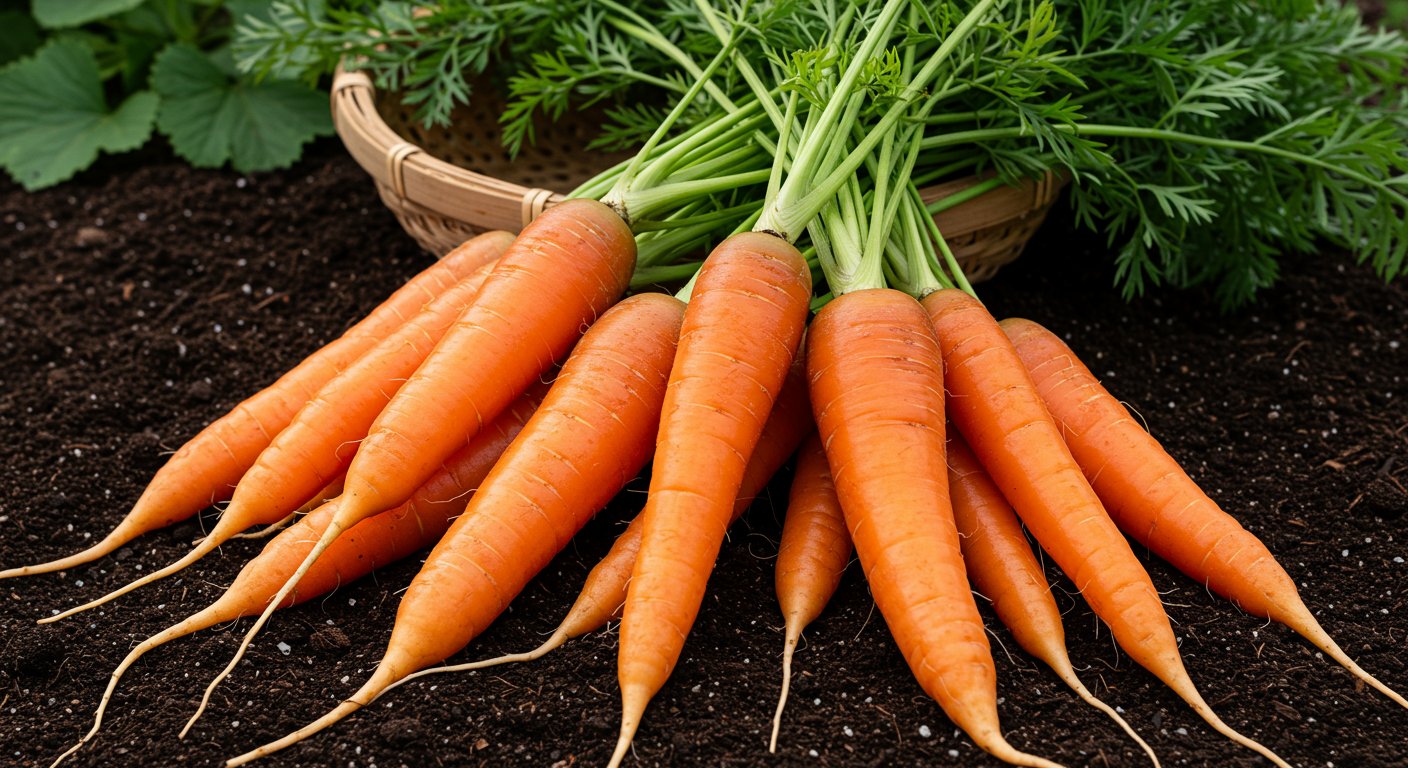
Nagoya City's "Yagoto-gosun carrot" is said to trace its roots to a selection from carrot seeds that a farmer in Tenpaku Ward introduced from a Tokyo seed company in the 8th year of Taisho. It seems to be named from the place name "Yagoto" and its length of about 5 sun (about 15 cm).
In the early Showa period it was popular enough to be exported to the Tokyo and Osaka markets and even to Hong Kong. Characterized by deep color, good flesh quality, and strong sweetness, it's still grown mainly within the city today.
* The image is an AI-created rendering
Okazaki City's "Hosshoji negi" is also a heirloom vegetable named after a place name. This green onion, improved to suit the region's character, has a flavor unique to that land.
Your hometown may have a heirloom vegetable you didn't know about. Searching for vegetables bearing place names may lead to new discoveries.
FOR BUSINESS
乾燥野菜を業務用でお探しですか
国産の野菜・果物を乾燥し、必要に応じて粉砕してお出ししています。扱っている品目は100種前後で、規格は 乾燥品の一覧・パウダーの一覧 に掲載しています。
少量でのご購入は、姉妹ブランドの通販サイト OYAOYA で承っています。
Vegetables with strange names that make you go "Huh!?"
Among them are heirloom vegetables with strange names that make you go "Huh!?" when you hear them. Names that at first glance don't seem to be vegetables tickle our curiosity.
Yamagata Prefecture's "ukogi" is generally known as a "hedge." Lord Uesugi Yozan recommending ukogi hedges was the trigger for its spread in Yonezawa; the ukogi hedge, which has thorns that also serve as crime prevention and can be used as an emergency food, spread because Lord Uesugi Yozan recommended it.
Akita Prefecture's "junsai" is also an aquatic plant a bit off the general image of a vegetable. It's characterized by a large amount of the agar-like part called "nuru."
The joy of hunting for unusual heirloom vegetables
Heirloom vegetables are being re-evaluated for their distinctive flavor, texture, and high nutritional value. Compared with uniform, mass-produced farm produce, the individual flavor of heirloom vegetables brings new discoveries to our tables.
You can find unusual heirloom vegetables at direct-sales outlets, specialty shops, and online stores across the country. Trying them with cooking methods unique to the land will open up new food experiences.
Why not hunt for heirloom vegetables with amusing names yourself? Learning the origins of their names and actually tasting them will surely deepen your understanding of Japan's rich food culture even further.
Summary: The wisdom and playfulness of our forebears in the names of heirloom vegetables
The amusing names of heirloom vegetables are packed with the wisdom and playfulness of our forebears. Named from a variety of elements -- shape, color, growing area, discoverer, and more -- these names hold value beyond a mere designation.
Heirloom vegetables are a precious presence protecting diversity and individuality amid a uniform modern food culture. Along with their amusing names, they're something we'd like to keep carefully passing on.
Please feel free to consult us about developing novelties or products that make use of heirloom vegetables.

Reference:
Hino Tourism Association "Heirloom vegetable: Hino-na" (accessed: 2025/08/04) https://hino-kanko.jp/souvenir/hinona/
Aichi's heirloom vegetables "Kindawara makuwauri" (accessed: 2025/08/04) https://www.pref.aichi.jp/engei/dentoyasai/item/07.html
Iwaki City Hall "Iwaki tokkuri-imo" (accessed: 2025/08/04) https://www.city.iwaki.lg.jp/www/contents/1001000000756/simple/tokkuriimo.pdf
Japan Vegetable Terroir Association "Kaizawa fukudachi-na (Akita heirloom vegetable)" (accessed: 2025/08/04) https://vege-terroir.jp/vegepedia/kaizawafukudachi/
Iwaki City Hall "Musumekitaka (azuki bean)" (accessed: 2025/08/04) https://www.city.iwaki.lg.jp/www/contents/1001000000754/simple/musumekitaka.pdf
Aichi's heirloom vegetables "Yagoto-gosun carrot" (accessed: 2025/08/04) https://www.pref.aichi.jp/engei/dentoyasai/item/16.html
Aichi's heirloom vegetables "Hosshoji negi" (accessed: 2025/08/04) https://www.pref.aichi.jp/engei/dentoyasai/item/23.html
Delicious Yamagata "ukogi | Yonezawa City, Kawanishi Town" (accessed: 2025/08/04) https://www.yamagata.nmai.org/crops/umaimono/native/ukogi.html
Ando Foods "What is junsai?" (accessed: 2025/08/04) https://andofoods.com/?mode=f1&srsltid=AfmBOopapCZE5RpUpcoFq2nrpwhUFFTu4A2HS5-YVazgjfWtop1iyl4D
Recommended reading
Heirloom vegetables from across Japan / Commercial dried vegetables / Sustainable initiatives / Japan's Heirloom Vegetables: Precious Varieties Handed Down in Each Region / What is shima-kabocha? Also called "chinkuwa" or "nankuwa"
10 heirloom vegetables with amusing names
| Variety name | Growing region | Origin of the name | Features |
|---|---|---|---|
| Chinkuwa (shima-kabocha) | Okinawa | "Kabocha" in the Okinawan dialect | A long, slender native kabocha |
| Tonburi | Akita | Because it resembles the "buriko (fish roe)" of the Tang | Called the "caviar of the field" |
| Zuiki | Kyoto / Nara | One theory holds it derives from "zuiki no namida (tears of joy)" | A preserved food made by drying taro stalks |
| Mottenohoka | Yamagata | From "outrageously (mottenohoka) delicious" | The variety name of an edible chrysanthemum |
| Negibozu | Various regions | The green onion's flower resembles a shaven head (bozu) | The flower spike of green onion. Eaten as tempura |
| Okanori | Various regions | Means "nori of the hill." Its stickiness resembles nori | A leafy vegetable of the mallow family |
| Yuzaki nebuka | Nara | A corruption of "nebuka (deep-rooted)" | A traditional green onion of Yamato |
| Manganji togarashi | Kyoto | Originated in the Manganji district of Maizuru, Kyoto | A large pepper with no heat |
| Shishigatani kabocha | Kyoto | The place name of Shishigatani in Sakyo Ward | A gourd-shaped Kyoto vegetable |
| Nabera | Okinawa | "Hechima (loofah)" in the Okinawan dialect | An edible loofah. Miso simmering is the standard |
The names of heirloom vegetables reflect the regional dialect, visual features, historical episodes, and more. Chinkuwa (shima-kabocha) and Manganji togarashi Details are also introduced in individual articles.
FOR BUSINESS
乾燥野菜を業務用でお探しですか
国産の野菜・果物を乾燥し、必要に応じて粉砕してお出ししています。扱っている品目は100種前後で、規格は 乾燥品の一覧・パウダーの一覧 に掲載しています。
少量でのご購入は、姉妹ブランドの通販サイト OYAOYA で承っています。
Frequently asked questions (FAQ)
We have materials available to help you understand dried processing OEM
Agriture OEM, flexibly handling everything from small lots to large lots
- OEM available from small lots of 10 kg
- Drying of brought-in raw materials also possible
- Support from processing to filling in one place
Download the OEM contract processing materials
We will send the materials to your email address based on the information you provide.
- Know the heirloom vegetables of Edo Tokyo | The city’s vanishing food culture
- 5 cases and strategies that succeeded in branding heirloom vegetables
Author of this article
Related articles
-
 Okinawa island vegetables: individualistic vegetables nurtured by a subtropical climate
 -
 Kaga vegetables: Kanazawa brand vegetables where tradition lives on
 -
 The appeal of Kansai heirloom vegetables | Specialties of Naniwa, Kyoto, and Yamato thoroughly explained
 -
 Kyoto heirloom vegetables: Kyoto specialties with a long history
 -
 A list of heirloom vegetables of the 8 prefectures of Kyushu and Okinawa|A thorough introduction to characteristics, growing regions, and seasons
 -
 Know the heirloom vegetables of Edo Tokyo | The city’s vanishing food culture
 -
 5 cases and strategies that succeeded in branding heirloom vegetables
 -
 What is the regional character of heirloom vegetables? The tastes and stories handed down across the land