
Freeze-Dried Soup OEM: A Guide to Small-Lot Manufacturing, Costs, and Manufacturer Comparison

Summary of this article
OEM of freeze-dried soup starts with which type you make—block, powder, or separated-ingredient. Grasp the compatibility—vegetable-based soups are well suited, while dairy- and fat-heavy potages need some ingenuity—and we have organized everything from minimum lots and costs to how to choose a manufacturer and how to differentiate through ingredients.
Freeze-dried soup, which becomes a proper bowl just by adding hot water, is broadening its channels—gifts, subscriptions, offices, and disaster stockpiles—driven by rising health awareness and time-saving needs. Consultations from companies wanting to launch their own brand via OEM are increasing, but because soup's compatibility with freeze-drying varies greatly by type, understanding the manufacturing design at the entrance to your plan is essential.
This article is for those considering OEM (contract manufacturing) of freeze-dried soup, organizing from the manufacturing-floor perspective the differences between production types, how to tell which soups suit freeze-drying and which don't, minimum lots and costs, and how to choose a manufacturer. Drawing on Agriture's experience in dried-vegetable blend design, it also digs into how to differentiate through ingredients.
The basics of whether to choose freeze-drying or hot-air drying are explained in The difference between freeze-drying and dried vegetables. This article goes a step further, focusing on design for soup as a product.
TOC
The three production types for freeze-dried soup OEM
Freeze-dried soup divides into three types by the finished shape. Because which one you choose changes the rehydration speed, the presence of ingredients, the minimum lot, and the unit price, deciding the direction early to match the product concept makes prototyping smooth.
Block type (cube-molded)
A method of filling soup and ingredients into a tray, freeze-drying them together, and finishing them into a square cube. When you add hot water, the block comes apart into a bowl, and because it has a special look, it's chosen for gifts and premium products. Since it can enclose ingredients, it suits soups meant to be filling in a single bowl.
Powder / granule type
A method of drying the soup and crushing it into powder or granules. It dissolves quickly in hot water and pairs well with types that don't put ingredients front and center, like potage and corn soup. It's easy to develop into stick packaging and large commercial volumes, and has the advantage of keeping cost per volume down.
Separated-ingredient type
A method of drying the soup base and the ingredients separately and combining them at packaging. Because you can set the optimal drying conditions for each ingredient, it's easy to keep vegetables crisp and colorful, and easy to develop a series with different ingredients on the same base. Note that the added process tends to make it pricier at small lots.
| Type | Soups it excels at | Features |
|---|---|---|
| Block type | Hearty, gift | A filling, special single bowl |
| Powder / granule type | Potage and corn-based | Dissolves quickly, easy to develop for commercial use |
| Separated-ingredient type | Vegetable soup, series development | You can craft the texture and color of the ingredients |
Soups that suit freeze-drying and those that don't
A soup's compatibility with freeze-drying divides by recipe. Judging early whether the soup you're aiming for is a suitable type prevents rework in prototyping.
| Compatibility | Soup examples |
|---|---|
| Well suited | Vegetable soup, miso-based, Japanese dashi soup, tomato-based, egg soup |
| Needs ingenuity | Dairy- and fat-heavy types like potage and corn, rich types |
Why potage types (dairy, fat) are difficult
Potage and corn soups that contain a lot of dairy or fat are types where the oil content is hard to handle during drying and storage, and where flavor deterioration from oxidation easily occurs. Since dairy itself is considered unsuitable for freeze-drying, it's common to handle it by adjusting the formulation and selecting ingredients, an area where you'll want to check the manufacturer's production track record.
Precisely because of this difficulty, whether a manufacturer can make potage types stably becomes a decision point in selection. At the prototype stage, check the smoothness after rehydration and how well the flavor holds, and refine the packaging design with the best-before date in mind for peace of mind.
- Formulation design of fat ratio and dairy content
- Ingredient and packaging measures to suppress oxidation
- Smoothness (viscosity) after rehydration
- Packaging-material design with the best-before date in mind
Manufacturing pointers by Japanese, Western, and Chinese type
For Japanese dashi soups it's aroma design, for Western soups it's the balance of fat and richness, and for Chinese soups it's the expression of aromatic oil and spiciness that are the crux. Strongly aromatic soups like curry, kimchi, and garlic-heavy ones can transfer aroma and are sometimes avoided, so consulting the manufacturer including the state of the line reveals a realistic landing point.
For any type, the aroma the moment you add hot water and the satisfaction of the dashi or bouillon sway the evaluation. On top of a well-crafted base, adding seasonality and color with ingredients lets you stand out in a soup market that tends to look uniform.
FOR BUSINESS
乾燥野菜のOEM・受託加工を承ります
国産の野菜・果物の乾燥、100メッシュ相当までの粉砕、10g以上の小袋充填までをお受けしています。小ロットの試作から量産までご相談ください。寄せられた相談の実例は OEM・卸のご相談 に掲載しています。
乾燥品の賞味期限は、出荷日から6ヶ月程度を目安にご案内しています。
Soup design by Japanese, Western, Chinese, and ethnic type
In soup OEM, the design crux changes with which cuisine genre you target. Grasping each genre's characteristics first sets the direction of prototyping.
| Genre | Representative soups | Design pointers | Points to watch |
|---|---|---|---|
| Japanese | Sumashi, kakitama, tonjiru | The aroma of the dashi and the crispness of the ingredients | Heating that doesn't drive off the aroma |
| Western | Consommé, minestrone, potage | The richness of the bouillon and the color | Potage needs dairy and fat measures |
| Chinese | Chinese soup, hot-and-sour soup, corn | Expression of aromatic oil and thickness | Handling fat and spiciness |
| Ethnic | Tom yum, pho, samgyetang | Acidity, herbs, spices | Aroma transfer and handling distinctive ingredients |
For Japanese it's the delicate aroma of the dashi, for Western the richness and color of the bouillon, for Chinese the aromatic oil and thickness, and for ethnic the acidity and herbs that become the individuality. Because strongly aromatic ingredients easily transfer to other products on the same line, consulting the manufacturer including the manufacturing sequence lands you on a realistic design.
Expanding one dashi base into a cross-genre series by changing ingredients and seasoning makes it easy to roll out seasonal-limited editions, assortments, and other lineups tailored to the retail floor.
Differences between freeze-dried soup and other types
Besides freeze-dried, instant soup comes in retort (pouch) and powder types. Because the presence of ingredients, flavor, ease of dissolving, shelf stability, and cost vary by product category, organizing why you would make it freeze-dried helps set the axis of your plan.
| Type | Ingredient presence and flavor | Storage and features | Suited sales channel |
|---|---|---|---|
| Freeze-dried | Easy to retain the shape and flavor of the ingredients | Lightweight, suited to long-term room-temperature storage | Gift, stockpile, e-commerce |
| Retort type | Easy to bring out thickness and richness | Contains water and adds weight | Everyday use, supermarkets |
| Powdered soup (spray-dried, etc.) | Dissolves quickly and is convenient, but ingredients are modest | Lightweight, low cost | Commercial, large volume |
When freeze-drying is chosen
Freeze-drying is characterized by keeping the shape and color of ingredients while rehydrating quickly with hot water. Being light and shelf-stable at room temperature, it pairs well with vegetable-intake appeal, gifts, disaster stockpiles, and e-commerce, and is chosen for products that want both appearance and shelf stability.
Choose by cost and application
Retort when you want to bring out rich thickness and a hearty feel, powder when you prioritize convenience and low cost—the best category shifts with the direction you're aiming for. When you value the presence of ingredients, lightness, shelf stability, and gift demand, freeze-drying's strengths come into play. Deciding which category to compete in first gives the product design a clear thread.
Minimum lot, cost, and how to proceed with development
The first thing to check in freeze-dried soup OEM is from how many servings you can make. The minimum lot varies widely with the manufacturer's equipment scale—from a few dozen servings for prototypes, and several thousand to tens of thousands of servings for main production as a guide.
| Stage | Approximate quantity | Notes |
|---|---|---|
| Prototype lot | Around 50 servings and up | Flavor development, sample confirmation |
| Small-lot main production | Several hundred to several thousand servings | Consult a small-lot-capable manufacturer |
| Standard lot | From about 29,000 servings for soup | Cosmos Foods' published figure |
Quantities change with cube size, ingredient composition, and packaging format. Understanding the division of roles—large manufacturers keep unit prices down thanks to large standard lots, while small-lot specialists are nimble from a few hundred servings—makes it easier to narrow down where to consult.
Flow from prototype to main production
Many manufacturers follow the flow of meeting → flavor development (prototyping) → sample confirmation → quotation → line test → main production. Soup often takes repeated prototyping to adjust the flavor, so allowing about half a year for development gives you breathing room. Confirming prototype costs and main-production unit prices early makes the budget easier to read.
| Step | Details |
|---|---|
| 1. Meeting | Share the product concept, target lot, and budget |
| 2. Flavor development (prototyping) | Prototype the soup, dashi, and ingredients (may be paid) |
| 3. Sample confirmation | Check the smoothness and flavor after rehydration |
| 4. Quotation | Finalize lot, unit price, and packaging |
| 5. Line test | Confirm quality on the mass-production line |
| 6. Main production | Development period is around half a year as a guide |
Cost benchmarks and how to choose a factory are the Food OEM Portal's complete guide to freeze-dry OEM systematically organized as well, so you can use it as material for internal review.
Manufacturers strong in freeze-dried soup OEM
For soup freeze-drying, choosing a factory with equipment suited to the type you're aiming for (block, powder, separated-ingredient) and with design skill in dashi and bouillon sways the quality. From the manufacturers listed on the Food OEM Portal, we have organized companies with a track record in soup. Since strengths differ, we recommend consulting and comparing several companies.
- Can they handle the type you're aiming for (block, powder, separated-ingredient)?
- Do they have a track record with dairy- and fat-heavy soups like potage?
- Does the minimum lot match the target quantity?
- Can they handle your desired packaging, such as sticks and cups?
- Presence of hygiene management and certification such as FSSC 22000
- Availability and conditions for prototyping
| Maker | Location | Strengths and areas of expertise |
|---|---|---|
| Asuzac Foods | Nagano Prefecture | A track record in soup block-molding with large-scale contract freeze-dry facilities, FSSC 22000 compliant |
| Blankenese | Osaka, Okayama | One-stop support from planning to packaging, centered on freeze-dry processing |
| Serecon Foods | Osaka, Kyoto | Combining freeze-dried vegetables and drying technology to handle small-lot prototyping of soups with ingredients |
| Tsujiko | Shiga Prefecture | Strong in drying and powdering ingredients, handling small-lot prototyping of powdered soups and dashi ingredients |
Each company's equipment and supported formats can be the Food OEM Portal's list of freeze-dry companies can be compared from. Convey the soup type, target lot, and conditions such as additive-free, then compare prototypes from several companies to reduce failures.
We have materials available to help you understand dried processing OEM
Agriture OEM, flexibly handling everything from small lots to large lots
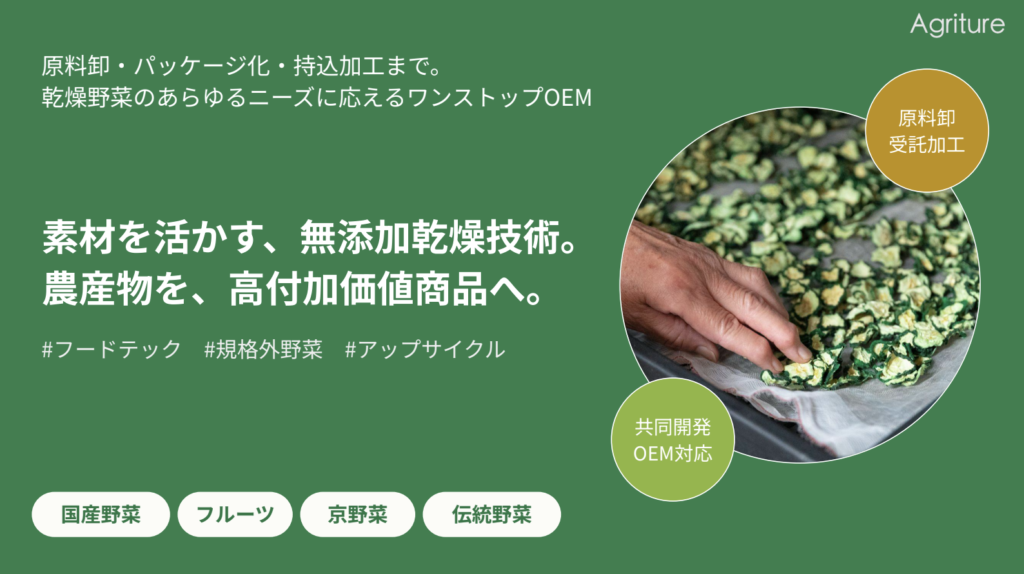
- OEM available from small lots of 10 kg
- Drying of brought-in raw materials also possible
- Support from processing to filling in one place
Giving soup individuality through ingredient blends
The more polished a soup base becomes, the more it tends to look uniform; what sets products apart is ingredient selection and blend design. Partnering with a factory that has raw-material sourcing and drying expertise here produces a distinctive bowl.
A case of matching ingredients to the flavor
At Agriture, for Nissin Foods' "Nissin Raoh," we developed and manufactured dried-vegetable assortment sets tailored to six flavors: soy sauce, miso, yuzu shio, tantanmen, tonkotsu shoyu, and champon. It's an effort of selecting and blending Kujo negi and Onion、cabbage、shiitake and others to match each soup's design—a prime example of optimizing ingredients per soup.
For your own soup too, designing ingredients to match the base—colorful vegetables for consommé, aromatic garnishes for Japanese dashi—raises the sense of satisfaction. For background, see the development case of the dried-vegetable set for Nissin Raoh.
Retaining ingredient texture through drying design
Even the same vegetable changes in texture depending on drying temperature and time. At Agriture, we dry Kyotango-grown spring new onions at low temperature over about two days, producing a soft mouthfeel when rehydrated. Because soup ingredients need to rehydrate quickly with hot water, balancing rehydration speed and texture is where skill shows.
We also work on upcycling off-spec vegetables, and being able to add a food-loss-reduction story as product value is another advantage of partnering with a factory involved from the raw-material side.
Design tailored to packaging format and sales channel
For freeze-dried soup, the optimal format and capacity change with the retail floor you sell in. Locking down packaging and sales channel in parallel with the production type keeps lot and unit-price estimates from wavering.
Choosing between cup, stick, and large-volume
Individually packaging cubes makes it easy to develop into single-serve and gift assortments. Powder/granule types can be put into stick packaging to boost portability, or into large packs aimed at commercial use and office stock—a high degree of freedom in capacity design is an advantage. Putting it in a cup lets you appeal to the ease of eating without needing to prepare a bowl to add hot water.
Because capacity and packaging change the minimum lot and unit price, choosing the format after concretely picturing the intended usage scene keeps the design free of strain.
Product design that changes by sales channel
For gifts and department stores, assortment sets combining several soups and premium price points made with select ingredients work well. In offices and health-conscious e-commerce, vegetable-intake appeal and capacity and price designs easy to continue daily drive repeat purchases.
For disaster stockpiles, drying precision and packaging that withstand long-term storage, plus proposals for bulk sales and rolling stock, become the axis. Deciding the channel first, then designing the soup type, capacity, and packaging backward, gives the plan consistency. Changing ingredients and capacity on the same base makes it easy to develop a series aimed at multiple channels.
We have materials available to help you understand dried processing OEM
Agriture OEM, flexibly handling everything from small lots to large lots
- OEM available from small lots of 10 kg
- Drying of brought-in raw materials also possible
- Support from processing to filling in one place
Summary: soup OEM starts with type selection and gauging compatibility
OEM of freeze-dried soup starts with the choice of which type to make—block, powder, or separated-ingredient. Gauging the compatibility—vegetable and dashi types are well suited, while dairy- and fat-heavy potage types need ingenuity—and comparing several manufacturers that can make the soup you're aiming for stably is the shortcut to success.
On top of a well-crafted base, being able to give individuality through ingredient blends makes a product that gets chosen even in a competitive soup market. At Agriture, we take consultations on dried-vegetable ingredient design and blend development tailored to the flavor. Feel free to reach out from the planning stage.
FOR BUSINESS
乾燥野菜のOEM・受託加工を承ります
国産の野菜・果物の乾燥、100メッシュ相当までの粉砕、10g以上の小袋充填までをお受けしています。小ロットの試作から量産までご相談ください。寄せられた相談の実例は OEM・卸のご相談 に掲載しています。
乾燥品の賞味期限は、出荷日から6ヶ月程度を目安にご案内しています。
FAQ
We have compiled the questions we often receive about freeze-dried soup OEM.
Recommended reading
- Freeze-dried vs. dried vegetables: how to choose by application, price, and lot
- Freeze-Dried Miso Soup OEM: The Key Points of Minimum Lots, Manufacturing Methods, and Choosing a Manufacturer
- Freeze-Dried Zosui OEM: Production Lots, Cooked-Rice Processing, and Contract Manufacturers Explained
Download the OEM contract processing materials
We will send the materials to your email address based on the information you provide.
If you are considering product development with off-spec or your own farm's vegetables:From planning to processing, materials, package printing and novelties, you can consult us through a single point of contact. → Learn more about one-stop product development
- Freeze-Dried Miso Soup OEM: The Key Points of Minimum Lots, Manufacturing Methods, and Choosing a Manufacturer
- Freeze-Dried Zosui OEM: Production Lots, Cooked-Rice Processing, and Contract Manufacturers Explained
Author of this article
Related articles
-
 Freeze-Drying Processing Costs | Price Ranges by Product and Lot
 -
 Freeze-Drying Minimum Lots: Small-Lot Ordering and Choosing a Manufacturer
 -
 Freeze-Dried Material Ranking | Popularity and How to Choose by Use
 -
 What is freeze-dried? A gentle explanation of the drying technology spreading to miso soup, vegetables, and strawberries
 -
 Freeze-Dried vs. Dried Vegetables: A Guide to Choosing a Drying Method by Flavor, Lot Size and Cost
 -
 Freeze-Dried Miso Soup OEM: The Key Points of Minimum Lots, Manufacturing Methods, and Choosing a Manufacturer
 -
Freeze-Dried Zosui OEM: Production Lots, Cooked-Rice Processing, and Contract Manufacturers Explained
-
Freeze-Dried Baby Food OEM: Manufacturing Standards, Safety Criteria, and How to Choose a Contract Partner