
What are Nagasaki’s heirloom vegetables? Features, season, and ways to eat the 16 “Nagasaki heirloom vegetables” (Unzen kobu takana, Nagasaki hakusai, Karako lotus root) explained

Nagasaki Prefecture's heirloom vegetables are a group of varieties grown in the mountainous areas of Nagasaki City, the Isahaya plain, Unzen-Shimabara, Hirado-Iki, Saikai City, and elsewhere (including items introduced after the war). The Japan Traditional Vegetable Promotion Association organizes 16 heirloom vegetables of Nagasaki Prefecture.
We introduce items handed down in Nagasaki, including Unzen kobu takana, Nagasaki Napa cabbage (tojin-na), Karako renkon, Nagasaki aka-kabu, Hirado no kibiki kabu, and Isshu wase ninniku.
TOC
The definition of "heirloom vegetable" and the scope of this article
| Certifying body | Main criteria |
|---|---|
| Kyoto Prefecture "Kyoto Heirloom Vegetables" | Cultivation history predating the Meiji era, covering the entire prefecture |
| Osaka Prefecture "Naniwa Heirloom Vegetables" | Cultivated within Osaka Prefecture from roughly 100 or more years ago |
| Nagano Prefecture "Shinshu Heirloom Vegetable Certification System" | Cultivation, food culture, and varietal traits from before the 1955–1964 period |
| Nagasaki Prefecture | No certification system of the prefecture's own has been confirmed as of this writing. The Japan Heirloom Vegetable Promotion Association organizes 16 heirloom vegetables |
This article introduces all 16 heirloom vegetables of Nagasaki Prefecture organized by the Japan Heirloom Vegetable Promotion Association.
A list of Nagasaki's 16 heirloom vegetables
Root vegetables
| Item | Features | Growing region | Season |
|---|---|---|---|
| Isshu wase ninniku | Small and white, about 12 cloves, mild | Iki City | April to June |
| Oshoga | Large rhizome, strong aroma and pungency | Toishi, Nagasaki City, and elsewhere | November |
| Karako renkon | Square and flat, grown in peat layers, a firm bite and a distinctive stickiness | Karako, Moriyama-cho, Isahaya City | September–March |
| Kibiki kabu | Reddish-purple and white, the root bends like a cow's horn | Ono, Hirado City | October–November |
| Nagasaki aka-kabu | Deep reddish-purple, white flesh, tender and sweet | Nishiyama-koba, Nagasaki City, and elsewhere | November to January |
| Nagasaki beni-daikon | A type of kabu, a vivid crimson | Nakao, Nagasaki City, and elsewhere | Garden pea |
Leafy greens
| Item | Features | Growing region | Season |
|---|---|---|---|
| Unzen kobu takana | A large white lump on the midrib; the young greens are pungent | Azuma-cho, Unzen City | December to March |
| Tsujita hakusai | Rounded heading, thick leaf flesh, a good bite | Nishiyama-koba, Nagasaki City | November–December |
| Nagasaki hakusai (tojin-na) | Non-heading, leaves stand upright and open outward (Nagasaki City official); tender, also good for pickles/simmered/stir-fried | Nagasaki City | November–February (harvest centered on November–December, Nagasaki City official) |
| Nagasaki takana | Narrow, crinkled leaves, a mustard-green flavor | Nishiyama-koba, Nagasaki City, and elsewhere | Harvest November–February, spring crop late April–early September (prefecture official and association) |
| Nagasaki wakegi | Strong bulb-dividing, tender, richly aromatic | Tazuhara, Nagasaki City, and elsewhere | Autumn to spring (October–March) |
| Natsu-negi | Grown by division, rich in flavor and aroma | Tazuhara, Nagasaki City, and elsewhere | April to November |
Fruit vegetables and others
| Item | Features | Growing region | Season |
|---|---|---|---|
| Saikai eda-ore-nasu | A round, large eggplant, usable widely—fresh, grilled, simmered, pickled | Saikai-cho, Saikai City, and elsewhere | July–November |
| Nagasaki naga-nasu | Deep black-purple, 35–40 cm, pairs well with oil | Higashi-Nagasaki, Nagasaki City | June to October |
| Konnyaku-imo (Takaki-cho) | A native konnyaku potato (tuber). Grown and processed locally, distributed as konnyaku | Takaki-cho, Isahaya City | October–November |
| Mochi-tomorokoshi | A native glutinous variety, a chewy texture | Takaki-cho, Isahaya City | August |
A product catalog that shows around 100 items we handle
Agriture, flexibly handling everything from small lots to large lots
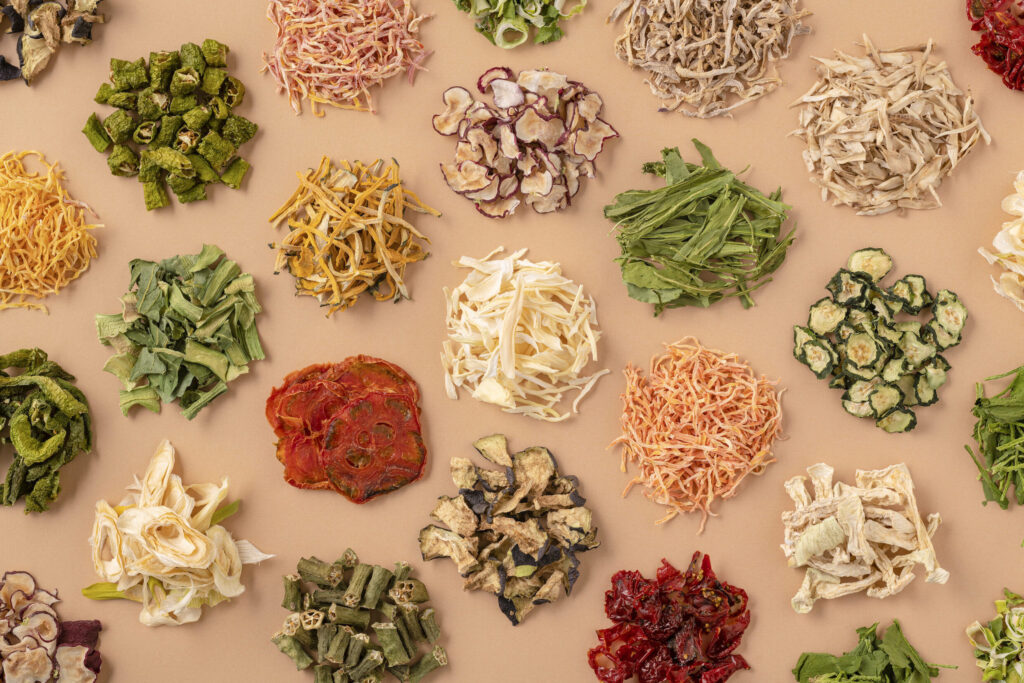
- Available for purchase in small lots from 1 kg
- We handle heirloom vegetables from across Japan
- Dried fruit and herbs also supported
FOR BUSINESS
乾燥野菜を業務用でお探しですか
国産の野菜・果物を乾燥し、必要に応じて粉砕してお出ししています。扱っている品目は100種前後で、規格は 乾燥品の一覧・パウダーの一覧 に掲載しています。
少量でのご購入は、姉妹ブランドの通販サイト OYAOYA で承っています。
The characteristics and preparation of 7 representative Nagasaki heirloom vegetables
Unzen kobu takana — a distinctive takana with a white lump on the midrib
| Season | December to March |
| Growing region | Azuma-cho, Unzen City |
| Well-suited dishes | Takana pickles, rice balls, stir-fries, fried rice |
Unzen kobu takana is a native takana grown in Azuma-cho, Unzen City, characterized by a shape in which a large white lump forms on the midrib (the central vein) of the leaf. The young greens have a distinctive pungency, and the grown leaves are thick with a satisfying bite. Unzen kobu takana pickles have long been used at Nagasaki tables.
It is processed after the December–March harvest as takana pickles, and year-round shipping is centered on processed goods (pickles and the like).
Nagasaki hakusai (tojin-na) — a versatile Chinese cabbage that stands upright and opens outward without heading
| Season | November–February (harvest centered on November–December, Nagasaki City official) |
| Growing region | Nagasaki City |
| Well-suited dishes | Pickles, simmered dishes, stir-fries, zoni |
Nagasaki hakusai also goes by the name "tojin-na," and Nagasaki City's official materials describe it as "non-heading, with leaves that stand upright and open outward." With a tender leaf quality, it can be used widely in pickles, simmered dishes, and stir-fries, and is also used as an ingredient in Nagasaki zoni.
It ships from JA farm stands within Nagasaki City in its season of November–February (harvest centered on November–December) (Nagasaki City official).
Karako renkon — the peat-layer lotus root of Moriyama, Isahaya
| Season | September–March |
| Growing region | Karako, Moriyama-cho, Isahaya City |
| Well-suited dishes | Simmered dishes, sunomono, kinpira, renkon manju |
Karako renkon is a lotus root grown in Karako, Moriyama-cho, Isahaya City. Because it grows in peat-layer soil, it takes on a square, somewhat flat shape. A firm bite and a sticky texture are its hallmarks.
Usable in a wide range of dishes—simmered dishes, sunomono, kinpira, renkon manju—it is distributed over the long span of September–March at Isahaya City farm stands such as "Mogitate-ichi."
Nagasaki aka-kabu — the deep reddish-purple kabu of Nishiyama-koba, Nagasaki
| Season | November to January |
| Growing region | Nishiyama-koba, Nagasaki City, and elsewhere |
| Well-suited dishes | Vinegar pickles, asazuke, salad, kabura-mushi |
Nagasaki aka-kabu is a kabu grown in Nishiyama-koba, Nagasaki City, characterized by a deep reddish-purple outer skin, white flesh, a tender texture, and strong sweetness. Vinegar-pickled, it develops a vivid crimson color.
It is distributed at JA farm stands within Nagasaki City in its season of November–January.
Kibiki kabu — the two-color reddish-purple-and-white kabu of Hirado
| Season | October–November |
| Growing region | Ono, Hirado City |
| Well-suited dishes | Vinegar pickles, asazuke, simmered dishes, pickles |
Kibiki kabu is a native kabu grown in Ono, Hirado City, characterized by a two-color reddish-purple-and-white appearance and a distinctive shape in which the root bends like a cow's horn.
Used in vinegar pickles, asazuke, and simmered dishes, it is distributed at farm stands within Hirado City in October–November.
Isshu wase ninniku — Iki's mild native garlic
| Season | April to June |
| Growing region | Iki City |
| Well-suited dishes | Fresh eating, foil-grilled, stir-fries, condiment |
Isshu wase ninniku is a native garlic grown in Iki City, characterized by a small, white bulb, about 12 cloves, and a mild flavor free of strong pungency.
Usable widely—fresh, foil-grilled, in stir-fries, and as a condiment—it is distributed at farm stands within Iki City in its season of April–June.
Nagasaki naga-nasu — the 35–40 cm long eggplant of Higashi-Nagasaki, Nagasaki
| Season | June to October |
| Growing region | Higashi-Nagasaki, Nagasaki City |
| Well-suited dishes | Stir-fries, age-bitashi, mabo-nasu, dengaku |
Nagasaki naga-nasu is a deep black-purple long eggplant grown in Higashi-Nagasaki, Nagasaki City, characterized by a length of 35–40 cm. It pairs well with oil, and its tender flesh suits heated dishes.
Its size and tenderness come into their own in stir-fries, age-bitashi, mabo-nasu, and dengaku.
How to buy Nagasaki's heirloom vegetables
| Item | Main sources | Timing |
|---|---|---|
| Unzen kobu takana | JA farm stands within Unzen City, pickles year-round | December to March |
| Nagasaki hakusai (tojin-na) | JA farm stands within Nagasaki City | November–February (Nagasaki City official) |
| Karako renkon | Isahaya City "Mogitate-ichi" and around Moriyama-cho | September–March |
| Nagasaki aka-kabu | Around Nishiyama-koba, Nagasaki City | November to January |
| Kibiki kabu | Farm stands in Hirado City | October–November |
| Isshu wase ninniku | Farm stands in Iki City | April to June |
| Nagasaki naga-nasu | JA farm stands in Higashi-Nagasaki, Nagasaki City | June to October |
A product catalog that shows around 100 items we handle
Agriture, flexibly handling everything from small lots to large lots
- Available for purchase in small lots from 1 kg
- We handle heirloom vegetables from across Japan
- Dried fruit and herbs also supported
FOR BUSINESS
乾燥野菜を業務用でお探しですか
国産の野菜・果物を乾燥し、必要に応じて粉砕してお出ししています。扱っている品目は100種前後で、規格は 乾燥品の一覧・パウダーの一覧 に掲載しています。
少量でのご購入は、姉妹ブランドの通販サイト OYAOYA で承っています。
FAQ
Summary
Nagasaki's heirloom vegetables number 16 items spread across Nagasaki City, Isahaya, Unzen, Hirado, Iki, and Saikai. Unzen kobu takana, Nagasaki hakusai (tojin-na), Karako renkon, Nagasaki aka-kabu, kibiki kabu, Isshu wase ninniku, and Nagasaki naga-nasu are distributed as representative items.
References / information sources
- Japan Heirloom Vegetable Promotion Association "Nagasaki Prefecture"
- National Agriculture and Food Research Organization Genebank "Native Variety Database"
Related articles
Download the product catalog
We will send the materials to your email address based on the information you provide.
- What are Saga’s heirloom vegetables? Features, season, and ways to eat the 11 items organized by the association (Onnayama daikon, Kirioka eggplant, Toya turnip) explained
- What are higo vegetables? Features, season, and ways to eat the 15 heirloom vegetables designated by Kumamoto City (Suizenji bean sprouts, Kumamoto long carrot, Kumamoto red eggplant) explained
Author of this article
Related articles
-
 Okinawa island vegetables: individualistic vegetables nurtured by a subtropical climate
 -
 Kaga vegetables: Kanazawa brand vegetables where tradition lives on
 -
 The appeal of Kansai heirloom vegetables | Specialties of Naniwa, Kyoto, and Yamato thoroughly explained
 -
 Kyoto heirloom vegetables: Kyoto specialties with a long history
 -
 A list of heirloom vegetables of the 8 prefectures of Kyushu and Okinawa|A thorough introduction to characteristics, growing regions, and seasons
 -
 Know the heirloom vegetables of Edo Tokyo | The city’s vanishing food culture
 -
 They'll make you smile! The fun names of heirloom vegetables and their origins
 -
 5 cases and strategies that succeeded in branding heirloom vegetables