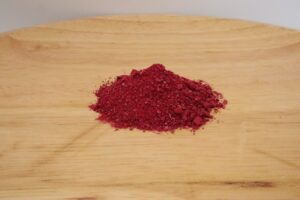
Nameko powder

Nameko powder is a raw material made by drying and finely milling nameko to spread the thickness and umami unique to nameko uniformly through instant miso soup, Japanese-style sauces, and soup powders. The sugars such as trehalose contained in nameko and the natural thickening components derived from the surface sliminess are finished into a size that disperses easily in liquids and powders. At Agriture, Dried nameko, we powder it by adding a fine-powdering step.
Where raw-material-form nameko suits "miso soup and nameko-oroshi ingredients where you want to keep the texture and sliminess," nameko powder suits applications where you want to spread thickness and umami uniformly. Combined with other mushroom powders such as Enoki powder・Maitake powder it is a rare ingredient suited to designing Japanese-style sauces, instant miso soup, and thickened nursing-care food bases.
TOC
Agriture's nameko powder: three points of commitment
Nameko is an unusual ingredient that combines thickening components and umami. At Agriture, we manage everything from pretreatment through milling and packaging in-house at our processing facility, aiming for a finish with little lot-to-lot variation.
1. Low-temperature drying that does not break down the thickening components
When nameko's sliminess (viscous polysaccharides) breaks down under heat, thickening becomes hard to develop even when dissolved in liquid. By removing moisture slowly at low temperature and suppressing heat generation in the milling step, we preserve in the powder the natural thickness produced when dissolved in water.
2. Balancing trehalose and umami
Nameko is an ingredient that contains more trehalose than most mushrooms, coexisting with gentle sweetness and umami. Because the flavor balance changes with drying conditions, design to suit the application is possible — umami-focused for Japanese-style sauces, and sweetness/thickening-focused for nursing-care food.
3. A design partner for thickened foods
Because it has a thickening function not found in ordinary mushroom powders, it can be designed as instant miso soup, Japanese-style sauces, a powder base for ankake, or thickening-adjusted powder for dysphagia-friendly food, combined with other mushroom powders and vegetable powders.
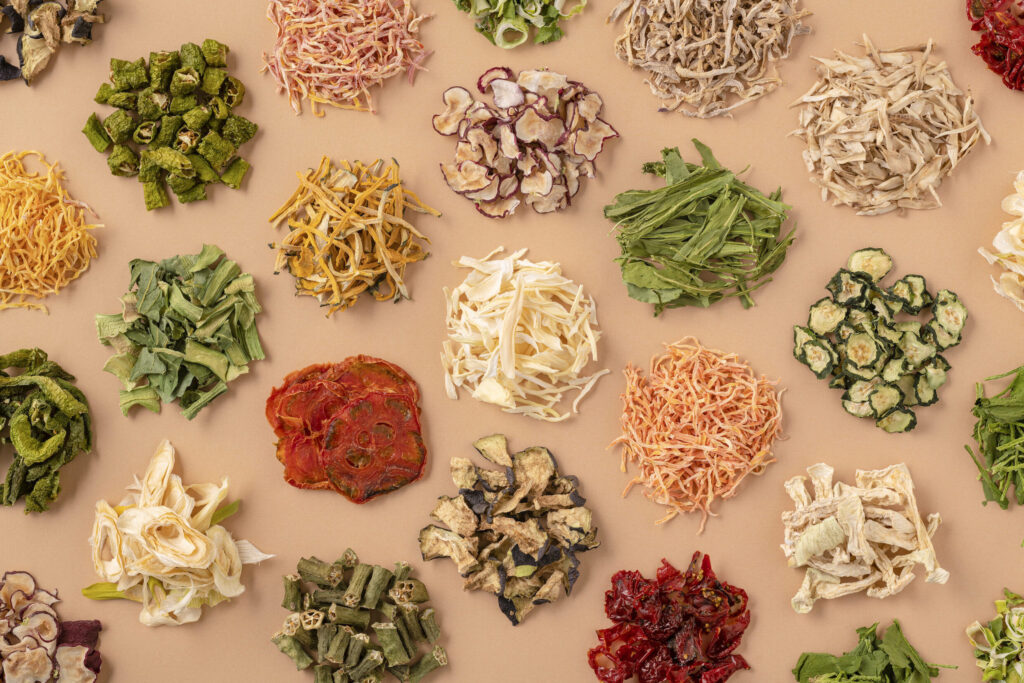
Product catalog showing the items we handle
Flexible support from small lots to large lots
- Sold in small lots from 1 kg
- Handling heirloom vegetables from across Japan
- Dried fruits and herbs also supported
Features of commercial nameko powder
Natural thickness
The sliminess component derived from nameko gives liquids a natural thickness. It suits instant miso soup and ankake powder where you want thickness without relying on thickeners.
Balancing umami and sweetness
Guanylate-type umami and trehalose-derived sweetness. In Japanese-style sauces and soup powders, you can express richness and an approachable sweetness at the same time.
Dispersibility in liquids and powders
Designed so that simply dissolving it in hot water spreads natural thickness and umami. Its strength as a powder is that it needs no rehydration and can be used as-is.
A base for nursing-care and dysphagia food
Because natural thickness develops, it is a raw material we are often consulted about when you want to design dysphagia and nursing-care food while reducing thickener usage.
Use together with the ingredient-shape version
Used together with dried nameko, you can balance thickness and umami (powder) with texture and sliminess (raw-material form).
Product specifications (commercial)
Basic specifications at the prototype stage are as follows. Purchase lot, lead time, and packaging format are worked out through individual consultation.
| Item | Details |
|---|---|
| Product name | Nameko powder |
| Raw material | Nameko (domestically grown) |
| Shape | Fine powder (dried nameko, milled) |
| Appearance | Pale brown to ochre fine powder |
| Aroma | The mellow mushroom aroma characteristic of nameko, with a faintly sweet aroma |
| Net content | Individual quote according to use and lot |
| Best-before date | About 6 months from the shipping date |
| Storage method | Avoid high temperature, high humidity, and direct sunlight; after opening, seal and store in a cool, dark place |
| Processing plant | Our own processing plant within Kyoto Prefecture |
| Minimum prototype lot | From 1 kg of raw material |
Customization support
| Item | What we support |
|---|---|
| Flavor type | Umami-focused (for Japanese-style sauces) / thickening- and sweetness-focused (for nursing-care food) |
| Pre-blending | Premixing available with flour, miso powder, other mushroom powders, and thickeners |
| Blend design | Composite recipes with mushrooms such as enoki, maitake, and shiitake, and vegetable powders |
| Packaging form | Commercial bulk, small bags for instant miso soup, large bags for nursing-care food factories, canisters |
| OEM productization | Development into instant miso soup, Japanese-style sauces, ankake powder, nursing-care food bases, and dysphagia food |
For applications where you want to keep texture and sliminess, the raw-material form is recommended
For miso soup ingredients, nameko-oroshi, aemono, tsukudani, and the like, applications that make use of nameko's texture and sliminess are best served by dried nameko (raw-material form). Its strength is that it can be rehydrated and used directly as an ingredient.
Commitments to variety, grower, and growing region
Nameko is a mushroom of the Strophariaceae family, with established sawdust-medium cultivation. Within Japan it is produced mainly in Yamagata, Nagano, and Niigata. As a powder raw material, varieties with a well-balanced sliminess and umami are more suitable than cap size.
Main growing region
| Growing region | Features |
|---|---|
| Yamagata Prefecture | Top-class national nameko production. Stable quality through traditional cultivation techniques |
| Nagano Prefecture | Sawdust-medium cultivation making use of a cool climate. Grows raw material with strong sliminess |
| Niigata Prefecture | Year-round production in the climate characteristic of snow country. Many lineages with rich flavor |
| Hokkaido | Cold-region cultivation yielding quality with strong sweetness |
Using varieties and lineages differently
Small nameko (the mainstream of sawdust-medium cultivation) is uniform in size and suited to versatile powder design. Medium-to-large nameko (lineages closer to wild) has strong umami, suited as a raw material for Japanese-style sauces and high-value-added products. We can discuss lineage selection and blend formulation to match the application.
Powdering technology and quality control
For nameko powder, the retention of thickening components governs quality. At Agriture, we manage everything from preparation through packaging consistently, suppressing lot-to-lot variation.
Low-temperature drying to preserve thickening components
Nameko's sliminess is polysaccharide-derived, and once it breaks down under heat, thickness no longer develops even when dissolved in water. By finishing slowly at low temperature, natural thickness spreads when dissolved in water even after it becomes a powder.
Heat control during grinding
Moisture-resistant packaging
Because nameko powder contains a lot of trehalose, it absorbs moisture easily and clumps if left. The finished powder is moved promptly to moisture-proof packaging; commercial bulk uses moisture-proof bags, and large bags for nursing-care food factories are combined with oxygen absorbers to maintain quality.
TIPS: Designing thickness for instant miso soup
Adding 2–5% nameko powder to the powder base of instant miso soup gives a natural thickness the moment hot water is poured, with an ingredient-rich finish. Using dried nameko as an ingredient alongside it brings you closer to an authentic finish where you can enjoy both sliminess and texture. In a dysphagia-food base for nursing care, a design that reduces thickener usage by roughly half is possible with a 10–15% nameko powder blend.
Use cases and adoption examples
Nameko powder is a rare ingredient that combines thickness and umami. We organize the applications we are often consulted about into five categories.
1. Instant miso soup and soup powders
- Making nameko miso soup instant
- Powder base for Japanese-style soup
- Instant thickened soup
- Blends for freeze-dried foods
2. Japanese-style sauces and ankake
- Powder base for ankake
- Sauce for nameko-oroshi
- Japanese-style pasta sauce, Japanese-style risotto
- Sauce for donburi (with thickening)
3. Nursing-care and dysphagia food
- Thickening-adjusted powder for dysphagia food
- Nursing-care food base for facility meals
- Stick soup for the elderly
- Thickening for liquid diets
4. Processed foods and prepared dishes
- Thickening and umami enhancement for retort products
- Sauce base for frozen prepared dishes
- Base for nameko soba and nameko udon
- Chinese-style umami-an, a substitute for potato starch
5. Dashi packs and all-purpose seasonings
- Mushroom dashi packs (a blend of nameko, maitake, and enoki)
- All-purpose mushroom seasoning (thickened type)
- Base for reduced-salt dashi and reduced-salt seasonings
- Richness for Japanese-style curry and stew
For mushroom-composite dashi design, please also refer to Enoki powder・Maitake powder For nursing-care food base design, you can also discuss combinations with Winter melon powder In the medicinal-diet area, product design in cooperation with Yasai Yakuzen is also possible.
How to use the powder and design blends
The raw-material form requires a rehydration step, but the powder's greatest advantage is that you can obtain thickness and umami by dissolving it directly in hot water. We organize the operational points specific to powders.
Basics of use
- Instant miso soup: blend 2–4 g per serving
- Ankake: dissolve 5–8 g per 200 ml of water
- Soup: 1–3 g per 200 ml as a guide
- Dysphagia-food base: 5–10 g per 100 ml of water for moderate thickness
- Sauce: add 1–2 g per 100 g
Example blend formulas
- Instant miso soup: 50% miso powder + 4% nameko + 3% flour + 35% ingredients (dried nameko, green onion) + 8% seasonings
- Ankake powder: 30% nameko + 30% dextrin + 20% soy sauce powder + 10% flour + 10% seasonings
- Dysphagia-food base: 15% nameko + 20% onion + 15% winter melon + 10% flour + 40% thickener and seasonings
- All-purpose mushroom dashi: 20% nameko + 35% maitake + 25% enoki + 20% flour
How to store
- Before opening: store in a cool, dark place at room temperature, away from heat, humidity, and direct sunlight
- After opening: because it readily absorbs moisture, transfer it to a resealable bag or airtight container; refrigerated storage is also fine
- The best-before date is roughly 6 months from the shipping date. After opening, use it up within 1–2 months as a guide
- Because thickening development declines when it absorbs moisture, combining with oxygen absorbers is recommended
Related articles / other mushroom raw materials
These are the mushroom-type powders and related raw materials handled by Agriture. Please use them when designing instant miso soup, nursing-care food, and Japanese-style sauces.
- Dried nameko: Raw-material form for miso soup and nameko-oroshi
- Enoki powder: A guanylate umami base
- Maitake powder: Functional mushroom, composite-dashi design
- Winter melon powder: A nursing-care food base standard
- Onion powder: An all-purpose ingredient for soup bases
Product catalog showing the items we handle
Flexible support from small lots to large lots
- Sold in small lots from 1 kg
- Handling heirloom vegetables from across Japan
- Dried fruits and herbs also supported
Frequently asked questions
How do dried nameko (raw-material form) and nameko powder differ in use?
The raw-material form suits applications where you want to keep texture and sliminess — miso soup ingredients, nameko-oroshi, aemono, and tsukudani. The powder suits applications where you want to spread thickness and umami uniformly — instant miso soup, Japanese-style sauces, ankake powder, and nursing-care food bases. In some cases both are used together in the same recipe to balance natural thickness and texture.
Does thickness remain after powdering?
Through low-temperature drying and heat suppression during milling, we aim for a finish where natural thickness develops when dissolved in water or hot water. If you raise the temperature to shorten drying time, the polysaccharide-derived thickening components break down, so finishing slowly over time is key to quality. It can be adopted for situations where you want thickness without using thickeners.
Can it be used for nursing-care and dysphagia food?
This is one of the applications we are often consulted about. Blending nameko powder into a dysphagia-food base yields natural thickness and can reduce the use of synthetic thickeners. We can also discuss viscosity design based on dysphagia-food standards (the classification of the Japanese Society of Dysphagia Rehabilitation) and OEM schemes for facility and hospital meals.
How does it differ from other mushroom powders?
Nameko's greatest feature is a thickening function not found in other mushroom powders. Using them by purpose broadens design scope — enoki for straightforward umami, maitake for a toasty note and functionality, and nameko for thickness and sweetness. For applications that make use of thickness — Japanese-style sauces, instant miso soup, nursing-care food bases, and the like — a formulation with nameko as the star is effective. After hearing the specifications, formulation, lot, and schedule of your intended finished product, we propose a quote and delivery timeline individually. You can consult us all the way through to finished products such as instant miso soup, Japanese-style sauces, nursing-care food bases, and ankake powder.
Please tell me the best-before date and how to store it.
The best-before date is about 6 months from the shipping date. Store the unopened product away from high temperature, high humidity, and direct sunlight, in a cool, dark place at room temperature. Because nameko powder contains a lot of trehalose, it absorbs moisture especially easily, so after opening transfer it to a zip-top bag or sealed container and use it up within 1–2 months as a guide. Combining with oxygen absorbers is also effective. Because thickening development declines when it absorbs moisture, take care with storage.