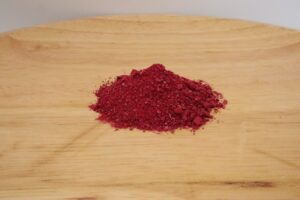
Maitake powder

Maitake powder is a raw material that dries and finely mills maitake to spread maitake's characteristic fragrant umami evenly through dashi, soup powder, functional food, and seasoning. It finishes maitake's synergizing umami of guanylic acid and glutamic acid, and functional components led by beta-glucan, into a size easy to disperse in liquids and powders. At Agriture, we Dried Maitake, we powder it by adding a fine-powdering step.
Whereas raw-material-shape maitake suits "stir-fry, hot-pot, and tempura ingredients where you want to keep the texture and fragrance," maitake powder suits uses where you want to "spread umami and functional components evenly." Blended with the same mushroom-family Enoki powder・Nameko powder, it also enables the design of a complex mushroom dashi impossible with a single mushroom.
TOC
Three points of dedication in Agriture's maitake powder
Maitake is an ingredient with value on both the umami-component and functional-component fronts. At Agriture, we manage everything from pretreatment through grinding and packaging in-house, aiming for a finish with little lot-to-lot variation.
1. Low-temperature drying that keeps umami components and function
Maitake is a rare mushroom rich in both guanylic acid and glutamic acid, achieving a synergistic umami effect in a single ingredient. Because raising the temperature too much advances the breakdown of both the umami components and functional components like beta-glucan, we finish it slowly at low temperature. The guide is a state where a fragrant maitake-like umami spreads the moment you taste the powder.
2. Grinding conditions that draw on fragrance
3. Blend design for functional foods
The beta-glucan (especially the MD-fraction type) contained in maitake draws attention as an appeal ingredient in functional foods and health drinks. Combined with other mushroom powders, vegetable powders, and yakuzen ingredients, we can handle OEM raw-material design for mushroom complex supplements and immune-system functional foods.
Product catalog showing the items we handle
Flexible support from small lots to large lots
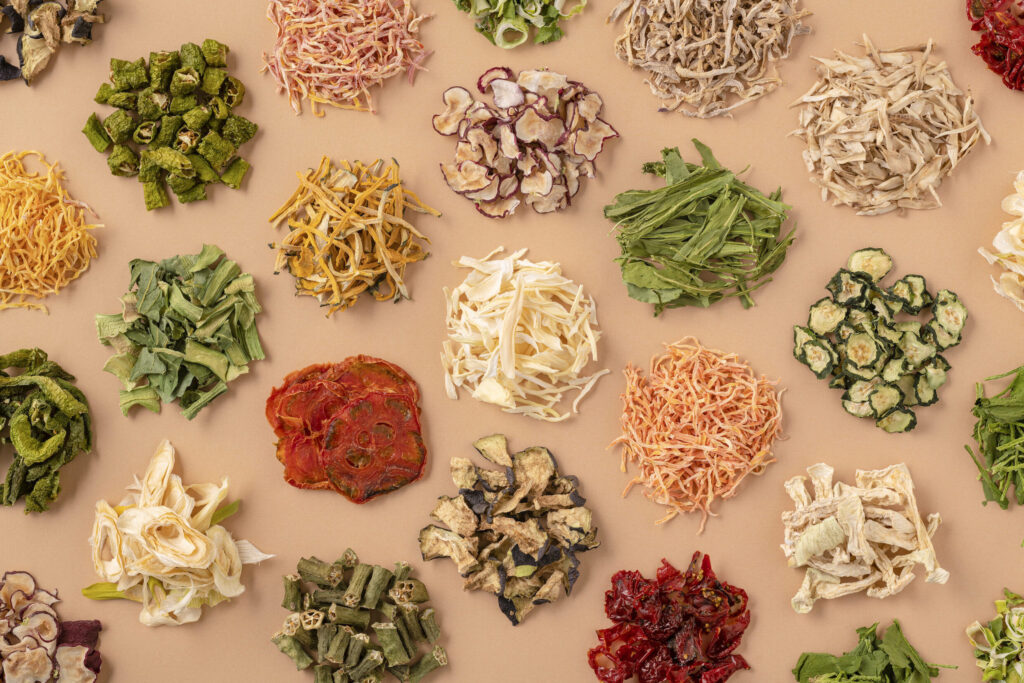
- Sold in small lots from 1 kg
- Handling heirloom vegetables from across Japan
- Dried fruits and herbs also supported
Features of commercial maitake powder
The synergistic umami of guanylic acid and glutamic acid
A rare mushroom achieving a synergistic umami effect in a single ingredient. It adds depth to design as an umami base for dashi and soup powder.
A beta-glucan-containing functional ingredient
As a functional ingredient containing beta-glucan (MD-fraction type), it can be developed as an OEM raw material for immune-system and health-appeal foods.
Dispersibility in liquids and powders
Dissolved into soup or miso soup, graininess is hardly noticeable, and it disperses evenly in powder mixes. It can be used as-is with no rehydration needed.
Complex mushroom dashi design
Combined with other mushroom powders such as enoki, nameko, and shiitake, it enables the core design of a complex mushroom dashi or an all-purpose seasoning.
Use together with the ingredient-shape version
Used together with dried maitake, you can achieve both umami depth (powder) and ingredient presence and fragrance (raw-material shape).
Product specifications (commercial)
Basic specifications at the prototype stage are as follows. Purchase lot, lead time, and packaging format are worked out through individual consultation.
| Item | Details |
|---|---|
| Product name | Maitake powder |
| Raw material | Maitake (domestic) |
| Shape | Fine powder (dried maitake ground) |
| Appearance | A pale-brown to dark-brown fine powder |
| Aroma | The fragrant umami aroma characteristic of maitake, a mushroom-like rich aroma |
| Net content | Individual quote according to use and lot |
| Best-before date | About 6 months from the shipping date |
| Storage method | Avoid high temperature, high humidity, and direct sunlight; after opening, seal and store in a cool, dark place |
| Processing plant | Our own processing plant within Kyoto Prefecture |
| Minimum prototype lot | From 1 kg of raw material |
Customization support
| Item | What we support |
|---|---|
| Pre-blending | Pre-mix support with powder, shiitake powder, enoki powder, vegetable powder, and salt |
| Blend design | Complex recipes with other mushroom powders, yakuzen ingredients, and vegetable powders |
| Packaging form | Commercial bulk, for enclosure in dashi packs, sticks and small packets, large bags for supplements |
| OEM productization | Development into soup powder, dashi packs, functional foods, seasoning, and supplements |
| Raw material supply | Besides our own raw material, we also support contract drying and grinding at a specified growing region |
For uses where you want to keep texture and a sense of ingredient presence, the raw-material form is recommended
For mixed rice, tempura, hot pot, stir-fries, and other uses where you want to draw on maitake's texture and fragrance, dried maitake (raw-material shape) suits. Its strength is that you can rehydrate it and use it straight as an ingredient.
Commitments to variety, grower, and growing region
Maitake is a mushroom of the Meripilaceae family, once so valuable it was called a "phantom mushroom." Now bed-log cultivation is established, and domestically it is produced nationwide centered on Niigata Prefecture. For powder raw material, varieties with fragrance and umami components in balance, rather than the size of the cluster, are suitable.
Main growing region
| Growing region | Features |
|---|---|
| Niigata Prefecture | Top maitake production nationwide. Bed-log cultivation technique is established |
| Shizuoka Prefecture | A major growing region where strongly fragrant strains are cultivated |
| Fukuoka Prefecture | A major growing area in western Japan. Distribution networks are established, making sourcing easy |
| Gunma Prefecture | Year-round production drawing on the cool climate. The cluster shape is well-formed |
Using varieties and lineages differently
General bed-log-cultivated maitake (the black type) is strongly fragrant, a versatile raw material suited to dashi and seasoning. White maitake (shiro maitake) is white in color with a delicate flavor, usable for soup powders and health foods that draw on appearance. For functional foods, you can specify a strain said to be high in beta-glucan content.
Powdering technology and quality control
For maitake powder, the way umami and fragrance remain changes with the drying and grinding conditions. At Agriture, we manage everything from preparation through packaging consistently, holding down lot-to-lot variation.
Low-temperature drying to retain umami and function
Guanylic acid, glutamic acid, and beta-glucan all advance in breakdown if the temperature band is too high. By finishing slowly at low temperature, we seal umami and function into the powder at once.
Heat control during grinding
Lot management for functional foods
For functional foods that appeal to beta-glucan content, we record raw-material origin, variety, and drying conditions by lot, and also keep content-analysis samples. We can also handle quality management premised on notification documents.
TIPS: The golden ratio for complex mushroom dashi
Use cases and adoption examples
Maitake powder is seeing expanding adoption on both umami and functional fronts. We organize the applications we are frequently asked about into 5 categories.
1. Soup powders and instant foods
- A maitake mixed-rice base
- A powder base for mushroom hot-pot broth and Japanese-style soup
- Instant miso soup and instant soup
- Blends for freeze-dried foods
2. Dashi packs / all-purpose seasonings
- A mushroom dashi pack (a maitake-shiitake blend)
- An all-purpose mushroom seasoning (chef's-secret-weapon type)
- A powder base for udon and soba broths
- Hot-pot bases and yosenabe broths
3. Functional foods and supplements
- Functional foods appealing to beta-glucan
- Immune-support supplements
- Mushroom complex supplements
- Health drinks and green-juice mixes
4. Seasonings / furikake
- Mushroom furikake (a base for rice and onigiri)
- Pasta seasoning and pizza spice
- A flavor for popcorn and nuts
- Marinade powder for yakiniku and fried chicken
5. Processed foods / prepared dishes
- An umami base for hamburger steak and meatballs
- Adding richness to retort curry and stew
- The filling for frozen gyoza and shumai
- A base for nursing-care food and salt-reduced seasoning
For mushroom-composite dashi design, please also refer to Enoki powder・Nameko powder please also refer to. For functional-food OEM, Food OEM Directory we accept consultations at. In the yakuzen area, Yasai Yakuzen is also possible.
How to use the powder and design blends
The raw-material form requires a reconstitution step, but the powder's advantage is that it can be formulated directly into powdered goods. We organize the operational points specific to powders.
Basics of use
- Soup: dissolve 0.5–1.5 g per 200 ml
- Blend 1–2 g per dashi-pack portion with other dashi ingredients
- Hamburg steak / meatballs: knead in 0.3–0.5 g per 100 g of ground meat
- Seasoning: blend with salt and pepper at 1:1 to 2:1
- Supplement ingredient: designed to the content that matches the product spec
Example blend formulas
- Complex mushroom dashi: maitake 35% + enoki 25% + shiitake 25% + powder 15%
- Mushroom soup mix: maitake 30% + onion 20% + skim milk 30% + salt and dextrin 20%
- All-purpose mushroom seasoning: maitake 35% + enoki 25% + salt and spices 40%
- Functional food: maitake 40% + other mushrooms 30% + dextrin 20% + others 10% (designed to match the product spec)
How to store
- Before opening: store in a cool, dark place at room temperature, away from heat, humidity, and direct sunlight
- After opening: because it readily absorbs moisture, transfer it to a resealable bag or airtight container; refrigerated storage is also fine
- The best-before date is roughly 6 months from the shipping date. After opening, use it up within 1–2 months as a guide
- If lumps form, sift through a tea strainer before use to disperse it evenly
Related articles / other mushroom raw materials
These are the mushroom-family powders and related raw materials Agriture handles. Please make use of them when designing complex dashi or functional foods.
- Dried Maitake: Raw-material shape for mixed-rice, hot-pot, and tempura ingredients
- Enoki powder: A guanylate umami base
- Nameko powder: A fine powder of body and umami
- Turmeric powder: A standard ingredient for functional foods
- Food OEM Directory: A consultation window for functional-food OEM
Product catalog showing the items we handle
Flexible support from small lots to large lots
- Sold in small lots from 1 kg
- Handling heirloom vegetables from across Japan
- Dried fruits and herbs also supported
Frequently asked questions
How do you decide between dried maitake (raw-material shape) and maitake powder?
The raw-material shape suits uses where you want to keep texture and fragrance — mixed rice, tempura, hot pot, and stir-fries. The powder suits uses where you want to spread umami and function evenly — dashi, soup powder, functional food, and seasoning. There are also cases where both are used together in the same recipe to achieve both umami depth and ingredient presence and fragrance.
How does it differ from other mushroom powders?
Maitake is a rare mushroom rich in both guanylic acid (mushroom-derived) and glutamic acid (amino-acid-derived), achieving a synergistic umami effect in a single ingredient. Using them differently — enoki for a straightforward umami centered on guanylic acid, nameko for body and depth, maitake for a complex umami with fragrance — widens the range of dashi design. A complex mushroom dashi combining the three gives a depth impossible with a single mushroom.
Can it be used as an ingredient for foods with function claims?
We accept consultations as an OEM raw material for foods with function claims. Because analysis of beta-glucan content, arranging evidence, and preparing notification documents cannot be handled by us alone, Food OEM Directory we form a scheme to introduce, via , a partner company strong in foods with function claims. We can handle lot-level raw-material management and retention of analysis samples. After hearing the intended finished-product specification, formulation, lot, and schedule, we propose an individual quote and lead time. You can consult us through to the finished product — soup powder, dashi packs, functional foods, seasoning, and more.
Please tell me the best-before date and how to store it.
The best-before date is roughly six months from the shipping date. While unopened, avoid high heat and humidity and direct sunlight, and store in a cool, dark place at room temperature. Because powder readily absorbs moisture, after opening we recommend transferring it to a zip bag or sealed container and using it up within about one to two months. To suppress deterioration of functional components, storage in a light-blocking container is recommended.
Can it be used as a base for reduced-salt seasonings?
This is one of the applications we are frequently asked about. Maitake is an ingredient that, through the synergistic effect of guanylic acid and glutamic acid, makes it easy to maintain satisfaction even with lower salt. Through complex dashi design combined with other mushroom-powder blends, it enables designs that don't feel lacking even with salt reduced by 20–30% — for salt-reduced soy sauce, salt-reduced dashi, nursing-care-food bases, and hospital-cafeteria menus.