
What are Miyagi’s heirloom vegetables? An explanation of the 22 native varieties handed down centered on Sendai

TOC
" also introduces yakuzen-style explanations for each vegetable, so please use it as a reference for starting yakuzen with domestic ingredients.
What are Miyagi's heirloom vegetables? The native varieties nurtured by the Date domain's food culture
Miyagi Prefecture is home to 22 heirloom varieties organized by the Japan Heirloom Vegetable Promotion Association (Miyagi Prefecture has no public certification system of its own). Many are native varieties grown for over 400 years since the Edo period, centered on the castle town of the Sendai (Date) domain. Heirloom vegetables It is widely known that the warlord Date Masamune put effort into developing food culture. There are varieties continuing since the Sendai domain era, but whether introduction by a specific lord can be confirmed varies by item; heirloom vegetables that can be called "vegetables connected to the Date domain" concentrate in Miyagi. There are
throughout the country, but that a lord's policy was directly involved in a variety's origin is a noteworthy point of Miyagi.
Date Masamune and Sendai's vegetable culture
| Item | There are several varieties said to have involved Date Masamune directly. Sendai naga-nasu, whose original strain he brought back from Hakata in 1593, and Sendai bashona, which originated from Mikawashima-na he brought back from Edo—Masamune's expeditions and sankin-kotai became the occasion for varieties to arrive. | Relationship with the Date domain |
|---|---|---|
| Route of arrival | Sendai naga-nasu | Date Masamune brought back the original strain |
| Hakata → Sendai (1593) | Sendai bashona | Date domain retainers brought it back from Edo |
| Edo Mikawashima-na → Sendai | Sendai hakusai | The variety was established within the Sendai domain's territory |
| Sendai magari-negi | Crossed with Chinese cabbage in the Meiji era → seed-saved on Matsushima Bay | Developed in the Amarume district within the Sendai domain's territory |
| A farming method adapted to poorly drained soil | Sendai yukina | Developed from native winter greens within the domain's territory |
| Selection from a Sendai native variety | Karatori-imo | Established as an ingredient for New Year zoni |
A taro built into Sendai's dietary customs
Masamune promoted the industrialization of food—starting with the use of edamame said to be the origin of "zunda-mochi," and including encouraging miso and soy-sauce brewing and developing rice paddies. This high interest in food became the foundation for many native vegetables remaining in Miyagi.
The 6 items grown in the Sendai area
- Sendai magari-negi Of the 22 items, 6 concentrate in the Sendai area. The consumption demand of the castle town, the Date domain's agricultural-encouragement policies, and the temperature swings characteristic of Tohoku led to the fixing of these varieties.
- Route of arrival — A variety born of a unique farming method adapted to the poorly drained soil of the Amarume district
- Edo Mikawashima-na → Sendai — A black-purple naga-nasu with a cultivation history of over 400 years
- Hakata → Sendai (1593) — Produced "Matsushima Jun No. 1," the origin of Japan's Chinese cabbage cultivation
- A farming method adapted to poorly drained soil — A large pickling green with leaves reaching 60–80 cm in length
- Selection from a Sendai native variety — A winter-only pickling green whose sweetness increases in the cold
— A red-stemmed taro. Its zuiki (leaf stalks) are used in New Year zoni
These items have been handed down for generations by farmers within Sendai City, but with the aging of growers and the expansion of urban areas, the growing area is on a declining trend.
The 4 vanished items and the challenge of preserving native varieties
| Of Miyagi's heirloom vegetables, 4 items are in a state where their present existence cannot be confirmed, due to lapsed seed lines or the disappearance of growers. As a case showing how difficult preserving native varieties is, they are worth keeping in the record. | Category | Growing region | Vanished item |
|---|---|---|---|
| Situation | Negi | Ippon-buto-negi | Tome City |
| Vanished due to the absence of growers | Leafy green | Ippon-buto-negi | Shindo no kaki-na |
| Seed line lapsed | Gourd (uri) | Ippon-buto-negi | Shindo no kaki-na |
| Nagashimoda-uri | Azuki bean | Ippon-buto-negi | Shindo no kaki-na |
Nagashimoda-azuki Heirloom vegetables of Aomori and Heirloom vegetables of Iwate That all 4 items concentrate in Tome City is worth noting. Tome City's agricultural structure is rice-centered, and it has been pointed out that having few farmers specializing in vegetables made carrying on native varieties difficult. The aging of growers advanced all at once, and the passing on of seeds was cut off.
Similar cases of vanishing have been reported in
as well, making native-variety conservation efforts an urgent task across all of Tohoku.
22-item quick-reference table
A full list of Miyagi's 22 heirloom vegetables and a seasonal calendar
| We organize in a list the 22 Miyagi heirloom vegetables certified by the Japan Heirloom Vegetable Promotion Association, and in the following section explain 7 representative items in detail. First, let us grasp the whole picture. | Item | Category | Growing region | Season | State |
|---|---|---|---|---|---|
| 1 | Sendai magari-negi | Negi | Sendai City | Winter (November–February) | Extant |
| 2 | Route of arrival | Eggplant | Sendai City | July–September | Extant |
| 3 | Edo Mikawashima-na → Sendai | Hakusai | Sendai City | Winter (November–February) | Extant |
| 4 | Hakata → Sendai (1593) | Pickling greens | Sendai City | Winter–spring | Extant |
| 5 | A farming method adapted to poorly drained soil | Pickling greens | Sendai City | December to January | Extant |
| 6 | Selection from a Sendai native variety | Taro | Sendai City | October–December | Extant |
| 7 | Aramachi-na | Leafy green | Ippon-buto-negi | Late March to April | Extant |
| 8 | Kannonji-zeri | Sannai seri | Ippon-buto-negi | May / December | Extant |
| 9 | Kuronuma tsubomi-na | Kaizawa fukudachi na | Ippon-buto-negi | Around March | Extant |
| 10 | Ishinomori no kaki-mame | Legume | Ippon-buto-negi | June | Extant |
| 11 | Mukashi kaki-mame | Legume | Ippon-buto-negi | Mid-January–late February | Extant |
| 12 | Mochitomigi | Grains | Ippon-buto-negi | Around August | Only seedlings extant |
| 13 | Onikobe-na | Pickling greens | Naruko-cho, Osaki City | Winter | Extant |
| 14 | Kami-ibano-imo | Taro | Sanbongi-cho, Osaki City | Autumn | Extant |
| 15 | Koze-na daikon | Daikon | Kami-machi | Winter | Extant |
| 16 | Choppe-nasu | Eggplant | Shiroishi City, Zao Town | Summer | Extant |
| 17 | Situation | Negi | Ippon-buto-negi | — | Vanished |
| 18 | Vanished due to the absence of growers | Leafy green | Ippon-buto-negi | — | Vanished |
| 19 | Seed line lapsed | Gourd (uri) | Ippon-buto-negi | — | Vanished |
| 20 | Nagashimoda-uri | Azuki bean | Ippon-buto-negi | — | Vanished |
| 21 | Yokoyama no nira | Nira | Ippon-buto-negi | Spring to autumn | Extant |
| 22 | Yomego-sasage | Akita shimofuri sasage | Ippon-buto-negi | Summer | Extant |
*The item count follows the Japan Heirloom Vegetable Promotion Association's certification list. It is 22 items in total, including the 4 vanished items.
Yam (yamanoimo)
We organized the harvest timing of the 18 extant items by month. Many of Miyagi's heirloom vegetables come into season in winter, and cultivation that makes the most of Tohoku's harsh cold is characteristic.
| Month | Items coming into season |
|---|---|
| January | Sendai yukina, Sendai hakusai, Sendai magari-negi, Sendai bashona, Onikobe-na, Koze-na daikon |
| February | Sendai hakusai, Sendai magari-negi, Onikobe-na, Koze-na daikon |
| March | Sendai bashona, Aramachi-na, Kuronuma tsubomi-na |
| April | Aramachi-na, mukashi kaki-mame, Yokoyama no nira |
| May | Kannonji-zeri (spring crop), mukashi kaki-mame, Yokoyama no nira |
| June | Ishinomori no kaki-mame, Yokoyama no nira |
| July | Sendai naga-nasu, choppe-nasu, Yokoyama no nira, yomego-sasage |
| August | Sendai naga-nasu, choppe-nasu, mochitomigi, Yokoyama no nira, yomego-sasage |
| September | Sendai naga-nasu, kami-ibano-imo, Yokoyama no nira |
| October | Karatori-imo, kami-ibano-imo, Yokoyama no nira |
| November | Sendai hakusai, Sendai magari-negi, karatori-imo |
| December | Sendai yukina, Sendai hakusai, Sendai magari-negi, karatori-imo, Kannonji-zeri (winter crop), Onikobe-na, Koze-na daikon |
That the seasonal peak concentrates in December–January is a major feature of Miyagi's heirloom vegetables. Sendai's winter has days on end when the low drops below freezing, but this cold raises the sugar content of leafy greens and promotes the starch accumulation of root vegetables. At Sendai's winter morning markets and farm stands, these in-season heirloom vegetables line up in rows.
A product catalog that shows around 100 items we handle
Agriture, flexibly handling everything from small lots to large lots
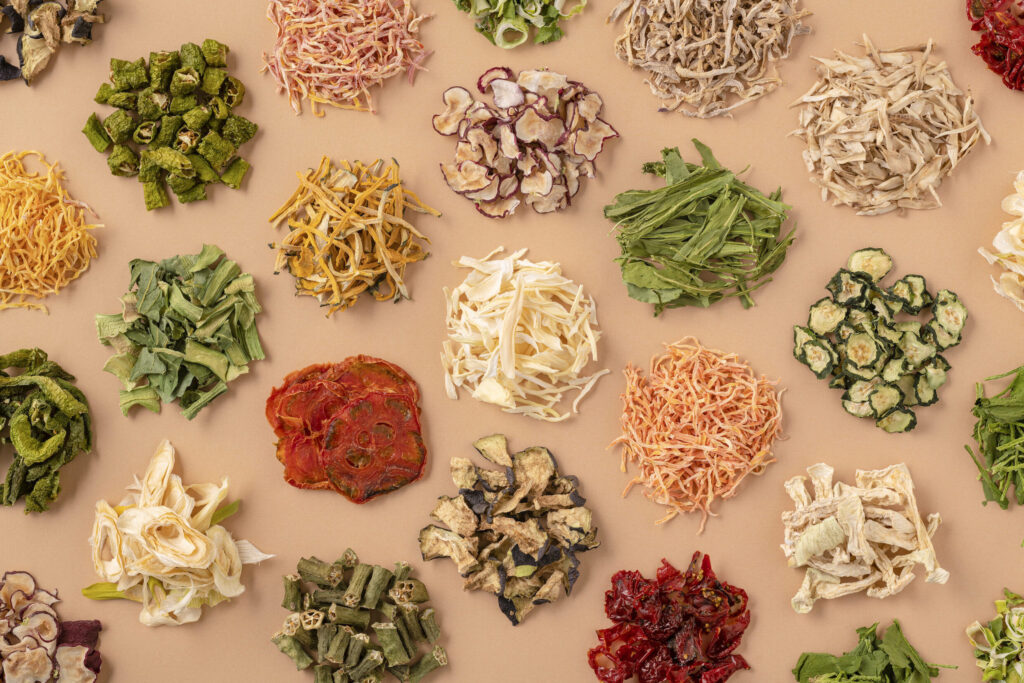
- Available for purchase in small lots from 1 kg
- We handle heirloom vegetables from across Japan
- Dried fruit and herbs also supported
FOR BUSINESS
乾燥野菜を業務用でお探しですか
国産の野菜・果物を乾燥し、必要に応じて粉砕してお出ししています。扱っている品目は100種前後で、規格は 乾燥品の一覧・パウダーの一覧 に掲載しています。
少量でのご購入は、姉妹ブランドの通販サイト OYAOYA で承っています。
The characteristics and preparation of 7 representative Miyagi heirloom vegetables
Having organized the 22 items in a list, from here we explain in detail the variety's origin, flavor, and recommended preparation for the 7 representative items with especially high recognition and large distribution volume.
Sendai hakusai — "Matsushima Jun No. 1," the root of Japan's Chinese cabbage
Sendai hakusai is a variety descended from "Matsushima Jun No. 1," whose seed was successfully collected in 1922 on Mahonajima in Matsushima Bay, and is the origin of Japan's Chinese cabbage cultivation.
| Item | Details |
|---|---|
| Category | Brassicaceae, Chinese cabbage |
| Season | November to February |
| Appearance | Heading type. Leaves are thick and tender |
| Taste | Strong in sweetness, holds up well when simmered |
| History | 1922: seed collection succeeded on Mahonajima, Matsushima Bay |
| Recommended cooking | Hot pot, pickles (Sendai hakusai pickles), cream stew |
Today's Chinese cabbage has undergone much variety improvement, but Sendai hakusai is thick and tender and holds its shape well even when simmered. Put in a hot pot, it is sweet to the core and gives the soup body. In Sendai, it also becomes a winter preserved food as "hakusai pickles."
Sendai magari-negi — the sweet leek born from drainage measures in the Amarume district
It is a variety born from the "yatoi" slant-planting method, a measure against poorly drained soil, in the Amarume district of Iwakiri, Sendai City.
| Item | Details |
|---|---|
| Category | Amaryllidaceae, Allium |
| Season | November to February |
| Appearance | The white part curves like a bow. Thick-fleshed |
| Taste | Heating brings out a strong sweetness. Little pungency |
| Origin | Arose naturally from the drainage-measure farming method of the Amarume district |
| Recommended cooking | Grilled leek, sukiyaki, tempura, condiment for Sendai seri nabe |
Slant-planting makes the leek grow while bending, and in the process the fibers soften. Heating raises the sugar content all at once, and grilled it turns a meltingly soft texture. Kyoto's heirloom vegetables, Kujo negi, is known as a "condiment leek," whereas Sendai magari-negi has the contrasting character of a "leek to be eaten heated."
Sendai naga-nasu — a 400-year variety Date Masamune brought back from Hakata
The history of Sendai naga-nasu goes back to 1593. Date Masamune, who went to Kyushu for Toyotomi Hideyoshi's Korean expedition, is said to have brought the original eggplant strain back from Hakata on his return. For over 400 years since, it has been selected and fixed within Sendai's climate.
| Item | Details |
|---|---|
| Category | Solanaceae, Solanum |
| Season | July to September |
| Appearance | A naga-nasu shape, black-purple with a pointed tip |
| Taste | Fine-grained flesh that melts when heated |
| History | 1593: Date Masamune brought back the original strain from Hakata |
| Recommended cooking | Yaki-nasu, nibitashi, miso dengaku, pickles |
Sendai naga-nasu has thin skin and high-moisture flesh, so made into yaki-nasu it turns so tender it splits with chopsticks. In Sendai it is an indispensable summer-table dish as "nasu pickles." Compared with today's variety-improved eggplants the yield is low, but it has die-hard fans for its rich flavor and smooth texture.
Sendai bashona — a broad-leaf pickling green Date retainers brought back from Edo
Sendai bashona is said to originate from Date retainers bringing Mikawashima-na, grown in Edo, back to Sendai. The name comes from the shape of its large leaves, resembling those of the basho (banana) plant.
| Item | Details |
|---|---|
| Category | Brassicaceae pickling green |
| Season | Winter–spring |
| Appearance | Leaves 60–80 cm long. A large variety with wide leaves too |
| Taste | A faint pungency and a good crisp bite |
| Origin | Date retainers brought back Edo Mikawashima-na |
| Recommended cooking | Ohitashi, pickles, oil stir-fry, miso-soup ingredient |
In Tokyo, Mikawashima-na has already vanished, but in Sendai it survived, transformed, as bashona. Because the leaves are large, one leaf is used to wrap onigiri in "na-meshi onigiri." Pickled, it offers a distinctive bite, and as a Sendai winter preserved food, each household passes down its own pickling method.
Koze-na daikon — a daikon whose root isn't eaten, with leaves over 80 cm
Koze-na daikon, grown in the Koze district of Kami-machi, is eaten in a way entirely different from ordinary daikon. Because the root doesn't enlarge, it is a "leaf daikon" in which the leaves (80–100 cm long) are eaten.
| Item | Details |
|---|---|
| Category | Brassicaceae, Raphanus |
| Season | Winter |
| Growing region | Koze district, Kami-machi |
| Appearance | The root is thin and small. Leaves 80–100 cm long |
| Taste | The crisp bite of daikon greens, with a slight bitterness |
| Recommended cooking | Pickles, stir-fries, miso-soup ingredient, ohitashi |
In contrast to the usual daikon eaten for its root, Koze-na daikon is used by cutting off the leaves. Locally, salt-pickled "na-zuke" is enjoyed as a winter standby dish; pickling mellows the bitterness, making it a valued companion to rice.
Kannonji-zeri — the root-seri indispensable to Sendai zoni
The seri grown in the Kannonji district of Tome City is called "root-seri" and is eaten whole, root and all. It is an indispensable ingredient in Sendai zoni, and at year-end its market price surges.
| Item | Details |
|---|---|
| Category | Apiaceae, Oenanthe |
| Season | May (spring crop) / December (winter crop) |
| Growing region | Kannonji district, Tome City |
| Appearance | The white root grows long. Slender overall |
| Taste | The root is crisp; the leaves have a fresh aroma |
| Recommended cooking | Sendai zoni, seri nabe, ohitashi, tempura |
Karatori-imo — the "zuiki" of New Year zoni
Karatori-imo is a red-stemmed taro grown in Sendai. Unlike ordinary taro, a culture of eating the zuiki (leaf stalks) has taken root. Dried zuiki is an indispensable ingredient in Sendai's New Year zoni.
| Item | Details |
|---|---|
| Category | Araceae, Colocasia |
| Season | October to December |
| Appearance | Stems are reddish-purple. The tubers are small |
| Taste | The tuber is sticky; the zuiki is crisp |
| How to eat | The zuiki (leaf stalks) are dried and stored, then used in New Year zoni |
| Recommended cooking | Zoni, simmered dishes, sunomono |
Drying and storing zuiki is Tohoku's very wisdom of life—securing winter food. Rehydrated dried zuiki brings back a distinctive crisp texture and, soaking up the zoni's dashi, becomes a richly flavored dish. As also touched on in the Heirloom vegetables of Hokkaido article Agriture works on, in cold regions preservation techniques are deeply tied to the food culture of native varieties.
Regional character—the heirloom vegetables of Sendai, Tome, the northern prefecture, and the southern prefecture
Miyagi's heirloom vegetables carry an image of concentrating in Sendai City, but in fact native varieties are also distributed in Tome City, Osaki City, Kami-machi, and Shiroishi City. Each region's climate, soil, and food culture shaped the character of the native varieties.
Sendai area (6 items)
The consumption demand of the castle town and the Date domain's agricultural policies supported the diversity of varieties. All 6 items are extant, and distribution volume is relatively stable.
- Sendai magari-negi (winter) — A unique farming method of the Amarume district. Suits grilled leek and sukiyaki
- Route of arrival (July–September) — A black-purple naga-nasu. Yaki-nasu, pickles
- Edo Mikawashima-na → Sendai (winter) — The original strain of Matsushima Jun No. 1. Hot pot, hakusai pickles
- Hakata → Sendai (1593) (winter to spring) — A large pickling green with leaves 60–80 cm long
- A farming method adapted to poorly drained soil (December–January) — A winter-only variety whose sweetness increases in the cold
- Selection from a Sendai native variety (October–December) — A red-stemmed taro whose zuiki is used in New Year zoni
Tome area (8 extant items + 4 vanished items)
Tome City is a rice-growing region in northern Miyagi, with rich paddy country spreading out. Though the item count is high, it is also the area where the 4 vanished items concentrate, making native-variety preservation a challenge.
- Aramachi-na (late March to April) — A spring vegetable resembling tsubomi-na. Suits ohitashi
- Kannonji-zeri (May / December) — A root-seri eaten to the root. An ingredient in Sendai zoni
- Kuronuma tsubomi-na (around March) — A tender Brassicaceae spring green
- Ishinomori no kaki-mame (June) — A bean with beautiful purple flowers and a distinctive flavor
- Mukashi kaki-mame (April–May) — A richly flavored native bean
- Mochitomigi (around August) — Black kernels, a chewy texture. Only seedlings extant
- Yokoyama no nira (spring to autumn) — A native nira grown in the Yokoyama district of Tome City
- Yomego-sasage (summer) — A native cowpea of Tome City
- [Vanished] Ippon-buto-negi / Shindo no kaki-na / Nagashimoda-uri / Nagashimoda-azuki
Northern and southern prefecture areas (4 items)
In areas other than Sendai and Tome, land-specific native varieties also remain. The mountainous Onikobe-na reflects the climate near the Yamagata prefectural border, and the southern prefecture's choppe-nasu is a variety nurtured in the cool environment at the foot of Mt. Zao.
- Onikobe-na (Naruko-cho, Osaki City; winter) — Arrived from Yamagata's Mogami region in the Taisho era. Two lineages, red-stemmed and white-stemmed, exist
- Kami-ibano-imo (Sanbongi-cho, Osaki City; autumn) — A small taro with reddish-purple stems
- Koze-na daikon (Koze, Kami-machi; winter) — A leaf daikon whose root doesn't enlarge. Leaves 80–100 cm long
- Choppe-nasu (Shiroishi City, Zao Town; summer) — A pickling-only eggplant with tender skin and flesh
Onikobe-na is a variety brought from Yamagata across the prefectural border, and—as also seen in Heirloom vegetables of Naniwa and Yamato heirloom vegetables—the pattern in which seeds move back and forth between adjacent regions and develop into distinct varieties is common nationwide.
How to buy Miyagi's heirloom vegetables and tips for storing them
Miyagi's heirloom vegetables are hardly distributed at ordinary supermarkets. To get them, making use of farm stands, morning markets, and mail order is the realistic route.
In-prefecture farm stands and morning markets
Limited to the seasonal window, but farm stands near the growing region are the surest place to get them. At morning markets and produce farm stands within Sendai City, Sendai magari-negi, Sendai hakusai, and the like line up mainly in winter.
| Item | Main sources | Availability period |
|---|---|---|
| Sendai magari-negi | Sendai morning market, JA Sendai farm stands, Sendai Jogai Market | November to February |
| Route of arrival | Sendai morning market, Sendai City Agriculture and Horticulture Center direct sales | July to September |
| Edo Mikawashima-na → Sendai | Sendai morning market, local supermarkets (winter only) | November to February |
| Sendai bashona and yukina | Sendai morning market, direct farm sales | December to March |
| Kannonji-zeri | Farm stands within Tome City, Sendai morning market (winter crop) | December |
| Koze-na daikon | Farm stands within Kami-machi | Winter |
| Selection from a Sendai native variety | Sendai morning market, direct farm sales | October to December |
The Sendai morning market is a 5-minute walk from Sendai Station, and in season several shops carry heirloom vegetables. At year-end, demand for seri and karatori-imo especially rises, and it is not unusual for them to sell out early in the morning.
Mail order / hometown tax to outside the prefecture
To get Miyagi's heirloom vegetables from outside the prefecture, there are the following methods.
- JA Sendai online shop — Sells Sendai magari-negi, Sendai hakusai, and the like on a winter-only basis
- Hometown tax donation — Sendai City's and Tome City's donation gifts sometimes include a Sendai magari-negi set, seri, and so on
- Direct-from-farm EC (Tabechoku, Pocket Marché, etc.) — You can buy in-season items listed by individual farmers
- Processed goods as Sendai souvenirs — Sendai naga-nasu pickles, frozen Sendai magari-negi, and the like
Because native varieties yield limited quantities, note that mail order often takes the form of "by reservation" or "limited quantity." There are also cases where reservations open 1–2 months before the season.
Storage method
The suitable storage method differs by item. Heirloom vegetables tend to keep for a shorter time than variety-improved modern ones, so early consumption is the basic rule.
| Item | Refrigerated storage | Long-term storage |
|---|---|---|
| Sendai magari-negi | Wrap in newspaper and keep in the crisper for 1 week | Chop and freeze (1 month) |
| Route of arrival | Individually wrap in plastic wrap, crisper for 4–5 days | Freeze after deep-frying / pickles |
| Edo Mikawashima-na → Sendai | Stand whole, wrapped in newspaper, in a cool, dark place for 2 weeks | Salt-pickling (hakusai pickles) |
| Sendai bashona and yukina | Wrap in damp newspaper, crisper for 3–4 days | Salt-pickling and soy-pickling |
| Kannonji-zeri | — Listed on direct-from-farm EC (Tabechoku, etc.) in winter only | Blanch briefly and freeze |
| Koze-na daikon | Cut the leaves apart, wrap in damp newspaper for 3 days | Salt-pickling (na-zuke) |
| Selection from a Sendai native variety | In a well-ventilated cool, dark place for 1–2 weeks | Dry the zuiki for storage (half a year or more) |
Karatori-imo's zuiki keeps for more than half a year when sun-dried. The method of rehydrating with water is one example of Tohoku's traditional preserved-food culture, and it is also a highly useful ingredient as a dried vegetable.
A product catalog that shows around 100 items we handle
Agriture, flexibly handling everything from small lots to large lots
- Available for purchase in small lots from 1 kg
- We handle heirloom vegetables from across Japan
- Dried fruit and herbs also supported
The Date domain's food culture and the movement to revive Sendai vegetables
Miyagi's heirloom vegetables are not mere agricultural products; they have a multilayered background that, in addition to the Sendai domain's food culture, includes items established from the Meiji era onward. Some varieties nearly lapsed at one point, but there is a history of local farmers, research institutions, and restaurants working together on revival.
The revival of Sendai hakusai—100 years since seed collection on Matsushima Bay
The history of Sendai hakusai overlaps with the very history of Chinese cabbage cultivation in Japan. The Chinese cabbage brought in from China in the Meiji era crossed easily with other Brassicaceae, making it hard to maintain a pure seed line. What drew attention there were the outlying islands of Matsushima Bay.
| Year | Event |
|---|---|
| Early Meiji era | Chinese cabbage seed brought to Japan from China. Stable cultivation stalled due to the crossing problem |
| 1922 | The Miyagi Prefectural Agricultural Experiment Station succeeded in isolated seed collection on Mahonajima, Matsushima Bay. "Matsushima Jun No. 1" and "Matsushima Jun No. 2" were born |
| 1920s–40s | Distributed nationwide as Matsushima hakusai. Became the foundation of Japan's Chinese cabbage cultivation |
| From the 1960s | The growing area of Matsushima hakusai plummeted with the spread of F1 varieties (first-generation hybrids) |
| 2000s– | Local farmers and JA Sendai began revival cultivation as "Sendai hakusai" |
| 2010s– | Restaurants within Sendai City adopted it on their menus. Recognition is on a recovering trend |
On the outlying islands of Matsushima Bay there were few other Brassicaceae plants, so crossing could be prevented and a pure seed line of Chinese cabbage maintained. This success in isolated seed collection became the starting point of the Chinese cabbage cultivation that later spread nationwide.
The traditional farming of Sendai magari-negi and young farmers
The "yatoi" farming of Sendai magari-negi is labor-intensive, raising production costs accordingly. Growers once plummeted, but a movement to reappraise the value of the traditional farming method is spreading.
| Era | Vanished item |
|---|---|
| Edo period | Slant-planting farming arose naturally as a drainage measure in the Amarume district |
| Meiji to early Showa era | Took hold in the market as Sendai's winter leek. Distributed under the name "Amarume negi" |
| 1960s–80s | Demand for magari-negi fell with the spread of upright leeks. The growing area shrank |
| 2000s | Reappraised amid a heirloom-vegetable boom. Branding efforts began |
| 2010s– | Young farmers entered. Sales channels expanded through partnership with restaurants |
FOR BUSINESS
乾燥野菜を業務用でお探しですか
国産の野菜・果物を乾燥し、必要に応じて粉砕してお出ししています。扱っている品目は100種前後で、規格は 乾燥品の一覧・パウダーの一覧 に掲載しています。
少量でのご購入は、姉妹ブランドの通販サイト OYAOYA で承っています。
FAQ
Summary
Miyagi's 22 heirloom vegetables are a group of native varieties born where three elements intersect: Date Masamune's food-culture policies, the castle-town demand of the Sendai domain, and Tohoku's harsh winter. Each variety has its own story—the "yatoi" farming of Sendai magari-negi, the birth of Sendai hakusai through isolated seed collection on Matsushima Bay, the 400-year cultivation of Sendai naga-nasu.
As the 4 vanished items show, preserving native varieties is by no means easy. On the other hand, the movement to protect tradition by eating is steadily spreading—the rising demand for Kannonji-zeri driven by the seri nabe boom, the expanded production of Sendai magari-negi through the entry of young farmers, and more. When you visit Miyagi, be sure to pick up in-season heirloom vegetables at the Sendai morning market or local farm stands.
References and related articles
References
- Japan Heirloom Vegetable Promotion Association — Miyagi's heirloom vegetables
- HYPONeX — Miyagi heirloom vegetables column
- Miyagi Prefectural Government — Variety introductions
Related articles
- A nationwide list of heirloom vegetables
- Kyoto's heirloom vegetables (Kyoto vegetables)
- Heirloom vegetables of Hokkaido
- Heirloom vegetables of Aomori
- Heirloom vegetables of Iwate
- Heirloom vegetables of Naniwa
- Yamato heirloom vegetables
Download the product catalog
We will send the materials to your email address based on the information you provide.
- What are Iwate’s heirloom vegetables? Features, season, and ways to eat the 17 items explained
- What are Akita’s heirloom vegetables? Features, season, and ways to eat the 39 items certified by the prefecture explained
Author of this article
Related articles
-
 Okinawa island vegetables: individualistic vegetables nurtured by a subtropical climate
 -
 Kaga vegetables: Kanazawa brand vegetables where tradition lives on
 -
 The appeal of Kansai heirloom vegetables | Specialties of Naniwa, Kyoto, and Yamato thoroughly explained
 -
 Kyoto heirloom vegetables: Kyoto specialties with a long history
 -
 A list of heirloom vegetables of the 8 prefectures of Kyushu and Okinawa|A thorough introduction to characteristics, growing regions, and seasons
 -
 Know the heirloom vegetables of Edo Tokyo | The city’s vanishing food culture
 -
 They'll make you smile! The fun names of heirloom vegetables and their origins
 -
 5 cases and strategies that succeeded in branding heirloom vegetables