
What are Iwate’s heirloom vegetables? Features, season, and ways to eat the 17 items explained

TOC
The definition of "heirloom vegetable" and the scope of this article
There is no nationwide unified definition of “heirloom vegetables,” and criteria differ by certifying body. To help you accurately understand this article's content, we first lay out the criteria of the main certifying bodies.
| Certifying body | Main criteria |
|---|---|
| Kyoto Prefecture "Kyoto Heirloom Vegetables" | Cultivated in Kyoto from before the Meiji era and unique to Kyoto |
| Osaka Prefecture "Naniwa Heirloom Vegetables" | Cultivated within Osaka Prefecture from roughly 100 or more years ago |
| Nara Prefecture "Yamato Heirloom Vegetables" | Items whose production in this prefecture is confirmed from before the war |
| Akita Prefecture "Akita Heirloom Vegetables" | Cultivated within the prefecture from before the Showa 30s |
| Regional systems such as Yamagata Prefecture's “Yamagata Okitama Heirloom Vegetables” (Okitama region) | Criteria differ by region |
| The Japan Traditional Vegetable Promotion Association | Independent certification criteria (broader) |
In this article, we introduce 17 varieties using the certification of the Japan Traditional Vegetables Promotion Association as the primary source. However, varieties bred and registered after the war, and items hard to include strictly as “vegetables” — such as fruits, aquatic plants, and mountain greens — are organized separately in the “Other Local Specialty Varieties” section at the end of the article.
What Are Iwate's Heirloom Vegetables? Native Varieties Nurtured by Three Regions — Tono, the Southern Prefecture, and the Coast
Iwate Prefecture has 17 heirloom vegetables certified by The Japan Traditional Vegetable Promotion Association. With the Kitakami Mountains as its backbone, the inland basins to the west, the ria coast to the east, and the granary to the south, Iwate's terrain is intricately intertwined, and different native varieties have been handed down village by village.
Especially distinctive are the “kabu culture” concentrated in the Tono Basin, the double structure of food culture split at the border of the Nambu and Date domains, and the richness of root vegetables and mountain greens born of the Sanriku coast's cool climate. This article organizes all 17 varieties and explains ways to eat and how to buy 7 representative ones.
The Tono Basin's Kabu Culture and Its Transmission from Omi
The Tono region has three varieties concentrated — Kuretsubo kabu, Tono kabu, and Kotohata kabu — all with the traits of the long-root line. They share a legend that from the Warring States period into the early Edo period, medicine peddlers from Omi (Shiga) brought in the seeds.
| Item | Shape | Season | How it was transmitted |
|---|---|---|---|
| Kuretsubo kabu | White, long root 20 cm | Late October–early November | Said to have been brought in by an Omi medicine peddler about 400 years ago |
| Tono kabu | White, long root 20 cm | Late October–early November | Transmitted from Omi in the Warring States period |
| Kotohata kabu | Red, slender | Around October | Revived by local farmers in 2014 after a 30-year lapse |
The Tono Basin is a highland about 300 m above sea level, and the day–night temperature swings concentrate the kabu's pungent components. Grated Kuretsubo kabu is a local condiment that even appears in “The Legends of Tono,” and the way of adding it to soba or grilled fish continues to this day.
The Diversity of Food Culture Born of the Nambu–Date Domain Border
In the Edo period, Iwate Prefecture was ruled by the Nambu domain in the north and the Date domain in the south. This domain border also became a border of food culture, creating differences in the lineup of heirloom vegetables.
- Nambu domain area (northern prefecture, coast): Akka ji-daikon, Aboukyu (edible chrysanthemum), hatake wasabi, and more. Many root vegetables and condiments adapted to the cool climate, with a developed preserved-food culture (shimi-daikon, hoshi-giku)
- Date domain area (southern prefecture): Ichinoseki specialty magari negi, basho-na, futago satoimo, and more. Varieties transmitted through exchange with the Sendai area took root, and a simmered-dish and soup culture became established
- Tono (southern edge of the Nambu domain): Kuretsubo kabu, Tono kabu, Kotohata kabu, Hayachine-na, Miyamori wasabi. As a relay point on the inland trade route, a distinctive gathering place where seeds from Omi and Kyoto directions converged
Efforts to Protect Iwate's Native Varieties
Among the 17 varieties are some that once died out, and within the prefecture, industry-government-academia conservation activities are advancing.
- Iwate Agricultural Research Center: Carries out seed preservation and characteristic surveys of native varieties
- Tono City Agriculture and Forestry Division: Supports the cultivation-succession programs for Kuretsubo kabu and Kotohata kabu
- Iwate University Faculty of Agriculture: Genetic-resource surveys and DNA analysis of native varieties
- Local farmers / seed-preservation groups: Passing on varieties through self-saved seed. The revival of Yagoshi kabu and Hayachine-na is thanks to local farmers' efforts
- The Japan Traditional Vegetable Promotion Association: Supports information dissemination by certifying and databasing heirloom vegetables nationwide
FOR BUSINESS
乾燥野菜を業務用でお探しですか
国産の野菜・果物を乾燥し、必要に応じて粉砕してお出ししています。扱っている品目は100種前後で、規格は 乾燥品の一覧・パウダーの一覧 に掲載しています。
少量でのご購入は、姉妹ブランドの通販サイト OYAOYA で承っています。
Iwate's Heirloom Vegetables: A List of All 17 Varieties and Seasonal Calendar
We've summarized Iwate Prefecture's 17 certified heirloom vegetables in a list, along with classification, growing region, and season. Distinctively for Iwate, root vegetables (daikon, kabu) are the most numerous at 6 varieties, making up more than a third of the total.
Quick Reference Table of the 17 Varieties
| # | Item | Category | Main growing region | Season | Features |
|---|---|---|---|---|---|
| 1 | Akka ji-daikon | Daikon | Akkachi, Iwaizumi Town | Late September | Crimson, small, 600 g, processed into shimi-daikon |
| 2 | Aboukyu | Edible chrysanthemum | Kuji City | October–early November | Thick yellow petals; a Nambu domain lord introduced it from Kyoto |
| 3 | Ichinoseki specialty magari negi | Negi | Ichinoseki City | Early winter | A long negi with a thick, bent white root, of Date domain origin |
| 4 | Kurohira mame | Legume | Tamayama, Morioka City | October–November | Black, oval-flat, about 2 cm, commercialized in the early Taisho era |
| 5 | Kuretsubo kabu | Turnip | Kamigo-cho, Tono City | October–early November | Long-root-line white kabu, 400 years of history, pungent condiment |
| 6 | Kotohata kabu | Turnip | Tono district | Around October | Red, slender, revived in 2014 after a 30-year lapse |
| 7 | Ji-uri / mukashi kyuri | Cucumber | Iwaizumi Town | July–September | Round and stubby, of the Siberian line |
| 8 | Tono kabu | Turnip | Tono region | October–early November | Long-root line 20 cm, transmitted from Omi in the Warring States period |
| 9 | Hashino kabu | Turnip | Hashino, Kamaishi City | November–April | A crimson-to-white gradation, a bent kabu |
| 10 | Basho-na | Leafy vegetable (karashina) | Esashi, Oshu City | October–November | Large leaves 40–50 cm, salt-pickled and lees-pickled |
| 11 | Hatake wasabi | Wasabi | Iwaizumi Town | Koito River basin, Kimitsu City | Japan-native; Iwate accounts for about 50% of national production |
| 12 | Hayachine-na | Leafy green | Tono region | November–the following May | Deep-green round leaves, revived from the brink of extinction, harvested 3 times a year |
| 13 | Futago satoimo | Taro | Futago-cho, Kitakami City | September–early November | Red-stalk variety, 300 years of history, strong stickiness and richness |
| 14 | Miyamori wasabi | Wasabi | Miyamori-cho, Tono City | December to January | 1 m tall, uniting pungency and sweetness, since 1915 (Taisho 4) |
| 15 | Yagoshi kabu | Turnip | Yagoshi, Ichinoseki City | December to February | Purple stalk, turns golden yellow when cooked, revived in 2006 |
| 16 | Iwate yamanashi | Fruit | The Kitakami mountain system | Autumn–early winter | A small wild variety of 3–8 cm, a famine-relief crop |
| 17 | Yama-budo | Fruit | The Kuji area | Late September–October | 8 mm spheres, 15 degrees sugar content, raw material for juice and wine |
Seasonal Calendar — Iwate's Native Varieties Concentrated in Autumn and Winter
| Month | Items coming into season |
|---|---|
| Koito River basin, Kimitsu City | Hatake wasabi, ji-uri / mukashi kyuri |
| September | Akka ji-daikon, futago satoimo, yama-budo |
| October | Kuretsubo kabu, Tono kabu, Kotohata kabu, Aboukyu, basho-na, kurohira mame |
| November | Hayachine-na (–the following May), Hashino kabu (–the following April) |
| December to February | Ichinoseki specialty magari negi, Yagoshi kabu, Miyamori wasabi |
| Autumn–early winter | Iwate yamanashi |
Of the 17 varieties, 14 come into season from September through the following February — a “concentrated autumn–winter” mix. This is closely tied to Iwate's short growing period and its winter preserved-food culture. About all that can be harvested in summer is hatake wasabi and ji-uri; toward winter, preservation processing such as shimi-daikon and hoshi-giku has been done.
A product catalog that shows around 100 items we handle
Agriture, flexibly handling everything from small lots to large lots
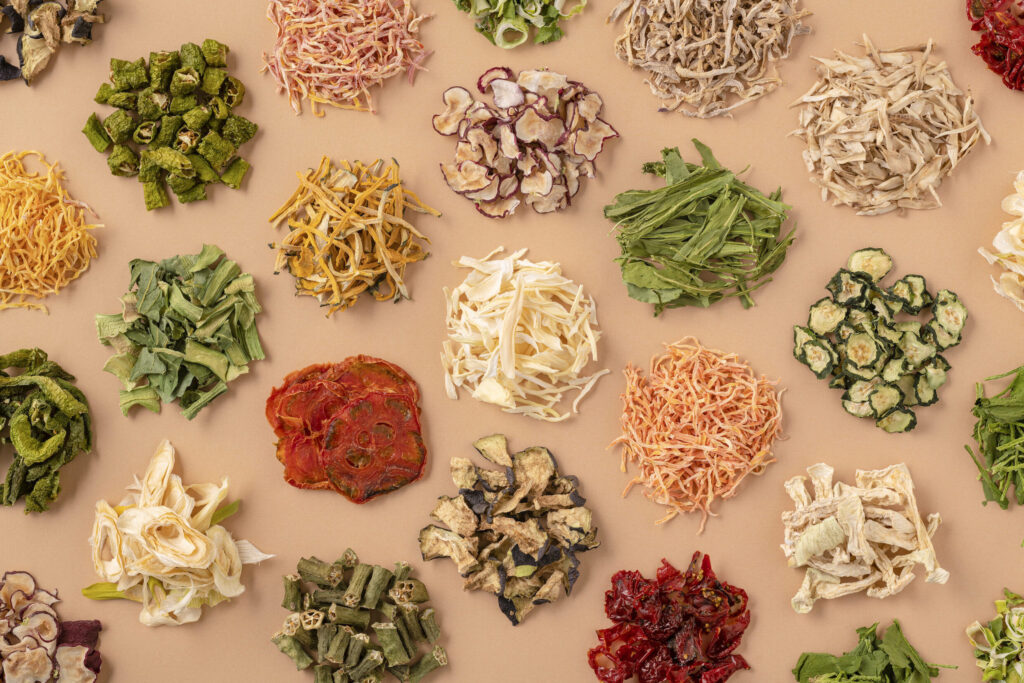
- Available for purchase in small lots from 1 kg
- We handle heirloom vegetables from across Japan
- Dried fruit and herbs also supported
The Characteristics and Ways to Eat 7 Representative Iwate Heirloom Vegetables
Having organized the 17 varieties in a list, we introduce in detail the growing region, season, and recommended dishes of 7 representative varieties that are especially high in distribution volume or influence on food culture.
Kuretsubo Kabu — Tono's Condiment Kabu, Continuing for 400 Years
| Item | Details |
|---|---|
| Season | Late October–early November |
| Growing region | Sahinai, Kamigo-cho, Tono City |
| Representative dishes | Grated condiment (for soba, grilled fish), pickles, miso soup |
Kuretsubo kabu is a long-rooted turnip about 20 cm in length, with a shape quite different from the ordinary round turnip. Grated, it releases a sharp bite similar to grated daikon, and in Tono it is an indispensable condiment for soba. The seeds are said to have been brought in about 400 years ago by a medicine peddler from Omi, and only a handful of farmers in the Sabinai district still grow it.
The key to serving it is to grate it right after harvest. Since the pungency fades as freshness declines, locals traditionally use it up the same day it is pulled from the field.
Futago satoimo — 300 years of stickiness and richness
| Item | Details |
|---|---|
| Season | Early September to early November |
| Growing region | Futago-cho, Kitakami City |
| Representative dishes | Imonoko-jiru, nikkorogashi, imoni |
A red-stemmed taro grown for more than 300 years in Futago-cho, Kitakami. It is far stickier than ordinary taro and holds its shape well when simmered, yet splits open with chopsticks to reveal a smooth, sticky texture inside.
The "imonoko-jiru" served at local autumn festivals and on riverbanks is a signature regional dish that stars Futago satoimo. This Iwate-style imoni, simmered with chicken, burdock, and mushrooms in a soy-sauce base, tastes entirely different from Yamagata's beef-and-miso version. the appeal of heirloom vegetables, start with this one bowl.
Akkachi daikon — the crimson freeze-dried daikon
| Item | Details |
|---|---|
| Season | Late September |
| Growing region | Akka district, Iwaizumi-cho |
| Representative dishes | Shimi-daikon (preserved food), simmered dishes, miso soup |
"Akka" is a place name derived from the Ainu language, and this daikon has long been grown in the mountainous areas of Iwaizumi-cho. It is about half the size of an ordinary daikon (roughly 600 g), and its skin has a distinctive crimson tinge.
Its greatest strength is its suitability for making shimi-daikon. Freezing and drying it outdoors repeatedly during the deep cold of winter draws out the moisture, dramatically improving both keeping quality and flavor. Rehydrated and used in simmered dishes or miso soup, it develops a concentrated sweetness that fresh daikon does not have. At Agriture, too, we dry Kyoto's heirloom vegetables, but the Tohoku freeze-drying method takes a different approach by harnessing the cold wind.
Hayachine-na — the Tono leafy green revived from the brink of extinction
| Item | Details |
|---|---|
| Season | November to the following May |
| Growing region | Tono region |
| Representative dishes | Ohitashi, pickles, miso soup ingredient |
A leafy green grown at the foot of Mt. Hayachine, characterized by its deep-green round leaves. The number of growers once fell to just a few and it nearly went extinct, but a local seed-preservation effort brought it back.
It can be harvested three times a year and, unusually, ships over a long span from autumn into the following spring. Because exposure to frost removes the harshness and adds sweetness, midwinter is considered the tastiest season. With little bitterness, it can go straight into ohitashi or miso soup, making it an easy leafy green to work into everyday meals.
Ichinoseki magari-negi — the thick leek of Date-domain origin
| Item | Details |
|---|---|
| Season | Early winter |
| Growing region | Ichinoseki City |
| Representative dishes | Hot pot, grilled leek, tempura |
A long leek with a thick white stalk and a distinctive shape that bends sharply partway up. Replanted midway through cultivation, it is deliberately made to bend, which concentrates sweetness in the white stalk. Its farming method is said to originate in the Date domain, placing it in the same lineage as Sendai's "magari-negi."
Heating turns its texture meltingly soft, and grilling or hot-pot cooking brings out its sweetness. Paired with Ichinoseki's local "mochi culture," it is an essential ingredient in zoni and mochi-course meals, supporting the region's tables.
Hatake wasabi — Iwaizumi, a leading producer
| Item | Details |
|---|---|
| Season | Ohitashi, karashi-ae, pickles, miso soup ingredient |
| Growing region | Iwaizumi Town |
| Representative dishes | Condiment (for sashimi, soba), wasabi pickles, soy-sauce-pickled stems |
"Hatake wasabi," grown on dry fields without mountain streams, is a crop for which Iwate accounts for roughly 50% of national production. Its bite is somewhat milder than that of stream-grown wasabi, and its stems and leaves are also edible.
The cool, humid climate of Iwaizumi-cho suits wasabi cultivation, and "soy-sauce-pickled hatake wasabi," which uses the flower buds, stems, and leaves in full, is a local preserved-food staple. Hana-wasabi, which appears in early spring, offers a seasonal taste that pairs a sharp bite with a faint sweetness at once.
Bashona — the broad-leaf mustard green of Esashi
| Item | Details |
|---|---|
| Season | October to November |
| Growing region | Esashi, Oshu City |
| Representative dishes | Salt-pickling, sake-lees pickling, wrapping onigiri |
A large mustard green whose leaves reach 40–50 cm in length; the name "bashona" comes from its resemblance to the leaves of the basho (banana) plant. It has long been grown in the Esashi district of Oshu.
Raw, it has a sharp bite, but salt-pickling softens the pungency while keeping a crisp crunch. "Bashona onigiri," in which a large leaf wraps a rice ball, has long been enjoyed as an Esashi fieldwork lunch and is a taste of the region. Sake-lees pickling allows long-term storage, making it a valued winter standby dish.
Regional character—the heirloom vegetables of Tono, the southern prefecture, and the coast
Iwate's 17 heirloom vegetables can be broadly sorted into three areas: the Tono area, the southern prefecture area, and the coastal area. Each region's climate, history, and food culture is vividly reflected in the lineup of local varieties.
Tono area (5 items) — a treasure trove of turnips and condiments
- Kuretsubo kabu: A long-rooted white turnip. Served grated as a condiment for soba. Cultivation is limited to the Sabinai district
- Tono kabu: Same long-rooted type as Kuretsubo kabu. Used routinely for pickles and as a miso-soup ingredient
- Kotohata kabu: A red, slender turnip. Cultivation had lapsed for 30 years but was revived in 2014
- Hayachine-na: Deep-green round leaves. Revived from the brink of extinction, and harvestable three times a year
- Miyamori wasabi: A large wasabi reaching 1 m in height. Combining bite and sweetness, it has been grown since 1915
The Tono basin is a cool highland at around 300 m elevation, an environment where a turnip's pungent compounds concentrate readily. Seeds brought in by Omi merchants and medicine peddlers adapted to the land and took root as distinct varieties in each hamlet—this is how Tono's turnip culture came to be.
Southern prefecture area (5 items) — the bounty of the Date domain and the granary
- Ichinoseki specialty magari negi: A magari-negi with a thick, sweet white stalk. Originating in the Date domain's farming method
- Yagoshi kabu: A purple-stemmed turnip. It lapsed after the war and was rediscovered and revived in 2006. Heating turns it a golden-yellow color
- Basho-na: A broad-leaf mustard green of 40–50 cm. Used as a preserved food in salt-pickling and sake-lees pickling
- Futago satoimo: A red-stemmed taro. With 300 years of history, it stars in imonoko-jiru
- Kurohira mame: A black oval, flat bean. A dual-purpose variety eaten both as edamame and as black beans
Centered on the Kitakami plain, the southern prefecture is Iwate's premier granary, with fertile soil suited to growing taro and beans as well. Under the influence of the Sendai (Date) domain, it is a region where a food culture built around simmered and soup dishes took root.
Coastal area (7 items) — a cool climate and wild bounty
- Akka ji-daikon: A small crimson daikon. Processing into shimi-daikon is the traditional preservation method
- Ji-uri / mukashi kyuri: A round, Siberian-lineage cucumber. Used for fresh eating and moromi pickling
- Hatake wasabi: Iwate accounts for about 50% of national production. Stems and leaves are also edible
- Aboukyu: A yellow edible chrysanthemum. It has a history of being introduced from Kyoto by the Nanbu domain lord
- Hashino kabu: A bent turnip characterized by a crimson-to-white gradation. Long-term storage is possible
- Iwate yamanashi: A small wild variety of 3–8 cm. Historically used as a famine-relief crop
- Yama-budo: A small fruit with a sugar content of 15 degrees. Processed as raw material for juice, wine, and jam
In the cool climate belt stretching from the Sanriku coast to the Kitakami mountains, alongside the preserved processing of root vegetables, the use of wild varieties such as yama-budo (wild grape) and Iwate-yamanashi (wild pear) is also active. The coast's characteristically humid environment has made large-scale cultivation of hatake wasabi possible.
How to buy Iwate's heirloom vegetables and tips for storing them
Because Iwate's heirloom vegetables are produced in limited quantities, they rarely appear at ordinary supermarkets. Knowing the purchase routes and the storage method for each item makes them easier to get without missing the seasonal window.
Look at farm stands and roadside stations within the prefecture
| Item | Main sources | Distribution period |
|---|---|---|
| Kuretsubo kabu | Farm stands in Tono (limited distribution) | October–November |
| Futago satoimo | Farm stands in Kitakami, JA Iwate Hanamaki | September to November |
| Akka ji-daikon | Roadside station "Iwaizumi" in Iwaizumi-cho | September–October |
| Hatake wasabi | Iwaizumi-cho farm stands, roadside stations | Koito River basin, Kimitsu City |
| Basho-na | Farm stands in the Esashi district | October–November (pickles year-round) |
| Yama-budo | Farm stands in the Kuji region (processed goods year-round) | September–October (fresh fruit) |
| Magari-negi | Farm stands and supermarkets in Ichinoseki | November to January |
Because Kuretsubo kabu is grown by only a few farmers in the Kamigo district of Tono, it is hard to obtain even at local farm stands. To be sure of getting it, the reliable options are to visit Tono's farm stands directly during the autumn harvest or to contact the Tono Tourism Association.
Mail order to other prefectures and hometown-tax donations
- Futago satoimo: It is sometimes offered from Kitakami as a hometown-tax donation gift, making it a strong route for obtaining it from outside the prefecture
- Wild grape juice and wine: Processed goods from the Kuji region can be bought year-round on mail-order sites. Search by product names such as "Kuzumaki Wine" or "wild grape concentrate"
- Hatake wasabi processed goods: Wasabi pickles and soy-sauce-pickled stems are distributed by mail order as an Iwaizumi-cho specialty
- Shimi-daikon: As a processed Akkachi daikon product, it is carried by dried-goods specialty shops and online stores for Iwate-produced goods
- Bashona pickles: Salt-pickled and sake-lees-pickled versions are sold by mail order by local businesses as an Esashi, Oshu specialty
Since only a limited number of items reach other prefectures fresh, buying processed goods (pickles, dried goods, juices) is the realistic option. Heirloom vegetables of Hokkaido and Heirloom vegetables of Aomori As with
Storage methods by item
| Item | Storage method | Storage period guide | Point |
|---|---|---|---|
| Kuretsubo kabu and Tono kabu | Wrap in newspaper and store in the crisper drawer of the refrigerator | 1–2 weeks | Since the bite fades with freshness, use it up early |
| Futago satoimo | Leave the soil on, wrap in newspaper, and store in a cool, dark place | 2–3 weeks | Washing shortens shelf life, so wash just before use |
| Akka ji-daikon | Process into shimi-daikon (freeze-dried outdoors) | Half a year to a year | Rehydrate with water before use. The soaking liquid, too, is infused with flavor |
| Abokyu (edible chrysanthemum) | Loosen the petals, boil in vinegared water, and freeze | 3 months frozen | Dried into hoshi-giku, it keeps at room temperature for a long time |
| Basho-na | Salt-pickling, sake-lees pickling | 3–6 months salt-pickled | Sun-drying for half a day before pickling keeps it from getting watery |
| Hatake wasabi | Wrap in damp kitchen paper and refrigerate | 1–2 weeks | Soy-sauce-pickling the stems and leaves keeps them for one month |
| Yama-budo | Process into juice, jam, or wine | Over a year as processed goods | Fresh fruit spoils easily; processing within 3 days of harvest is recommended |
Iwate's heirloom vegetables have been handed down inseparably from "preservation techniques for getting through winter"—shimi-daikon, hoshi-giku, salt-pickling, and more. Since few items keep long fresh, processing and preserving them while in season is the Iwate way of using them.
A product catalog that shows around 100 items we handle
Agriture, flexibly handling everything from small lots to large lots
- Available for purchase in small lots from 1 kg
- We handle heirloom vegetables from across Japan
- Dried fruit and herbs also supported
From lapse to revival—the people protecting Iwate's heirloom vegetables
Among the 17 items are varieties whose cultivation once ceased entirely but were revived by local people. Here we lay out, in timeline form, the lapse and revival of three representative items.
Kotobata kabu — a 30-year lapse and the 2014 revival
| Era | Event |
|---|---|
| Up to the early 1980s | Grown for home use in the Kotobata district of Tono |
| Mid-1980s | Aging and depopulation reduced growers to zero. A roughly 30-year lapse |
| 2013 | The existence of seeds stored at a local seed bank was confirmed |
| 2014 | A Tono farmer began revival cultivation. The red, slender turnip returned to the fields |
| From 2014 onward | Shipped in small quantities to local farm stands. Expanding the growing area is the challenge |
The revival of Kotobata kabu is a case that would not have happened without a seed-preservation system. Seeds that retained their germinating ability even after a 30-year gap, and the resolve of the farmer who took them on, made the revival possible.
Yagoshi kabu — from a postwar lapse to a 1994 cultivation revival
| Era | Event |
|---|---|
| Prewar and wartime | Grown as a home-use vegetable in the Yagoshi district of Ichinoseki |
| Postwar | Cultivation lapsed as improved Western turnip varieties spread |
| 2006 | Old seeds were found in a local farmer's storehouse. Germination was confirmed in trial cultivation |
| From 2007 | Farmers in Ichinoseki resumed cultivation. Its trait of turning golden-yellow when heated, on a purple stem, became a talking point |
| Present | Supplied in small quantities to local restaurants and farm stands. Highly rated by chefs |
What drew attention to Yagoshi kabu was the visual impact of turning golden-yellow when heated. Local chefs seized on this trait and adopted it in simmered dishes and potages, spreading its recognition.
Hayachine-na — a revival from the brink of extinction
| Era | Event |
|---|---|
| Up to the late Showa era | Widely grown as a winter leafy green in the Tono region |
| Early Heisei era | The shift to market-distribution varieties advanced and growers plummeted, down to just a few |
| Early 2000s | A local heirloom-preservation group collected the remaining seeds and began propagating them |
| Late 2000s | After trial cultivation, shipping resumed. Its high yield of three harvests a year was reappraised |
| Present | Distributed mainly through Tono-area farm stands. The frost-touched winter leaves are said to be the tastiest |
Hayachine-na is a fine example of a "variety that is good to eat" being revived. Harvestable three times a year, with sweetness increased by frost, its high practicality sparked the reappraisal, and it is steadily becoming a popular winter product at the region's farm stands.
Common to these revival cases is that two things came together: the chance that "seeds had survived," and an individual's will to "try growing it."sustainable agriculture From this standpoint, too, the movement to protect the genetic resources of local varieties is becoming a foundation that supports the future of Iwate's agriculture.
FOR BUSINESS
乾燥野菜を業務用でお探しですか
国産の野菜・果物を乾燥し、必要に応じて粉砕してお出ししています。扱っている品目は100種前後で、規格は 乾燥品の一覧・パウダーの一覧 に掲載しています。
少量でのご購入は、姉妹ブランドの通販サイト OYAOYA で承っています。
FAQ
Summary
Iwate's 17 heirloom vegetables each have distinct regional character: the turnip culture of the Tono basin, the Date-domain-derived root and grain crops of the southern prefecture, and the root vegetables and fruits nurtured by the cool climate of the coast. The greatest appeal of Iwate's local varieties is that each item has been handed down inseparable from a land-specific way of eating and preservation technique—Kuretsubo kabu as a condiment, Futago satoimo in imonoko-jiru, Akkachi daikon as shimi-daikon.
There are also varieties like Kotobata kabu and Yagoshi kabu that lapsed once before being revived, showing that preserving local varieties requires both seed management and the people to carry on cultivation. When the autumn-winter season arrives, be sure to bring Iwate's heirloom vegetables to your table through farm stands and hometown-tax donations.
References / information sources
- Japan Heirloom Vegetable Promotion Association — List of Iwate Prefecture heirloom vegetables
- HYPONeX — Iwate heirloom vegetables column
- Iwate Prefectural Government — Promotion of prefectural agricultural production
Other regional specialty varieties
These items are included in the Japan Heirloom Vegetable Promotion Association's list, but here we introduce items that go beyond the category of "vegetable"—such as fruits and wild varieties—separately as "regional specialty varieties." The fact that they remain important crops supporting Iwate's food culture is unchanged.
| Item | Category | Growing region | Characteristics and standing |
|---|---|---|---|
| Iwate yamanashi | Fruit (wild variety) | The Kitakami mountain system | A small wild pear of 3–8 cm. It has a history of use as a famine-relief crop. Strictly speaking a fruit, but as a native crop of the mountains it forms part of Iwate's food culture |
| Yama-budo | Fruit (wild variety) | The Kuji area | A small fruit, 8 mm across, with a sugar content of 15 degrees. Processed as raw material for juice, jam, and wine. A wild fruit, but established as a specialty of the Kuji region |
Related articles
- What are Japan's heirloom vegetables? A roundup of representative varieties nationwide
- Types and characteristics of Kyoto's heirloom vegetables (Kyoto vegetables)
- Hokkaido's heirloom vegetables — local varieties nurtured by a harsh climate
- Aomori's heirloom vegetables — a guide to the local varieties of Tsugaru and Nanbu
- Naniwa's heirloom vegetables — 20 local varieties of Osaka
Download the product catalog
We will send the materials to your email address based on the information you provide.
- What are Aomori’s heirloom vegetables? Features, season, and ways to eat the 11 items explained
- What are Miyagi’s heirloom vegetables? An explanation of the 22 native varieties handed down centered on Sendai
Author of this article
Related articles
-
 Okinawa island vegetables: individualistic vegetables nurtured by a subtropical climate
 -
 Kaga vegetables: Kanazawa brand vegetables where tradition lives on
 -
 The appeal of Kansai heirloom vegetables | Specialties of Naniwa, Kyoto, and Yamato thoroughly explained
 -
 Kyoto heirloom vegetables: Kyoto specialties with a long history
 -
 A list of heirloom vegetables of the 8 prefectures of Kyushu and Okinawa|A thorough introduction to characteristics, growing regions, and seasons
 -
 Know the heirloom vegetables of Edo Tokyo | The city’s vanishing food culture
 -
 They'll make you smile! The fun names of heirloom vegetables and their origins
 -
 5 cases and strategies that succeeded in branding heirloom vegetables