Solving the Vegetable Shortage in Corporate Disaster Preparedness | 7 Recommended Stockpile Vegetables

Summary of this article
We cover 7 dried vegetables recommended for disaster stockpiling and how to solve the nutritional gaps of emergency and preserved foods. For corporate stockpile managers and health-management staff, we organize stockpiling guidelines of 2–3 bags per person per day and 6–9 bags for three days, examples of rolling-stock operation, recommended vegetables by dietary fiber, minerals, vitamin A, and vitamin D, and how to prepare at home—drawing on the MEXT Food Composition Database.
Stockpiling vegetables is a topic often overlooked in corporate disaster plans. Typical emergency and preserved foods—alpha rice, hardtack, cup noodles, canned goods—skew toward carbohydrates and protein and tend to lack vitamins, minerals, and dietary fiber. This article organizes 7 recommended stockpile vegetables, how dried vegetables solve nutritional gaps, rolling-stock operation, how to choose by nutrient, and an FAQ, for corporate stockpile managers and health-management staff.
TOC
Three things you'll learn from this article
- The "vegetable" problem often overlooked in corporate disaster stockpiling
- Health risks caused by nutritional imbalance during a disaster
- 7 recommended stockpile options using dried vegetables and how to choose them
- How to balance daily consumption and stockpiling with rolling stock
- Recommended stockpile vegetables by nutrient
When did you last check the contents of your company's disaster stockpile?
Emergency water and hardtack stacked at the back of a shelf in the general affairs department—offices like this are not rare.
In corporate disaster materials from the Cabinet Office and local governments, a three-day supply of food and drink per employee is set as the basic guideline. Nine liters of water and nine meals is one benchmark, and depending on the job type or location, some cases call for considering a one-week supply.
Yet looking at many companies' stockpiles, alpha rice, hardtack, cup noodles, canned goods and the like skew toward carbohydrates and protein, which is the reality. "Vegetables" containing vitamins and minerals are entirely missing, and it stands out that many stockpiles aren't equipped to get through three days with peace of mind.
Let's check the nutritional balance of stockpile foods
| Nutrients | Common stockpile foods | Adequacy |
|---|---|---|
| Carbohydrate | Alpha rice, hardtack, cup noodles, breads | ◎ Sufficient |
| Protein | Canned goods (tuna, mackerel), retort foods | ○ Fair |
| Nutrients are the basic components that people must take in to live. They are needed as the body's energy source, structural components, and for regulating metabolism. | Canned goods, cup noodles | ○ Fair |
| Vitamins and minerals | ? | × Almost none |
| Dietary fiber | ? | × Almost none |
This imbalance affects the body more than expected over three days of evacuation living.
Health risks caused by nutritional imbalance during a disaster
Health problems that tend to arise in evacuation living
Looking at past disasters, meals at evacuation shelters tend to center on carbohydrates, and the following health problems become more likely.
- Constipation: lack of dietary fiber slows the gut
- Canker sores, rough skin: lack of B vitamins and vitamin C
- Fatigue, reduced concentration: mineral deficiency
- Effects on nutritional balance: vitamin C and zinc tend to be lacking
At shelters after the Great East Japan Earthquake, canker sores, constipation, and a shortage of side dishes became issues, according to reports (including oral-health papers on disaster areas published on J-STAGE). The more days pass after a disaster, the more replenishing vegetables, minerals, and dietary fiber becomes decisive for maintaining health.
Why vegetables don't make it into stockpiles
The biggest reason is that fresh vegetables don't keep. Until recently there were almost no options for foods that keep at room temperature for a long time while still containing vegetable nutrients. Options for vegetables as preserved food—dried vegetables, vegetable soups, vegetable juices, freeze-dried—have grown, and among them dried vegetables are an easy shape to handle in home and corporate stockpiles.
4 reasons dried vegetables are ideal for disaster stockpiling
1. 常温で置ける:賞味期限は6ヶ月程度
The best-before date of dried vegetables is generally 6 months to 1 year. They don't match alpha rice (5 years), but half a year or more at room temperature is plenty for rolling-stock operation. They don't take up refrigerator or freezer space, so you can keep a good supply on an office shelf or in a warehouse.
2. Light and compact, easy on stockpile space
Because the moisture is removed, the weight is about one-tenth of fresh vegetables. Storage space is minimal too. Even a three-day supply for 50 people fits in 2–3 cardboard boxes, so you can make good use of limited stockpile shelving. It's also an easy shape to include in disaster-supply kits.
3. Easy to prepare—just rehydrate with hot or cold water
You can eat them just by rehydrating with hot or cold water. If you can boil water on a portable stove during a disaster, adding dried vegetables to miso soup, soup, rice porridge, or curry makes a warm, tasty meal. At home, using them as miso soup ingredients day to day naturally connects your stockpile with everyday meals.
4. Nutrients are well retained
In dried vegetables, dietary fiber and minerals become concentrated, while vitamin C tends to be partly lost. Detailed nutritional changes are shown in the table below (referencing MEXT Food Composition Database).
| Nutrients | Change from drying |
|---|---|
| Dietary fiber | Retained almost intact (in fact concentrated) |
| Minerals (iron, calcium, potassium, magnesium) | Heat-stable, well retained |
| Vitamin A (beta-carotene), vitamin E | Largely retained |
| Vitamin D (shiitake, etc.) | Increases with sun drying |
| B vitamins | Decrease somewhat but a certain amount remains |
| Vitamin C | Tends to decrease (supplement with other foods) |
7 recommended vegetables for stockpiling
Among dried vegetables, here are 7 types recommended for disaster stockpiling, in order. We evaluated them on five axes—shelf life, versatility, ease of rehydration, nutritional balance, and familiarity—and selected vegetables that are easy to use in everyday miso soup, soup, curry, and rice porridge.
| We organize in a list the 22 Miyagi heirloom vegetables certified by the Japan Heirloom Vegetable Promotion Association, and in the following section explain 7 representative items in detail. First, let us grasp the whole picture. | Vegetables | Why we recommend it | Key nutrients | How to use |
|---|---|---|---|---|
| No.1 | Dried daikon | Versatile in miso soup, simmered dishes, rice porridge | Dietary fiber, potassium | Can be added without rehydrating |
| No.2 | Dried carrot | A source of color and nutrients | Beta-carotene (vitamin A) | Soup, curry, boxed lunches |
| No.3 | Dried spinach | For replenishing iron and calcium | Iron, calcium, folate | Miso soup, ohitashi, tamagoyaki |
| No.4 | Dried shiitake | Umami plus vitamin D | Vitamin D, dietary fiber | Doubles as stock and ingredient |
| No.5 | Dried cabbage | Versatile as a soup ingredient | Dietary fiber, vitamin K | Vegetable soup, stew |
| No.6 | Dried onion | Umami base, quick cooking | Dietary fiber, potassium | Curry, stir-fries, soup |
| No.7 | Dried kabocha squash | Sweetness and dietary fiber | Beta-carotene, dietary fiber | Soup, simmered dishes, side dishes |
Keeping one or two of each vegetable on hand makes it easier to prevent nutritional imbalance even over three days of evacuation living. For an office of about 50 people, we recommend centering on the top three items (daikon, carrot, spinach) and combining familiar vegetables. Since the 7 are evaluated on "ease of use, ease of rehydration, how well they give off stock, and familiarity," reading this alongside the next section, "How to choose by nutrient," makes it easier to build a combination that fits your company's or household's goals.
Learn about Office Yaoya
We have prepared materials
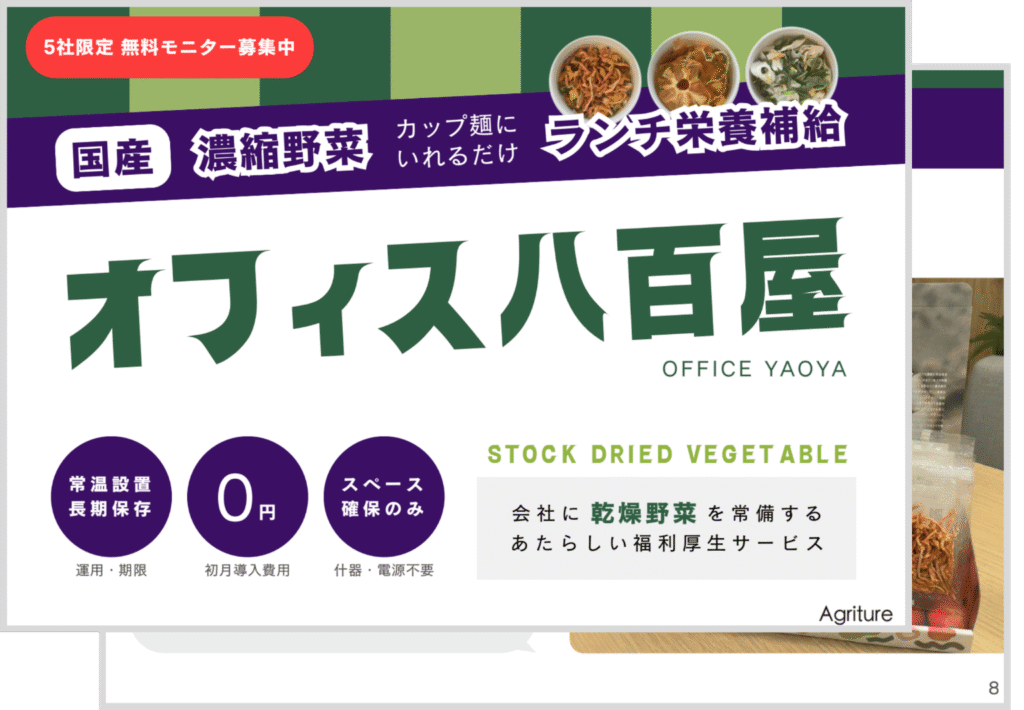
- Service details and vegetable lineup
- Pricing and plans
- How adoption and operation work
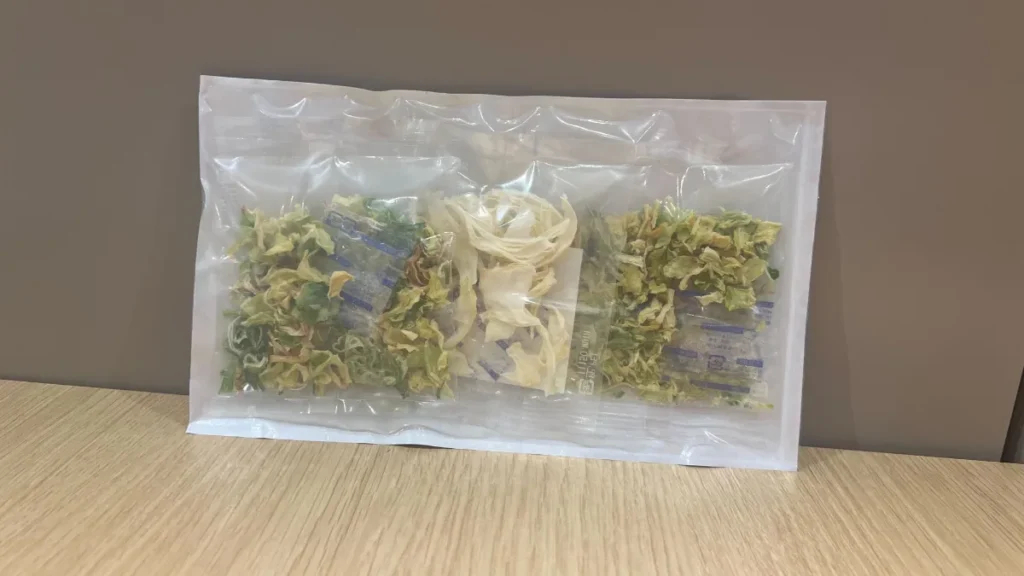
Sample sets are also available. Download the materials for details!
We offer sample sets so you can try Office Yaoya in small quantities. See the materials for details.
By nutrient | How to choose stockpile vegetables
Which vegetables to choose changes depending on which nutrient you prioritize. Below are recommendations by nutrient, organized based on the MEXT Food Composition Database and public information from the Japan Dietetic Association.
If you prioritize dietary fiber
Dried kiriboshi daikon, burdock, kabocha, and shiitake is concentrated in dietary fiber and helps with constipation. The MEXT Standard Tables of Food Composition database also confirms that kiriboshi daikon (dried shredded daikon radish) has more concentrated dietary fiber than fresh daikon (note that this is because water is removed and components become concentrated, so the dried product corresponds to several hundred grams once rehydrated). Even though only a small amount is used per serving, it is a practical source of dietary fiber.
If you prioritize minerals like iron and calcium
Minerals are heat-stable and remain almost intact through the drying process. Dried spinach, komatsuna, and kiriboshi daikon are rich in iron, calcium, and potassium. They help prevent anemia and maintain bone health. Dried spinach in particular becomes a meal's worth of mineral replenishment just by rehydrating in hot water and adding it to miso soup.
If you prioritize vitamins A and D
Vitamin A (beta-carotene) is abundant in dried carrot and kabocha, and vitamin D in Dried shiitake. Sun-dried shiitake in particular shows a markedly higher vitamin D content MEXT Food Composition Database when comparing raw and dried shiitake. Vitamin A relates to eyesight and skin health, and vitamin D to bone formation and immune maintenance.
Supplement vitamin C with other foods
Vitamin C is easily lost to heat and time, so you can't get enough of it from dried vegetables. It's practical to supplement vitamin C with vegetable juice (room-temperature storage type), canned fruit, dried fruit, and vitamin-fortified drinks. Combining these with dried vegetables rounds out the nutritional balance.
How to review your stockpile food list | Adding vegetables
Stockpile guideline per employee (three-day supply)
| Item | Quantity | Notes |
|---|---|---|
| Drinking water | 9 L (3 L × 3 days) | Cabinet Office recommendation |
| Staple food (alpha rice, retort rice, etc.) | 9 meals | Cabinet Office recommendation |
| Dried vegetables (for miso soup, soup) | 6–9 bags | 2–3 bags per day |
| Canned goods (protein source) | 3–6 cans | Tuna, mackerel, simmered meat, etc. |
| Instant soup and miso soup | 3–6 servings | For adding dried vegetables |
| Vegetable juice (room-temperature storage) | 3–6 bottles | For vitamin C replenishment |
| Others | As needed | Yokan, biscuits, CalorieMate, etc. |
The key is to position dried vegetables not as an "extra" but as a "core stockpile item."2–3 bags per person per day, 6–9 bags for three days. For an office of 50 people, roughly 300–450 bags is the guideline.
Make your stockpile a "living asset" with rolling stock
What is rolling stock?
Rolling stock is a method of consuming stockpile items in daily life while replenishing only what you use. It's a modern basic of stockpiling recommended by disaster-preparedness experts and local governments in Japan.
There are three benefits.
- No risk of discarding entire batches at their best-before date
- Employees get used to the taste, reducing stress during a disaster
- Stockpile cost can be folded into everyday employee-benefit expenses
Example of rolling-stock operation for dried vegetables
- Keep dried vegetables in the office at 100–200 bags at all times in stock
- Employees routinely use them in miso soup and soup (10–20 bags a day)
- When stock falls below a set level, reorder once or twice a month
- Always maintain at least a three-day supply (number of employees × 9 bags)
With this approach, you can run disaster stockpiling and health-management meal initiatives on the same system. The cost can also be booked as employee-benefit expenses, making it a highly persuasive setup for general affairs, HR, and safety and health staff. When employees are used to the everyday taste, they can eat without stress in an emergency too.
Using "Office Yaoya" to systematize stockpiling × health management
For companies that want to "run disaster stockpiling and everyday health management on the same system," Agriture operates Office Yaoya (office greengrocer), a set-and-forget dried-vegetable employee-benefit service. It keeps dried vegetables, dried fruit, and instant miso soup on hand in unused office space; employees consume them day to day, and the same stock also serves as a disaster stockpile.
What is Office Yaoya | A set-and-forget dried-vegetable service
Office Yaoya is an employee-facing service with the concept of "realize in-house health management with set-and-forget dried vegetables."The ingredients handled are dried vegetables, dried fruit, vegetable powder, and instant miso soup, and the vegetable lineup is delivered seasonally from about 100 raw ingredients. Individually wrapped (about 3–8 g per bag), no rehydration needed, and keeping for 3 months or more at room temperature, so no refrigeration is required. It can be introduced even in small offices of 10 people or fewer, and installs in the space of a single Nekopos-size box.
What's provided and price guideline
| Item | Details |
|---|---|
| Price | Per serving From 100 yen (when employees purchase) |
| Initial and monthly cost | Free (a plan with zero cost to the company is available) |
| Ingredient | Dried vegetables, dried fruit, vegetable powder, instant miso soup |
| Use cases | Add to instant miso soup, cup-noodle ingredients, snacks, tea-time bites |
| Delivery frequency | Once every few months (low operational burden) |
| Payment | PayPay payment supported (when employees purchase) |
| Installation space | The space of a single Nekopos-size box |
Because it can be introduced from a small lot, it suits a small start such as "first trying it at the department level for 10 to 30 people." You can also begin with a trial of a sample set and move to full adoption while gauging the in-house response.
Realize disaster stockpiling, health management, and employee benefits at once
A feature of Office Yaoya is that it can cover all four—disaster stockpiling, health management, employee benefits, and sustainability—with a single system.
- Disaster stockpiling: dried vegetables that keep for 3 months or more at room temperature are always in the office, and rolling stock runs automatically
- Health management: helps address the Japanese vegetable shortage (about 70 g short per day on average) and matches the dietary-improvement items for Certified Health & Productivity Management Organizations
- Employee benefits: meal subsidies, employee-purchase plans, delivery options for remote-working staff, and more
- Sustainability: by upcycling off-spec vegetables that don't reach the market, it also helps reduce food loss. Can be linked with CSR initiatives
The ability to "consolidate initiatives that had been run on separate budgets by separate people into one" is valued by general affairs, HR, and CSR staff. There are also cases where it's used for recruiting branding, serving as a message that "this company thinks about both its employees' health and its emergency preparedness."
The path to adoption
- Download materials: request the company overview materials from the Office Yaoya official site
- Consultation: confirm number of employees, locations, and intended use (stockpiling-focused / health-management-focused, etc.)
- Sample-set trial: test the employee response and operational feel with a small quantity
- Full adoption: decide the delivery cycle and lineup and start operation
- Regular replenishment: deliveries once every few months keep stock cycling automatically
Details and material requests are accepted at the Office Yaoya official page.
FAQ | Stockpile vegetables Q&A
Summary | The peace of mind during a disaster that vegetable stockpiling brings
Adding vegetables to your corporate disaster stockpile lets you maintain nutritional balance even over three days of evacuation living and reduce employees' health risks. Dried vegetables are stockpile vegetables with all three virtues—light, long-keeping, and easy to cook—and keeping daikon, carrot, spinach, shiitake and the like on hand greatly changes meals during a disaster.
Balancing daily consumption and stockpiling with a rolling-stock method lowers waste risk while also serving as an employee benefit. Reviewing your disaster stockpile is the first step in a company's health management. If "building a system in-house is too much," one option is to use an employee-benefit service like Office Yaoya (office greengrocer) that runs disaster stockpiling × health management with a set-and-forget approach. Start by simply adding vegetables.

Recommended reading
What is corporate disaster preparedness? 2026 edition (parent article) / Corporate disaster stockpile list, 2026 edition / 10 examples of corporate disaster-preparedness initiatives / Complete rolling-stock guide 2026 / [2026 edition] 7 recommended emergency foods / Sustainable initiatives / Commercial dried vegetables / Product lineup
Download the office dried vegetable materials
We will send the materials to your email address based on the information you provide.
- Vegetable shortage lowering productivity? The link between presenteeism and diet
- A stockpile strategy balancing BCP × health management | Using dried vegetables