
Whole Freeze-Dried Strawberry | Uses in Confectionery and Preventing Breakage

Summary of this article
Features of the whole-berry type of freeze-dried strawberry and how to use it in confectionery. We organize specific uses in cakes, chocolate, Japanese confectionery, and gift sweets, the packaging design and handling rules for countering breakage and moisture absorption, and Agriture's adoption patterns using Kyotango-grown strawberries.
Freeze-dried strawberries The whole-berry type is a three-dimensional dried ingredient that retains the shape of the fresh strawberry as it is. It brings out strengths in products that appeal by appearance, such as decoration for confectionery and bread, toppings for Japanese confectionery, and chocolate and premium gifts. On the other hand, because it has the weakness of breaking easily during transport and filling, it is also a shape that requires care in packaging design and handling.
This article organizes the features of the whole-berry type, how to use it in confectionery and bread, countermeasures for its fragility, storage techniques, and selection points in OEM, based on the cases Agriture handles with Kyotango-grown strawberries. For comparison with other shapes, diced・Sliced, and for commercial use in general, commercial freeze-dried strawberries.

TOC
Features of freeze-dried strawberry (whole)
The whole-berry type is an ingredient made by rapidly freezing fresh strawberries and then drying them by vacuum sublimation, leaving the shape of the fruit as it is. Because the three-dimensionality and vivid red color remain, simply placing them on top of a cake or baked good greatly changes the appeal of the product photo.
Strengths unique to the whole-berry type
- Three-dimensionality and a premium feel: Just placing a single berry on top of a cake creates a high-end impression
- Appeal of the ingredient itself: Because it looks like the strawberry itself, unprocessed, it pairs well with ingredient-focused brands
- Vividness of color: Retains a red color close to fresh that hot-air drying cannot achieve
- Accent in texture: The crisp, light texture works in contrast with cream and chocolate
Weaknesses and cautions of the whole-berry type
- Fragility: Breaks easily during transport, filling, and handling. Design with cushioning material and individual packaging is essential
- Low yield: Because keeping the shape is difficult, the finished unit cost is higher than other shapes
- Moisture absorption: With its large surface area, the texture changes more easily than diced or powder
- Variation in size: Because the individual variation of fresh strawberries remains as is, uniformity like that of shaped forms is hard to expect
How to use it in confectionery and bread
The whole-berry type is adopted as an ingredient that becomes the face of a product. We organize specific uses in confectionery and bread by product category.
Use cases by category
The basic way to choose is whole for decoration, diced for kneading in, and powder for blending. Below organizes the product categories where whole is readily chosen, together with the aim of the product design.
| Product category | How to use | Aim of presentation |
|---|---|---|
| Cakes and tarts | Placed on top of cream or ganache | Accent of three-dimensionality and red color |
| Chocolate and bonbons | Enclosed whole inside, or placed on top | The effect of pink flesh peeking out when broken |
| Japanese confectionery (monaka, yokan) | Top placement, center placement | Modernizing traditional confectionery with a Western ingredient |
| Marshmallow and meringue | Enclosed whole in the batter | The crisp textural contrast when bitten |
| Gift-box confectionery | Included as is in individual packaging | Appeal of the ingredient itself and a gift-like presentation |
How to use it in cakes and tarts
- Because touching cream or ganache changes the texture through moisture absorption, the basic operation is to place it just before serving
- For frozen cakes, individually packaging it and attaching it separately so that frost does not form is also effective
- In Agriture projects, there are many consultations about placing about 1-3 berries on a whole cake and about 1 berry on a cut slice
How to use it in chocolate and bonbons
- Coating with chocolate provides a countermeasure against moisture absorption and can be developed into long-shelf-life products
- Wrapping in white chocolate makes the pink contrast when broken stand out
- In Agriture projects, it is often adopted as the central ingredient of bonbon chocolates for Valentine's and White Day products
How to use it in Japanese confectionery
- Sandwiched in the wafer of monaka, the contrast of the bean paste and strawberry makes a spring-like Japanese-Western fusion sweet
- Placed in the cross-section of yokan, appealing through the color of the cut face
- It pairs well with seasonal limited products and is easy to incorporate into spring-to-early-summer lineups
FOR BUSINESS
乾燥いちごを、原料としてお探しですか
国産のいちごを乾燥・粉砕してお出ししています。カット形状や粒度の指定、継続してのお取引もご相談ください。規格は 乾燥いちご に掲載しています。
いちごの少量販売は姉妹ブランドの OYAOYA では取り扱いがありません。ほかの品目はカタログをご覧ください。
Countermeasures for breakage and moisture absorption
The biggest challenges of the whole-berry type are breakage and moisture absorption. To keep the breakage rate low at the mass-production and logistics stages and preserve the shape until it reaches the consumer, address it on both fronts of packaging design and handling rules.
Points of packaging design
- Aluminum-laminate individual packaging: The basic configuration to prevent moisture absorption and oxidation
- Combined use of oxygen absorber and silica gel: Essential for long-shelf-life products
- Outer packaging with cushioning: Absorbs impact in commercial large bags and gift boxes
- Storing one berry per tray slot: For high-unit-price products, fix them in place with a partitioned tray
Handling rules (on-site operation)
- After opening, transfer to an airtight container and store in a low-humidity place
- Handle with sanitary gloves or tweezers rather than bare hands
- Place on cakes or cream just before serving, or attach separately in individual packaging
- Open commercial large bags in amounts you can use up, and store the rest in small portions
Points for choosing the whole-berry type in OEM
For the whole-berry type, the way to avoid failure is to first decide whether to adopt it for products that emphasize the ingredient itself and appearance, and then compare it with other shapes.
Situations where you should choose whole
- You want the ingredient's presence to stand out in product photos and packaging
- The selling price is on the higher side (premium confectionery, gifts) and can absorb the unit-price increase
- You can budget the cost of breakage countermeasures with individual packaging or partitioned outer packaging
- An outlet with a special feel, such as seasonal limited, gift, or tourist souvenir
Situations where it is better not to choose whole
- Uses that break the shape, such as kneading into batter or blending into cream (→ diced or powder)
- You want to keep the breakage risk low in mass-distributed chain products (→ diced)
- You need solubility for beverages, drinks, or smoothies (→ powder)
Adoption patterns in Agriture projects
Agriture handles whole freeze-dried strawberries using domestic strawberries grown in Kyotango. Variety designation such as Benihoppe or Akihime is possible through contracts with farmers and growing regions, and the patterns we are actually consulted about most are as follows.
- Adopted as a decorative ingredient for premium baked goods, tarts, and cake brands
- Included in individual packaging for tourist souvenirs and gift boxes (differentiated by the ingredient itself)
- The central ingredient of bonbon chocolates for Valentine's and White Day
- For top and center placement in modern rebrands of Japanese confectionery (monaka, yokan)
- Stepped handling from prototype 10-50 kg to mass production 500 kg
- You can consult us all the way to packaging design for individual packaging, commercial large bags, and gift boxes
- Sharing the breakage-loss rate in advance makes it easier to plan inventory
We have materials available to help you understand dried processing OEM
Agriture OEM, flexibly handling everything from small lots to large lots
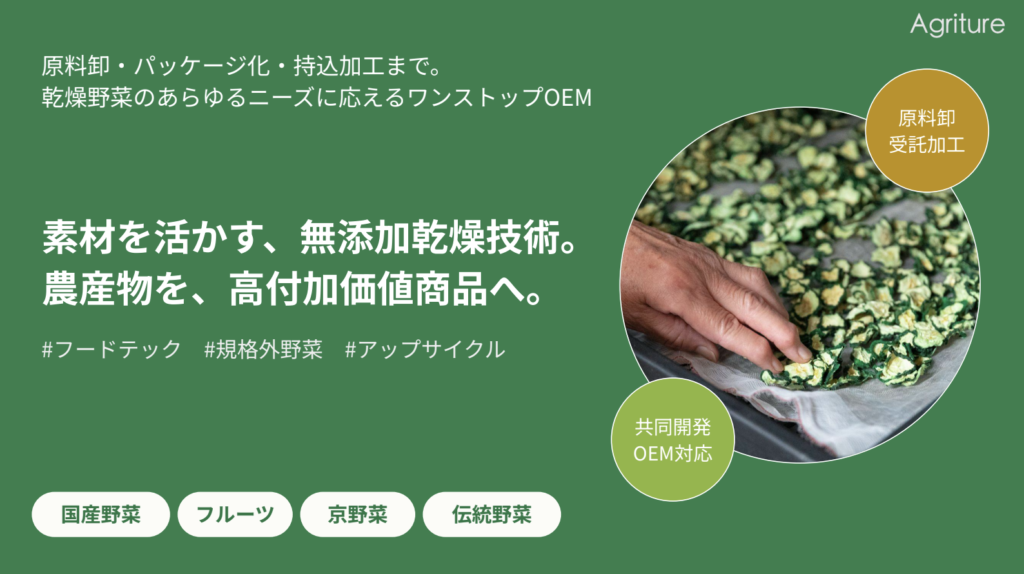
- OEM available from small lots of 10 kg
- Drying of brought-in raw materials also possible
- Support from processing to filling in one place
FOR BUSINESS
乾燥いちごを、原料としてお探しですか
国産のいちごを乾燥・粉砕してお出ししています。カット形状や粒度の指定、継続してのお取引もご相談ください。規格は 乾燥いちご に掲載しています。
いちごの少量販売は姉妹ブランドの OYAOYA では取り扱いがありません。ほかの品目はカタログをご覧ください。
FAQ
What kinds of products is the whole-berry type suited to?
It suits products that appeal by appearance, such as cake and tart decoration, chocolate and bonbons, top placement on Japanese confectionery, and gift sweets. It is a shape that pairs especially well with premium confectionery that can command a selling price and gift uses.
I hear whole berries break easily; what are the countermeasures?
The basics are combining aluminum-laminate individual packaging plus oxygen absorber/silica gel, outer packaging with cushioning, and partitioned trays. For handling, too, use sanitary gloves or tweezers, and it is safe to place them on cakes just before serving or attach them separately.
What are the cautions when selling them placed on cakes or tarts?
Because touching cream or ganache changes the texture through moisture absorption, placing them just before serving is ideal. For frozen cakes, attaching them separately in individual packaging so frost does not form keeps the texture.
How should I use it differently from other shapes (slice, diced, powder)?
Whole is for appealing by appearance, slice for topping chocolate or granola, diced for kneading into batter, and powder for blending into beverages and cream. For details, Sliced・diced・Commercial freeze-dried strawberries.
Can I consult about OEM?
Yes. Agriture handles whole freeze-dried Kyotango-grown strawberries in stages from prototype 10-50 kg to mass production 500 kg. You can consult us all the way to individual packaging design for gifts and variety designation. Food OEM no Madoguchi (Agriture) Please consult us.
Summary
Freeze-dried strawberry (whole) is an ingredient that lets you create the face of a product with its three-dimensionality and red color. While it requires packaging design and handling rules against breakage and moisture absorption, it is a shape easy to differentiate in premium confectionery, gifts, and tourist souvenirs. Choose it to match your product's appeal axis while comparing with other shapes.
Related article: Commercial freeze-dried strawberries・diced・Sliced・Minimum lot・Processing cost. For OEM consultations, Food OEM no Madoguchi (Agriture).
Download the OEM contract processing materials
We will send the materials to your email address based on the information you provide.
If you are considering product development with off-spec or your own farm's vegetables:From planning to processing, materials, package printing and novelties, you can consult us through a single point of contact. → Learn more about one-stop product development
- Prevent trade show failures! 8 common failure patterns and countermeasures
- Black Tea OEM Original Blends: Origin and Flavor Design
Author of this article
Related articles
-
 Original coffee marketing strategy | Ways to grow sales
 -
 ベジタリアンとは?国の規格が分けている4つの区分と食べられないもの
 -
 長ねぎと白ねぎは同じもの?ねぎの種類と呼び名を国の資料で確かめる
 -
 柚子の種類は何種類あるのか、公の資料で名前が残る系統を数えた
 -
 柚子の皮の使い道は干すと広がる、果汁と種まで使い切る手順
 -
 ゆずの時期は年に二度、青ゆずは7月から黄ゆずは10月から
 -
 ゆずの産地は高知が半分を占め、二位は徳島から愛媛に変わった
 -
 Preventing Food OEM Failures: Common Failure Cases and Countermeasures for Success