食物繊維が多い食べ物は?野菜・豆・海藻・きのこを多い順に見る

Summary of this article
We ranked foods high in dietary fiber by approximate content, based on the Standard Tables of Food Composition in Japan (Eighth Revised Edition), Supplement 2023. We also include a vegetables-only ranking, why the figures differ between dried and fresh foods, and roughly how much you get when converted to the amount eaten in one serving.
When you hear “high-fiber foods,” vegetables tend to come to mind, but in fact fiber is found widely, all the way to beans, seaweed, mushrooms, grains, tubers, and fruit. Dietary fiber tends to fall short in daily meals, but knowing it by category lets you increase it without strain.
This article introduces high-fiber foods by category, and covers the difference between soluble and insoluble fiber, how to take it when you’re concerned about regularity, and tips for easily supplementing it with dried vegetables. Since the Japanese are said to tend to fall short on fiber, first let’s cover “which foods it’s abundant in.”
Recommended reading
TOC
What Is Dietary Fiber? The Difference Between Soluble and Insoluble
Dietary fiber comes in two types: “the kind that dissolves in water” and “the kind that doesn’t.” Which type is more abundant differs by food, and the point is to take in a good balance of both.
| Type | Features | Foods that contain a lot |
|---|---|---|
| Water-soluble dietary fiber | Dissolves in water into a gel, slowing digestion. The sense of fullness after a meal lasts more easily (pectin, β-glucan, etc.) | Seaweed, fruit, barley, oatmeal |
| Insoluble dietary fiber | Absorbs water and swells, increasing stool bulk and supporting bowel movement (cellulose, etc.) | The outer skins of vegetables, beans, mushrooms, and grains |
Soluble works slowly, insoluble adds bulk—each has a different action. Rather than skewing to just one, combining foods that contain both helps regulate bowel movement and the gut environment. So let’s look, by category, at which foods it’s abundant in.
High-Fiber Foods [by Category]
High-fiber foods aren’t just vegetables. They exist widely across seven categories—beans, seaweed, mushrooms, grains, tubers, and fruit. First let’s check the overall picture in a list.
| Category | Representative foods | Predominant type |
|---|---|---|
| Vegetables | Burdock, broccoli, pumpkin, kiriboshi daikon | Mainly insoluble |
| Beans and soy products | Soybeans, natto, okara, azuki, kidney beans | Mainly insoluble |
| Seaweed | Hijiki, wakame, agar, kombu | Mainly soluble |
| Mushrooms | Kikurage, shiitake, enoki, maitake | Mainly insoluble |
| Grains | Oatmeal, brown rice, whole wheat, mochi barley | Both soluble and insoluble |
| Tubers and konjac | Sweet potato, taro, konjac | A good balance of both |
| Fruit | Dried persimmon, apple, kiwi, avocado | Mainly soluble |
Vegetables
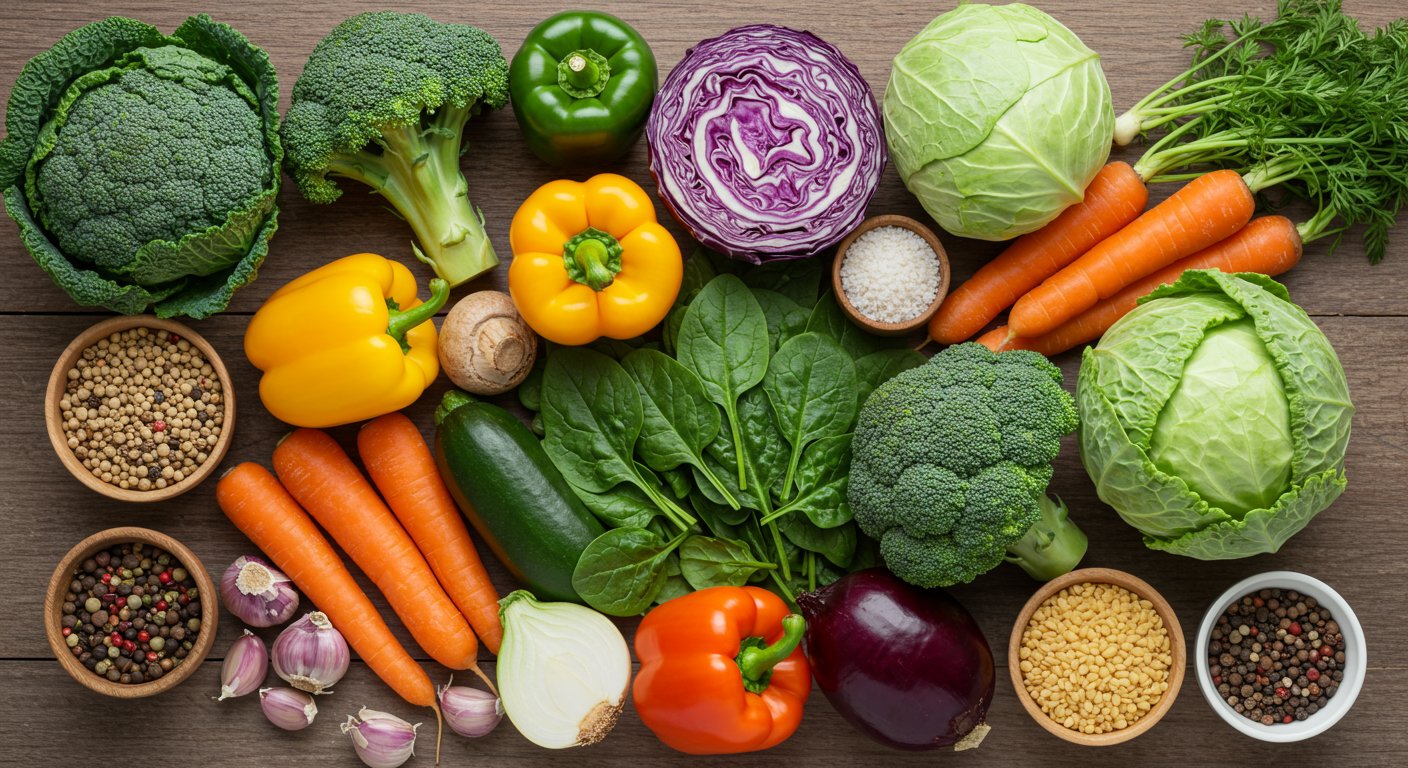
Vegetables are mainly insoluble fiber, a group suited to adding stool bulk. Since it’s abundant near the skin and core, washing them well and using them whole lets you take in more.
- Burdock, broccoli, and pumpkin are rich in it in the skin and core, too
- Carrot, spinach, komatsuna, and cabbage are also easy for everyday use
- The dry good kiriboshi daikon has its moisture removed and is concentrated, so you can take in plenty in a small amount
Beans and soy products
Beans are rich in insoluble fiber, and their strength is being easy to keep on hand. Processed products need no prep.
- Beans themselves such as soybeans, azuki, and kidney beans
- Soy products like natto and okara make a dish on their own
- As simmered beans, a salad topping, or a soup ingredient
Seaweed
Seaweed is mainly soluble fiber, helping correct the balance of a diet that tends to skew toward insoluble.
- Hijiki, wakame, kombu, and agar are representative
- Can be kept on hand as dry goods and used just by rehydrating
- Easy to add to miso soup, simmered dishes, or as a salad side
Mushrooms
Mushrooms are low in calories and suited to adding bulk, letting you supplement fiber well.
- Kikurage, shiitake, enoki, maitake
- Dried kikurage in particular is easy to take fiber from
- In a wide range of dishes—stir-fries, hot pots, soups
Grains
Rethinking your staple can raise your daily baseline intake. Switching from white rice or white bread is efficient.
- Oatmeal, brown rice, whole-wheat bread, mochi barley
- Oatmeal and barley are also high in soluble fiber
- Just swapping your usual staple keeps it going without strain
Tubers and konjac
Tubers give a satisfying fullness, and konjac is a low-calorie, easy-to-incorporate group.
- Sweet potato and taro can even serve as a staple substitute
- Konjac contains insoluble fiber and is low in calories
- For everyday use in simmered dishes, oden, or roasted sweet potato
Fruit
Fruit is mainly soluble fiber, with the advantage of being easy to work into breakfast or a snack.
- Dried persimmon, apple, kiwi, avocado
- Dried persimmon is concentrated and easy to take in a small amount
- Apple and kiwi are easy for breakfast or dessert
A Ranking of Especially High-Fiber Foods
We ranked "which actually has the most" based on figures from the Standard Tables of Food Composition in Japan. The figures are approximate values per 100 g of edible portion and vary depending on variety, growing region, season, and processing conditions. Treat them not as exact values but as a way to get a sense of relative amounts.
| Rank | Food | Approximate total dietary fiber (g per 100 g edible portion) |
|---|---|---|
| 1 | Aragekikurage wood ear mushroom (dried) | 79.5 |
| 2 | Powdered agar | 79.0 |
| 3 | Wood ear mushroom (dried) | 57.4 |
| 4 | Dried hijiki seaweed (dried) | 51.8 |
| 5 | Dried shiitake mushroom (dried) | 46.7 |
| 6 | Okara soybean pulp (dried) | 43.6 |
| 7 | Toasted nori seaweed | 36.0 |
| 8 | Adzuki beans (whole, dried) | 24.8 |
| 9 | Soybeans (yellow, domestic, dried) | 21.5 |
| 10 | Kiriboshi daikon (dried) | 21.3 |
| 11 | Dried persimmon | 14.0 |
| 12 | Pressed barley (dried) | 12.2 |
| 13 | Figs (dried) | 10.7 |
| 14 | Almonds (dried) | 10.1 |
| 15 | Natto (fermented soybeans) | 9.5 |
| 16 | Oatmeal | 9.4 |
The top of the list is almost entirely dried foods. Because the water has been removed, the same 100 g contains more.
However, this ranking can't be used directly as a priority list for your table. Nobody eats 100 g of dried shiitake, but 100 g of broccoli is a realistic amount. You need to look at per-100 g figures separately from the amounts actually eaten. Approximate per-serving figures are given below.
Ranking vegetables only
This list excludes dried foods and beans and ranks fresh vegetables only. These are also approximate values per 100 g of edible portion.
| Rank | Vegetables (fresh) | Approximate total dietary fiber (g per 100 g edible portion) |
|---|---|---|
| 1 | Molokhia | 5.9 |
| 2 | burdock | 5.7 |
| 3 | Brussels sprouts | 5.5 |
| 4 | broccoli | 5.1 |
| 5 | Edamame | 5.0 |
| 6 | okra | 5.0 |
| 7 | Daikon radish (leaves) | 4.0 |
| 8 | Kabocha squash (Western type) | 3.5 |
| 9 | Shungiku (garland chrysanthemum) | 3.2 |
| 10 | Sweet corn | 3.0 |
| 11 | Kurokawa kanzaki hanana | 2.9 |
| 12 | Carrot (with skin) | 2.8 |
| 13 | Sweet potato (with skin) | 2.8 |
| 14 | Bamboo shoots | 2.8 |
| 15 | Spinach | 2.8 |
| 16 | Eggplant | 2.2 |
| 17 | Lotus root | 2.0 |
| 18 | Komatsuna (Japanese mustard spinach) | 1.9 |
| 19 | Asparagus | 1.8 |
| 20 | cabbage | 1.8 |
| 21 | Onions | 1.5 |
| 22 | Daikon radish (root, with skin) | 1.4 |
| 23 | Napa cabbage | 1.3 |
| 24 | Lettuce | 1.1 |
| 25 | Tomato | 1.0 |
The top vegetables are molokhia, burdock root, Brussels sprouts, broccoli, edamame, and okra. Meanwhile, salad staples like lettuce and tomatoes contain around 1 g, so the numbers don't go up much even if you eat a lot.
How the skin is handled also makes a difference. Sweet potato has 2.8 g with skin and 2.2 g without. Carrot has 2.8 g both with and without skin, so there is no difference. Daikon radish root has 1.4 g, whereas the leaves have 4.0 g, nearly three times as much. The parts that tend to be thrown away sometimes contain more.
How much is in a typical serving?
Per-100 g figures are far removed from the amounts people actually eat. These are approximate figures converted to an ordinary single serving. They vary depending on how the amount is measured, so treat them as a rough guide.
| Food | Approximate serving size | Approximate amount per serving |
|---|---|---|
| broccoli | 3 florets (about 60 g) | About 3.1 g |
| Natto (fermented soybeans) | 1 pack (about 40 g) | About 3.8 g |
| burdock | 1/3 root (about 50 g) | About 2.9 g |
| Oatmeal | 1 serving (about 30 g) | About 2.8 g |
| Dried shiitake mushroom | 2 mushrooms (about 6 g) | About 2.8 g |
| Dried hijiki seaweed (dried) | 2 tablespoons (about 5 g) | About 2.6 g |
| Kiriboshi daikon (dried) | About 10 g | About 2.1 g |
Wood ear mushroom and hijiki, which differed widely per 100 g at 79.5 g and 51.8 g, show a much smaller difference per serving. It's more practical to choose based on what you can keep eating than on rankings.
How to Take Fiber When You’re Concerned About Regularity
With dietary fiber, rather than “the more you eat the better,” a balance of types and ease of keeping it up matter. We’ve organized ways to take it in worth keeping in mind when you’re concerned about regularity or the gut environment.
Take a Good Balance of Soluble and Insoluble
With only insoluble, stool bulk increases, but with too little soluble you may feel bloated instead. Combining vegetables and mushrooms (insoluble) with seaweed, fruit, and oatmeal (soluble) makes it easier to strike a balance. The trick is not to skew to one ingredient but to choose across categories.
Add “One More Dish” at Every Meal, Without Strain
Rather than taking it all at once, adding a little at every meal lasts better. Just adding one dish to your usual meal—wakame or mushrooms to miso soup, beans on a salad, mochi barley rice as the staple—steadily increases it.
Easily with Dried Vegetables or Powder
When you’re too busy to prepare fresh ingredients, dried vegetables and vegetable powder are handy. Dried vegetables keep long and take little cooking effort—just add them to miso soup or soup to supplement vegetables. Vegetable powder can be used just by mixing it into soup, dressing, or pasta sauce, so it also suits those who eat out often or can’t make time to cook.
Even in our work with dried vegetables at Agriture, we feel that ease of keeping it up matters most. Adding a handful of dried vegetables to miso soup, mixing powder into soup—the less cooking effort involved, the more it becomes a habit, and it ends up being the best shortcut after all.
Supplement It Easily with Dried Vegetables and Kiriboshi Daikon
Among high-fiber foods, dried types have two advantages: “concentrated and easy to take in a small amount” and “keep well.” Kiriboshi daikon, dried mushrooms, and dried-vegetable mixes are options that make it easy to work fiber into busy days.
For reference, when our dried vegetable mix (carrot, tomato, komatsuna, mizuna, and spinach) was measured by an analytical laboratory, total dietary fiber was about 20 g per 100 g (tested by Japan Food Research Laboratories). If you use 5 g per serving, that works out to roughly 1 g.
Figures for dried products change with the raw material blend and the moisture content of the finished product, so this is also approximate. It varies by lot and product.
Agriture makes dried vegetables and powder centered on Kyoto-grown vegetables. The relationship between dried vegetables and dietary fiber is covered in The relationship between dried vegetables and dietary fiber, and the benefits of dried vegetables in The 5 Benefits of Dried Vegetables. The use of vegetable powder is in Sustainable Recipes and Uses.

Summary: Learn High-Fiber Foods by Category
High-fiber foods are found widely—not just vegetables but beans, seaweed, mushrooms, grains, tubers, and fruit. Taking a good balance of soluble and insoluble, and keeping it up with one more dish at every meal, is the trick to getting it without strain.
Dry goods in particular—dried kikurage, hijiki, kiriboshi daikon, and dried persimmon—are foods where the fiber is concentrated and easy to take in even in small amounts. When fresh ingredients are hard to prepare, making use of dried vegetables and vegetable powder is an easy method, too. Starting today, try working in one item at a time, across categories.
FAQ
Sources of figures
The figures in this article are approximate values based on per-100 g edible portion values listed in the Standard Tables of Food Composition in Japan (Eighth Revised Edition), Supplement 2023 (Ministry of Education, Culture, Sports, Science and Technology). Per-serving figures are reference values converted from approximate serving sizes and vary depending on actual amounts, varieties, and cooking methods.
Values for our products are reference values based on analysis results from Japan Food Research Laboratories. They vary depending on the raw material blend and moisture content.