
Peace of mind even for first-time food OEM! Tips for choosing a manufacturer and ordering without going wrong

Summary of this article
As five points for choosing a manufacturer for your first food OEM, we explain lot quantity and flexibility, producible items, strengths in raw materials and production methods, responsiveness to taste and appearance, and a development stance aligned with trends. We also introduce the flow from information gathering through prototyping, ordering, and delivery, the characteristics of categories that are easy to handle in small lots—such as dried vegetables, dried fruit, and protein products—and the needs of the era such as vegan and SDGs responsiveness.
Food OEM This is a system in which, without owning your own factory, you outsource manufacturing to a specialist maker and create original-brand products. With the expansion of online retail and D2C business, it is used broadly, from sole proprietors to major companies.
However, there are not a few cases where choosing an OEM maker poorly leads to cost overruns or quality troubles. This article compiles information useful in practice—from the basics of food OEM to five points to check when choosing a maker, the flow of a request, cost guidelines, and points to note.
TOC
What is food OEM? A system for outsourcing the manufacture of your own brand products
OEM stands for “Original Equipment Manufacturer,” a system in which you have your own brand's products manufactured using another company's production facilities. It is a very common approach in the food industry, and many of the PB (private brand) products lined up in supermarkets and convenience stores are also made this way.
Recently, its use has advanced in online-retail-only brands and D2C businesses as well, and cases of sole proprietors and small businesses entering the market are increasing.
| Merits of food OEM | Examples |
|---|---|
| You can keep initial investment down | No factory construction or equipment investment needed. In some cases you can start product development from several hundred thousand yen |
| You can start from small lots | Some makers handle orders in units of 100, so you can expand in stages from test sales |
| You can leverage specialist technology | The maker holds the manufacturing know-how, quality-control system, and licenses |
| You can focus on planning and sales | Leave the manufacturing process to the maker and put resources into marketing and channel development |
Note that ODM (Original Design Manufacturer) is easily confused with OEM. Whereas OEM is “having a maker manufacture a product you planned yourself,” ODM is a form in which “the maker handles even the planning and design.” OEM suits you if you have a product concept in-house; ODM suits you if you want to consult from the planning stage.
Five points for choosing a food OEM maker
To make an OEM succeed, selecting the maker that becomes your partner is essential above all. There are reported cases of quality troubles when choosing by cost alone. Judge comprehensively from the following five perspectives.
1. Lot quantity and flexibility
In the early stage, to keep inventory risk down, a maker that can handle small lots is ideal to choose. In online retail, a cycle of starting from small quantities and moving to product improvement or increased production while watching sales is important. Since the minimum lot ranges from 100 to 1,000 units depending on the maker, please confirm in advance.
2. Producible items and track record
Check whether the maker handles the genre you want to develop—dried fruit, dried vegetables, seasonings, granola, health foods, supplements, and so on. The broader a company's manufacturing categories, the more likely it can flexibly respond to your development ideas.
Past manufacturing track record and clients' industries are also material for judgment. A maker that has handled many products in the same category makes it easier to receive concrete proposals on raw-material sourcing and the optimal production method.
3. Strengths in raw materials and production methods
In product development, “differentiation” is the key. For example, an OEM partner with elements that differentiate it from others—such as Kyoto heirloom vegetables, organic ingredients, or allergen-free production methods—gives you an edge on the branding side as well.
Agriture partners directly with Kyoto farmers to manufacture dried vegetables and dried fruit that make use of off-grade vegetables. Traceability that can go back to the raw material's growing region and cultivation method is also one element that increases a product's credibility.
4. Quality control and the factory's hygiene system
Since food is something that goes into the mouth, the hygiene management system is a point that cannot be compromised. Check in advance—via factory tours or documents—whether the maker is HACCP-compliant, its measures to prevent foreign-matter contamination, and its temperature-management mechanisms.
Also, the ability to handle nutrition labeling and allergy labeling based on the Food Labeling Act is essential. Since labeling errors directly lead to recall risk, whether you can receive support in creating labels is also material for the selection decision.
5. Proposal ability and responsiveness to trends
Consumer interest is expanding toward “health,” “sustainable,” “additive-free,” and “Vegan」「SDGs.” Whether the OEM partner actively proposes product development responsive to such currents also affects future growth potential. Food OEM market trends in 2026.
| Selection point | What to check | Example risk |
|---|---|---|
| Lot quantity | Minimum lot and response speed for increased production | Holding large inventory worsens cash flow |
| Items and track record | Supported genres and past transaction record | Insufficient know-how leads to repeated re-do of prototypes |
| Raw materials and production methods | Differentiating materials and whether there are production-method patents | Becoming the same product as competitors and getting caught in price competition |
| Quality control | HACCP compliance and labeling support | Recall or administrative guidance due to labeling errors |
| Proposal ability | Trend proposals and prototyping speed | Unable to respond to market changes and the product becomes outdated |
The flow of a food OEM from request to delivery
It differs somewhat by maker, but the general food OEM flow is the following six steps.
| Step | Details | Guideline period |
|---|---|---|
| 1. Information gathering and inquiry | List up candidates from OEM makers' websites and trade shows, and make inquiries | 1–2 weeks |
| 2. Interview and meeting | Share the product concept, target, and budget. Also confirm licensing | 1–2 weeks |
| 3. Creating and evaluating prototypes | Recipe development and prototyping. Check taste, texture, and appearance, and repeat feedback | 2–4 weeks |
| 4. Finalizing quote, lot, and schedule | Finalize the final specification, unit price, and delivery date. Package design also at this stage | 1–2 weeks |
| 5. Main order and manufacturing | After ordering, completion goes through the processes of raw-material sourcing → manufacturing → inspection | 3 to 6 weeks |
| 6. Delivery and sales launch | Delivery after inspection is complete. Do not forget the final check of nutrition labeling and allergy labeling | – |
For a first time, about two to four months from inquiry to delivery is typical. From the second time on, because the recipe is finalized, delivery within one to two months of ordering is often possible.
Costs and points to note for food OEM
Breakdown of initial costs
The initial cost of a food OEM differs greatly by product category and lot quantity. A general breakdown is as follows.
| Cost item | Guideline | Notes |
|---|---|---|
| Prototyping cost | 10,000 to 50,000 yen | Recipe development and tasting samples. Varies with the number of rounds |
| Manufacturing cost (raw materials + processing) | Varies by lot | The smaller the lot, the higher the unit price tends to be |
| Package cost | 50,000 to 300,000 yen | Design, printing, and material costs. Low cost with ready-made pouches |
| Nutritional analysis | 10,000 to 30,000 yen per item | Testing based on the Food Labeling Act |
| Delivery and shipping cost | Actual cost | Varies by lot and destination |
In total, 200,000 to 500,000 yen is one guideline for a small lot (about 100 to 300 units). However, choosing a maker by “cheapness” alone can lead to regret on the quality side. Keep the balance of cost and quality in mind.
Three points to note to avoid failure
- Checking the contract: confirm in advance the minimum-order-quantity commitment, cancellation conditions, and the attribution of intellectual property (rights to the recipe). Verbal-only arrangements are a cause of trouble
- Checking food labeling: nutrition labeling, allergy labeling, the order of listing raw materials, and so on are set by law. Rather than leaving it to the maker, build a system to double-check on your side as well
- Obtaining the necessary licenses: depending on the type of food, a business license or notification is required. Confirm in advance the licenses appropriate to the product you will sell, such as confectionery manufacturing or prepared-food manufacturing
Try starting from a category that is easy to begin with in small lots
Today, food categories excellent in “storability,” “freedom,” and “versatility”—such as dried vegetables and dried fruit—are popular as an entry point for small-lot OEM. In the health-food and supplement fields as well, makers that handle small lots are increasing.
| Category | Features | Minimum lot guideline | Suitable sales channels |
|---|---|---|---|
| Dried vegetables | Storable long-term at room temperature. A wide range of development uses, such as soups, granola, and novelties | From 100 units | E-commerce, gifts, novelties |
| Dried fruit | Higher added value with no added sugar and domestically grown ingredients. Slice, dice, and powder available | From 100 units | E-commerce, confectionery ingredients, cafes |
| Protein products | Demand is expanding with beauty and health orientation. Easy to differentiate with plant-based protein | From 300 units | E-commerce, gyms, subscriptions |
| Stick filling | Powdered soup, aojiru, protein, and the like. Individually wrapped and highly portable | From 500 units | E-commerce, in-store, novelties |
Using Kyoto-grown produce or heirloom vegetables makes differentiation easier and makes it easier to draw consumer interest as a product with a story. How to use dried fruit OEM and Food OEM manufacturing in the Kansai region please also use as a reference.
Frequently asked questions about food OEM
We have materials available to help you understand dried processing OEM
Agriture OEM, flexibly handling everything from small lots to large lots
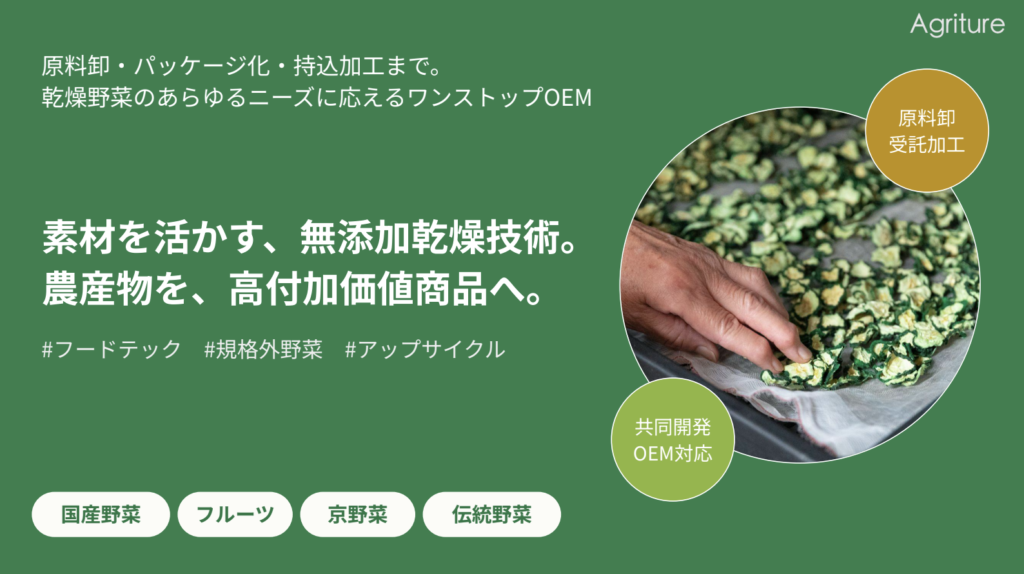
- OEM available from small lots of 10 kg
- Drying of brought-in raw materials also possible
- Support from processing to filling in one place
Using dried vegetables, novelties and promotional goods please feel free to consult us about the planning and manufacturing of.
Summary: Start a business at low risk with food OEM
Food OEM is a practical approach that lets you roll out original products without owning your own production equipment. In choosing a maker, comprehensively evaluating the five points—lot quantity, items, raw materials, quality control, and proposal ability—is the key to success.
If you are thinking “I don't know where to start” or “I want to test-sell in a small lot,” we recommend first consulting an OEM maker. Use the option of food OEM as a first step to give shape to your idea.

Download the OEM contract processing materials
We will send the materials to your email address based on the information you provide.
If you are considering product development with off-spec or your own farm's vegetables:From planning to processing, materials, package printing and novelties, you can consult us through a single point of contact. → Learn more about one-stop product development
FOR BUSINESS
乾燥野菜のOEM・受託加工を承ります
国産の野菜・果物の乾燥、100メッシュ相当までの粉砕、10g以上の小袋充填までをお受けしています。小ロットの試作から量産までご相談ください。寄せられた相談の実例は OEM・卸のご相談 に掲載しています。
乾燥品の賞味期限は、出荷日から6ヶ月程度を目安にご案内しています。
- Seven points to avoid failure when choosing a domestic dried vegetable manufacturer
- Why dried vegetables and dried fruit suit OEM for sole proprietors: introducing small-lot cases and points of success
Author of this article
Related articles
-
 Food industry trade show trends 2025 | The latest developments to keep in mind
 -
 A guide to preparing for a trade show | Schedule, costs, and checklist
 -
 Prevent trade show failures! 8 common failure patterns and countermeasures
 -
 Kyoto-style food development | Gift-oriented product development OEM using Kyoto vegetables
 -
 Creating a regional brand with a Kyoto-vegetable OEM | The complete flow from planning to sales
 -
 Kyoto ingredient processing OEM | How to make the most of Kyoto vegetables and quality control
 -
 How to source commercial vegetable powder in small lots, and how to use it
 -
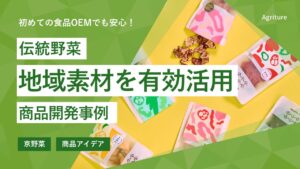 Heirloom vegetable OEM | A commercialization case guide using Kyoto vegetables and local ingredients