
What are Aomori’s heirloom vegetables? Features, season, and ways to eat the 11 items explained

TOC
The definition of "heirloom vegetable" and the scope of this article
There is no nationwide unified definition of “heirloom vegetables,” and criteria differ by certifying body. To help you accurately understand this article's content, we first lay out the criteria of the main certifying bodies.
| Certifying body | Main criteria |
|---|---|
| Kyoto Prefecture "Kyoto Heirloom Vegetables" | Cultivated in Kyoto from before the Meiji era and unique to Kyoto |
| Osaka Prefecture "Naniwa Heirloom Vegetables" | Cultivated within Osaka Prefecture from roughly 100 or more years ago |
| Nara Prefecture "Yamato Heirloom Vegetables" | A variety with a cultivation history of more than 40 years |
| Akita Prefecture "Akita Heirloom Vegetables" | Cultivated within the prefecture from before the Showa 30s |
| Yamagata Prefecture "Yamagata Heirloom Vegetables" | Cultivated within the prefecture from before Showa 20 |
| The Japan Traditional Vegetable Promotion Association | Independent certification criteria (broader) |
In this article, we introduce 11 items with certification by the Japan Heirloom Vegetable Promotion Association as the main source. However, varieties bred and registered after the war, and items that don't readily fall within the strict category of "vegetable" — such as fruits, aquatic plants, and wild mountain vegetables — are organized separately in the "Other local specialty varieties" section at the end of the article.
What are Aomori's heirloom vegetables? Native varieties nurtured by two landscapes — Tsugaru and Nanbu
Aomori Prefecture sits at the northern tip of Honshu, with varied topography stretching from the Tsugaru Strait to the Hakkoda mountain range and the Nanbu plain on the Pacific side. Within this broad prefecture exist two distinct food-culture zones — "Tsugaru" and "Nanbu" — rooted in the feudal-domain divisions of the Edo period, and native vegetables that took root in each land have been handed down.
The heirloom vegetables of Aomori Prefecture certified by the Japan Heirloom Vegetable Promotion Association currently number 11 items. From the edible chrysanthemum "Abokyu" and the chili pepper "Shimizumori Nanba" to "Owani Onsen bean sprouts" grown using hot-spring heat, they include distinctive varieties found in no other prefecture. This article organizes the 11 items in a list and explains 7 representative items in detail.
The Tsugaru and Nanbu domains — how differing food cultures preserved native varieties
Until the Meiji Restoration, Aomori Prefecture was divided into the western Tsugaru domain (Hirosaki domain) and the eastern Nanbu domain. Against the backdrop of the Tsugaru domain's warm, Sea-of-Japan-side climate and rice culture, it developed field crops such as chili peppers and edamame, while the Nanbu domain, amid the cool Pacific-side yamase climate, has a history of raising cold-resistant items such as edible chrysanthemums and green onions.
Comparing Tsugaru and Nanbu
| Category | Tsugaru area (Hirosaki, Goshogawara) | Nanbu area (Hachinohe, Sannohe) |
|---|---|---|
| Climate | Sea-of-Japan side, heavy snow in winter | Pacific side, influenced by yamase |
| Representative items | Shimizumori Nanba, kemame, Ichomachida seri | Abokyu, Nukazuka cucumber, Nanbu futo-negi |
| Food culture | Tsugaru miso and pickling culture | Chrysanthemum dishes and root-vegetable preserved foods |
In this way, the domain boundary became the food-culture boundary itself, and native varieties suited to each landscape were preserved independently — this is a distinctive feature of Aomori. In contrast to Kyoto's Kyoto vegetables, which developed out of aristocratic culture, Heirloom vegetables of Aomori have been maintained within farmers' own seed-saving and local eating habits.
The relationship between cold-region preserved-food culture and heirloom vegetables
| Preservation technique | Available items |
|---|---|
| Sun-drying (dried chrysanthemum) | Aboukyu |
| Year-round cultivation with hot-spring heat | Owani Onsen bean sprouts |
| Sweet-vinegar pickling / nuka pickling | Zaruishi turnip, Tsutsui red turnip |
| Issho-zuke / freezing | Shimizumori Nanba |
| Salt-boiled and frozen | Kemame |
| Pickle processing | Nukazuka cucumber |
Located at the northern tip of Honshu, securing food for winter has always been the foremost challenge. Steaming and drying autumn-harvested chrysanthemums into "dried chrysanthemum," winter bean-sprout cultivation using hot-spring heat, turnip pickles — these preservation and processing techniques have become the motivation for passing heirloom-vegetable varieties on to the next generation.
Agriture, too, handles the drying and processing of domestically grown vegetables, and has an affinity for techniques that raise the storability of heirloom vegetables. From our experience of low-temperature drying and processing Kyoto's heirloom vegetables such as Kujo green onion and Shogoin daikon, we can see that cold-region native varieties include many items well suited to drying and freezing — Abokyu's dried chrysanthemum, kemame's salt-boiled freezing, and Nukazuka cucumber's pickles being prime examples.
The "Aomori Shokumeijin" program and local-production-for-local-consumption efforts
- Shokumeijin certification program: the prefecture certifies chefs and producers who spread the appeal of local ingredients
- Recipe development: devising and popularizing new menu items using heirloom vegetables
- Food-education events: holding events where people can experience native varieties across the prefecture
- Farm stands and hometown tax donations: expanding sales channels beyond the prefecture to increase points of contact with consumers
Aomori Prefecture has established the "Aomori Shokumeijin" program, certifying chefs and producers who spread the appeal of local ingredients. Through this program, recipe development and food-education events using heirloom vegetables are held across the prefecture, and opportunities for consumers to encounter native varieties are on an increasing trend (reference: Aomori Prefectural Government, "Aomori's Vegetables")。
To sustainably preserve heirloom vegetables whose production is limited, efforts to increase the number of people who eat them are essential. In addition to the prefecture's measures, expanding sales channels beyond the prefecture through farm stands and hometown tax donations is also advancing.
FOR BUSINESS
乾燥野菜を業務用でお探しですか
国産の野菜・果物を乾燥し、必要に応じて粉砕してお出ししています。扱っている品目は100種前後で、規格は 乾燥品の一覧・パウダーの一覧 に掲載しています。
少量でのご購入は、姉妹ブランドの通販サイト OYAOYA で承っています。
A full list of Aomori's 11 heirloom vegetables and a seasonal calendar
The heirloom vegetables of Aomori Prefecture certified by the Japan Heirloom Vegetable Promotion Association number 11 items (reference: The Japan Traditional Vegetable Promotion Association). First check all the items in a list, then organize the harvest seasons in a month-by-month seasonal calendar.
11-item quick-reference table
| # | Item name | Category | Main growing region | Season | One-Line Feature |
|---|---|---|---|---|---|
| 1 | Abokyu | Edible chrysanthemum | Hachinohe to Sannohe | Late October–early November | A yellow chrysanthemum with no bitterness. Introduced from Kyoto by the Nanbu domain lord in the Edo period |
| 2 | Ichomachida seri | Sannai seri | Ichomachida, Hirosaki City | Late November | Strong aroma and crisp texture. Over 400 years of cultivation history |
| 3 | Okoppe-imo | Potato | Okoppe, Oma Town | Autumn–winter | A native potato of the Okoppe district of Oma Town. Fluffy and floury. Introduced from America in 1905 |
| 4 | Ganku-mijika | Yam | Tohoku Town to Towada City | Late autumn / spring | A yam with a short neck and strong stickiness |
| 5 | Kemame | Edamame | Tsugaru region | Mid-September–early October | A large-grained edamame covered in brown fuzz. A chestnut-like sweetness |
| 6 | Owani Onsen bean sprouts | Bean sprouts | Owani Town | Year-round | The raw material is the native soybean "Kohachi-mame." 40cm long. Grown for over 350 years using hot-spring heat |
| 7 | Zaruishi turnip | Turnip | Tsutsui to Inakadate Village | November | A pink red turnip |
| 8 | Shimizumori Nanba | Chili pepper | Shimizumori, Hirosaki City | August–October | Mild pungency and high sugar. Revived from a single growing farmer |
| 9 | Nanbu futo-negi | Negi | Nanbu Town | Late October–November | 1.5 times the sugar of ordinary green onions. A rare variety in the midst of revival |
| 10 | Tsutsui red turnip | Turnip | Tsutsui, Aomori City | Late October–early November | A round turnip of deep crimson |
| 11 | Nukazuka cucumber | Cucumber | Hachinohe to Shichinohe | July–August | A Siberian-type black-warted cucumber. 5cm thick |
Seasonal calendar (month-by-month table)
| Item | July | August | September | October | November | Year-round |
|---|---|---|---|---|---|---|
| Nukazuka cucumber | ● | ● | ||||
| Shimizumori Nanba | ● | ● | ● | |||
| Kemame | ● | ● | ||||
| Aboukyu | ● | ● | ||||
| Tsutsui red turnip | ● | ● | ||||
| Nanbu futo-negi | ● | ● | ||||
| Zaruishi turnip | ● | |||||
| Ichomachida seri | ● | |||||
| Okoppe-imo | ● | ● | ||||
| Ganku-mijika | ● | Spring too | ||||
| Owani Onsen bean sprouts | ● |
Looking at the calendar, Aomori's heirloom vegetables divide broadly into a "summer-harvest type"and and an "autumn-winter-concentrated type."The summer-harvest type comprises two items — Nukazuka cucumber (July–August) and Shimizumori Nanba (August–October) — both cool-climate varieties of the Siberian and nanban types. The remaining 9 items have their season concentrated in October–November, harvested and processed into pickles and dried chrysanthemum before the snow falls — directly tied to a food culture unique to cold regions. The sole exception is Owani Onsen bean sprouts, whose year-round cultivation using hot-spring heat is a singular trait found in no other heirloom vegetable.
A product catalog that shows around 100 items we handle
Agriture, flexibly handling everything from small lots to large lots
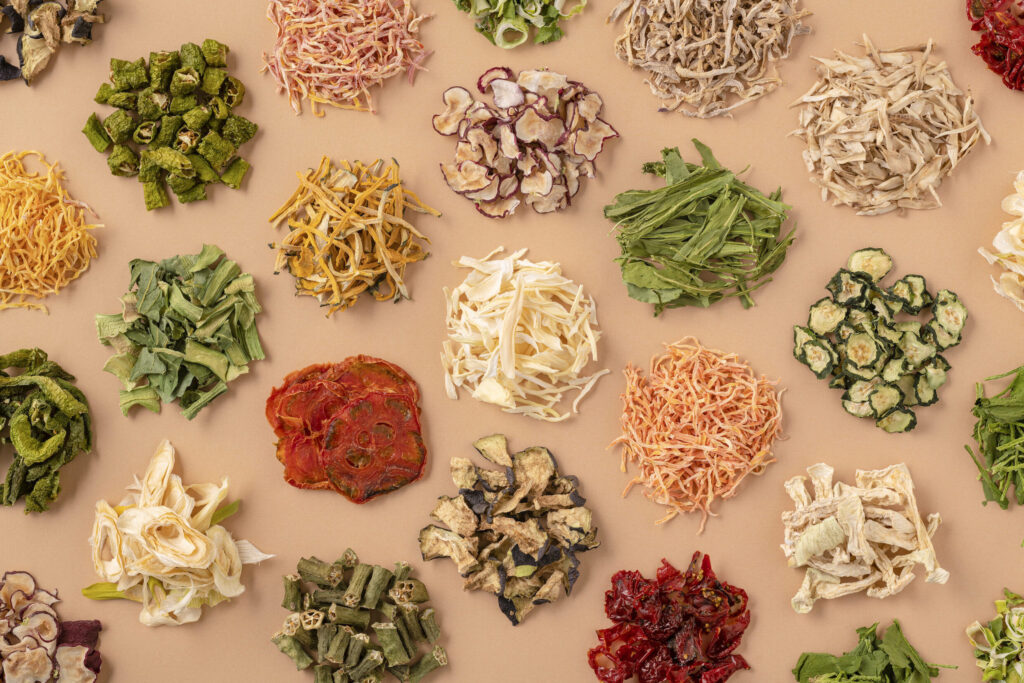
- Available for purchase in small lots from 1 kg
- We handle heirloom vegetables from across Japan
- Dried fruit and herbs also supported
The features and ways to eat 7 representative Aomori heirloom vegetables
Among the 11 items, we take up 7 with the greatest production, name recognition, and influence on food culture. While organizing each item's season, growing region, and suited dishes in a mini-table, we also dig into the history and cultivation-method features behind them.
Shimizumori Nanba — the mild chili pepper that was revived
| Item | Details |
|---|---|
| Season | August–October |
| Main growing region | Shimizumori, Hirosaki City |
| Well-suited dishes | Miso-pickled, tempura, issho-zuke, pasta |
Shimizumori Nanba is a native chili pepper that has been cultivated in the Shimizumori district of Hirosaki City. Its greatest feature is that, compared with the common taka-no-tsume, it's mild in heat and, being high in sugar, you can even taste sweetness biting into it raw. Locally, it's cherished as an ingredient for "issho-zuke," made by combining it with miso and koji.
At one point the number of growing farmers had dwindled to just one, but through the activities of a preservation society it has recovered to more than 75 households (for details, see the "Revival Story" below). In terms of cooking, since the Edo period it has drawn attention from the 2010s for how readily it lends itself to Western food, too — eaten raw dipped in miso, made into tempura, or used to add heat to pasta (reference: Mynavi Agriculture)。
Owani Onsen bean sprouts — 350 years of hot-spring cultivation
| Item | Details |
|---|---|
| Season | Year-round (thanks to hot-spring cultivation) |
| Main growing region | Owani Town, Minamitsugaru District |
| Well-suited dishes | Hot pot, stir-fry, ohitashi, miso soup |
Owani Onsen bean sprouts are "hot-spring bean sprouts" that have been cultivated for more than 350 years using the hot-spring heat of Owani Town. The raw material is a native soybean variety called "Kohachi-mame." A different thing entirely from ordinary supermarket bean sprouts, they grow to about 40cm long, with a rich bean flavor lingering from root to stem.
Cultivation uses a unique method of drawing hot-spring water into the soil, allowing stable production even in the dead of winter. However, because it's labor-intensive, producers are limited, and buying them at a farm stand or roadside station in Owani Town is the sure route. With their crisp texture and the umami of the bean, adding them to a hot pot lets them soak up the broth and make their presence felt.
Kemame — Tsugaru's taste of autumn
| Item | Details |
|---|---|
| Season | Mid-September–early October |
| Main growing region | Throughout the Tsugaru region |
| Well-suited dishes | Salt-boiled, zunda mochi, takikomi gohan, smoked |
Kemame is a large-grained edamame whose pod surface is covered in brown fuzz. A native variety cultivated for home consumption in the Tsugaru region since the Edo period, it has larger grains than common edamame, spreading a sweetness and richness close to chestnut across the palate.
Its season runs from mid-September to early October, harvested later than common edamame. Salt-boiled as a beer snack is the standard, but making it into a paste for zunda mochi is the Tsugaru way. Being a variety high in fat with a rich flavor, it has the advantage that its flavor doesn't fade easily even when smoked.
Abokyu — an edible chrysanthemum conveyed from the capital
| Item | Details |
|---|---|
| Season | Late October–early November |
| Main growing region | Hachinohe City to Sannohe District |
| Well-suited dishes | Ohitashi, sunomono, dried chrysanthemum, tempura |
Abokyu is a yellow edible chrysanthemum with thick petals and no bitterness. Said to have been brought from Kyoto by the Nanbu domain lord in the Edo period, it took root in the Nanbu region from Hachinohe to Sannohe. Come late October, its harvest season, it's an ingredient so rooted in daily life that it appears in local supermarkets too.
The basic way to eat it is to pluck the petals, blanch them briefly in boiling water, and make sunomono or ohitashi. As a preserved food, the traditional "dried chrysanthemum" — steamed petals dried in the sun — can be rehydrated and used in winter soups and simmered dishes. Heirloom vegetables of Hokkaido Even compared with, the culture of eating edible chrysanthemum as an everyday food is a distinctive trait unique to Aomori.
Nukazuka cucumber — a Siberian type from the Edo period
| Item | Details |
|---|---|
| Season | July–August |
| Main growing region | Hachinohe City to Shichinohe Town |
| Well-suited dishes | Hiyajiru, pickles, salad, eaten whole with miso |
Nukazuka cucumber is a cucumber characterized by a squat shape about 20cm long and 5cm thick. Classified as a Siberian-type "black-warted cucumber," it has black protrusions (warts) on the surface. Cultivated around Hachinohe since the Edo period, its production plummeted for a time, pushed out by the spread of common varieties.
High in moisture with a refreshing bitterness, the local way is to eat it whole, skin and all, dipped in miso. Being thick-fleshed, it keeps its bite even when pickled, and pairs superbly with light pickles and nuka pickles. At Agriture, we dry and process old-fashioned cucumber varieties grown in Kyotango, and since thick-fleshed varieties like the Nukazuka cucumber develop a distinctive crisp texture when dried and processed, we're paying attention to it as a processing ingredient too.
Nanbu futo-negi — a thick green onion with 1.5 times the sugar
| Item | Details |
|---|---|
| Season | Late October–November |
| Main growing region | Nanbu Town |
| Well-suited dishes | Grilled green onion, hot pot, gratin, sukiyaki |
Nanbu futo-negi is a thick green onion with about 1.5 times the sugar of ordinary green onions. At one point growers plummeted, but it's now on the road to revival thanks to local volunteers (for details, see the "Revival Story" below). Cut the white part into 2cm rounds and grill it, and a sweet juice oozes out from within — the green onion alone makes a dish.
From a medicinal-food perspective, white green onion is classified as "pungent-warm surface-releasing" and is expected to have a warming effect on the body (reference: the relationship between heirloom vegetables and medicinal food). The reason thick green onion has been prized in the Nanbu region, with its harsh winter cold, is said to lie not only in its good flavor but also in the practical aspect of managing physical condition during winter.
Ichomachida seri — 400 years of aroma
| Item | Details |
|---|---|
| Season | Late November |
| Main growing region | Ichomachida, Hirosaki City |
| Well-suited dishes | Kiritanpo hot pot, ohitashi, tempura, zoni |
Ichomachida seri is a native variety of Japanese parsley (seri) that has been cultivated for more than 400 years in the Ichomachida district of Hirosaki City. Compared with the common seri distributed in the market, it has a stronger aroma and a pronounced crisp bite in the stems.
Its season is short — late November — and the harvest is limited, but restaurants in Hirosaki City prize it as a seasonal ingredient. The culture of adding seri to Akita's kiritanpo hot pot is common across all of Tohoku, but using Ichomachida seri makes the aroma stand out in a different league. Since the roots are edible too, do try deep-frying the roots plain and sprinkling them with salt.
Regional character — the heirloom vegetables of Tsugaru and Nanbu
Aomori Prefecture's heirloom vegetables can be organized into two areas —Tsugaru (west) and Nanbu (east) — carrying on the feudal-era divisions. The climate, history, and food culture of each are reflected in the heirloom-vegetable lineup, and even comparing heirloom vegetables across the country, having this many diverse food-culture zones within a single prefecture is a rare case.
Tsugaru area
- Shimizumori Nanba (Hirosaki City): the heart of chili-pepper culture. Combined use with miso and koji is deeply rooted
- Kemame (throughout the Tsugaru region): autumn edamame culture. With seed-saving, the flavor differs from house to house
- Ichomachida seri (Hirosaki City): an aromatic vegetable indispensable to Tsugaru's winter table
- Owani Onsen bean sprouts (Owani Town): year-round cultivation using hot-spring heat. The crystallization of Tsugaru wisdom
The Tsugaru area is characterized by moist air from the Sea of Japan and heavy snow, and a preserved-food culture developed for getting through winter. Shimizumori Nanba's issho-zuke and kemame's zunda processing are ways of eating born from the wisdom of raising storability.
Nanbu area
- Aboukyu (Hachinohe to Sannohe): the representative of edible-chrysanthemum culture. Processed into dried chrysanthemum as a winter staple
- Nukazuka cucumber (Hachinohe to Shichinohe): a Siberian-type native variety. Thick and full-fleshed
- Nanbu futo-negi (Nanbu Town): a rare green onion in the midst of revival
- Zaruishi turnip (Tsutsui to Inakadate Village): a pink turnip for pickling
- Tsutsui red turnip (Tsutsui, Aomori City): a round turnip of deep crimson
- Okoppe-imo (Okoppe, Oma Town): a native potato introduced from America in 1905. Fluffy and floury
- Ganku-mijika (Tohoku Town to Towada City): a highly sticky native yam. A specialty of the Kami-Sanhachi area
The Nanbu area is prone to the influence of yamase (the cold wind from the Pacific), and many root vegetables and green onions suited to the cool climate are found. The culture of eating edible chrysanthemum is shared with Yamagata Prefecture too, but the point that it has continued to protect the distinctive variety Abokyu is the Nanbu region's own originality. Heirloom vegetables of Naniwa and Yamato heirloom vegetables In contrast to the warm-region variety composition seen in, the lineup here features cold-hardy items.
The Nanbu area further includes "Okoppe-imo," a native potato from the Okoppe district of Oma Town, and "ganku-mijika," a highly sticky native yam cultivated in the Kami-Sanhachi area (Tohoku Town to Towada City). Okoppe-imo has an older history than the Danshaku potato, and its floury, fluffy texture resists falling apart when simmered. Locally it's used in kofuki-imo and as a miso-soup ingredient, and offerings at restaurants are increasing.
How to buy Aomori's heirloom vegetables and tips for storing them
Because heirloom vegetables have limited production, chances of seeing them at ordinary supermarkets are slim. We've compiled methods for obtaining them reliably, and storage methods for enjoying short-season items over a longer period.
Farm stands and roadside stations within the prefecture
| Facility | Area | Items easy to obtain |
|---|---|---|
| Roadside station Inakadate "Yayoi no Sato" | Inakadate Village | Zaruishi turnip, Tsutsui red turnip |
| Owani Town, Wani come | Owani Town | Owani Onsen bean sprouts |
| Hirosaki City agricultural-products farm stand "Noichiri" | Hirosaki City | Shimizumori Nanba, kemame, Ichomachida seri |
| Hachinohe Tatehana Wharf morning market | Hachinohe City | Abokyu / Nukazuka cucumber |
| Roadside station Yokohama "Nanohana Plaza" | Yokohama Town | Ganku-mijika / seasonal vegetables |
Visiting the growing region in season is the most reliable method. In particular, the Hachinohe Tatehana Wharf morning market is one of Japan's largest morning markets, with Nukazuka cucumbers in July–August and Abokyu in October–November.
Mail order beyond the prefecture
- Hometown tax donation: some municipalities — Hirosaki City, Owani Town, and Nanbu Town — offer Shimizumori Nanba processed goods and hot-spring bean-sprout sets as return gifts
- JA-operated online shops: JA Tsugaru Mirai, JA Yuki Aomori, and others sometimes hold limited-period sales during the season
- Individual farmers' EC: for kemame and Shimizumori Nanba, cases of individual farmers selling directly on BASE and Pocket Marché are also increasing
That said, because heirloom vegetables have small harvests, mail order is mostly by reservation or in limited quantities. We recommend gathering information one to two months before the season and applying the moment reservations open.
Storage methods (dried chrysanthemum, freezing, etc.)
Storage methods by item
| Item | Storage method | Storage period guide |
|---|---|---|
| Aboukyu | Steamed and then sun-dried (dried chrysanthemum) | Half a year to a year |
| Shimizumori Nanba | Issho-zuke processing / freezing | Issho-zuke: more than six months / frozen: 3 months |
| Kemame | Frozen after salt-boiling | 2 to 3 months frozen |
| Nukazuka cucumber | Pickle processing / salt-massaged, wrung out, then frozen | Pickles: 1 to 2 months / frozen: 1 month |
| Tsutsui red turnip / zaruishi turnip | Sweet-vinegar pickling / nuka pickling | 1 to 2 months |
| Owani Onsen bean sprouts | Refrigerated (consume early) | 3 to 4 days refrigerated |
The approach of "processing to raise storability" suits the storage of heirloom vegetables. Abokyu's dried chrysanthemum is a prime example — drying concentrates the umami, and rehydrating it in water lets you use it in cooking anytime. With the low-temperature drying technique Agriture handles, processing that enables long-term storage without spoiling the vegetable's flavor is possible, and the combination of heirloom vegetables and drying is a well-matched field.
A product catalog that shows around 100 items we handle
Agriture, flexibly handling everything from small lots to large lots
- Available for purchase in small lots from 1 kg
- We handle heirloom vegetables from across Japan
- Dried fruit and herbs also supported
Aomori heirloom vegetables revived from the brink of extinction
Heirloom vegetables go extinct once the "people who protect the seeds" are gone. In Aomori too, farmers giving up cultivation one after another due to aging and lack of successors has led to multiple cases of varieties facing a survival crisis. Here we introduce 3 items with revival stories.
Shimizumori Nanba — from 1 growing farmer to 75 households
| Year | Event |
|---|---|
| 2003 | Growing farmers dwindled to just one. A crisis of variety extinction |
| 2004 | The Hirosaki Native Chili Pepper Study Group (now the preservation society) was founded. Began preserving seed and recording cultivation techniques |
| 2005– | Free distribution of seedlings and cultivation workshops held every year |
| Present | As of 2020, 61 households were cultivating it. Issho-zuke and nanban miso have been branded |
The key to the revival was branding as processed goods, such as "issho-zuke" and "nanban miso." By expanding sales channels for processed goods, not just fresh, an economic motivation for cultivation arose. Lowering the barrier to entry with free seedling distribution was also a factor in the rapid increase of growing farmers (reference: Hyponex "Heirloom Vegetable Column")。
Nanbu futo-negi — revived from the last single grower
| Year | Event |
|---|---|
| 1964 (Showa 39) | Seed registration. Widely cultivated around Nanbu Town |
| 2000s | Growers plummeted due to its unsuitability for mass production — its thickness and long cultivation period. Down to the last one |
| 2010s– | A volunteer group in Nanbu Town set about the revival. Raising awareness in partnership with local restaurants |
| Present | On the road to revival. Quality — 1.5 times the sugar of ordinary green onions — is a tailwind |
The driving force of the revival is the good flavor itself. Its quality — 1.5 times the sugar of ordinary green onions — led to inquiries from the restaurant side, becoming an economic reason to resume cultivation. With local restaurants putting it on their menus, consumer awareness is rising too.
Nukazuka cucumber — the challenge of the production heritage society
| Timing | Event |
|---|---|
| Edo period | Cultivation began around Hachinohe as a Siberian-type cucumber |
| Late Showa | Growing farmers declined with the spread of F1 varieties |
| 2014 | The "Nukazuka Cucumber Production Heritage Society" was established |
| Present | Restaurants within Hachinohe City adopted it on their menus as a "summer vegetable," and awareness is spreading |
The Nukazuka cucumber is cultivated with the "Nukazuka Cucumber Production Heritage Society" of Hachinohe City at the center. Because it differs from common cucumbers in both shape and flavor, it was a variety that didn't ride market distribution easily, but with local izakaya and restaurants adopting it on their menus as a "Hachinohe summer vegetable," its awareness has risen.
It's a challenge common to heirloom vegetables nationwide, but a distinctive feature of Aomori's cases is that citizen-led organizations such as "preservation societies" and "heritage societies" have been the driving force of revival. Kyoto's heirloom vegetables In contrast to being protected by government-led brand certification systems, it serves as a reference example of grassroots power saving a variety.
FOR BUSINESS
乾燥野菜を業務用でお探しですか
国産の野菜・果物を乾燥し、必要に応じて粉砕してお出ししています。扱っている品目は100種前後で、規格は 乾燥品の一覧・パウダーの一覧 に掲載しています。
少量でのご購入は、姉妹ブランドの通販サイト OYAOYA で承っています。
FAQ
Summary
Aomori Prefecture's 11 heirloom vegetables are a collection of native varieties nurtured by two food-culture zones — Tsugaru and Nanbu. Owani Onsen bean sprouts, grown for more than 350 years with hot-spring heat; Shimizumori Nanba, revived from a single growing farmer; kemame with its chestnut-like sweetness — all are varieties that could only have been born within that land's landscape and eating habits.
Because most items have their harvest season concentrated in the autumn and winter of October–November, the trick to obtaining them is to visit in season or to make use of processed goods like dried chrysanthemum and issho-zuke. If you've taken an interest in Aomori's heirloom vegetables, do visit the growing region in season and pick them up for yourself at a local farm stand.
References / information sources
- Japan Heirloom Vegetable Promotion Association, "Aomori Prefecture's Heirloom Vegetables"
- Aomori Prefectural Government, Department of Agriculture, Forestry and Fisheries, "Aomori's Vegetables"
- Hyponex Yasai Daijiten, "Heirloom Vegetable Column"
- Mynavi Agriculture, "The Revival Story of Shimizumori Nanba"
- Zairai Tsugaru Shimizumori Nanba Preservation Society official materials
- Nukazuka Cucumber Production Heritage Society official materials
Other regional specialty varieties
Included in the Japan Heirloom Vegetable Promotion Association's list, but bred and registered after the war and thus positioned somewhat differently from "heirloom vegetables" in the strict sense (native varieties from before the war), these items are introduced separately here as "local specialty varieties."
| Item | Category | Growing region | Characteristics and standing |
|---|---|---|---|
| Nanbu futo-negi | Negi | Nanbu Town | A thick green onion with seed registration in 1964 (Showa 39). A bred variety selected from native Nanbu-type green onions, it's high in sugar and brings out a strong sweetness when heated. Being registered after the war it differs from a strict native variety, but it's a variety that represents Aomori's food culture |
Related articles
We also cover heirloom vegetables of regions other than Aomori in the following articles.
- Hokkaido's heirloom vegetables — the full picture of native varieties nurtured by a cold region
- Kyoto's heirloom vegetables (Kyoto vegetables) — native varieties protected by the thousand-year capital
- Naniwa's heirloom vegetables — native varieties supporting Osaka's food culture
- Yamato's heirloom vegetables — varieties remaining in Nara since ancient times
Other regional specialty varieties
Included in the Japan Heirloom Vegetable Promotion Association's list, but bred and registered after the war and thus positioned somewhat differently from "heirloom vegetables" in the strict sense (native varieties from before the war), these items are introduced separately here as "local specialty varieties."
| Item | Category | Growing region | Characteristics and standing |
|---|---|---|---|
| Nanbu futo-negi | Negi | Nanbu Town | A thick green onion with seed registration in 1964 (Showa 39). A bred variety selected from native Nanbu-type green onions, it's high in sugar and brings out a strong sweetness when heated. Being registered after the war it differs from a strict native variety, but it's a variety that represents Aomori's food culture |
Related articles
- Japan's Heirloom Vegetables: Precious Varieties Handed Down in Each Region
- Kyoto heirloom vegetables: Kyoto specialties with a long history
- Heirloom vegetables of Hokkaido
- Heirloom vegetables of Iwate
- Heirloom vegetables of Miyagi
- Heirloom vegetables of Akita
- Heirloom vegetables of Naniwa
Download the product catalog
We will send the materials to your email address based on the information you provide.
- What are Hokkaido’s heirloom vegetables? Features, season, and ways to eat the 14 items explained
- What are Iwate’s heirloom vegetables? Features, season, and ways to eat the 17 items explained
Author of this article
Related articles
-
 Okinawa island vegetables: individualistic vegetables nurtured by a subtropical climate
 -
 Kaga vegetables: Kanazawa brand vegetables where tradition lives on
 -
 The appeal of Kansai heirloom vegetables | Specialties of Naniwa, Kyoto, and Yamato thoroughly explained
 -
 Kyoto heirloom vegetables: Kyoto specialties with a long history
 -
 A list of heirloom vegetables of the 8 prefectures of Kyushu and Okinawa|A thorough introduction to characteristics, growing regions, and seasons
 -
 Know the heirloom vegetables of Edo Tokyo | The city’s vanishing food culture
 -
 They'll make you smile! The fun names of heirloom vegetables and their origins
 -
 5 cases and strategies that succeeded in branding heirloom vegetables