
How to choose corporate gifts 2026 | Food gifts that stand out for mid-year and year-end gifting

Summary of this article
As a 2026 corporate-gift trend, we explain that "story-type" gifts are mainstream — products shipped direct from the producing region where you can see the grower's face, health-conscious foods, SDGs-conscious gifts, regionally limited items, and more. We introduce budget guides of 5,000-10,000 yen for major clients and 3,000-5,000 yen for general clients, mid-year and year-end gift etiquette, and 5 selection criteria that please clients, such as individual packaging, room-temperature storage, and allergy consideration.
TOC
Are you getting by with "beer vouchers, I guess" for gifts to your clients?
As mid-year (ochugen) and year-end (oseibo) gift season approaches, choosing gifts for clients is a headache for those in charge of sales planning. Honestly, aren't there many companies that end up getting by every time with the same catalog Gift or beer vouchers?
In fact, how you choose a corporate gift can greatly change your relationship with a client. Lately, gifts that are not just "nice to receive" but "memorable" and "a conversation starter" are increasingly valued, and more companies are breaking away from standard items.
This article, drawing on 2026 corporate-gift trends, tells you how to choose food gifts that clients will truly be pleased with.
What you will learn from this article
- The latest trends in corporate gifts and gift items for 2026
- Recommended food gifts by budget and the selection criteria
- Mid-year and year-end gift etiquette and points to note
- The features of a gift that makes a client go "oh!"
2026 corporate-gift trends | How have corporate gifts changed?
"Experience-type" and "story-type" gifts go mainstream
The most notable change in the 2026 corporate-gift market is that, rather than a mere luxury item, "products with a story behind them" are now chosen.
The client's representative is human too, so a product that makes them think "oh, interesting" when they open the gift leaves more of an impression. Specifically, there are trends like these.
| Trend | Examples | Why it's chosen |
|---|---|---|
| Products shipped direct from the producing region, where you can see the grower's face | A dried-vegetable set shipped direct from a Kyoto farm | High in story value, a conversation starter |
| Health-conscious food gifts | Additive-free soups, organic seasonings | Conveys a stance of caring for the recipient's health |
| SDGs-conscious gifts | Food-loss-reducing foods, products using non-standard vegetables | Also serves as an appeal of the company's stance |
| Regionally limited, small-batch items | Products from small regional makers | A special feel of "only available here" |
Why the break from standard gifts is advancing
Over the past few years, the usage rate of catalog gifts and beer common vouchers has been gradually declining in the corporate-gift market. Behind this is the spread of the idea that "gifts, too, are part of corporate branding."
Getting a client to feel "this company has good taste" leads to long-term relationship-building. From a sales-planning standpoint, there's no reason not to be mindful of this.
The shift in budget sense | "Cheap and shoddy" no longer works
The general budget bands for corporate gifts are as follows.
| Relationship with the gift recipient | Budget guide (per gift) | Point |
|---|---|---|
| For major clients and executives | ¥5,000–10,000 | Quality-focused, conveying a special feel |
| For general clients and departments | ¥3,000–5,000 | A balance of value and presentation |
| For individuals you're indebted to | 2,000–3,000 yen | Something that conveys your feelings |
Even with the budget held flat, there's a growing tendency to choose "something more memorable for the same amount."
Basic etiquette for mid-year and year-end gifts | Rules to grasp for corporate gifting
Get the timing of the gift wrong and it's ruined
The gift-giving times for ochugen and oseibo differ by region. In gifting between companies, matching the location of the recipient's company is the basic.
| Category | Kanto | Kansai | Nationwide guide |
|---|---|---|---|
| Mid-year gifts | Early July - July 15 | Mid-July - August 15 | Early July–early August |
| Year-end gift (oseibo) | Early December - December 20 | December 13 - December 20 | Early December - around the 20th |
It's easy to overlook, but if it arrives too late, it gives an "afterthought" feel. Oseibo in particular overlaps with the hectic year-end period, so arranging for it to arrive by around December 15 is best.
How you write the noshi and cover letter changes your credibility
In corporate gifting, the noshi and cover letter are essential. Being sloppy here can ruin even a fine gift.
- Noshi paper: for both ochugen and oseibo, a red-and-white butterfly knot (flower knot)
- Front inscription: "Ochugen" / "Oseibo" ("Ochugen" / "Oseibo" in kana is also fine)
- Name inscription: company name + representative's name, or department name
- Cover letter: it's polite to send a greeting letter separately before the item arrives
Gifts to avoid and points to note
There are unspoken rules to gifting between companies. Some things that are fine between individuals are best avoided in a business setting.
- Bladed items: not acceptable, as they evoke "cutting ties"
- Handkerchiefs: written in kanji as "tegire" (手巾), evoking a break in relations
- Tea (green tea): in some regions it carries a strong image of funeral rites
- Things whose price is too obvious: gift certificates are convenient but give an impersonal impression
- Things with an extremely short best-before date: consider the risk of it arriving while no one is there
5 selection criteria for food gifts that please clients
Criterion 1: Individually packaged and "easy to share"
Corporate gifts aren't necessarily eaten only by the person in charge who received them. Since they're often distributed among department members, products that are individually packaged and easy to share are overwhelmingly preferred.
Honestly, no matter how luxurious, being given a "whole cake that needs cutting" is a nuisance, right? Whether it's in a form that's easy to hand out around the office is the first point to check.
Criterion 2: Room-temperature storage and long shelf life
Refrigerated items force the recipient to give up fridge space. During the summer ochugen season in particular, when multiple gifts arrive, products that store at room temperature and have a long best-before date are appreciated.
| Storage condition | Benefits | Cons | Suitable scenes |
|---|---|---|---|
| Room-temperature storage (best-before date of 3 months or more) | Easy to store, easy to distribute | The "special feel" of fresh items is thin | For departments, large clients |
| Refrigerated | Premium feel, freshness appeal | Needs storage space | For executives individually |
| Frozen | Long-term storable | The effort of thawing | For individuals (home delivery) |
Dried vegetables and freeze-dried foods store at room temperature with a long shelf life and are lightweight, so shipping costs are kept down too. The dried vegetables we at Agriture make in Kyoto are seeing this kind of corporate-gift demand grow year by year, and we often receive bulk orders especially during the ochugen season.
Criterion 3: Can it accommodate allergies and religious diets
If you have dealings with global companies, consideration for food allergies and religious dietary restrictions is essential. Whether the ingredient listing is clear and whether there are options free of major allergens are important criteria.
Food gifts made mainly from vegetables have the advantage of being less subject to allergy and religious-diet constraints, making them easy to give to a wide range of people.
Criterion 4: The visual "impact of the moment it's opened"
A gift is decided in the instant it's opened. Choose a product with a refined package design and a visual impact that makes them go "oh!" when the box is opened.
Lately, food gifts that are fun to look at are increasing, such as dried-vegetable sets that make the most of the vivid colors of Kyoto vegetables. Colorful products sometimes get shared on social media, so you can also expect a secondary promotional effect.
Criterion 5: Does it have "a story you can tell"
Having a story you can tell in conversation with a client — "actually, the gift I sent the other day is made by a Kyoto farmer who…" — becomes a lubricant for business communication.
By choosing gifts "whose background you can tell" — products particular about growing region or process, products drawing on regional tradition, products contributing to solving social issues — you can deliver value beyond a mere gift.
We have materials available to help you understand vegetable-based novelties
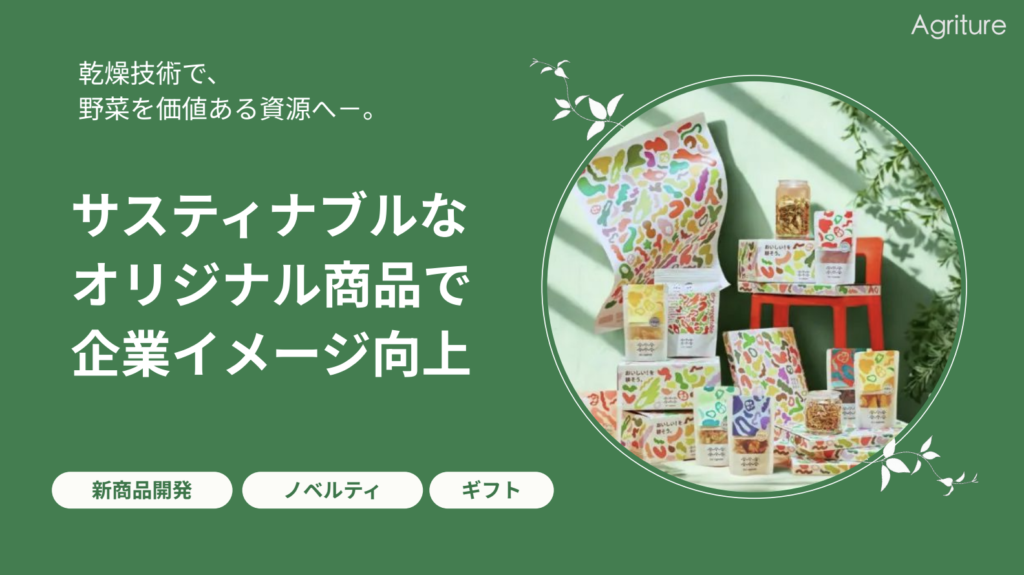
- SDGs-friendly products using non-standard vegetables
- Delivery possible in as short as two weeks
- Small lots from 500 bags
Recommended food gifts by budget | 2026-edition selection
3,000-yen range: tasteful gifts you can give casually
This price band calls for a balance of "not too expensive, not too cheap." It's just the right range for gifts to general clients.
| Genre | Recommended point | Points to note |
|---|---|---|
| Dried-vegetable and dried-fruit set | Lightweight, room-temperature storage, colorful | Choose packaging that doesn't look skimpy in quantity |
| Dashi and seasoning set | Practical, usable at home too | Avoid overly standard brands |
| Baked-goods and cookie assortment | Individually packaged, easy to hand out | Check for allergy accommodation |
5,000-yen range: the ideal price band for major clients
This is the volume zone for corporate gifts. At this price band you can satisfy both quality and quantity, making it the range with the richest options.
- Food assortment shipped direct from the producing region: a set of Kyoto dried vegetables and seasonings, or another combination with regional character
- Premium soup and miso soup set: individually packaged and easy, matching a health-conscious bent too
- Craft jam and honey set: shines at the breakfast table and pleases families too
10,000 yen and up: gifts for special clients
This price band competes on "quality" and "story" rather than "quantity." It's for gifts to the executive class and to especially important clients.
- Food gifts with original labels or name-inscription: packaging with your own logo boosts company recognition
- Set of rare seasonal ingredients: hard-to-obtain regional ingredients have great talking-point value
- Food gift + experience set: with a producing-region visit voucher, an online cooking class, and the like
How to use corporate gifts for "your own branding"
Original packaging to make it memorable
Increasingly common lately are gifts using your own original packaging or labels, rather than off-the-shelf gifts. More makers can produce from small lots via OEM, and there are cases where you can make an original gift from as few as about 50 units.
A food gift with your own logo or message is more memorable than a typical gift, and you can expect a branding effect too. At Agriture, we also take on production of original gift sets using Kyoto-grown dried vegetables for companies, and a feature is the very high repeat rate.
Build a gift strategy tuned to the seasons
Setting up a year-round gifting schedule, not just ochugen and oseibo, lets you keep creating touchpoints with clients.
| Timing | Gift occasion | Recommended food gift |
|---|---|---|
| January | New Year's greetings | Auspicious food set |
| March–April | Fiscal-year-change greeting | Spring ingredient gift |
| July | Mid-year gifts | A cooling gift for summer |
| September | Mid-period greeting | Autumn-flavors set |
| December | Year-end gift (oseibo) | A luxurious set for the year-end and New Year |
Turning your gift list into a database
Spending time every year fretting "what did we send last year?" is a waste. Turning the past gifting history for each client into a database makes the following year's selection go smoothly.
The items to record are the recipient's name, contact's name, past items, amount, and the recipient's reaction. Excel or a spreadsheet is plenty to manage it, so start this year.
Using dried vegetables, Corporate gifts and novelties please feel free to consult us about the planning and manufacturing of.
We have materials available to help you understand vegetable-based novelties
- SDGs-friendly products using non-standard vegetables
- Delivery possible in as short as two weeks
- Small lots from 500 bags
Summary
Corporate gifts are an important communication tool for deepening relationships with clients. In light of 2026 trends, the following points are especially important.
- Break from standard items and choose gifts with a story
- Foods meeting the three conditions of individual packaging, room-temperature storage, and long shelf life suit office gifts
- Differentiate with an original gift that leverages your own brand
- Grasp the basics of gift etiquette while being mindful of the recipient company's culture
- Turn your gifting history into data and run a yearly PDCA cycle
Rather than fretting over "what should we send the client" every season, we recommend setting up your annual gifting plan in advance. The more time you spend on choosing the item, the more that care comes through to the recipient.
FAQ
Recommended reading
Commercial dried vegetables / Drying processing service / Contract processing service / A Collection of Ideas for Using Dried Kujo Green Onion Powder | What Is a Food OEM Material That Makes Use of Natural Green Color and Aroma? / Raw Material Risk Management for Food Manufacturers and How to Use Dried Vegetables
Download the novelty materials
We will send the materials to your email address based on the information you provide.
If you are considering product development with off-spec or your own farm's vegetables:From planning to processing, materials, package printing and novelties, you can consult us through a single point of contact. → Learn more about one-stop product development
- How to choose souvenir gifts for shareholder meetings | 5 food gift trends
- How to choose retirement gifts | A collection of food gift ideas that convey gratitude
Author of this article
Related articles
-
 Food industry trade show trends 2025 | The latest developments to keep in mind
 -
 A guide to preparing for a trade show | Schedule, costs, and checklist
 -
 Prevent trade show failures! 8 common failure patterns and countermeasures
 -
 Kyoto-style food development | Gift-oriented product development OEM using Kyoto vegetables
 -
 Creating a regional brand with a Kyoto-vegetable OEM | The complete flow from planning to sales
 -
 Kyoto ingredient processing OEM | How to make the most of Kyoto vegetables and quality control
 -
 How to source commercial vegetable powder in small lots, and how to use it
 -
 Heirloom vegetable OEM | A commercialization case guide using Kyoto vegetables and local ingredients