Differences among apple growing regions? Comparing Aomori, Nagano, and Yamagata

Summary of this article
As differences among apple-producing regions, we thoroughly compare the three major producing regions: Aomori Prefecture, which accounts for about 60% of Japan's production; Nagano Prefecture, with its original varieties the "Apple Three Brothers"; and Yamagata Prefecture, which ripens apples fully in a warm climate. We explain regional characteristics such as Aomori's juicy Fuji, Nagano's Shinano Sweet, Akibae, and Shinano Gold, and Yamagata's deep flavor, along with the long-term storage technology of CA storage and the seasons of early, mid, and late varieties.
Even the same "Fuji" gives a different impression of flavor between Aomori-grown and Nagano-grown. Many people have surely wondered, comparing origin labels at supermarkets and farm stands, why the price and texture differ. Apple flavor isn't decided by variety alone; a region's climate, elevation, and day-night temperature swing are deeply involved. This article organizes the individuality and how to choose by producing region from a consumer's viewpoint, centered on the three major regions representing apple production—Aomori, Nagano, and Yamagata—and including Iwate and Fukushima as well.
TOC
Aomori Prefecture: why it's called the kingdom of apples
The one that has long run at the top of domestic apple production is Aomori Prefecture. A cool climate with relatively comfortable summers, well-draining soil derived from volcanic ash, and vast cultivation land centered on the Tsugaru region form the foundation of stable quality. The image of "apples mean Aomori" is supported not only by high production but also by stable distribution.
Firm flesh nurtured by a cool climate
Aomori apples tend to have firm flesh and deep skin coloring, as the harvest-season temperature falls firmly. The Tsugaru Plain in particular has stable autumn chill, so red varieties are said to color vividly. They also have a solid reputation for shelf life, and Aomori accounts for many of the apples that appear in early spring after storage.
Representative varieties are Fuji, Orin, and Tsugaru
Representative of Aomori is Fuji, with a good balance of sweetness and acidity. Prone to honeying and highly storable, it can be enjoyed into the new year and beyond. Yellow-green, fragrant Orin, and Tsugaru, which appears from late summer into early autumn, are also Aomori mainstays, and because the varieties peak at different times, you can savor apples over a long period from Aomori alone.
Distributed year-round through storage technology
Behind Aomori appearing in stores year-round is the accumulation of preservation technology such as low-temperature and CA storage. Because a mechanism is in place to store autumn-harvested apples while keeping freshness and ship them in line with demand, it's easy to choose apples of stable quality even in spring and summer. For tips on home storage, see winter storage helpful.
Nagano Prefecture: temperature swings and distinctive varieties
The major producing region next to Aomori is Nagano Prefecture. Orchards spread across inland highland areas, and the large gap between day and night temperatures is a major weapon for apple cultivation. The prefecture also puts effort, prefecture-wide, into breeding new varieties, and original varieties born here have spread nationwide.
High elevation and large temperature swings
Nagano's apple orchards are often in high-elevation places, well sunlit during the day and chilly at night. The larger this temperature swing, the more sugar the fruit is said to gain, giving rise to firm sweetness and aroma. The strong sunlight unique to mountainous areas also contributes to coloring, connecting to a flavor balanced with clean acidity. The region's topographical characteristics are also covered in detail in the article on Nagano-grown.
Shinano Gold, Shinano Sweet, and Akibae
Indispensable in speaking of Nagano is the group of so-called "Shinshu-born" varieties. Yellow, well-balanced-in-sweetness-and-acidity Shinano Gold; juicy, gently sweet Shinano Sweet; and deep-red, richly flavored Akibae are sometimes collectively called the "Nagano Three Brothers." With varieties of clear individuality on hand, Nagano-grown suits those who want to enjoy tasting them side by side.
The abundance of varieties suited to tasting side by side
Nagano grows the classics Fuji and Tsugaru too, while its original varieties have a strong presence. Sweetness-first Shinano Sweet, or Shinano Gold for a crisp sweet-tart edge—its appeal is being easy to choose by preference. If you want to know the differences by variety, please also check the variety ranking.
Yamagata Prefecture: a region for enjoying fully ripened flavor
Yamagata Prefecture, known as a major producing region in Tohoku, is also a famous apple region. It is a land where fruit cultivation in general is thriving, such as cherries and La France, and the know-how of fruit-making lives on in apples too. The basin's characteristic climate raises firmly ripened apples.
The richness the basin climate brings
Yamagata has many inland basins, with a climate of large temperature swings—hot summers cooling sharply toward autumn. In such an environment, fruit is said to gain sweetness easily, tending toward a rich, juicy finish. Cultivation with a full-ripening orientation—not rushing the harvest and letting the fruit color firmly on the tree—also characterizes Yamagata's flavor.
Fuji, Tsugaru, and Orin, plus Shuyo
In Yamagata too, the staples Fuji, Tsugaru, and Orin are widely grown. On top of these, encountering varieties unique to the land, such as Yamagata-born Shuyo, is another pleasure. Those who value ease of honeying and abundant juice tend to be highly satisfied choosing Yamagata-grown, which is shipped fully ripe. The overall picture of the producing region is summarized in the article on Yamagata-grown.
The connoisseurship unique to a fruit kingdom
In Yamagata, where fruit cultivation in general is thriving, growers' eyes for judging sugar content and ripeness are keen. At direct-sales outlets and farm stands, easily encountering apples at their eating peak is another strength of the region. Gift boxes are also well-stocked, making it a candidate when you want to choose apples as a gift.
Other major producing regions: Iwate, Fukushima, Akita, and more
Beyond the three major regions, there are many areas raising high-quality apples, centered on Tohoku and northern Kanto. Each has individuality reflecting its land's climate, and knowing them widens your options.
Iwate Prefecture's cool highland cultivation
Iwate Prefecture has thriving apple cultivation making use of its cool climate, and its strengths are said to be clean acidity and firm flesh. Many producing areas are at elevation, and the firmly chilly environment is said to connect to good coloring.
The individuality of Fukushima, Akita, and Gunma
Fukushima Prefecture has thriving fruit cultivation in general, with areas where you can enjoy apple picking alongside peach picking. Akita Prefecture against the backdrop of a Sea-of-Japan-side climate, and Gunma Prefecture with cultivation in relatively warm areas—each carries out variety-making to match its land's conditions. Because even the same variety gives a different impression of flavor when the region changes, it's worth trying when you spot one.
Comparing the main varieties and seasons by producing region
Organizing the differences by producing region makes the guide for choosing easier to grasp. We've put the representative varieties and climate characteristics in a table. Since cultivated varieties vary by region and farmer, please view it as a tendency only.
| Growing region | Climate characteristics | Representative varieties | Flavor tendency |
|---|---|---|---|
| Aomori Prefecture | Cool and stable, with well-developed storage technology | Fuji, Orin, Tsugaru | Deep coloring, firm flesh, and good shelf life |
| Nagano Prefecture | High elevation, large temperature swings | Shinano Gold, Shinano Sweet, and Akibae | Fragrant, with standout sweet-tart balance and individuality |
| Yamagata Prefecture | Basin with large temperature swings | Fuji, Tsugaru, Orin, Shuyo | Full-ripening oriented, rich and juicy |
| Iwate Prefecture | Cool highland cultivation | Fuji, Tsugaru, and others | Clean acidity and firm flesh |
Early, mid, and late varieties peak at different times
Apples have early varieties that appear from late summer, mid varieties at the heart of autumn, and late varieties that peak from late autumn into winter. Tsugaru is relatively early, Akibae and Shinano Sweet are autumn, and Fuji is a representative late variety. Because the eating peak changes by variety even within the same region, you can enjoy different varieties by season.
Even the same variety gives a different impression by producing region
Fuji is grown in all of Aomori, Nagano, and Yamagata, but the impression is said to change with the land's conditions—coloring and shelf life in cool Aomori, sweetness and aroma in Nagano and Yamagata with their large temperature swings. The origin label is a hint for reading the flavor tendency.
Knowing the relationship of climate and elevation to flavor
The true nature of the differences by producing region lies in each land's natural conditions. Knowing the mechanism lets you imagine the flavor to some degree from the origin label.
The day-night temperature swing draws out sweetness
The sugar that leaves make through photosynthesis during the day is said to be less consumed and more readily stored in the fruit when the nighttime temperature falls. That's why apples from highlands and basins with large day-night temperature swings are said to gain sweetness easily. Nagano and Yamagata producing apples of strong individuality is related to these large temperature swings.
Elevation and sunlight influence coloring
High-elevation producing regions have strong sunlight, and the red of the skin is said to come out easily due to the effect of ultraviolet light. Well-colored apples give a good impression in appearance and suit gifting too. That said, coloring and good-or-bad flavor don't necessarily align, so choosing not by looks alone but together with the characteristics of variety and producing region is recommended.
Honeying is a combination of variety and ripeness
The honey visible when cut is said to appear readily when a honeying-prone variety like Fuji is firmly ripened fully. Rather than the honey itself being sweet, it is easier to understand as a sign of good ripening. If you want to enjoy honeying, choosing Fuji-centered fruit from full-ripening-oriented regions makes it easier to encounter.
Storage and distribution changing by producing region
Differences by producing region relate not only to flavor but to when and in what state you can get them. Being mindful of buying timing and storage keeps the deliciousness longer.
The difference between stored apples and new-crop
New-crop apples just harvested in autumn are appealing for their juicy texture, while those that appear from spring on after storage tend toward a settled flavor with ripening progressed. Aomori appearing stably year-round is a strength of storage, and choosing between new-crop and stored apples by season widens the ways to enjoy them.
The basics of home storage
Apples are weak to dryness and heat, so basically storing them in a poly bag in the fridge's vegetable drawer is said to be best. Because they emit ethylene gas that can hasten the ripening of other fruit and vegetables, keeping them separate when storing is reassuring. Tips for making them last are also introduced in winter storage the explanation.
Choosing the in-season producing region at farm stands and direct-sales outlets
The time you can most feel a region's individuality is its land's peak season. At farm stands, direct-sales outlets, and online farm-direct services, you can easily encounter freshly harvested varieties and sometimes find region-limited varieties rarely lined up at supermarkets. Once your region of interest is decided, ordering it timed to its peak season is also recommended.
Points for finding your preferred producing region
Each of the three major regions has its strengths, so which region you should choose changes with what you prioritize. Working backward from your preferred direction lets you choose without hesitation.
Choosing by sweetness, acidity, and texture
If you want rich sweetness and juiciness, Nagano or Yamagata with large temperature swings; for firm texture and good shelf life, Aomori; for clean acidity, a cool region like Iwate—you can choose along these lines. First comparing the familiar Fuji across regions makes it easy to feel the differences by producing region.
Choosing by use: eating fresh, processing, gifting
For eating as-is, an in-season variety; for cooking with heat, a firmly acidic variety; for a gift, one from a region with good coloring and appearance—choosing this way makes you less likely to fail. For processing such as dried fruit or baked goods, varieties whose acidity and aroma remain are said to give a more well-defined result.
Buying with the season calendar in mind
Early varieties like Tsugaru at the end of summer, Shinano Sweet and Akibae in autumn, Fuji from late autumn into winter—the eating peak splits by variety. Choosing producing region and variety in line with the season lets you encounter apples in their most delicious state. Trying different producing regions and varieties throughout the year is also one way to enjoy choosing apples.
Summary: knowing the producing region makes choosing apples more fun
Aomori with firm flesh and stable year-round supply from its cool climate and storage technology, Nagano with distinctive varieties making use of high elevation and temperature swings, and Yamagata with full-ripe richness from its basin climate—the three major regions each have clear strengths. Other regions like Iwate and Fukushima also have land-specific appeal, and even the same Fuji gives a different impression of flavor when the region changes. Working backward from your preference in sweetness, acidity, and texture, and your use—fresh, processing, gifting—and choosing with the season in mind makes choosing apples much richer. Once you find a region of interest, first compare a familiar variety across producing regions.
Honey-cored Shinshu apple, domestic dried apple
Sugar-free, a crunchy new texture—dried fruit of honey-cored "leaf-unremoved Shinshu apple"
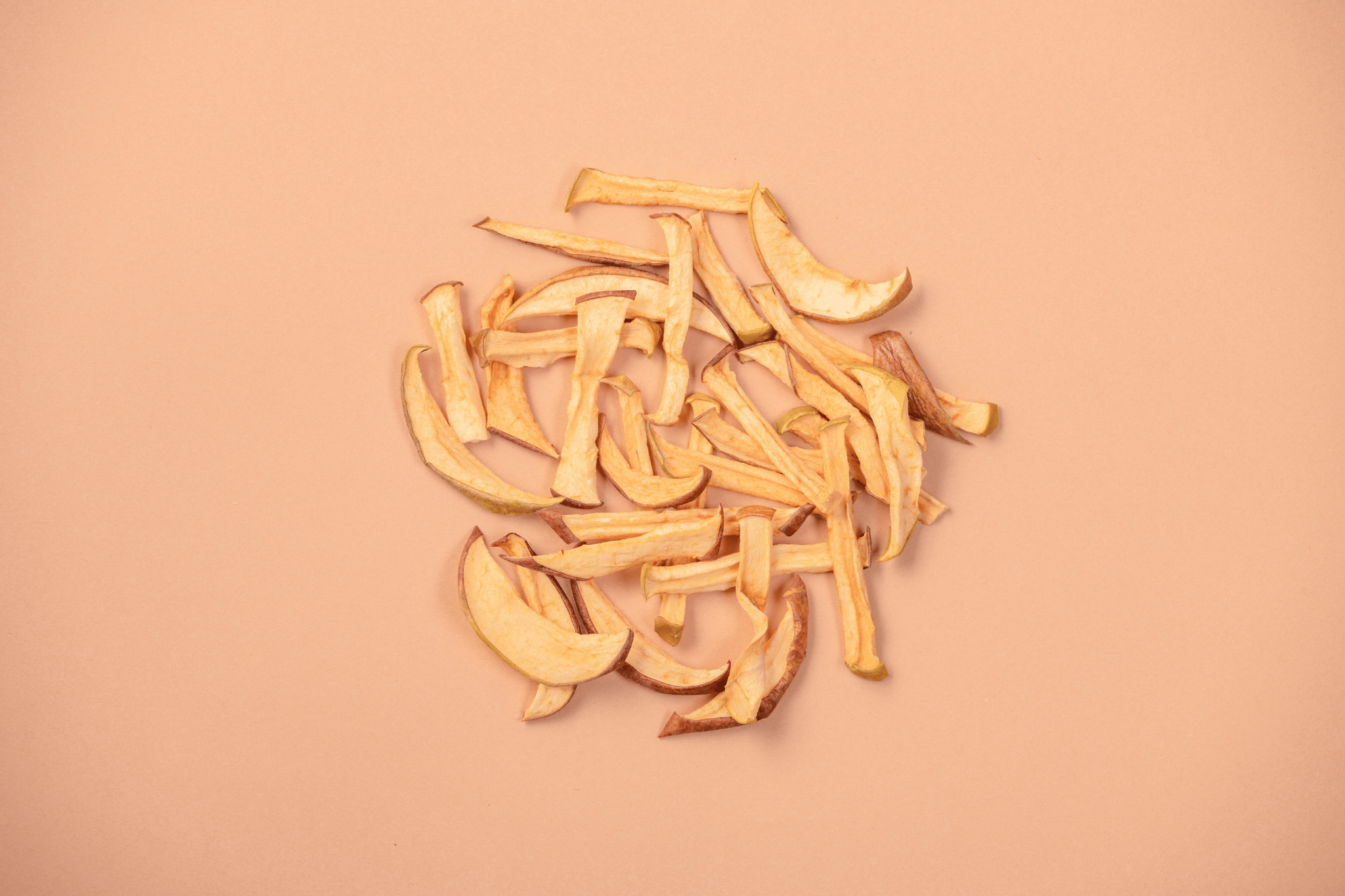
- Made with honey-cored "leaf-unremoved Shinshu apple"
- Sugar-free, dense natural sweetness
- Available in two forms, stick and dice
Recommended reading
- What are the characteristics of Fuji apples?
- Characteristics of Nagano-grown apples
- Characteristics of Yamagata-grown apples
- Apple-variety popularity ranking
FOR BUSINESS
乾燥りんごを、原料としてお探しですか
国産のりんごを乾燥・粉砕してお出ししています。カット形状や粒度の指定、継続してのお取引もご相談ください。規格は 乾燥りんご に掲載しています。
少量でのご購入は、姉妹ブランドの通販サイト OYAOYA で承っています。