
The nine allergen-labeling items — now including cashew nuts — that cannot be omitted even on small packs

You want to dry and bag your own vegetables, or make a product using fruit from your orchard. The first thing that stops you in your tracks is the question of what to put on the back-of-pack label. Allergen labeling in particular has a growing list of covered items, has rules and exceptions in how it is written, and can lead to a recall if you get it wrong.
On April 1, 2026, cashew nuts were added to the list of mandatory labeling. This is the first addition to the mandatory items since walnuts in 2023. This article is based on the Food Labeling Standards and notices published by the Consumer Affairs Agency, the Food Labeling Standards Q&A, and the handbook for businesses. It deals only with labeling and does not touch on symptoms or treatment.
TOC
Foods that require allergen labeling and foods that do not
Packaged processed foods are covered
The scope covers packaged processed foods and additives. The Food Labeling Standards Q&A describes the scope as "processed foods that use, as a raw material, a food (specified raw material) set out in Appended Table 14 of the Food Labeling Standards, or additives derived from a specified raw material, that are intended for sale." Dried vegetables, dried fruits, and mixed products sold in bags or packs fall within this.
Loose sales, sales by weight, and dining in are outside the scope
Foods sold without packaging are not covered. The Consumer Affairs Agency handbook lists as outside the scope foods sold without packaging, such as loose sales and sales by weight; foods served or delivered by restaurants; and alcoholic beverages. However, even a restaurant must label if it sells packaged food. If you bag food and line it up on the shelves at a farm stand, that counts as a packaged processed food.
You cannot omit it even on a small bag
There is no way out by claiming there is not enough labeling area. The handbook states, "Even where the labelable area of the packaging is 30 ㎠ or less, food allergen labeling cannot be omitted." The smaller the pack — a sample bag or an individually wrapped novelty — the more this one line matters.
When you cannot fit it all in, the answer is consolidated labeling, not omission. More on this later.
Raw materials wholesaled for commercial use are also subject to the requirement
You are not exempt just because you do not sell directly to consumers. The Q&A answers, "Allergen labeling is required even for commercial use or for raw materials of processed foods, so please label them." Dried vegetables supplied as a raw material to manufacturers or restaurants are also covered.
FOR BUSINESS
Looking for dried vegetables for commercial use?
We dry domestically grown vegetables and fruits, grinding them as needed, to supply them. We handle around 100 items, and specifications are List of dried products・List of powders listed at.
Small-quantity purchases are available through our sister brand's online store, OYAOYA.
Mandatory labeling has grown to nine items, and the recommended items have shifted to twenty
Nine items are now mandatory to label
The following nine items are required to be labeled under the Food Labeling Standards.
shrimp, cashew nuts, crab, walnut, wheat, buckwheat, egg, milk, peanut
The April 2026 edition of the handbook positions these nine items as the "nine items with high severity and case counts." Materials and label stock made before March 2026 still list the eight items without cashew nuts.
The twenty items you need not state, but which go unconveyed if you don't
The following twenty items are recommended for labeling by notice rather than by law.
almond, abalone, squid, salmon roe, orange, kiwifruit, beef, sesame, salmon, mackerel, soybean, chicken, banana, pistachio, pork, macadamia nut, peach, yam, apple, gelatin
Together with the nine mandatory items, that makes 29. These twenty items are also in flux. On March 28, 2024, macadamia nut was added and, at the same time, matsutake was removed. On April 1, 2026, pistachio was added, on the grounds that a nationwide survey continued to find a considerable number of cases. Along with this, the Consumer Affairs Agency has asked prefectures and others to instruct businesses to label pistachio promptly, taking into account the feasibility for businesses and the cross-reactivity with cashew nuts, which have newly moved to the specified raw materials.
Because it is a recommendation, not stating it is not a violation.
State on the label whether you cover up to 9 items or up to 29
If you do not state the twenty recommended items, the reader cannot tell whether you do not use that raw material or whether you use it but did not state it. The handbook recommends writing, near the consolidated labeling box, something that makes clear whether the scope is 9 items or 29. The example phrasings it gives include "This food covers 29 allergen items.", "Allergens (29 items covered)", "Allergens cover the 9 mandatory items.", and "Allergens (specified raw materials only)."
Just adding one line reduces inquiries.
By when do you need to switch over for cashew nuts?
The transitional period runs until March 31, 2028
Article 2 of the Supplementary Provisions of the Food Labeling Standards (Cabinet Office Order No. 34 of Reiwa 8) sets out the transitional measures as follows.
> For the labeling of processed foods that are manufactured, processed, or imported by March 31, Reiwa 10 (excluding processed foods for commercial use) and of processed foods for commercial use that are sold by that date, the prior rules may still be followed, notwithstanding the provisions of Appended Table 14 of the Food Labeling Standards as amended under Article 1.
Appended Table 14 is the list of specified raw materials. How you read it splits two ways depending on who you sell to.
- Processed foods for consumers: anything manufactured, processed, or imported by March 31, 2028 (Reiwa 10) may keep its conventional labeling
- Processed foods for commercial use: anything sold by March 31, 2028 may keep its conventional labeling
For consumer products the reference point is the date of manufacture; for commercial products it is the date of sale. For those wholesaling raw materials, the judgment depends on when they ship the stock on hand.
In an administrative notice dated April 1, Reiwa 8, the Consumer Affairs Agency states, "Although a two-year transitional period is provided, please instruct businesses to make efforts to label as promptly as possible." The intent is not that you may wait until the deadline.
The grace period for walnuts has already ended
Walnut moved to the specified raw materials on March 9, 2023. According to the Consumer Affairs Agency's "Overview of past amendments to the Food Labeling Standards," the transitional period for walnut ran until March 31, Reiwa 7 (2025). If a product you make now does not label walnut, that is not a matter of grace but a labeling omission.
The administrative notice of March 9, Reiwa 5, which added walnut, already mentions cashew nuts at that point. The sentence reads: "As for cashew nuts, which are treated as equivalent to specified raw materials, since an increase in case counts is currently recognized, second only to walnut among tree nuts, please make it known to food-related businesses that do not carry out allergen labeling that they should make even greater efforts to label them where possible." This means that from three years before the requirement took effect, the Consumer Affairs Agency was strengthening its recommendation and naming cashew nuts specifically.
Whether to write it as individual labeling or consolidated labeling
The default is individual labeling, written right after the raw material name
The Q&A states, "As a rule, display allergen labeling in parentheses immediately after the raw material name, indicating that the item contains a specified raw material or that an additive contained in the food is derived from a specified raw material." For a raw material it is "(contains ~)" and for an additive it is, as a rule, "(derived from ~)."
The handbook's dinner-roll example takes this form.
Raw materials: whole-grain flour (contains wheat), sugar, egg, shortening (contains soybean), skim milk powder, yeast, salt
Additives: emulsifier (derived from egg), antioxidant (V.C)
The Q&A explains that individual labeling was made the default so that people who can eat only a limited range of foods can reliably obtain the information.
Consolidated labeling groups everything at the end of the raw materials field
Consolidated labeling is also allowed. It is the style of grouping everything at the end of the raw materials field as "(contains ○○ and ○○ in part)." The handbook shows two forms.
When the raw materials and additives are split into separate fields, write it at the end of each field.
Raw materials: quasi-chocolate (palm oil, sugar, whole milk powder, cocoa powder, lactose, cacao mass, salt), wheat flour, shortening, sugar, egg, corn syrup, glucose, maltose, processed fats and oils, caramel syrup, salt, (contains soybean, milk ingredients, wheat, beef, and egg in part)
Additives: sorbitol, ethanol, emulsifier, leavening agent, flavoring, (contains soybean and milk ingredients in part)
When the additives are written after the raw materials with a slash, place just one at the end.
Raw materials: quasi-chocolate (palm oil, sugar, whole milk powder, cocoa powder, lactose, cacao mass, salt), wheat flour, shortening, sugar, egg, corn syrup, glucose, maltose, processed fats and oils, caramel syrup, salt / sorbitol, ethanol, emulsifier, leavening agent, flavoring, (contains soybean, milk ingredients, wheat, beef, and egg in part)
When listing two or more items in a row, connect them with "・". As an example where individual labeling is difficult, the Q&A cites the case where consolidated labeling uses fewer characters and, given the available labeling area, only consolidated labeling can fit. A small-pack product with many items falls into this.
You cannot mix individual and consolidated labeling
You cannot use both within the same labeling. The Q&A rejects it, stating, "These forms of labeling cannot be used in combination." Putting only some raw materials in parentheses and grouping the rest at the end is not permitted.
There is, however, one exception. The Q&A goes on to state, "However, only where the raw materials are shown on an invoice or the like in business-to-business transactions, the allergen labeling on the packaging should, as a rule, be consolidated for raw materials and individual for additives." Only when the raw materials are listed on an invoice in a business-to-business transaction does the packaging labeling become the combination of consolidated for raw materials and individual for additives.
When the same allergen recurs, you can omit it
When the same specified raw material appears many times in individual labeling, writing it on any one of them lets you omit the rest. The Food Labeling Standards provide that "if the fact of containing or being derived from a specified raw material is displayed for any one of them, the display of containing or being derived from the specified raw material may be omitted for the other raw materials or additives."
It is also said that you should choose which one to omit from. This is because some foods — such as the wheat in soy sauce or the soybean in miso — are generally said to be edible even though they contain an allergen. The Q&A indicates that when such foods are involved, it is preferable either to write "contains" on a raw material other than the one said to be edible, or, if you write it on the soy-sauce side, to add near the consolidated labeling box something like "The hydrolyzed protein contains soybean, and the yeast extract contains wheat."
You may make the characters larger or change their color
A style that makes only the allergen portion stand out is permitted. The Q&A states that changing the color or size of the characters for specified raw materials is a useful measure. Specifically, it lists such methods as making the characters larger than the rest of the labeling (roughly up to 1.5 times the other characters), changing the character color while taking the background color into account, changing the font, bolding, underlining, and shading.
Raw material names written as an alternative or expanded notation can be made to stand out in the same way. When writing more than one item, make them all the same color and size.
Write "milk" as "contains milk ingredients"
Milk alone is written differently. The Q&A states, "The allergen label for 'milk' is displayed as 'contains milk ingredients.'" Writing "contains milk" on a dairy product, or "contains milk" or "contains dairy product" on a food whose main ingredient is milk or the like, is not permitted. This is because it would look as if the product were made using the "milk" or "dairy product" itself as defined in the Milk and Milk Products Ordinance.
The Q&A gives four reasons: that it is hard for businesses to understand; that compliance is costly; that for patients it is enough to know that "milk ingredients" are contained; and that it serves to distinguish from confusing terms such as "emulsifier."
Only in the case of additives is the treatment different: for the way it fits in Japanese, you write "derived from milk" rather than "derived from milk ingredients." For a raw material it is "contains milk ingredients," and for an additive it is "derived from milk."
With an alternative or expanded notation, you can omit "contains"
Even a notation written differently from the item name lets you omit the "contains" display, as long as the reader can understand it to be the same thing. The Consumer Affairs Agency organizes this into two kinds.
- Alternative notation: a notation that differs in writing style or wording but can be understood to be identical to the specified raw material
- Expanded notation: a notation that, by including the name of the specified raw material or its alternative notation, can be understood as a food that uses the specified raw material
The split is that "wheat flour" is an expanded notation because it contains the name of wheat, while "komugi" is an alternative notation because it only changes the way it is written.
List of alternative and expanded notations by item
From Appended Table 3 of the notice, the "List of alternative notation methods for specified raw materials," we extract the nine mandatory items.
| Item | Alternative notation | Expanded notation (examples) |
|---|---|---|
| shrimp | Ebi (海老, エビ) | shrimp tempura, sakura shrimp |
| Cashews | None | None |
| crab | Kani (蟹, カニ) | Shanghai hairy crab, crab shumai, snow crab |
| Walnuts | Kurumi (クルミ) | walnut bread, walnut cake |
| wheat | Komugi (こむぎ, コムギ) | wheat flour, wheat germ |
| buckwheat | Soba (ソバ) | sobagaki, buckwheat flour |
| Eggs | Tamago (玉子, たまご, タマゴ), egg, chicken egg, duck egg, quail egg | thick rolled omelet, ham and egg |
| 乳 | milk, butter, butter oil, cheese, ice cream | ice milk, raw milk, garlic butter, cow's milk, processed cheese, concentrated milk, lactose, sweetened condensed milk, milk protein, modified milk powder |
| Peanut | peanut | peanut butter, peanut cream |
The cashew-nut cell being blank is not a transcription slip. In Appended Table 3, the cashew-nut row is left blank for both alternative and expanded notation. In other words, there is no route to omission other than writing "cashew nuts."
Egg comes with a note. Although "egg white" and "egg yolk" contain the character for "egg," from an accident-prevention standpoint they are not permitted to omit the "contains" display as an expanded notation.
Among the alternative notations for milk, "milk," "butter," "butter oil," "cheese," and "ice cream" do not contain the character for "milk." Because there are also foods with confusing names such as coconut milk and cacao butter, the Q&A states that for these it is preferable to write "contains milk ingredients" wherever possible.
With consolidated labeling, write even the alternative notation
Omission via alternative or expanded notation applies to individual labeling. When you choose consolidated labeling, the treatment is reversed. The handbook notes, "Specified raw materials that fall under an alternative or expanded notation, such as whole milk powder or wheat flour, must also be shown in the consolidated labeling."
Dropping wheat from the "(contains ... in part)" at the end because the raw materials say "wheat flour" is a mistake. In the chocolate-cake example above, too, whole milk powder and wheat flour appear in the raw materials, and milk ingredients and wheat still appear at the end.
Lumping items together as "grains" or "meats" is not allowed
Grouping specified raw materials under a broad category name is prohibited — notations such as "grains," "meats," "animal-based ○○," "fruits," or "fruit juice." Correctly, you give the item names, as in "grains (wheat, soybean)" or "wheat, soybean," "beef, pork, chicken," or "apple, kiwifruit, peach."
There are exceptions, too. Only where the catch is taken indiscriminately by net and used directly as a raw material, so that you cannot know which kinds of seafood are included, are notations such as "hydrolyzed protein (seafood)," "fish sauce (seafood)," and "surimi (seafood)" permitted.
What you can write on the label when you also make other products on the same equipment
A precautionary statement is not mandatory
Even when something is not used as a raw material, it can get mixed in through the production line. The Q&A states that even where the possibility of contamination cannot be completely ruled out, there is no labeling obligation if the contaminant is judged not to be a raw material. Conversely, if it is always contained, it counts as being used as a raw material and must be labeled.
The precautionary statement itself is also not mandatory but is treated as desirable. For shrimp and crab, it is also noted that where the frequency and amount of unintended contamination in the raw materials is low, no precautionary statement is needed, since it would end up unduly narrowing patients' range of food choices.
You cannot write only that it "may be contained"
If you do decide to write one, there are prohibited phrasings: labels that indicate only a possibility, such as "May contain." or "There is a risk it is contained."
The Q&A explains the reason as follows: if easy possibility-labeling spreads, manufacturers may come to write it without sufficient investigation, foods that do not actually contain the allergen end up being avoided, and patients' range of choice is narrowed.
Precautionary wording you can use as-is
The Q&A calls for a clear precautionary statement that includes the situation in which contamination occurs, and states that it is preferable to write it outside the raw materials labeling field. The example phrasings it gives are as follows.
- When using the same production line: "The factory that makes this product also produces products containing ○○ (name of the specified raw material)." "Made on equipment that has used ○○ (name of the specified raw material)."
- When it is due to the harvesting method of the raw material: "The whitebait used in this product is caught by a fishing method in which crab (name of the specified raw material) gets mixed in."
- When it is due to the fish preying on shrimp or crab: "The threadfin bream used in this product (kamaboko) feeds on shrimp (name of the specified raw material)."
The difference between a possibility-only label and the examples above is whether the reason for contamination is written. On which equipment, making what, it could get mixed in. If you go that far, the reader can judge against their own situation.
Reduce contamination through cleaning and production order
Before writing a precautionary statement, there are steps to reduce the contamination itself. The Q&A lists two measures: after thoroughly cleaning the production line, make the products that do not contain specified raw materials first; and use dedicated equipment wherever possible.
The information you hand over when entrusting raw materials for processing
When you outsource steps such as drying, milling, and small-pack filling, the information splits between the side that holds the raw materials and the side that holds the equipment. At Agriture, too, the conversation stalls at the same two points whenever we take in raw materials: the raw material specification sheet, and what is on the production line.
Note that the one ultimately responsible for the labeling is the seller. The side that takes on the processing does not decide the labeling for you.
Read the specification sheet all the way down to compound ingredients
As the first step in building the labeling, the handbook says to arrange the raw materials in order of blending quantity, extract the compound ingredients from the specification sheets obtained from the raw material maker, and expand them until they become single raw materials. In the croquette it gives as an example, wheat gluten had been added to turn textured vegetable protein into granules, so wheat that cannot be read from the name comes out.
The handbook puts it this way: "Do not judge by the name alone; make it a habit to always check, using specification sheets and the like, for the presence of specified raw materials within compound ingredients."
With additive preparations such as seasoning liquids, seasonings, fats and oils, and emulsifiers, you cannot read the contents from the name alone. Without a specification sheet, you have to start by inquiring with the raw material maker, which stretches out the number of days until the label content is finalized.
Decide in advance who tells whom when a specification changes
One cause of voluntary recalls listed in the handbook is a case where a change in a raw material's specification went unnoticed and the labeling was missing. The measure it presents is a flow of having the supplier accurately convey the specified-raw-material information when there is a change in product specifications, and checking whether the labeling has been updated.
When the side entrusting the raw materials and the side processing them are separate, this communication slips through. Three items are enough to settle in advance.
- Record the version number and date of the specification sheet
- When there is a change, who contacts whom, and by when
- Before ordering labels, check the date of the specification sheet on hand
Ask what is made on that line
Whether to write a precautionary statement cannot be decided without knowing what is made on that equipment. The Q&A states that it is preferable to manage what raw materials go into the foods made on a production line and to provide information to consumers as needed.
As the party outsourcing, ask what items are handled on the same equipment. Whether the nine specified raw materials in particular are handled directly determines the wording of the precautionary statement.
It is the selling side that answers the inquiries
A label can't convey everything. The handbook asks you to gather information such as your manufacturing processes and raw-material specification sheets so you are ready for inquiries from consumers. The questions it lists as ones you actually receive include which raw material a parenthetical note at the end applies to, whether any labeling has been omitted, and whether products containing the relevant specified raw materials are made on the same production line.
To answer these three, there are also three things to obtain from the processing side: a full set of raw-material specification sheets, the items handled on the same equipment, and records of the cleaning procedure and production order. They correspond one to one with the questions.
Who faces what when the labeling is wrong
The four causes that led to voluntary recalls
The handbook divides cases of voluntary recall caused by food-allergen labeling errors into four causes.
1. Applying the wrong label or using the wrong container (putting a croquette label on a menchi-katsu so that "egg" was missing, filling a tuna-can container with the contents of a salmon can, and the like)
2. Formulation errors or errors in the manufacturing process (mistakenly blending walnut into a confection, mistakenly sharing lines that had been kept separate, and the like)
3. Labeling errors (omitted entries, mistranslation of imported goods, overlooking a change in a raw material's specification)
4. Unintended contamination during the manufacturing process (poor cleaning at a product changeover left egg from the previous product, detected in in-house testing)
Translated into drying, grinding, and repacking steps, cause 1 becomes putting the wrong item's label on a small pack, cause 2 becomes mixing up the item in the grinder, and cause 4 becomes the previous item remaining because of insufficient cleaning at changeover. All of them occur not because of the work itself but when a verification step is skipped. The countermeasures given are likewise to have more than one person check, and to keep inspection and cleaning records.
What happens if you sell without correcting the labeling
Food-allergen labeling is treated as a labeling item that has a major bearing on safety when food is consumed. According to the handbook, a recall order or business-suspension order may be issued under Article 6, Paragraph 8 of the Food Labeling Act, and failure to comply with such an order carries imprisonment of up to 3 years or a fine of up to 3 million yen, and a fine of up to 300 million yen for a corporation. Selling food whose labeling does not comply with the standards may carry imprisonment of up to 2 years or a fine of up to 2 million yen, and a fine of up to 100 million yen for a corporation.
Health centers and the like look at three points: confirming from the relevant documents whether, at purchase, the seller provided information on the presence of specified raw materials; testing and inspecting the product; and checking contamination-prevention measures such as how the production line is cleaned. In other words, they check whether the documents have been kept.
FOR BUSINESS
Looking for dried vegetables for commercial use?
We dry domestically grown vegetables and fruits, grinding them as needed, to supply them. We handle around 100 items, and specifications are List of dried products・List of powders listed at.
Small-quantity purchases are available through our sister brand's online store, OYAOYA.
FAQ
Summary
Allergen labeling looks like a lot to remember, but the order in which you decide is fixed. Is the product within scope? Up to the 9 mandatory items, or up to the 29 items including the recommended ones? Individual labeling or collective labeling? And, if equipment is shared, how to word the precautionary note.
If there is one thing to start on now, it is matching your stock of label stock against your planned production dates. Anything manufactured on or after April 1, 2028, must be labeled with the 9 items including cashew nut. How many sheets printed with only 8 items remain, and when you will use them up: once you know this, the time to reprint is set.
Recommended reading
- Country-of-origin labeling rules for raw materials in processed foods (/oem/origin-labeling-rules/)
- How to read a quality specification sheet for dried vegetables (/oem/quality-spec-guide/)
We have materials available to help you understand dried processing OEM
Agriture OEM, flexibly handling everything from small lots to large lots
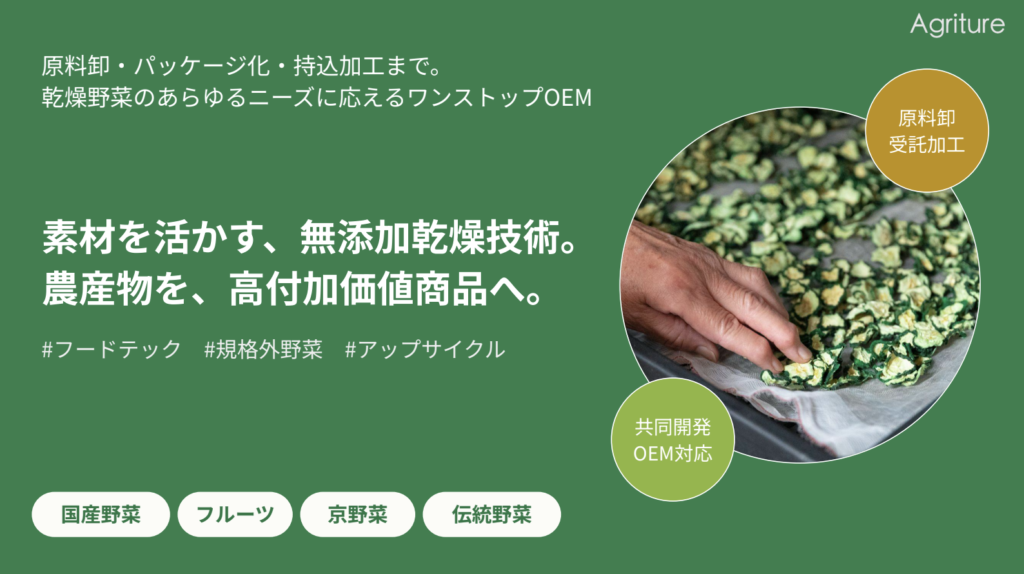
- OEM available from small lots of 10 kg
- Drying of brought-in raw materials also possible
- Support from processing to filling in one place
Download the OEM contract processing materials
We will send the materials to your email address based on the information you provide.
- Before pursuing sixth-industrialization certification, decide whether to do the processing yourself or outsource it
- What to write on a food's consolidated labeling panel, and how much may be omitted
Author of this article
Related articles
-
 How to Make Dried Tomatoes: Drying Tips, and How Cherry and Large Tomatoes Turn Out Differently
-
 Kansai Food OEM: 6 Steps to Making a New Product and Subsidies
-
 Practical Guide to Importing Dried Vegetables: Tariffs, HS Codes, and Quarantine Explained
-
How to choose retirement gifts | A collection of food gift ideas that convey gratitude
-
 How to choose commercial vegetable dashi: comparing across three axes of ingredient, format, and scope
-
 A guide to preparing for a trade show | Schedule, costs, and checklist
-
 Peace of mind even for first-time food OEM! Tips for choosing a manufacturer and ordering without going wrong
-
 How to source commercial vegetable powder in small lots, and how to use it