
Half of the world's apples are grown in China, and only 13,000 tons are imported into Japan

Summary of this article
World apple production is 97.88 million tons in FAO's 2024 data, with China accounting for 52.4%. Japan imports almost no fresh apples; the Reiwa 7 (2025) figure was 13,252 tons, all from New Zealand. We organize, from primary sources, the conditions of the four growing regions conditionally cleared under quarantine, and the fact that Pink Lady and Jazz are trademarks rather than variety names.
It is rare in Japan to see a "foreign apple" price tag in a supermarket fruit section. Imported bananas line up as a matter of course, yet apples alone are all domestic. The reason is neither preference nor price, but the plant quarantine system.
This article takes world apple production from the statistical database of the Food and Agriculture Organization of the United Nations (FAO), confirms the import volume into Japan with the plant-quarantine statistics of the Ministry of Agriculture, Forestry and Fisheries' Plant Protection Station, and cross-checks the breeding country, breeding year, and parentage of overseas varieties against each country's plant patents and national fruit-tree collection records.
"Pink Lady," "Jazz," and "Envy," which come up along the way, are none of them variety names. They are trademarks, varieties whose cultivation and sale are managed under license. The spread of domestic varieties and cultivation is An article summarizing the characteristics of each apple variety covered in, so here we focus on overseas and imports.
TOC
World apples total 97.88 million tons a year, half of which comes from China
The 2024 apple production recorded in FAO's statistical database (FAOSTAT) was 97,880,076 tons worldwide. The harvested area was 4,685,316 hectares, with a yield of 20.89 tons per hectare. There are 94 countries and regions reporting production.
Production and world share by country (2024)
We list the top 15 countries in order of production and have added Japan for reference. Share is the proportion of the world total, and yield is production divided by harvested area.
| Rank | 国 | Production volume (t) | World Share | Harvested area (ha) | Yield (t/ha) |
|---|---|---|---|---|---|
| 1 | China | 51,286,350 | 52.4% | 2,089,744 | 24.5 |
| 2 | United States United States | 4,922,840 | 5.0% | 121,205 | 40.6 |
| 3 | Turkey | 4,420,185 | 4.5% | 165,319 | 26.7 |
| 4 | Poland | 3,384,500 | 3.5% | 148,000 | 22.9 |
| 5 | India | 2,625,899 | 2.7% | 304,130 | 8.6 |
| 6 | Italy | 2,398,540 | 2.5% | 53,380 | 44.9 |
| 7 | Iran | 2,346,929 | 2.4% | 120,514 | 19.5 |
| 8 | Russia | 2,014,406 | 2.1% | 189,893 | 10.6 |
| 9 | France | 1,964,030 | 2.0% | 52,760 | 37.2 |
| 10 | Uzbeki stan | 1,482,332 | 1.5% | 123,847 | 12.0 |
| 11 | South Africa | 1,327,545 | 1.4% | 31,099 | 42.7 |
| 12 | Chile | 1,299,064 | 1.3% | 24,994 | 52.0 |
| 13 | Ukraine | 1,150,900 | 1.2% | 76,300 | 15.1 |
| 14 | Brazil | 997,470 | 1.0% | 33,054 | 30.2 |
| 15 | Egypt | 959,101 | 1.0% | 35,632 | 26.9 |
| 21 | Japan | 658,377 | 0.7% | 33,403 | 19.7 |
| - | World total | 97,880,076 | 100% | 4,685,316 | 20.9 |
The top 3 countries account for 60%, and the top 10 reach 80%
China, the United States, and Turkey together produce 60,629,375 tons, 61.9 percent of the world total. Adding Poland and India, the top 5 countries reach 68.1 percent, and the top 10 through Uzbekistan reach 78.5 percent.
Even though 94 countries and regions report production, 80 percent is concentrated in 10 countries. The apple is a fruit tree that needs a period of low winter temperatures, so the latitude and elevation bands where it can be grown are limited. Its growing regions are distributed quite differently from tropical bananas or subtropical citrus.
World production doubled in 30 years, with much of the increase coming from China
In the same FAO data, world apple production in 1994 was 46,468,250 tons. The 97,880,076 tons of 2024 is 2.1 times that figure. China's share was 48.0 percent as of 2014, with production of 40,924,707 tons. Over ten years it added 10.36 million tons to reach 52.4 percent.
The amount harvested from one hectare varies sixfold between countries
Reading the table across, you can see that area and production are not proportional. Chile has a harvested area of 24,994 hectares and 1,299,064 tons, or 52.0 tons per hectare. India has 304,130 hectares and 2,625,899 tons, or 8.6 tons. India's area is 12 times larger, yet its production is only twice as much.
The countries whose yield exceeds 40 tons are Chile, Italy, South Africa, and the United States, all of which are dominated by orchards combining dwarfing rootstocks, high-density planting, and irrigation systems geared toward export. In the Crop Statistics Survey, Japan's 2024 yield was 1,810 kilograms per 10 ares, or 18.1 tons per hectare, below the world average of 20.9 tons. For differences in cultivation by growing region, see an article comparing the apple-growing regions of Aomori, Nagano, and Yamagata for more.
Japan ranks 21st in the world, and is a country that barely imports apples
In the FAO data, Japan ranked 21st, with production of 658,377 tons and a world share of 0.7 percent. However, this figure is an FAO estimate and differs from Japan's own statistics.
The 2025 domestic harvest was 577,400 tons
According to the Ministry of Agriculture, Forestry and Fisheries' Crop Statistics Survey, the 2025 apple crop had a cultivated area of 33,700 hectares, a bearing-tree area of 32,500 hectares, a yield of 1,780 kilograms per 10 ares, a harvest of 577,400 tons, and a shipment volume of 529,700 tons. Compared with the previous year, the harvest fell by 31,800 tons, a 5 percent decrease.
The previous year's 2024 crop had a harvest of 609,200 tons. By prefecture, the order was Aomori with 370,500 tons, Nagano with 106,400 tons, Iwate with 36,700 tons, and Yamagata with 32,700 tons. The cultivated area shrank by 1,300 hectares from the previous year, so yields are swinging with the weather even as orchard area contracts.
The FAO figure for Japan and the domestic statistics differ by 50,000 tons
The FAO's 2024 value for Japan, 658,377 tons, carries the flag "I" indicating an estimate. The Crop Statistics Survey harvest for the 2024 crop, by contrast, was 609,200 tons. The difference is 49,177 tons, about 8 percent.
For 2023, the FAO value was 604,000 tons with the flag "A" for an official figure, matching the Crop Statistics Survey's 2023 crop of 604,000 tons. In years when the domestic release was in time they match; in years when it was not, the FAO fills the gap with an estimate. You need to use the right source for each purpose: FAO for comparing world rankings, and the Crop Statistics Survey for Japan's production.
Of 1.73 million tons of imported fresh fruit, apples do not reach 1 percent
According to the Ministry of Agriculture, Forestry and Fisheries' "Situation Surrounding Fruit Trees" (August 2026), imports of fresh fruit in 2025 were 1.73 million tons, and processed products were 740,000 tons. The fresh breakdown was 61 percent bananas, 10 percent pineapples, 7 percent kiwifruit, 5 percent oranges, 3 percent avocados, and 2 percent lemons, with these six items making up about 90 percent.
Apples fall within the remaining 12 percent of "other fresh items." The 13,252 tons of fresh apple import inspections in 2025, discussed below, amount to 0.77 percent of the 1.73 million tons of fresh fruit imports. In the same material, the 2023 estimate shows that of domestic fruit demand, 37 percent was domestically grown and 63 percent imported. Even though imports dominate fruit overall, apples alone are filled by domestic supply.
Imports of fresh apples are permitted from only four growing regions
Liberalization of apple imports took place in 1971 (Showa 46). In terms of tariffs, the door opened more than 50 years ago. The reason fresh apples still do not come in is that a separate import-prohibition provision of the Plant Protection Act is at work.
What is blocking them is fire blight and the codling moth
Appended Table 2 of the Enforcement Regulations of the Plant Protection Act (Ministry of Agriculture and Forestry Ordinance No. 73 of 1950) lists quarantine pests that must not be allowed to enter Japan, along with their host plants and target regions. What blocks apple imports is Item 16 of this Appended Table 2.
The harmful organism in Item 16 is Erwinia amylovora, the fire blight bacterium in its Japanese name. Living plants of "plants of the genus Malus" are listed as host plants, and in parentheses it is explicitly stated as "excluding seeds, and including fresh fruit, flowers, and pollen." The target regions include more than 50 countries and regions, such as the Republic of Korea, the People's Republic of China, the United States, Canada, France, and New Zealand. The major apple-producing countries line up almost exactly.
The other is Cydia pomonella, the codling moth. It is a moth not distributed in Japan, and because its larvae bore into the interior of the fruit, they are hard to detect from the outside. These two position the apple as a "host plant of pests that cannot be found during import inspection."
The four growing regions conditionally cleared, and the basis for each
Appended Table 2 has an exception list called the "Supplementary Table," and when it is technically confirmed between Japan and the exporting country that a complete disinfestation and disinfection technology has been established on the exporting side, the Minister of Agriculture, Forestry and Fisheries sets standards and lifts the import ban. For fresh apple fruit, there are only four cases: Supplementary Tables 24, 25, 31, and 34.
| Growing region | Regulatory basis | Implementation detail notification date | Audience Variety | Main quarantine conditions |
|---|---|---|---|---|
| New Zealand | Appended Table 2 Supplementary Table 24 | 1993 June 1 | Limited None | Disinfection at a designated fumigation facility or cold-treatment facility. The cold-treatment facility maintains the specified temperature within ±0.6°C per room |
| United States United States | Appended Table 2 Supplementary Table 25 | 1994 August 22 | Limited None | Facilities limited to within Washington, Oregon, and Califor- nia states. Cold treatment or methyl bromide fumigation |
| France | Appended Table 2 Supplementary Table 31 | 1997 September 10 | Golden Delicious Seed only | Produced in districts designated as fire-blight-free zones. Outside the protected zone, a buffer zone of at least 500 m wide is required |
| Austral- ia (Tas- mania only) | Appended Table 2 Supplementary Table 34 | 1998 December 25 | Fuji variety only | Disinfection at a designated with methyl bromide fumigation. The packing location is a dedicated space connected to the fumigation |
France is limited to the Golden Delicious variety, and Tasmania to the Fuji variety. The existence of an import quota specified down to the variety name, as a formal system, clearly illustrates how special the apple is.
U.S.-grown apples keep the fruit core at 2.2°C or below for 55 days
Opening the implementation details for fresh apple fruit grown in the United States, the disinfection conditions are written out in fine detail. For cold treatment, first use pre-refrigeration to bring the core of the fruit at four or more points in the load down to 2.2 degrees Celsius or below, then continuously hold it at 2.2 degrees or below for 55 days. The automatic temperature recorder must be able to record in units of 0.1 degrees Celsius every 4 hours, and must maintain an accuracy of plus or minus 0.1 degrees Celsius for at least 2 months after calibration.
The fumigation facility performs empty fumigation with 10 grams of methyl bromide per cubic meter of internal volume, and passes an airtightness inspection confirming that the average gas concentration after 48 hours is at least 70 percent of that immediately after dosing. When ventilation holes are provided in the packing, mesh with a hole diameter of 1.6 millimeters or less is fitted.
At the packing location, the same mesh must be fitted over openings, except from November 1 to March 31 in Washington and Oregon states, and from October 11 to the end of February in California. Both the figure of 55 days and the figure of 1.6 millimeters are lines drawn to keep out the single species, the codling moth.
FOR BUSINESS
Looking for dried apples as a raw material?
We dry and grind domestically grown apples to supply them. Feel free to specify cut shape and particle size, and to discuss ongoing supply. Specifications are Dried apple listed at.
Small-quantity purchases are available through our sister brand's online store, OYAOYA.
The fresh apples that entered Japan in 2025 totaled 13,252 tons, all grown in New Zealand
Whether the system is open to four growing regions and how much actually came in are separate matters. The plant quarantine statistics of the Ministry of Agriculture, Forestry and Fisheries Plant Protection Station publish inspection results for imported plants by item and by country of production. In the statistics for 2025 (Reiwa 7), only one country of production appeared for fresh plants of the genus Malus.
Only New Zealand-grown fruit appears in the quarantine statistics
From the "Inspection Table of Imported Plants by Item and by Country: Fresh Fruit," the inspection results for fresh plants of the genus Malus are lined up for three years.
| Year | Country of production | Testing Cases | Inspection volume (kg) | tons converted |
|---|---|---|---|---|
| Reiwa 5 (2023) (2023) | New Zealand | 238 | 4,648,739 | 4,649 |
| Reiwa 5 (2023) (2023) | Others | 3 | 11,089 | 11 |
| 2024 (2024) | New Zealand | 371 | 8,041,008 | 8,041 |
| 2024 (2024) | Others | 1 | 2,880 | 3 |
| Reiwa 7 (2025) | New Zealand | 588 | 13,252,487 | 13,252 |
| Reiwa 7 (2025) | Subtotal | 588 | 13,252,487 | 13,252 |
For 2025 there is no "other" row, and the subtotal matches the New Zealand figure exactly. Fresh apples from the United States, France, and Tasmania are not recorded in this year's statistics. Although the system allows imports from four growing regions, in practice it has converged on a single country.
It has increased nearly threefold in three years
From 4,660 tons in 2023 to 13,252 tons in 2025, that is 2.8 times in two years. The number of cases also rose from 241 to 588. This is 2.3 percent of the 2025 domestic harvest of 577,400 tons. In a period when domestic production fell by nearly 30,000 tons from the 2023 crop, imports grew by 8,600 tons.
In the same statistics, the disinfection column had 0 cases, and the disposal column had 1 case of 5,712 kilograms.
Frozen apples are coming in from China
In the same inspection table, under "Frozen and other edible fresh fruit," there is a row for frozen plants of the genus Malus. In 2025 it was 73 cases and 416,781 kilograms from China, in 2024 it was 59 cases and 385,744 kilograms, and in 2023 it was 33 cases and 249,966 kilograms.
Fresh apples are stopped by fire blight and the codling moth, but once frozen, their quarantine treatment changes. When thinking about the "import" of apples, you need to keep in mind that fresh and processing-use routes are entirely different. For how to dry domestically grown raw material, see an article explaining the apple-drying method step by step for more.
Rearranging the breeding country, breeding year, and parent crosses of overseas varieties from primary sources
Gala, Granny Smith, Braeburn, Jazz, Pink Lady, Envy, Honeycrisp. All of these names often come up in Japanese-language articles, but their breeding years and parent crosses are frequently written without sources. I opened U.S. plant patent specifications, the lineage records of the UK's National Fruit Collection, and NARO's breeding-variety profiles one by one and cross-checked them.
A profile list of the 12 main varieties
"Yes" in the trademark column indicates that the variety is sold under a trademark separate from the variety name. "Unknown" in the parent-cross column means that the records can only be traced to one parent.
| Variety name (trademark name) | Breeding country | Breeding / Year of registration | Parentage | Trademark |
|---|---|---|---|---|
| Fuji | Japan (Fujisaki, Aomori) | 1962 Norin registration | Kokko × Delicious | None |
| Gala | New Zealand | U.S. Patent No. 3,637 1974 | Kidd's Orange × Golden Delicious | None |
| Royal Gala | New Zealand | U.S. Patent No. 4,121 1977 | A bud sport of Gala | None |
| Delicious (Red Delicious) | Additional certification Iowa | Discovered around 1880 1895 introduced | Yellow Bell- flower, presumed | None |
| Golden Delicious | West Virginia, USA | 1890 Discovered 1914 introduced | Grimes Golden × unknown | None |
| Granny Smith | Austral- Ryde (New South Wales) | Fruiting confirmed in 1868 | French Crab × unknown | None |
| Brae burn | New Zealand | 1952 Commercial cultivation began | Lady Hamilton × unknown | None |
| Cox's Orange Pippin | United Kingdom (Bucking- hamshire) | 1825 around, bred 1850 around, introduced | recorded None | None |
| Honey crisp | Additional certification University of Minnesota | U.S. Patent No. 7,197 1990 | Keep sake × MN1627 (identified in 2017) | Yes |
| Cripps Pink (Pink Lady) | Austral- Ryde (Western Australia) | U.S. Patent No. 7,880 1992 | Lady Williams × Golden Delicious | Yes |
| Scifresh (Jazz) | New Zealand | U.S. Patent No. 13,888 2003 | Brae burn × Royal Gala | Yes |
| Scilate (Envy) | New Zealand | U.S. Patent No. 20,477 2009 | Royal Gala × Brae burn | Yes |
Two chance seedlings connect today's store shelves by bloodline
Looking over the table, the name Golden Delicious appears repeatedly in the parent-cross column. It is the father of Gala and one parent of Cripps Pink. In the National Fruit Collection records, Golden Delicious is also a parent of Japanese varieties such as "Mutsu," "Jonagold," and "Tsugaru."
Delicious is the father of "Fuji." That Fuji was born from a cross with Japan's "Ralls Janet" is clearly documented in NARO's records, and the National Fruit Collection's record for Delicious also lists Fuji among its offspring. One tree found in West Virginia in 1890, and one found in Iowa around 1880. These two trees connect a considerable part of the world's apple shelves.
Varieties born from chance seedlings, and varieties born from planned crosses
Line them up by breeding year, oldest first, and there is a boundary where their character changes. Cox's Orange Pippin (around 1825), Granny Smith (1868), Delicious (around 1880), Golden Delicious (1890), Braeburn (1952). Up to here, every one traces back to a single tree someone found by chance. That is why the cross parentage stops at "× unknown" — not because the writer failed to look hard enough, but because it does not exist as a record.
Fuji, Gala, Cripps Pink, and SciFresh and Scilate, on the other hand, are the results of deliberate crosses made by public research institutions. Granny Smith's record notes it as "the mother of Lady Williams." The offspring of a chance-found green apple became, through a planned cross, a parent of Pink Lady. The two eras are connected by lineage.
Honeycrisp's cross parentage was recorded incorrectly in its patent
The holder of U.S. Plant Patent No. 7,197 (registered March 20, 1990) is the Regents of the University of Minnesota. The specification states it was a seedling planted in 1962 in Block 53 of the University of Minnesota Horticultural Research Center, cross number AB 603, arising from a cross of Macoun and Honeygold. It was selected in September 1974 and tested under the selection number MN 1711.
However, a peer-reviewed paper published in Horticulture Research in 2017 verified this record. Based on a linkage map using SNP markers and haplotype analysis, it concluded that one parent was "Keepsake" and the other an unreleased University of Minnesota selection, "MN1627." The same paper also showed that MN1627's parents are "Duchess of Oldenburg" and "Golden Delicious."
It takes several years from sowing to fruiting, and a selection orchard holds thousands of seedlings. On a timeline of sowing in 1962, selection in 1974, and patent registration in 1990, there is ample room for a swapped label or a transcription error in the ledger. Articles that assert a cross parentage need to be examined for whether their basis is the patent, DNA analysis, or hearsay.
Pink Lady and Jazz are not variety names but trademarks
This is the part that most differs from Japanese varieties. Pink Lady, Jazz, and Envy are all trademarks, and each has a separate corresponding variety name. And behind the trademark sits a system that manages cultivation and sales by license.
The name Pink Lady is applied to only part of the variety called Cripps Pink
The export strategy survey report compiled by Japan's Ministry of Agriculture, Forestry and Fisheries as a FY2008 project to promote agricultural trade facilitation (March 2009, Pink Lady edition) is a document that explains this structure head-on in Japanese. The report states that "Pink Lady is a trademark name, and basically the trademark name is applied to those of the apple variety Cripps Pink that exceed the international unified quality standard."
Even fruit picked from the same tree cannot be sold as Pink Lady if it falls below the standard. The rights holders are also split. According to the same report, the breeder's rights in each country are held by the Department of Agriculture and Food Western Australia (DAFWA), and the trademark rights by the Australian Growers"Apple and Pear Australia (APAL)," built on an industry association, manages it.
The club system is a mechanism for managing production volume and price as a group
The same report calls this method the "club system." Growers, distributors, and nursery producers form a group, and production and distribution are controlled within that group. A portion of the profits obtained is pooled and used for marketing in the market and for brand protection — that is the structure.
The effect shows up in the price. The report notes that in Europe, Pink Lady "forms a premium brand priced about 30 to 50 percent higher than the average apple variety," and also states that production, distribution, and pricing in Europe are controlled by the European Pink Lady association. However, this is a survey as of March 2009. The figures and the system may have changed since, so it should be read as a description of that time.
Royalties are a two-track structure of breeder's rights and trademark rights
The report also shows the breakdown of collection. In the Pink Lady system, royalties on both the breeder's rights and the trademark rights are collected, and the trademark-rights royalty in the European market is cited at a level of about 9,000 yen per ton. All breeder's-rights royalty income flows back to DAFWA and is used for developing new varieties, protecting breeder's rights, and registering new varieties.
Trademark-rights royalty income was estimated at about 900 million yen in the European market excluding the UK in FY2007/08. Of this, 14 percent is returned to APAL, and the rest is pooled by the local master licensee and used for operating costs, promotion, and protection of the trademark rights. The report also lists challenges: that it lost ownership of sports because it did not register the variety and the trademark domestically in Australia at the time of development, that production control in the Southern Hemisphere is loose, and that uncontracted production is increasing in China.
Jazz and Envy are siblings born from the same cross in 1985
In Japanese articles, it is common to see Jazz explained as "a cross of Gala and Braeburn" and Envy as "a cross of Braeburn and Gala," described separately. Placing the two U.S. plant patent specifications side by side makes the relationship between these two varieties clear.
Selected from crosses of the same year, the same place, and the same combination
The subject of U.S. Plant Patent No. 13,888 (registered June 17, 2003) is "SciFresh." The specification states it was selected from a seedling population obtained from a cross of Braeburn and Royal Gala, and that the cross was made on a tree at Havelock North in Hawke's Bay, New Zealand, in 1985. The inventor is Allan G. White, and the applicant is a New Zealand horticulture and food research institute.
The subject of U.S. Plant Patent No. 20,477 (registered November 10, 2009) is "Scilate." This one was selected from a cross with Royal Gala as the mother and Braeburn as the father, and it is clearly stated that the cross was made on a tree on land at Havelock North in 1985. The inventor is also the same Allan G. White.
Scilate's specification cites "SciFresh (U.S. Plant Patent No. 13,888)" as a closely related variety and states that it is distinguished from it. They are registered as separate varieties, but they are sister selections that came out of the same 1985 cross.
From 8,000 seeds, 211 trees, and from those, one variety
T&G Global, which holds the exclusive global license for both varieties, disclosed the scale of the development in an announcement on November 19, 2025. From the cross of Royal Gala and Braeburn, more than 8,000 seeds were obtained, of which about 7,000 were planted, 211 advanced to the next selection orchard, and from those Scilate was chosen.
The same announcement states that development took more than 20 years, and that SciFresh was launched as JAZZ in 2004 and Scilate as ENVY in 2008. Working back from the 1985 cross to market launch, that is 19 years for Jazz and 23 years for Envy. Since this is an announcement from the rights-holder side, it is not appropriate to treat it as statistics at face value, but the cross year and cross parentage match the patent specifications.
The difference from Japanese varieties is that even the right to sell is fenced off
The earlier MAFF report lists Kanzi, Kiku, Honeycrunch, Cameo, and Tentation as club-system varieties following Pink Lady, and names the most successful as "Jazz," held by the New Zealand grower organization ENZA. It cites two features of Jazz: that it used a position of stronger influence than APAL to build a tightly controlled system, and that it granted production licenses to the Southern Hemisphere cautiously, so that only the shortfall that could not be covered by shipments from its own country would be made up in other countries.
Fuji has no trademark. Registered in 1962 as the agriculture-and-forestry certified variety "Apple Norin No. 1," anyone who obtains the nursery stock can grow it, and anyone can sell it under the name "Fuji." That is why it spread across the world, but no matter how far it spreads, no royalty returns to the breeding side. Open the variety as a public good, or fence it with rights and keep the price up. New overseas varieties almost all choose the latter.
How much is Japanese-born Fuji grown overseas?
The explanation that "Fuji is the most grown apple in the world" is often seen, but no public statistics aggregating production by variety for the whole world can be found. Here we write only what could be confirmed.
Over 70 percent of China's apple production is Fuji-type
The annual report on China's deciduous fruit published by the USDA Foreign Agricultural Service (USDA FAS) on November 6, 2024 (report number CH2024-0139) states that the late-maturing Fuji-type varieties harvested in late October dominate China's apple production, accounting for over 70 percent of the country's total production. Most of the remaining 30 percent are early- and mid-season varieties such as Gala, harvested from July to September.
Overlaying this report with FAO's 2024 China share of 52.4 percent yields an estimate that more than a third of the world's apples are Fuji-type. Since it is a rough calculation multiplying two different sources, it cannot be treated as a statistical value, but it gives an outline of how a Japanese-born variety has become the mainstay of the world's largest growing region. The same report lists Cosmic Crisp, Envy, Gala, and Rockit among the imported apples circulating in the Chinese market.
The EU's Fuji is 280,000 tons, the 9th largest by variety
For Europe, there is the EU production forecast by variety (Prognosfruit) that the World Apple and Pear Association (WAPA) publishes every August. We extracted the main varieties from the latest edition presented in Constance, Germany, on August 6, 2026.
| Variety | 2025 Final (thousand t) | 2026/27 Forecast (thousand t) | Year-on-year |
|---|---|---|---|
| Golden Delicious | 2,035 | 1,810 | -11.1% |
| Gala | 1,496 | 1,363 | -8.9% |
| Red Delicious | 524 | 497 | -5.3% |
| Idared Red | 517 | 416 | -19.7% |
| Granny Smith | 360 | 345 | -4.1% |
| Cripps Pink | 369 | 343 | -7.2% |
| Elstar | 371 | 304 | -18.2% |
| Fuji | 280 | 282 | +0.6% |
| Jona gold | 335 | 243 | -27.4% |
| Brae burn | 182 | 153 | -15.9% |
| Cox's | 15 | 12 | -18.9% |
| Other new varieties | 634 | 694 | +9.4% |
| EU total | 11,254 | 9,496 | -15.6% |
Fuji is forecast at 282,000 tons for 2026/27, 9th among EU varieties. While the whole is projected to fall 15.6 percent year-on-year, Fuji is on the few-and-far-between increasing side with a slight 0.6 percent rise. What stands out is Cripps Pink at 343,000 tons — the Pink Lady variety is grown more in the EU than Fuji. Only "other new varieties" increased, by 9.4 percent, and the shift toward varieties sold under the club system shows up in the figures.
Only Fuji varieties can be brought into Japan from Tasmania
On the institutional side, too, traces of Fuji's spread across the world remain. Australia's detailed rules for plant quarantine of fresh apple fruit from Tasmania (notification of December 25, 1998) state the subject as "fresh Fuji apple fruit from Tasmania, Australia, in Supplementary Table 34 of Appended Table 2." This means Japan opened a quota to import, conversely, from a Southern Hemisphere growing region a variety its own country gave rise to.
Fuji's domestic standing can also be confirmed with figures. In MAFF's Crop Statistics Survey (2023 crop), out of 604,000 tons of apples total, Fuji is 307,000 tons, or 50.8 percent. It is followed by Tsugaru at 65,800 tons, Orin at 44,600 tons, and Jonagold at 37,000 tons. NARO's introduction of bred varieties gives, as observations in Morioka, Fuji's sugar content as 14 to 16 percent and its cold-storage keeping quality as 5 months or more. Fuji's own characteristics are An article summarizing the features of Fuji apples for a summary.
How, conversely, do Japanese apples go out?
While imports are almost nonexistent, Japan exports fresh apples. This asymmetry — they don't come in, but they go out — is also created by the quarantine system.
Export value of 14.4 billion yen in 2025, with Taiwan and Hong Kong at about 90 percent
According to MAFF's "The Situation Surrounding Fruit Trees" (August 2026), the export value of fruit in 2025 was 26.2 billion yen, of which apples accounted for 14.4 billion yen, about 60 percent of the total. The export destinations were Taiwan at 15.2 billion yen and Hong Kong at 8.2 billion yen, and these two places make up about 90 percent of all fruit.
The same document gives three reasons the 2025 export value fell from the previous year's 33.3 billion yen: that the peak-demand Lunar New Year fell on February 17, later than the previous year's January 29, shifting the export peak into the following year; that snow damage reduced the harvest; and that high temperatures made the fruit overall tend toward small size, making it hard to secure gift-use fruit. The statement that export value moves with the date of the Lunar New Year shows that Japanese apples are handled not as an everyday fruit but within the gift category.
Exports to India were approved in March 2022
Increasing export destinations requires plant quarantine negotiations with the counterpart country. Among the recent developments the document cites, the one involving apples is the approval of apple exports to India (March 2022). The Plant Protection Station's materials also include a list of items for which quarantine conditions have been set through bilateral negotiations for export from Japan, and for apples it lists Taiwan, India, Thailand, the United States, Canada, Australia, New Zealand, and Vietnam.
According to the same document, six items including apples were selected as priority export items, and as of December 2025 four growing regions for apples were certified as "flagship export regions." There have been 59 import tolerance applications since FY2015 to set maximum residue levels for pesticides, 51 of them for Taiwan. That quotas open up through negotiations where each approval takes years is the same as Japan having only four growing regions in its import quota.
The true identity of apples labeled "foreign-grown" in stores
Taking the figures so far into account, the buyer's view also changes. We will organize just three points on how to read the labeling.
Fresh foreign-grown apples can be assumed to be almost entirely from New Zealand
In the 2025 plant quarantine statistics, the only fresh apples given an import inspection were from New Zealand. In 2023 and 2024 there is a faint "other" row, but the quantities are 11,089 kilograms and 2,880 kilograms.
What is institutionally possible is only four routes: New Zealand, three U.S. states, Golden Delicious from France, and Fuji from Tasmania. It is hard to imagine any other country name being written on a country-of-origin label.
For varieties sold under a trademark name, the labeling does not match the variety name
The variety names of the apples sold as Jazz, Envy, and Pink Lady are SciFresh, Scilate, and Cripps Pink, respectively. Because the name on the price tag and the variety name differ, searching by variety sometimes turns up no information.
When you want to look into the flavor tendencies, searching by the variety name or the cross parentage rather than the trademark name hits the mark. Once you know that Jazz and Envy are siblings from the same cross, the reason their texture is close also becomes clear.
In processed products, they come in from a different country
Fresh and processed take separate routes. In the 2025 quarantine statistics, 416,781 kilograms of frozen Malus came in from China. That is a country for which not even 1 kilogram is recorded for fresh.
Seen from the standpoint of using apples as a raw material, this difference is the very set of options for sourcing. We handle raw material made by hot-air drying domestically grown apples and, as needed, pulverizing to the equivalent of 100 mesh. The best-before date of the dried product is about 6 months from the shipping date, and we can accommodate small-pack filling of 10 grams or more. The specifications are listed at Dried apple product page We list them there. For the keeping quality of fresh apples, see An article summarizing how to store apples by variety.
FOR BUSINESS
Looking for dried apples as a raw material?
We dry and grind domestically grown apples to supply them. Feel free to specify cut shape and particle size, and to discuss ongoing supply. Specifications are Dried apple listed at.
Small-quantity purchases are available through our sister brand's online store, OYAOYA.
FAQ
Summary
The world's apples came to 97,880,076 tons in 2024, 52.4 percent of which comes from China. The top 10 countries account for 78.5 percent. Japan is 21st by FAO's estimate, and in the domestic Crop Statistics Survey the 2025 crop was 577,400 tons.
Fresh apples entering Japan are prohibited from import as host plants of fire blight bacteria under Appended Table 2 of the Enforcement Regulations of the Plant Protection Act, and the only conditionally approved routes in the supplementary tables are four: New Zealand, three U.S. states, Golden Delicious from France, and Fuji from Tasmania. The amount that actually passed inspection in 2025 was 13,252 tons, all from New Zealand. That is 2.3 percent of the domestic harvest and 0.77 percent of the 1.73 million tons of fresh fruit imports.
On the variety side, Pink Lady, Jazz, and Envy are trademarks, and the variety names are Cripps Pink, SciFresh, and Scilate. Cultivation and sales are managed by license, and royalties are collected on a two-track basis of breeder's rights and trademark rights. Jazz and Envy are siblings born from the same cross in 1985.
Fuji accounts for over 70 percent of China's apple production and is also 9th by variety in the EU at 282,000 tons. It is a variety that spread across the world without holding a trademark. The next time you pick up a foreign-grown apple, look at two things: the country of origin and the variety name. The quarantine system and the design of variety rights appear there just as they are.
Honey-cored Shinshu apple, domestic dried apple
Sugar-free, a crunchy new texture—dried fruit of honey-cored "leaf-unremoved Shinshu apple"
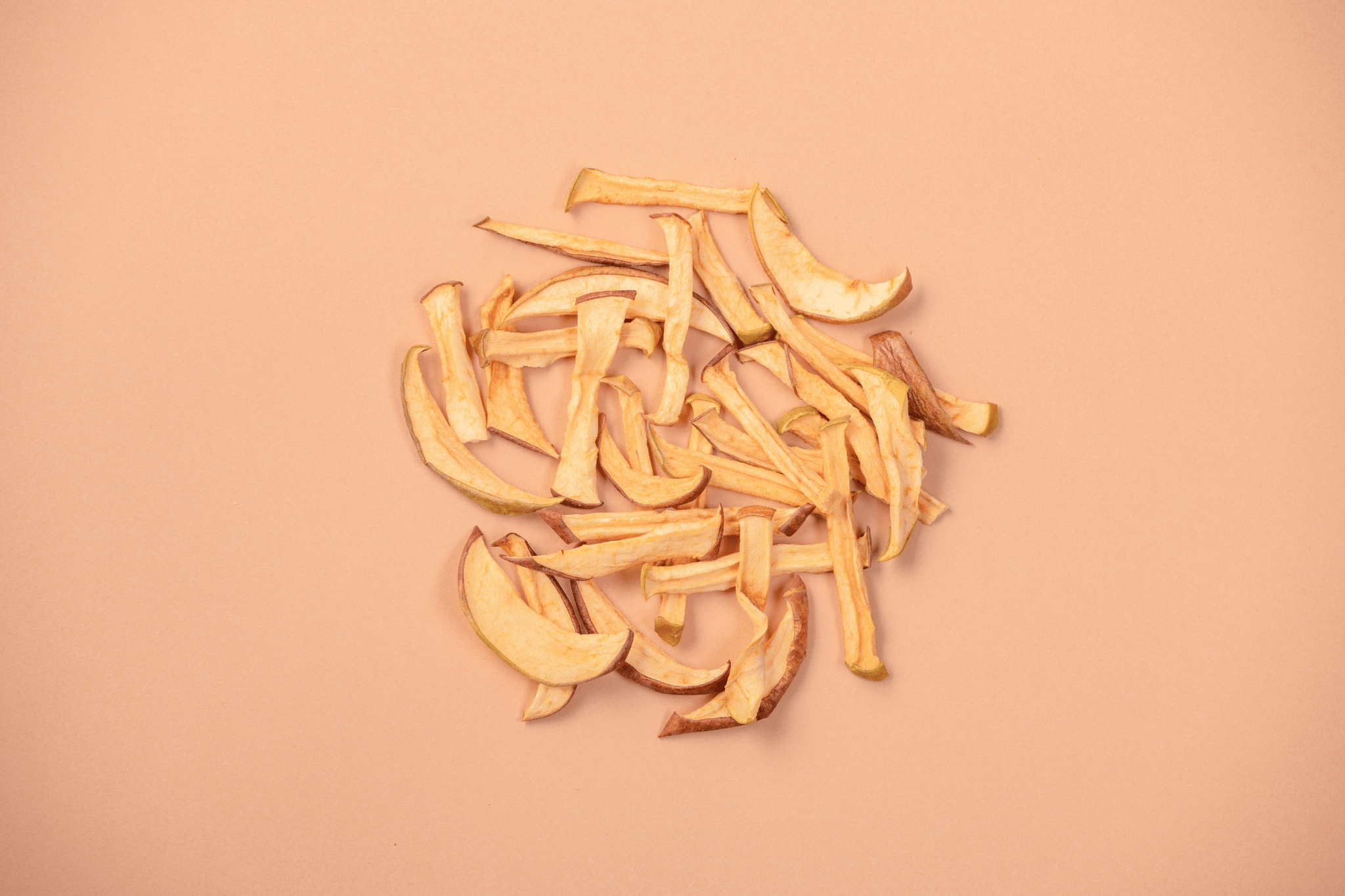
- Made with honey-cored "leaf-unremoved Shinshu apple"
- Sugar-free, dense natural sweetness
- Available in two forms, stick and dice
- How to Choose Genuine Fair Trade Products: 5 Criteria and How to Tell
- Differences among apple growing regions? Comparing Aomori, Nagano, and Yamagata
Author of this article
Related articles
-
 Preventing vegetable shortfall while dieting | Add dietary fiber with dried vegetables
-
 Aojiru vs. vegetable juice vs. dried vegetables, thoroughly compared | Which method truly works for beating vegetable deficiency?
-
 What is yakuzen? Its meaning, the difference from kampo, and the basics of starting with familiar ingredients explained
-
 What's the Difference Between Yakuzen and Kampo? A Gentle Look at Food vs. Crude Drugs, Purpose, and Philosophy
-
 Assembling domestically grown yakuzen ingredients: the difference between familiar vegetables and imported crude drugs
-
 What Is Ichimi Togarashi? The Difference from Shichimi, Ingredients, Uses, and How to Choose
-
 What is huajiao? We have sorted out the difference between huajiao, hojiao, and sansho
-
 What are the types of sansho? A list of the differences between mi-zansho, kona-zansho, and ao-zansho