
We Prototyped "Dried Lemon Slices" Using Domestically Grown Lemons

This time, at Agriture we prototyped “dried lemon slices” using domestic lemons. So that they can be used as a garnish for cocktails and drinks, we dry them in a thinly sliced state.
The lemon peel portion tends to retain its yellow even after drying, while the pulp portion is characterized by changing to a brown or reddish color when dried. The appearance differs from fresh lemon slices, but this color change is favorably accepted in the world of craft cocktails and herbal teas as a texture unique to dried lemon.
Dried lemon slices can be used as a topping for cocktails, sours, and carbonated water, as well as a flavor material floated in black tea or herbal tea. It is a product for which inquiries can be expected as a commercial garnish for restaurants or as a material for gift-oriented drink kits.
At Agriture, we make proposals for OEM manufacturing of dried vegetables and fruit and for commercial raw materials. You can consult with us about the processing of dried lemon slices, starting from prototyping.
TOC
Characteristics of dried lemon slices and focal points of processing
Dried lemon slices are a material made by round-slicing lemons and drying them. Their greatest characteristic is that they include the peel, pulp, and seeds as-is and can be used by floating them straight into cocktails or herbal tea. In the drying process the pulp portion discolors to brown or reddish, but because the peel’s yellow remains, the look when floated is sufficiently secured. Inquiries are increasing as a PB material for restaurants and as a gift product. Lemon product page you can confirm the existing specifications here.
Color change from drying and countermeasures
The most important thing in the quality design of dried lemon slices is the color change. We have organized the relationship between drying conditions and color.
| Part | Before drying | After drying | Notes |
|---|---|---|---|
| Peel (outer) | Vivid yellow | Yellow to slightly brownish | Color retention is good |
| Pulp | Pale yellow, with translucency | Brown to reddish brown | Discoloration from Maillard reaction + oxidation |
| Seeds | White to pale yellow | Brown | Removal is also possible depending on the use |
The pulp discoloration is due to the reaction of the lemon’s sugars and acids, and there is no quality problem. When floated in a cocktail or tea, the peel’s yellow stands out, so the appearance evaluation is favorable.
You can check the details of turnip's powder form on the
Dried lemon slices discolor in the pulp to brown or reddish, but this is a natural reaction during drying. Used as a cocktail garnish, the peel’s yellow stands out and the appearance is sufficiently beautiful. For requests like “I want slices with a beautiful color,” we recommend prototyping that controls the degree of discoloration by adjusting the drying temperature.
.
Dried lemon slices are mainly used to “float,” “decorate,” and “steep.” We introduce ideas by use.
Cocktails / craft drinks
Dried lemon slices can be used as a cocktail garnish simply by floating them into the glass as-is. Unlike fresh lemon, they can be stored long-term, raising restaurants’ operational efficiency.
- Cocktail garnish (gin and tonic, mojito, sangria)
- Topping for craft lemonade and lemon soda
- Accent for highballs and beer cocktails
Herbal tea and fruit tea
Floating dried lemon slices in black tea or herbal tea adds a citrus aroma and visual gorgeousness. It is also a material suited to set products with tea bags.
- Set products of dried lemon tea
- Blend material for fruit herbal tea
- PB tea material for cafés
Confectionery and sweets
You can use lemon slices as a decoration material—placing them straight onto chocolate or decorating the top of a pound cake.
- Topping for chocolate and bonbons
- Decoration for pound cakes and tarts
- A gorgeous accent for baked-sweets gifts
Gift and packaged products
Dried lemon slices are beautiful in appearance and a material that looks good in the packaging of gift products. List of dried-vegetable products please also consider combinations with other dried fruits here.
- The star material of a dried-fruit assortment gift
- Hot-drink kit (lemon + honey + ginger)
- Seasonal gifts for ochugen and oseibo
FOR BUSINESS
乾燥レモンを、原料としてお探しですか
国産のレモンを乾燥・粉砕してお出ししています。カット形状や粒度の指定、継続してのお取引もご相談ください。規格は 乾燥レモン・Lemon Powder に掲載しています。
少量でのご購入は、姉妹ブランドの通販サイト OYAOYA で承っています。
A base raw material for vegetable bouillon and dashi powder
We have summarized the representative specifications for commercial lots of dried lemon slices.
A vegetable base powder for baby food
| Item | Agriture's manufacturing specs and OEM support |
|---|---|
| Raw materials | Domestic lemon |
| Manufacturing spec | Round slices (thickness adjustable) |
| Processing plant | Our own processing plant within Kyoto Prefecture |
| Additives | Domestic turnip |
| Best-before date | About 6 months from the shipping date |
| Processing shape | From 1 kg of raw material |
| Main production lot | Slice / dice cut / powder |
| Not used | Minimum prototyping lot |
Customization support
- Slice thickness: adjustable from about 3 mm to 5 mm (the thinner, the faster the rehydration)
- With or without seeds: a seed-removed finish can also be accommodated
- Packaging: individually wrapped small pouches, 500 g bags, 1 kg bags
- Shape: slice (for pickles), dice cut (for ingredients), powder
- Set: assortment with other dried fruits supported
Blending: pre-blend support with other dried vegetables
Because dried lemon slices change in color and texture with slice thickness and drying conditions, we recommend comparison at the prototype stage.
- dried vegetable / powder OEM inquiry form Let us know the prototype details, desired slice thickness, and intended use from
- Share the acceptable color range and use in a concept hearing (Zoom or email)
- We ship prototype samples in units of 1 kg of raw material (usually 2–3 weeks). Comparison prototyping of different thicknesses is possible
- Contact us with the prototyping content, desired shape, and assumed application via
- Share the requirements of the blending destination in a concept hearing (Zoom or email)
If you tell us the use—such as “I want to make a cocktail garnish” or “I want to put it in a tea set”—we will propose the balance of slice thickness and finished color.
Product catalog showing the items we handle
Flexible support from small lots to large lots
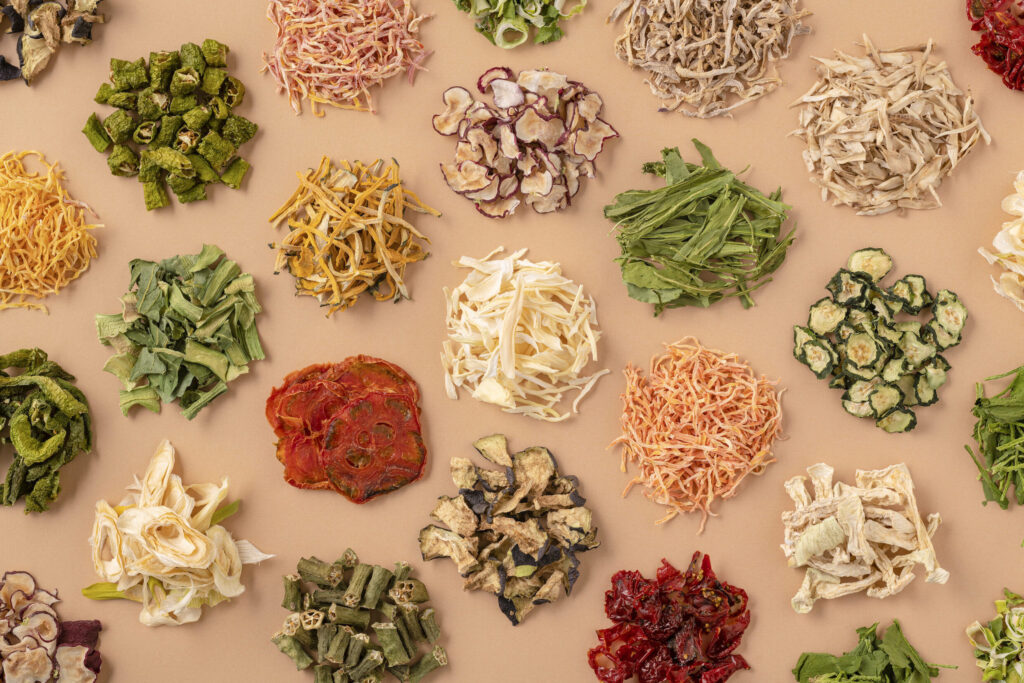
- Sold in small lots from 1 kg
- Handling heirloom vegetables from across Japan
- Dried fruits and herbs also supported
FOR BUSINESS
乾燥レモンを、原料としてお探しですか
国産のレモンを乾燥・粉砕してお出ししています。カット形状や粒度の指定、継続してのお取引もご相談ください。規格は 乾燥レモン・Lemon Powder に掲載しています。
少量でのご購入は、姉妹ブランドの通販サイト OYAOYA で承っています。
Frequently asked questions
Q. Is there a quality problem with the pulp turning brown?
A. There is no quality problem. It is a natural discoloration due to the reaction of the lemon’s sugars and acids (Maillard reaction and oxidation). Because the peel’s yellow remains, the look when floated in a cocktail or tea is good.
Q. Can the seeds be removed?
A. A seed-removed finish can also be accommodated. However, because the amount of seeds varies by lemon variety and individual differences, guaranteeing complete removal may be difficult. Please confirm at the prototype stage.
Q. Can I choose the thickness of the slices?
A. It can be adjusted within a range of about 3–5 mm. Thin slices suit tea use (rehydrate quickly), and thicker slices suit cocktail garnishes (giving presence).
Q. Can it be set with other dried fruits?
A. Yes. We also support assortments with the dried fruits and dried vegetables that Agriture handles. Product listing page Please check the specifications on
Q. Can it be blended with other dried vegetables?
A. It can be combined with the 60-plus dried vegetables handled by Agriture. Please check the items handled on
Related pages and further reading
- We Prototyped "Dried Piman (Bell Pepper)" Using Domestically Grown Piman
- We Prototyped "Dried Shimonita Negi" Using Domestically Grown Shimonita Negi
Author of this article
Related articles
-
 We Prototyped "Chestnut Skin Powder" Using Domestically Grown Chestnut Skins
 -
 A Notice About the Rose Prototype
 -
 We produced a prototype of dried cactus made from domestic cactus (nopal)
 -
We Made a Prototype of Dried Blueberry Leaf Using Japanese-Grown Blueberry Leaves
-
 We Prototyped "Basil Powder" Using Domestically Grown Sweet Basil
 -
 We Prototyped "Purple Chili Powder" Using Domestically Grown Purple Chili
 -
 We Prototyped "Asparagus Powder" Using Domestically Grown Asparagus
 -
 We Prototyped "Green Papaya Powder" Using Domestically Grown Green Papaya