ウェルネスとは?意味と、健康・ウェルビーイングとの違い

More and more HR, general affairs, and corporate planning staff are asking us, “What exactly is wellness?” and “How does it differ from health management?” Wellness is not simply about promoting health; it is a holistic concept that encompasses physical, mental, and social well-being.
This article gives a simple overview of what wellness means, the eight-dimensional model, how it differs from health management, real-world corporate examples of wellness adoption, and three steps you can start on your own.
TOC
What is wellness? A simple explanation
Wellness refers to actively pursuing a better physical, mental, and social state—not merely being free of illness. The concept was introduced in the 1950s in lectures by the American physician Dr. Halbert Dunn and became widely known through his 1961 book “High-Level Wellness.” Going a step beyond “health,” it spread as a positive view of health that includes a sense of purpose, happiness, and social participation.
It overlaps considerably with the WHO (World Health Organization) definition of health as “a state of complete physical, mental, and social well-being,” and today it is applied across a wide range of fields such as medicine, food, exercise, sleep, mental care, and the workplace environment.
Wellness in one minute
- Definition: A concept of pursuing positive health in which body, mind, and society are all in good condition
- Keywords: QOL (quality of life), well-being, health promotion
- Related fields: diet, exercise, sleep, mental care, social participation, career
- Who it applies to: multi-layered—from individuals and families to workplaces and local communities
- The difference: unlike “health,” which tends to be seen medically as “the absence of illness,” wellness is a positive view of health that also includes the mind, society, and a sense of purpose
The eight dimensions of wellness
To capture wellness from multiple angles, the basic framework is the six-dimensional model proposed by Dr. Bill Hettler in the United States National Wellness Institute , which the U.S. SAMHSA (Substance Abuse and Mental Health Services Administration) and others expanded by adding financial and environmental dimensions into the “eight-dimensional model,”a system that is now widely known. In the design of health management and employee benefits at Japanese companies, initiatives that keep these eight dimensions in mind are increasing.
| Dimension | Meaning | Examples |
|---|---|---|
| Physical | Exercise, diet, sleep, condition management | Moderate exercise, healthy eating habits, health checkups |
| Mental (emotional) | Recognizing emotions and dealing with them in healthy ways | Stress management, meditation, counseling |
| Social | Connections with family, workplace, and community | Community participation, building relationships |
| Intellectual | Learning, curiosity, creativity | Reading, reskilling, taking on new challenges |
| Occupational | Job satisfaction and views on one’s career | Work that fits one’s aptitude, fulfilling work, career development |
| Environmental | Living environment, nature, workplace space | Contact with nature, a well-organized workplace environment |
| Spiritual | Values, outlook on life, the search for meaning | Meditation, beliefs, volunteering, self-reflection |
| Financial | Economic stability and future planning | Household budgeting, saving, building assets |
If any one of the eight dimensions declines sharply, overall wellness tends to fall apart. Being mindful of balance and keeping each in order leads to long-term health and a sense of purpose.
FOR BUSINESS
乾燥野菜を業務用でお探しですか
国産の野菜・果物を乾燥し、必要に応じて粉砕してお出ししています。扱っている品目は100種前後で、規格は 乾燥品の一覧・パウダーの一覧 に掲載しています。
少量でのご購入は、姉妹ブランドの通販サイト OYAOYA で承っています。
What is the difference between wellness and health management?
“Wellness” and “health management” are often confused, but they differ in perspective, purpose, and metrics. A comparison looks like this:
| Aspect | Wellness | Health management |
|---|---|---|
| Actor | Individuals and society | Companies and management |
| Purpose | Improving QOL and a sense of happiness | Improving labor productivity and business performance |
| Scope | Multidimensional: body, mind, society, career, and more | Mainly improving the health of employees |
| Metrics | Subjective happiness, QOL scores | Health checkup results, turnover rate, presenteeism |
| Background | Developed from the 1950s in the U.S. (Dr. Dunn) | From the 1990s onward; in Japan it took off in earnest with METI’s 2014 initiatives |
“Wellness management” and “health management 2.0”As these terms suggest, initiatives that integrate wellness and health management are also spreading. The “Certified Health & Productivity Management Outstanding Organizations Recognition Program” promoted by the Ministry of Economy, Trade and Industry sets multifaceted evaluation items such as diet, sleep, work fulfillment, and mental health, making it an area with broad points of contact with the idea of wellness (reference: Ministry of Economy, Trade and Industry: Health & Productivity Management Outstanding Organizations Recognition Program)。
5 corporate wellness initiatives
When a company adopts wellness, there are several entry points such as employee benefits, talent strategy, office environment, and dietary support. Here we introduce the direction of five representative initiatives.
1. Office food (in-house stocked food and cafeteria support)
This is an initiative to keep vegetables, dried foods, and healthy snacks stocked in the office to help improve employees’ eating habits. Because setting up a new company cafeteria is a heavy burden, benefit services that combine regular delivery with in-office stocking are being chosen.
Office Yaoya, operated by Agriture, Office Yaoya (office greengrocer) lowers the barrier to office adoption in the following ways.
- Centered on shelf-stable dried vegetables: can be placed even without a large refrigerator in the office
- Regular delivery and small-pack options: low operational burden for the person in charge and minimal waste
- Cost kept down through non-standard produce and direct-from-farm sourcing: easy to sustain even on a limited benefits budget
- Seasonal Kyoto-grown vegetables plus healthy snacks: a lineup employees can look forward to
It is a system that lets even small and mid-sized companies, startups, and branch offices without a cafeteria start their wellness efforts from the dietary area.
2. Enhanced health checkups and preventive care
This is a preventive approach in partnership with medical institutions, including expanded options for regular checkups, subsidies for comprehensive medical exams, specific health guidance, and lifestyle-disease prevention programs. Early detection and intervention lead to lower medical costs and greater peace of mind for employees.
3. Mental health care and counseling
This includes introducing an EAP (Employee Assistance Program), placing in-house counselors, conducting regular stress checks, and offering meditation and mindfulness programs. Since the COVID-19 pandemic, interest in mental health has continued to rise, making it a key area of corporate wellness measures.
4. Diversifying benefits (fitness, sleep, exercise)
These are measures that support physical wellness, such as corporate gym memberships, yoga and Pilates subsidies, sleep-improvement apps, and health point systems. At companies centered on remote work, subsidies for fitness apps and online training subscriptions are also increasing.
5. Wellness tourism and employee training
These include employee training in rural areas, hot-spring towns, and nature-rich environments; wellness-tourism-style off-site meetings; and team building that incorporates farming experiences. In Japan, organizations such as the Wellness Tourism Association have developed certified programs, and the Japan Tourism Agency is also promoting community-linked wellness tourism.
3 steps to start wellness on your own
Wellness is not only for companies—individuals can start today. Since it is hard to balance all eight dimensions at once, we recommend tackling them in the following three steps, in order of ease.
STEP 1: Get your physical wellness in order
- Be conscious of vegetables, protein, and fermented foods in every meal
- Get around seven hours of sleep a day
- Incorporate aerobic exercise (walking or jogging) three times a week
STEP 2: Get your mental and social wellness in order
- Manage stress with five minutes a day of meditation or breathing exercises
- Make time for conversation with family, friends, and coworkers
- Maintain social connections through hobbies and community activities
STEP 3: Cultivate intellectual, occupational, and financial wellness
- Reading, relearning, and acquiring new skills
- Reflecting on work fulfillment and career outlook, and setting goals
- Reviewing household finances and planning for the future (NISA, iDeCo, insurance)
The Ministry of Health, Labour and Welfare operates e-Healthnet, where experts explain wellness information across fields such as exercise, diet, and sleep. Please refer to it as well.
Trends in the wellness industry and related terms
The global wellness industry continues to grow rapidly; according to the Global Wellness Institute, the wellness economy reached USD 5.6 trillion worldwide (2022). In Japan too, the market is expanding in fields such as wellness food, wellness tourism, and health tech.
Related terms worth knowing
- Fasting: a health practice of restricting food for a set period. Positioned within the dietary area of wellness.
- Plant-based: a diet centered on plant-derived foods. A prime example of wellness combined with sustainability.
- Sustainable: a concept closely tied to environmental wellness as well.
- Functional vegetables: vegetables with enhanced nutrition or added value. A core part of wellness food.
- Well-being: used almost synonymously with wellness and highly valued in corporate management as well
Learn about Office Yaoya
We have prepared materials
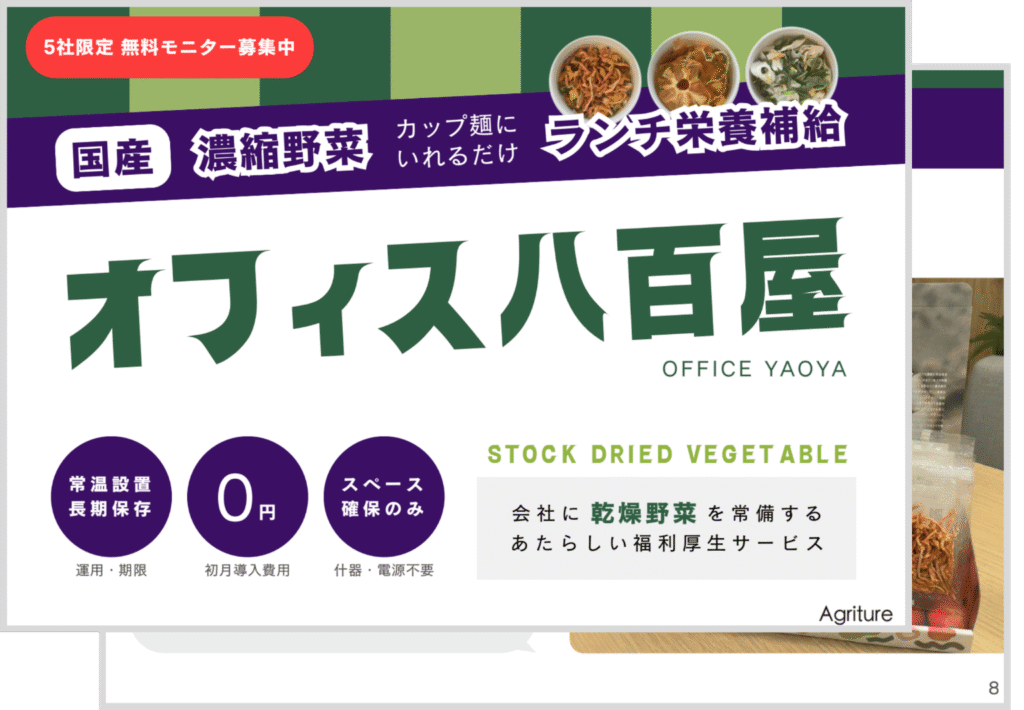
- Service details and vegetable lineup
- Pricing and plans
- How adoption and operation work

Sample sets are also available. Download the materials for details!
We offer sample sets so you can try Office Yaoya in small quantities. See the materials for details.
Summary: wellness works through both companies and individuals
Wellness is a holistic concept of pursuing positive health across body, mind, and society. Although its perspective differs from that of health management, combining the two makes for an initiative that is valuable to both companies and employees.
The key to successful wellness is to start without strain—individuals from whichever of the eight dimensions is easiest to begin with, and companies through a combination of diet, health checkups, mental care, and benefits. Agriture supports the dietary area of corporate wellness through Office Yaoya (office greengrocer) and wholesale and OEM of commercial dried vegetables , both easy to keep up even in a busy office.
FOR BUSINESS
乾燥野菜を業務用でお探しですか
国産の野菜・果物を乾燥し、必要に応じて粉砕してお出ししています。扱っている品目は100種前後で、規格は 乾燥品の一覧・パウダーの一覧 に掲載しています。
少量でのご購入は、姉妹ブランドの通販サイト OYAOYA で承っています。
FAQ
Recommended reading
Download the office dried vegetable materials
We will send the materials to your email address based on the information you provide.