
Food industry trade show trends 2025 | The latest developments to keep in mind

Summary of this article
In 2025, food-industry trade shows such as FOODEX JAPAN and FOOMA JAPAN, along with other large-scale exhibitions, run from January to December across the country. This article explains the autumn-winter schedule for JFEX Winter, FABEX Kansai, FOOD STYLE Fukuoka, and others; FOODEX JAPAN and the Food & Beverage OEM Expo in spring 2026; and the three values of attending—grasping the latest trends, developing new business partners, and validating market fit.
From raw-material sourcing to manufacturing and import/export, trade shows that span the entire supply chain Trade show are held one after another, becoming a not-to-be-missed venue for deals and trend discovery for industry players. Yet with so many trade shows held, many wonder “which event should I attend?” and “what can I gain?”
This article explains in detail the latest trends at the major food-industry trade shows held in 2025 and the concrete benefits you can gain by attending.
Recommended reading
An overview of 2025 food-industry trade shows
For the food industry, 2025 is a banner year for trade shows.
From January to December, large-scale trade shows are held almost every month across the country. Especially noteworthy is the strong lineup of industry-representative events, such as “FOODEX JAPAN,” Asia’s largest of its kind, and “FOOMA JAPAN,” one of the world’s largest comprehensive food-manufacturing shows.
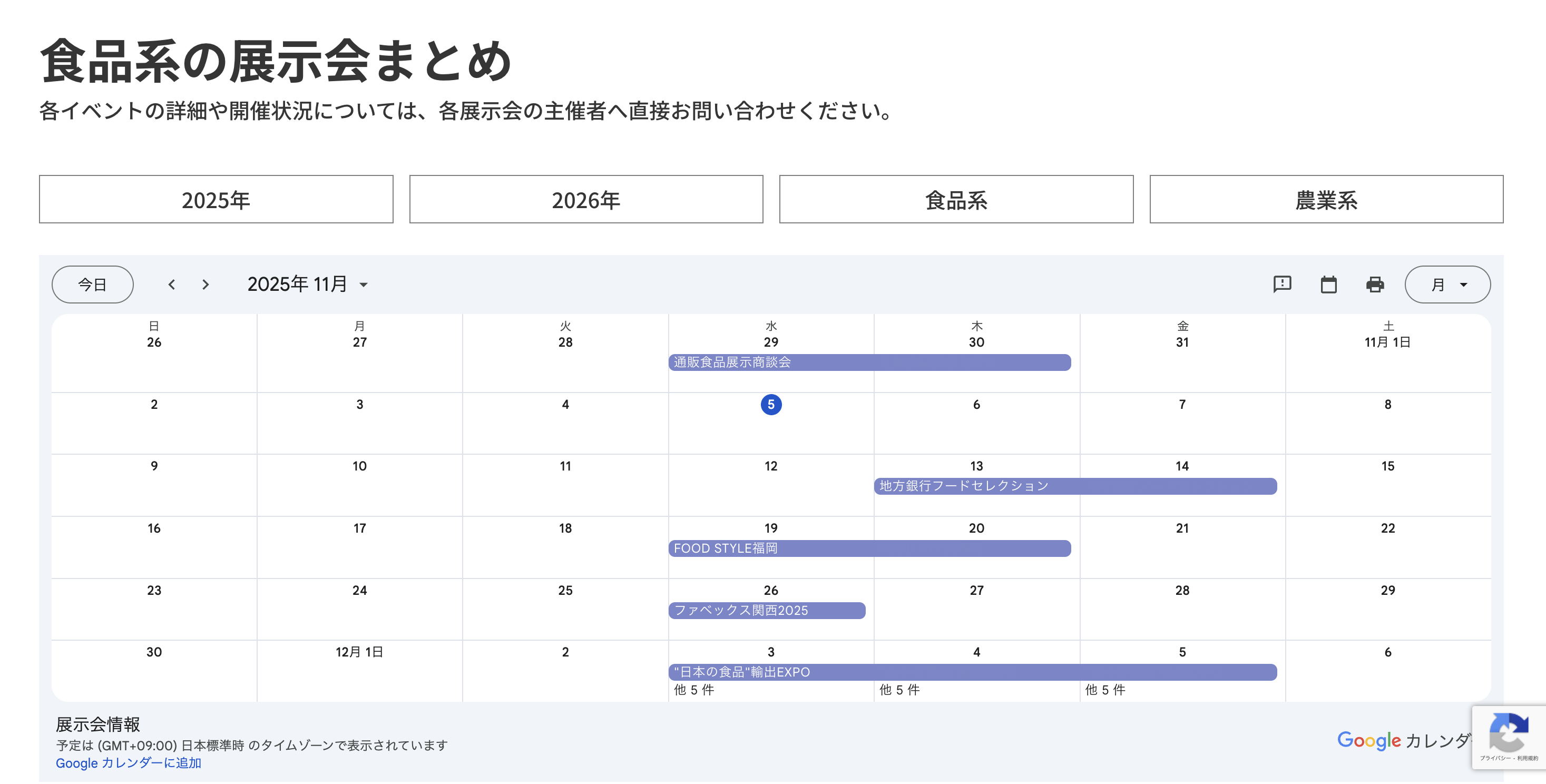
Schedule of major trade shows
From autumn through year-end, the food industry holds large-scale trade shows one after another.
In October, the “Mail-Order Food Exhibition and Business Meeting” is held at the Tokyo Kotsu Kaikan, gathering regional specialties and mail-order gift products in one place. It’s a trade show that offers small and mid-sized businesses a springboard for expanding sales channels and forming new partnerships.
In November, the “Regional Bank Food Selection” is held at Tokyo Big Sight. Many food and agriculture companies recommended by regional banks nationwide exhibit, offering the chance to encounter locally born brands and new food businesses. That same month, “FOOD STYLE Fukuoka” takes place at Marine Messe Fukuoka, an important business-meeting opportunity for companies aiming to expand into the restaurant, prepared-food, and retail industries. Furthermore, in late November, “FABEX Kansai 2025” is held at INTEX Osaka, showcasing the latest technologies and products supporting food manufacturing and distribution, centered on the western Japan region.
In December, “JFEX Winter (7th International Food & Beverage Trade Week)” is held at Makuhari Messe. Specialized shows related to food, beverages, and import/export converge, an international trade show where domestic and overseas buyers do business. Around the same time, shows such as “Drink Japan” and “Food Factory Week” related to manufacturing, processing, and beverages are co-located, strengthening collaboration across the industry.
Toward the 2026 trade-show season
In early January, “FABEX Tokyo” is held at Ikebukuro Sunshine City, drawing attention as a business venue that colors the food industry’s new year. In February, “International Hotel & Restaurant Show” and “Food Catering Show” are co-held at Tokyo Big Sight, letting you check the latest trends in the restaurant, lodging, and catering fields all at once. At Makuhari Messe, large-scale events for the retail and distribution industries continue, such as “Supermarket Trade Show” and “Cafe Show Japan.”
In spring, “FOODEX JAPAN” is held at Makuhari Messe, bringing together food and beverage industry players from home and abroad. At Tokyo Big Sight, “Food & Beverage OEM Expo,” “Premium Food Show,” and “Dessert, Sweets & Bakery Show” are co-held, with active dealmaking across a wide range of fields from processed foods to OEM and sweets.
In May, “Hobby Cooking Fair” and “Kore kara no Shokutaku Ten (The Dining Table of the Future)” are held at Tokyo Big Sight, spotlighting consumer products and home cooking appliances. In Kyushu, “West Japan Food Industry Creation Expo ’26” is held at Marine Messe Fukuoka, drawing popularity as an event that supports the development of the regional food industry.
Into summer, “FOOMA JAPAN,” “ifia JAPAN,” and “Health Food Expo” are held at Tokyo Big Sight, sharing the latest technologies and market trends in food manufacturing and functional foods. In late June, “Japan Food Export EXPO” and “International Food Logistics EXPO” are also held, drawing attention as trade shows covering export/import, logistics, and materials.
In autumn, events covering everything from manufacturing to product planning—such as “FOOD STYLE Tokyo,” “Food Factory Week 2026,” and “Food Development Exhibition 2026”—are held in Tokyo and Osaka. In November, “FOOD Exhibition 2026” takes place at Tokyo Big Sight, showcasing the latest trends in the food business.

3 values you gain by attending trade shows
Attending a trade show offers value beyond mere information gathering.
Grasping the latest trends and understanding industry movements
The food industry is a field of intense technological innovation and shifting trends. At trade shows, you can grasp the latest movements across the entire supply chain—from raw-material sourcing to manufacturing technology, packaging, and import/export—all at once. In 2025 in particular, themes like sustainability, health consciousness, and digitalization are emphasized at each show, letting you feel these trends firsthand.
“JFEX (International Food & Beverage Trade Week)” is composed of five product-specific shows—processed foods, wine and spirits, premium foods, fresh foods, and foods for inbound tourism—letting you efficiently research foods and related services from around the world. At such highly specialized trade shows, you can intensively gather information directly tied to your own business domain.
Developing new business partners and business matching
Trade shows are a valuable opportunity to speak directly with companies and overseas buyers you don’t usually have contact with. By using appointment-based business meetings, you can efficiently advance discussions with your target companies. Because buyers from a wide range of food-related industries—retail, restaurants, hotels, wholesalers, distributors—attend, you can tailor your promotion to your target.
In fact, one exhibitor said, “It’s great to meet overseas new customers, domestic buyers, and existing customers all at once,” while another felt the show’s value: “We were able to connect with people from countries we’d never had contact with.” There are even reports of receiving business inquiries from Europe, North America, and various Asian countries—showing that trade shows serve as a starting point for international business expansion.
Validating a product or service’s market fit
For companies wanting to confirm which market a new product resonates with, trade shows are an ideal venue for test marketing. By directly observing visitors’ reactions and gathering feedback, you can put it to use in product improvement and adjusting your sales strategy. There are also many chances to be picked up by media, achieving effective promotion while keeping advertising costs down.
A guide to notable trade shows by field
Food-industry trade shows each specialize in a particular field or purpose.
Manufacturing and technology trade shows
“FOOMA JAPAN” is one of the world’s largest comprehensive shows bringing together machinery, equipment, and technology for food manufacturing. With roughly 1,000 or more exhibitors, you can see and touch the latest manufacturing technologies and efficiency solutions in person. “MOBAC SHOW,” specialized in the baking and confectionery industry, also drives industry innovation through exhibits of specialized machinery, equipment, and tools, as well as raw materials and supplies.
Business-meeting and distribution trade shows
“Supermarket Trade Show” boasts a 59-time history as a business-meeting exhibition delivering the latest information to the food-distribution industry centered on supermarkets. Many buyers from retail, wholesale and trading, prepared foods, and restaurants nationwide attend, functioning as a venue that leads to new sales channels and business opportunities.
“FOOD STYLE Japan” and “FOOD STYLE Kansai” are important business-meeting-style trade shows for companies aiming to expand into the restaurant, prepared-food, and retail industries. At “FOOD STYLE Kansai,” one of the largest of its kind in the Kansai region, you can develop sales channels centered on the western Japan area.
Field-specialized trade shows
The seafood industry has “Japan International Seafood Show” and “Seafood Show Osaka,” exhibition and business-meeting events focused on fish and marine products under the theme of further popularizing fish consumption. In agriculture, “Agri Week” and “International 6th-Industrialization EXPO” cover a wide range from agricultural materials, technology, and services to sixth-sector industrialization.
Specialized to the restaurant industry, “Restaurant Solution EXPO,” “Yakiniku Business Fair,” and “Izakaya JAPAN” each provide venues for problem-solving and new discoveries tailored to their respective business formats, offering active business-meeting opportunities.
Points for using trade shows effectively
To make the most of attending a trade show, advance preparation is required.
Clarifying your purpose and doing prior research
First, clarify your purpose for attending. Depending on the goal—developing new partners, researching the latest technology, competitive analysis, grasping trends—the booths to visit and seminars to attend will change. Exhibitor and product search sites are often published in advance, so listing the companies you want to visit is efficient.
At large-scale trade shows like “FOODEX JAPAN” in particular, using appointment-based business meetings lets you reliably secure meeting opportunities with target companies. Build a promotion strategy tailored to your target and use your time efficiently.
Making use of seminars and events
Many trade shows have adjoining seminars on the latest industry trends and problem-solving. At “Food Business Frontline Seminar” and various specialized seminars, you have a valuable chance to learn directly from industry-leading companies and experts. Hands-on programs such as tasting events are also highly effective for understanding a product’s features with all five senses.
The importance of follow-up
For the business cards and information gained at a trade show, the follow-up afterward determines success or failure. Contact companies with business potential right after the show ends, and present concrete proposals and next steps. A trade show is only the beginning—the continued communication afterward is the key to business success.
Summary: Use trade shows strategically
The 2025 food-industry trade shows offer a rich variety of events covering the entire supply chain, from raw-material sourcing to manufacturing and import/export. Grasping the latest trends, developing new business partners, validating a product’s market fit—the value you gain from attending is immeasurable.
By clarifying your purpose, doing thorough prior research, and making use of seminars and events, you can maximize your investment in a trade show. Efficiently gathering trade-show and exhibition information specialized in the food, beverage, and agriculture fields and selecting the events suited to your company is the first step to success.
Trade shows in the food, beverage, and agriculture fields held in Japan have become an indispensable business tool for industry players. Do use them strategically and seize your business opportunities.
If you’d like to know more about food-industry trade-show information,Trade showcheck the latest schedules, exhibit targets, and notable industry themes
If you are considering product development with off-spec or your own farm's vegetables:From planning to processing, materials, package printing and novelties, you can consult us through a single point of contact. → Learn more about one-stop product development
FOR BUSINESS
乾燥野菜のOEM・受託加工を承ります
国産の野菜・果物の乾燥、100メッシュ相当までの粉砕、10g以上の小袋充填までをお受けしています。小ロットの試作から量産までご相談ください。寄せられた相談の実例は OEM・卸のご相談 に掲載しています。
乾燥品の賞味期限は、出荷日から6ヶ月程度を目安にご案内しています。
- How to Use OEM Matching Sites: Efficiently Finding the Optimal Manufacturing Partner
- A guide to preparing for a trade show | Schedule, costs, and checklist
Author of this article
Related articles
-
 Original coffee marketing strategy | Ways to grow sales
 -
 ベジタリアンとは?国の規格が分けている4つの区分と食べられないもの
 -
 長ねぎと白ねぎは同じもの?ねぎの種類と呼び名を国の資料で確かめる
 -
 柚子の種類は何種類あるのか、公の資料で名前が残る系統を数えた
 -
 ゆずの時期は年に二度、青ゆずは7月から黄ゆずは10月から
 -
 ゆずの産地は高知が半分を占め、二位は徳島から愛媛に変わった
 -
 Preventing Food OEM Failures: Common Failure Cases and Countermeasures for Success
 -
 How to find a food OEM | How to efficiently find the best manufacturing partner