Yuzu Powder: the Harvest Sets Your Window, Not Your Launch Date

Yuzu is the easiest Japanese ingredient to reach our minimum with and the hardest one to schedule. Those two facts are connected, and both come from the same place: the fruit arrives when it arrives, and it is strong enough that a retail bag holds very little of it.
If you are putting yuzu powder on a shelf outside Japan, the planning works differently from every other product we fill. Here is how.
目次
Two harvests, two different products
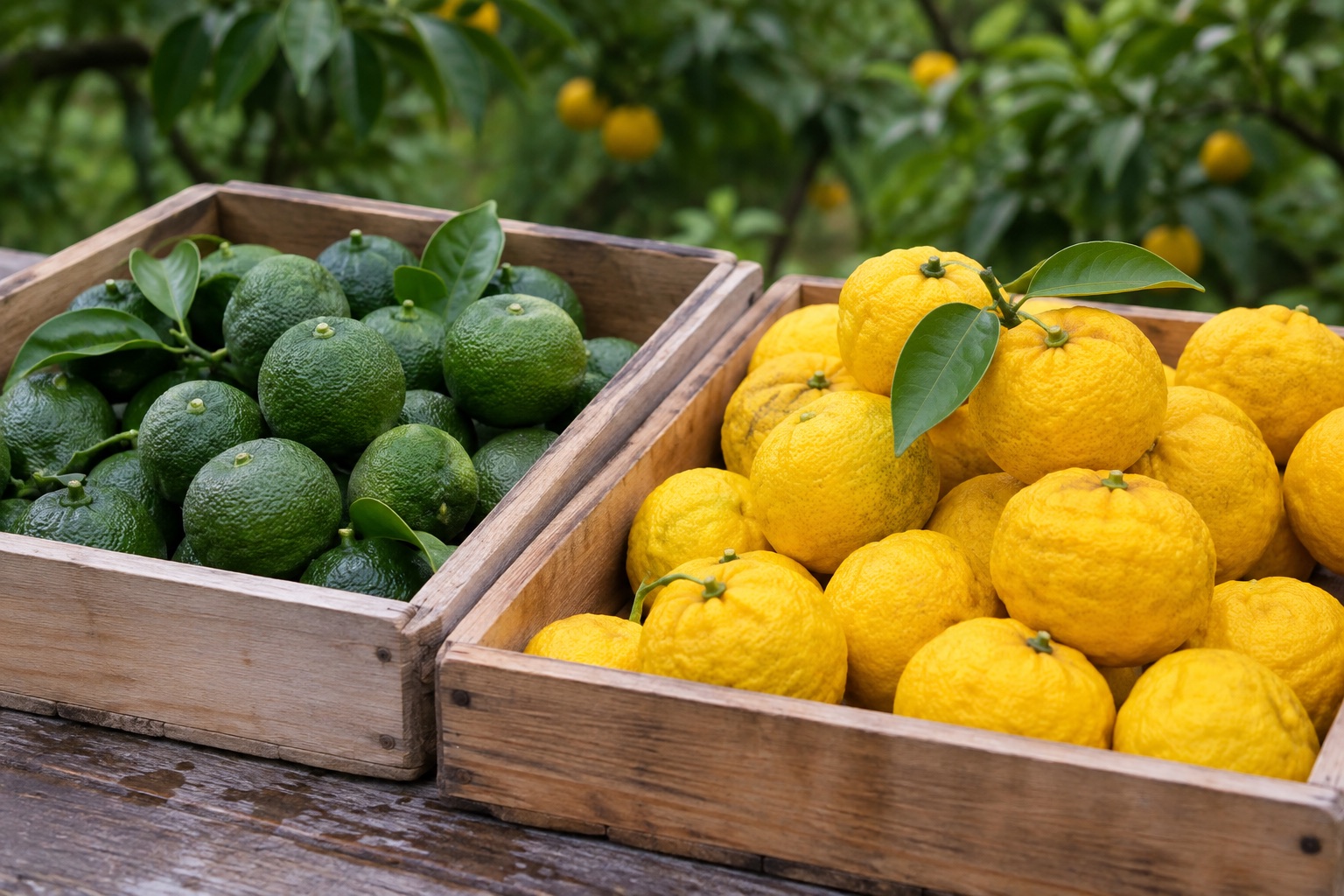
Yuzu comes in twice, and the two windows are nowhere near each other. Green yuzu is the unripe fruit, picked through the summer: July at the earliest, mostly through August into September. Yellow yuzu is the same fruit left on the tree to ripen. It starts colouring in November, the bulk of the crop comes in during December, and picking runs on into January.
They are not interchangeable in a product. Green yuzu is sharper and more herbal, yellow is rounder and more aromatic, and which one your powder was made from is decided months before anything reaches a bag. The exact dates also move by region and by grower, so treat the months above as the shape of the year. Get the actual picking window from your producer in writing before you plan around it.
| Harvest | Picked | Powder exists from | What that means for a launch |
|---|---|---|---|
| Green yuzu | July at the earliest, mainly August into September | September into October | An autumn fill, clear of every shutdown |
| Yellow yuzu | From November, peak December, into January | Late December into February | A fill that collides with the New Year close |
What this means for you is that your supply window is set by someone else’s calendar. Your producer makes the powder after the harvest, and the quantity that exists for a given season is finite. A yuzu project planned backwards from a launch date will fail at the first step. A yuzu project planned forwards from the harvest will not.
The order to do things in
- Agree the quantity with your producer before the harvest, not after it.
- Confirm which harvest the powder comes from, because it changes the product.
- Fix the packing dates once you know when the finished powder will exist.
- Work out the shipping leg out of Japan last.
The dates matter more here than for a year round ingredient, and yellow yuzu is where it bites. Fruit picked in December becomes finished powder in late December or January, which is exactly when the Japanese plants are closed. Put three to four weeks of filling on top of a January reopening and a yellow yuzu product you hoped to launch in January is really a February or a March launch. The Japanese factory calendar has the windows.
Which harvest to start with
If you are testing a market instead of committing to a range, green yuzu is the easier first order. The powder exists in the autumn, the fill lands clear of all three Japanese shutdowns, and nothing about the schedule is fighting you. Yellow yuzu is worth the trouble when the rounder aroma is the point of the product, but plan it as a two season project: agree the quantity before the November picking, and expect the finished bags in the spring.
Why 500 bags of yuzu is a small amount of yuzu
Our minimum is 500 bags per order and the fill price does not change with the gram weight. Yuzu is potent, so retail formats are small, which makes it one of the cheapest ingredients to clear the minimum with.
| Bag size | Net powder in 500 bags | What it suits |
|---|---|---|
| 5 g | 2.5 kg | Single use sachet, trial size |
| 10 g | 5 kg | The common retail seasoning size |
| 15 g | 7.5 kg | Retail shaker refill |
| 20 g | 10 kg | Larger retail / cafe format |
| 50 g | 25 kg | Wholesale & food service |
Read that middle column as the net weight that ends up inside the bags, not the weight to put on a pallet. Filling to a target weight always leaves a little in the machine and in the last part filled bag, so 2.5 kg shipped will not give you 500 full sachets. Tell us the weight you plan to ship with the bag count you want, and we will confirm the margin is comfortable before you book freight. The overage differs by material and format, which is why we check it instead of publishing a percentage.
Even with that margin, two and a half kilograms is a complete first order. Compare it with matcha, where a 30 g retail bag needs fifteen kilograms for the same 500 bags, and you can see why yuzu is a sensible product to test a market with before committing real money. The 500 bag minimum is counted across every size and recipe in one order, so a sachet plus a retail bag plus a wholesale pack can share a single run.
The cost side is the mirror image. At USD 0.65 a bag the fill is flat, so a 5 g sachet carries the same filling cost as a 50 g pouch. On very small formats the packing is a large share of the unit cost, which is why sachets usually make sense as a sample or as one component of a multi pack.
Bag choice for a citrus powder
Colour and aroma are most of what you are selling, and both are what a thin clear bag fails to protect. Citrus powders also tend to pick up moisture once a bag has been opened, which argues for a zipper on anything the customer uses more than once.
| Option | Size | Per piece | Why |
|---|---|---|---|
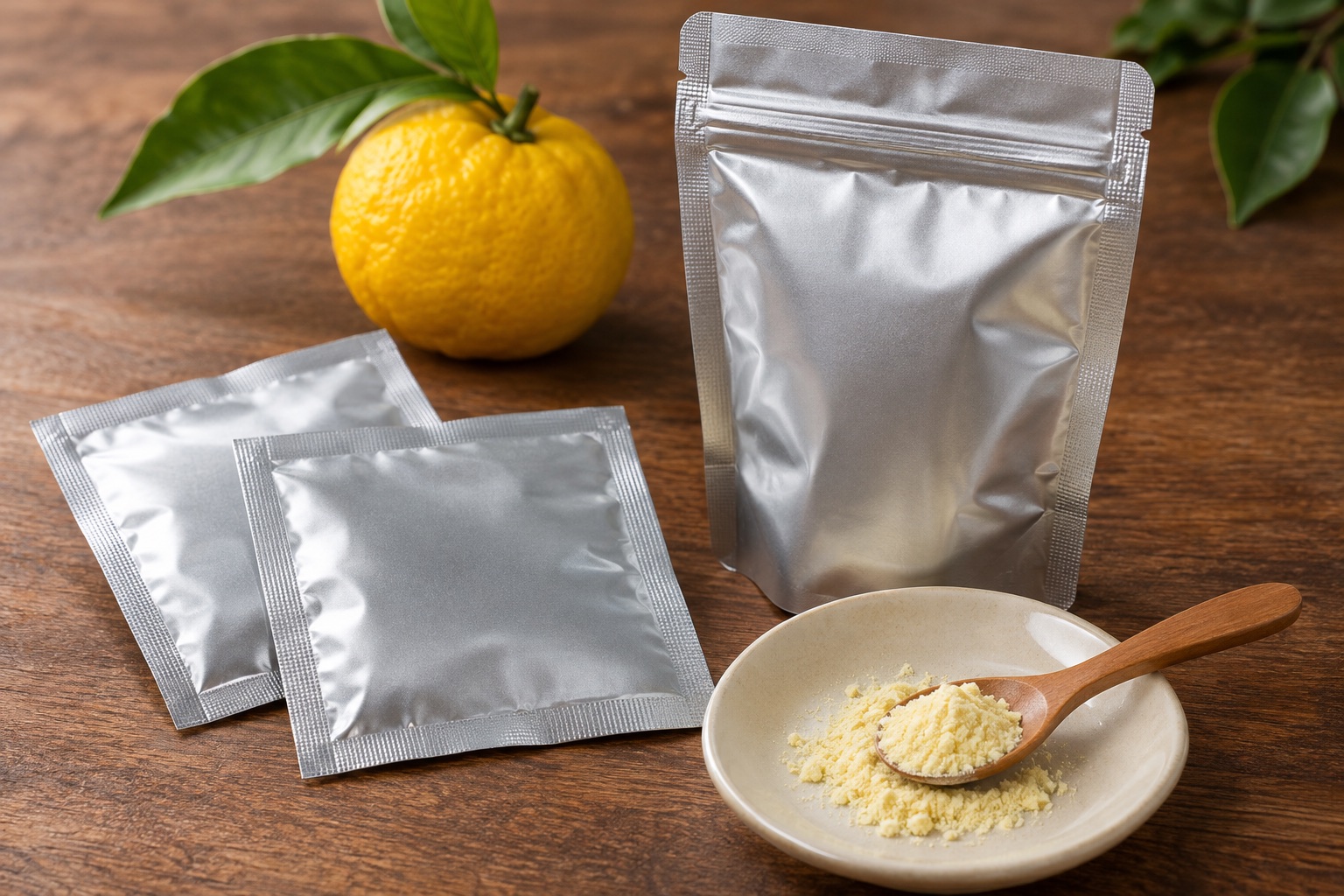
| Aluminium stand up pouch with zipper | 130 by 130 mm | USD 0.30 | The default for a retail yuzu bag |
| Biomass metallised kraft three side seal | 110 by 125 mm | USD 0.20 | Barrier with a paper face, good for sachets |
| Biomass metallised kraft stand pouch with zipper | 180 by 240 mm | USD 0.60 | Larger retail, craft look |
We fill and heat seal in ambient air on every format, with no nitrogen flushing and no vacuum. For yuzu that is less of a problem than it is for matcha, because the formats are small and a 10 g bag gets used up quickly, but it is still the reason to choose a barrier bag over a clear window. The full stock bag list has the rest of the options and what each costs.
What we will not do to it
We do not dry the peel and we do not mill it. The step that turns yuzu into powder belongs to your producer, and the powder reaches us finished and ready to weigh. We also do not develop blends, which matters for yuzu more than for most ingredients, because so much of what gets sold is yuzu plus something else.
- Yuzu salt, yuzu sugar or a yuzu seasoning mix: if it arrives already blended, it is an ordinary fill at USD 0.65 a bag.
- If the components arrive separately and you tell us the grams of each, we will weigh both into the same bag at USD 1.10. That is a filling job, not a recipe.
- If you want advice on the ratio, that is product development and it is not something we do at any quantity.
Stick packs are the one format the line genuinely cannot run, which is worth saying because a single serve yuzu seasoning stick is a common idea. Ask about any other shape before you design around it. The complete boundary is in what a packer will not do.
A worked first order
Five hundred 10 g retail bags, our stock aluminium pouch, one front label, five kilograms of powder from your producer.
| Line | Unit | 500 bags |
|---|---|---|
| Fill & seal | USD 0.65 per bag | USD 325.00 |
| Aluminium pouch with zipper, 130 by 130 mm | USD 0.30 per piece | USD 150.00 |
| Label application, one position | USD 0.15 per position | USD 75.00 |
| Set up fee, first order only | USD 130 once | USD 130.00 |
| Dispatch handling | USD 2.55 per shipment | USD 2.55 |
| Total | USD 682.55 | |
| Per bag | USD 1.37 | |
| Per bag on reorder | USD 1.11 |
The powder cost and the freight sit on top of that, and both are yours. What the table shows is that the packing side of a yuzu launch is under seven hundred dollars, which is usually the smallest number in the whole project.
What to tell us when you ask
- Which harvest the powder is from, and when it will physically exist.
- The bag size in grams and the total bag count.
- Whether it is yuzu alone or yuzu with something else already blended in.
- Whether you need a back label as well as a front one, at USD 0.15 each.
- The date you need finished stock in your own warehouse.
With the harvest date and the bag count we can tell you which dates are realistic, which for yuzu is the answer that actually decides the project. Rates, minimums and conditions are on the contract packing page.
Questions we get asked
When is yuzu actually harvested?
Green yuzu through the summer, July at the earliest and mainly August into September. Yellow yuzu starts colouring in November, the bulk comes in during December and picking runs into January. The dates move by region, so get the picking window from your producer in writing.
Why does yellow yuzu complicate a launch?
Fruit picked in December becomes finished powder in late December or January, which is exactly when the Japanese plants are closed. A product you hoped to launch in January is realistically a February or March launch.
How much powder does a first order need?
Five hundred bags of 10 g is five kilograms net, plus a margin for what the filler leaves behind. That is the cheapest way into our minimum of any ingredient we handle.
Do you make yuzu powder?
No. We do not dry peel and we do not mill it. The powder reaches us finished and ready to weigh.
Can you blend yuzu with salt or sugar?
Not as a recipe. If you send both components finished and tell us the grams of each, that is a measured mix at USD 1.10 a bag.
Related reading
- Sakura, where the form decides everything
- The three weeks when nothing ships in Japan
- Stock bags and what each one costs per piece
- Kinako in retail bags
- Sending your material to a Japanese packer
Tell us the harvest and the bag count. That is enough to say which dates are realistic. WhatsApp reaches us fastest, and we answer in English. If you would rather not use it, the enquiry form does the same job.
Message us on WhatsApp Use the enquiry form Agriture Inc., Kyoto, Japan- A Packer Is Not a Manufacturer: What We Will Not Do
- Kinako in Retail Bags: What an Overseas Brand Decides First
この記事を書いた人
関連記事
-
 Organic, Halal, Vegan: the Claims We Cannot Certify
-
What Goes on the Label, and Who Supplies It
-
Boxed Sets and Multi Packs: the Count That Decides Everything
-
Private Label Matcha: Who Sells You the Tea, and Who Bags It
-
Hojicha Is the Easy One to Bag, and the Roast Is Why
-
Tea Filter Bags in Small Quantities, and the Arithmetic Nobody Expects
-
Pack It in Japan, or Ship It Home in Bulk and Pack It There
-
Dried Shiitake: the One Where the Customer Wants to See It